The Republican Party of Ohio paid lawyers $300,000 to keep a competitor off the ballot.
Typical two-party corruption. We can blame the party, yes — but also blame the system.
A “two-party system” is, mathematicians tell us, the logical result of simple plurality/winner-takes-all elections. That is, when the first candidate “past the post” wins enough votes to best any other, that candidate wins.
When you count votes like this, two parties emerge to dominate.
But to really rule the roost, those parties are incentivized to pile on . . . to make it hard for “minor-party” challengers. Ballot access becomes a nasty business.
Last year Charlie Earl ran for the governorship of Ohio as a Libertarian Party candidate. But he was blocked from the ballot. And when the Ohio LP “filed a federal lawsuit to try to force Earl’s name on the ballot,” Ohio Republican Party Chair Matt Borges testified that his party had nothing to do with the legal maneuvers involved.
As Borges put it at the time, “Anyone who’s looking for the conspiracy behind it — it’s just not there.”
Now, it turns out, the conspiracy was there. His party paid the bills.
Whether Borges was lying or not — maybe he was clueless about these shenanigans — the deed got done.
More important than whether Borges himself can be held culpable for the ballot-access conspiracy, it’s the system that encourages such anti-democratic nonsense that needs changing. First-past-the-post elections must go. There are alternatives, as my friends at FairVote.org champion.
As Ohio GOP leaders stand shame-faced with the evidence of evildoing, it’s time to press such reforms.
I mean Nebraska’s civil war, a 23-year schism between its unicameral legislature and what’s known as the state’s “second house” — that is, the people, acting through the initiative and referendum process, often checking the power of the first house.
Hero of the day? State Senator Mike Groene of North Platte, who championed Legislative Bill 367. Kudos also to the 42-0 vote of the Nebraska Legislature that enacted the measure, as well as to Governor Pete Ricketts for signing it into law.
Groene, who has been politically active for years with the Western Nebraska Taxpayers Association, got into office as a result of term limits. His LB 367 reverses the state’s seven-year ban on paying petition circulators according to the number of signatures they gather. He convincingly argued that the ban had “really broken the back of people trying to take part in their government through the petition process.”
“It’s time for this body to call a truce,” Groene told fellow lawmakers, declaring that since term limits were first passed, citizens and their representatives had been locked in a “civil war.”
During that war, State Sen. Diane Schimek, a 20-year legislator about to be term-limited, successfully pushed legislation to restrict citizen petitions. Part of her measure was struck down as unconstitutional in Citizens in Charge v. Gale. Now the rest has been unanimously repealed by the state legislature.
Sen. Paul Schumacher of Columbus favored Groene’s bill, saying that legislators could use a more viable initiative check on their power. The unicameral’s attacks on citizen petitions were, he said, “reflective of a government that was afraid of its people.”
Incentives matter. Which is why Ohioans have much to celebratethis week.
Federal District Judge Michael Watson turned his previous temporary injunction against enforcement of Senate Bill 47 into a permanent injunction. That statue outlawed non-residents from helping Buckeye State residents by gathering petition signatures for an initiative or referendum.
The case is Citizens in Charge v. Husted. Citizens in Charge — where I work — protects initiative rights. Jon Husted is the Ohio Secretary of State.
But Judge Watson went further, declaring Sec. Husted’s office liable for damages to one of our co-plaintiffs, Cincinnati for Pension Reform. The judge found that “a reasonable official would have understood that enforcement of the residency requirement would violate plaintiffs’ First Amendment right to engage in political speech.”
Public officials have what’s known as “qualified immunity,” which protects them from liability when acting in good faith. A spokesman for Husted offered a defense: they were acting “on the assumption that the law is constitutional.”
“Some qualified-immunity cases are difficult,” countered election-law expert Daniel Tokaji. “Not this one.”
Ohio’s residency law was ruled unconstitutional in 2008, after Ralph Nader’s presidential campaign sued. In 2009, the previous secretary of state officially acknowledged the law unenforceable regarding all petitions. Yet, seeking to block citizen petitions, legislators passed it again, and Husted was quick to enforce.
“If public officials from the governor down through the police know that they will be liable for enforcing an unconstitutional law,” he explained, “they are far more likely to take Ohioans’ constitutional rights seriously.”
Are people in Arkansas as stupid as their legislators think?
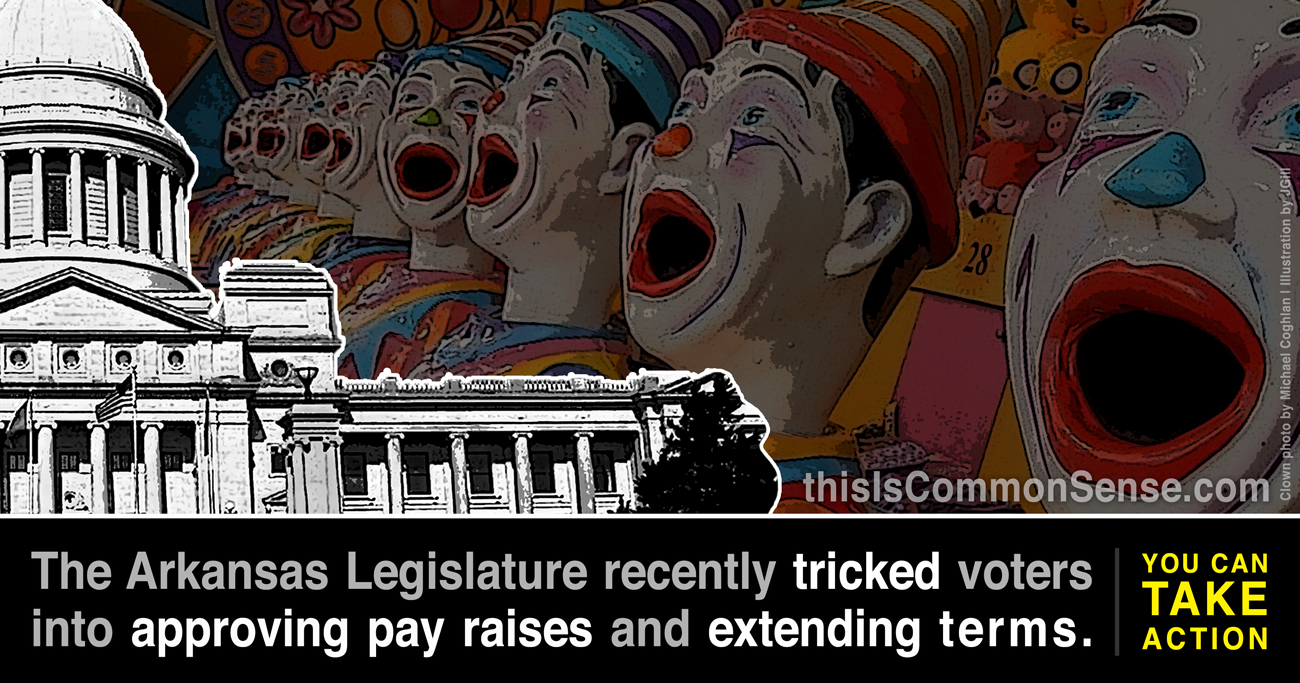
Last November, legislators tricked enough voters to narrowly pass Issue 3.
I’ve addressed before the measure’s dishonest ballot language, mis-identifying a doubling of allowed terms as the “setting of term limits.” And about a much-ballyhooed gift ban that has proven so weak that now most legislators are offered “free meals nearly every day.”
Perhaps the biggest of the tricks used to pass the measure was this: Hide from voters the measure’s establishment of an “Independent Citizens Commission” . . . a majority hand-picked by those same legislators.
This “Legislative Cronies Commission” (as it should be called) has announced it will unilaterally hike pay by an outrageous 150 percent!
The commission claims to have looked at legislative salaries in nearby states, except Texas and Mississippi — two states that just so happen to pay lower salaries. Economic factors were also considered, supposedly, but household income in Arkansas has actually dropped in the last decade.
The commission held only one poorly publicized hearing — at, get this, 10:00 am on a Monday, when most folks were working. No surprise, public comments have run ten to one negative. Letters and emails contain words and phrases such as “shameful,” “insult,” “actually sick to my stomach,” “a joke,” “ludicrous,” “appalled” and “slap in the face.”
This led Larry Ross, chief crony on the commission, to rudely dis citizens, telling the Arkansas Democrat-Gazette that he would look at the “quality” of comments, not the “quantity.”
Only a tsunami of public anger can stop this rip-off of Arkansas taxpayers. Act fast. A March 16 meeting is set to finalize the increase.
Tell the Independent [sic] Citizens [yeah, right] Commission what you think: call (501) 682-1866.
“The outrage over the Brown Bill, and it is outrage,” wrote The Argus Leader’s Jonathan Ellis, “is being voiced across the political spectrum.”
The Brown Bill, Senate Bill 166, is legislation introduced by South Dakota State Sen. Corey Brown (R-Gettysburg) to nearly double the number of signatures citizens must gather on petitions to place issues on the ballot.
Er, I mean, it was legislation.
“I’m quite surprised that a lot of folks are willing to not engage in an intellectual conversation,” Sen. Brown said in scuttling a hearing where such a conversation might take place. He asked that his own bill be tabled and fellow legislators obliged, of course, meaning an inglorious demise for what had been “emergency” legislation.
Perhaps what surprised the good senator were so many folks lighting up the state capitol switchboard — fervently opposed to his move to make it more difficult for voters to have a say. An online Argus Leader poll showed 87 percent of South Dakotans against making it “harder for citizens to initiative measures.”
Then again, maybe public opposition to his bill didn’t surprise Sen. Brown one little bit. Legislators routinely slap emergency clauses onto legislation because that prevents voters from petitioning to refer that legislation onto the general election ballot.
South Dakota became the first state to enact statewide initiative and referendum back in 1898. The people cherish this process.
“Who says politicians don’t listen?” asked Tim Eyman in a recent email to his Washington State supporters.
“OK, you got me: we normally do. 😉 But not today.”
Pleased as punch, Eyman announced the resurrection of the two-thirds requirement for legislators to raise taxes. Three times voters have passed initiatives promoted by Mr. Eyman mandating a 2/3 legislative vote or a vote of the people before taxes can rise — in 2007, 2010 and again in 2012, the last two times by a whopping 64 percent vote.
But in 2013, the state supreme court ruled voters could not so limit their state legislature, short of a constitutional amendment. And — you guessed it — the Evergreen State lacks a statewide initiative process for voters to amend the constitution . . . without the permission of their legislators.
Eyman was blocked; the voters thwarted. Legislators could go back to raising taxes as usual.
Not so fast!
Enter State Sen. Mike Baumgartner (R-Spokane), who helped motivate a narrow GOP majority to pass a new Senate rule, 26-23, that no new tax may pass the chamber without garnering a 2/3 vote.
Democrats are livid. “Going around the voters is not only disingenuous,” bemoaned Washington State Democrats Chairman Jaxon Ravens, “it is wrong.”
Going around the voters? Really? It must have slipped his mind that “the voters” had previously voted (and been thwarted) three times.
“[H]as the Senate already nullified any attempt by Gov. Jay Inslee to create a carbon emissions charge or a capital gains tax — solely by rearranging its own internal rules?” asked John Strang at Crosscut.com.
More important than which party controls the U.S. Senate, or which nine people don Supreme Court robes, or even who will be elected president of these United States come 2016, is something much more within our individual and collective control: what you and I do to protect and advance liberty.
From this date — January 1, 2015 — forward, let us never wait for a political savior to ride in on a white horse. We cannot wait.
And we don’t have to.
In fact, only through “We the People” taking the leadership role can a pro-liberty agenda be established. Politicians won’t do it for us, not consistently.
Yet, the few might follow our good lead.
And we can hopefully make all politicians respond to the issues that define the future of freedom.
Starting right now, as president of the Liberty Initiative Fund, I ask you: join me in placing a three-plank pro-liberty platform on state and local ballots and, thereby into law and government policy across the country, between now and November 8, 2016.
Hold government accountable. Pass term limits in more cities and states. Fix out-of-control public employee pensions. Enact ethics reforms.
Fight crony capitalism. Create a voter check on public subsidies. Protect citizens from eminent domain abuse. Open up business entry.
Protect our liberties. Clean up law enforcement with measures that stop the highway robbery known as civil asset forfeiture, require police to wear lapel cameras, and mandate independent prosecutors in fatal or violent incidents involving police.
We can create better government, a freer marketplace and a safer society.
Gandhi said: “We must become the changes we seek in the world.”
I say, “At least, let’s put our changes on the ballot and give them a fighting chance.”
There will never be a patronage army for liberty. But there is you and me. And since we agree . . . we might be able do something about it.
We’re strong enough to start.
These battles appeal to libertarians, conservatives, liberals, progressives.
I’m reminded of Patrick Henry’s 1775 “Give Me Liberty” speech:
They tell us, sir, that we are weak; unable to cope with so formidable an adversary. But when shall we be stronger? Will it be the next week, or the next year? Will it be when we are totally disarmed, and when a British guard shall be stationed in every house? . . .
Sir, we are not weak if we make a proper use of those means which the God of nature hath placed in our power. The millions of people, armed in the holy cause of liberty, and in such a country as that which we possess, are invincible by any force which our enemy can send against us.
Mr. Henry was talking about cataclysmic historical forces, the defeat of the world’s foremost empire. So are we, in a way.
This nation of shopkeepers, the common folks with common sense and common decency, must again battle the Empire of Big Government. And let me advance the notion that we are up to that awesome task.
Every New Year’s Day I reflect on the words of author and politician, Marianne Williamson, who in her book, Return to Love, wrote:
Our deepest fear is not that we are inadequate. Our deepest fear is that we are powerful beyond measure. It is our light, not our darkness, that most frightens us. We ask ourselves, who am I to be brilliant, gorgeous, talented and fabulous? Actually, who are you not to be? You are a child of God. Your playing small doesn’t serve the world. We were born to make manifest the glory of God that is within us. It’s not just in some of us; it’s in everyone. And as we let our own light shine, we unconsciously give other people permission to do the same. As we are liberated from our own fear, our presence automatically liberates others.
Let’s work together to make 2015 the year we helped create an America more free. Call me (571-659-2320) or email me (paul@libertyifund.org) if you want to take action in your city or state.
Oh, wait! Don’t call me today; I’m watching college football. But please call me (or email) tomorrow, Friday, Jan. 2, 2015. If I’m busy, or talking to someone who dialed me a minute earlier, leave a message (that’s just, ahem, common sense) — I’ll call you back.
Let’s take charge and usher in change together, at the grassroots, this year.
Back in August, the city council in Topeka, Kansas, voted to expand a redevelopment district and purchase Heartland Park Topeka, a “multi-purpose motorsports facility” featuring drag racing, dirt racing and more.
Chris Imming wasn’t keen on the notion. He put together an initiative petition calling for a public vote. Topeka townspeople eagerly signed it.
Taking this as a cue, did the city officialdom welcome this vibrant exercise of basic American democracy? Did they ready themselves for that election?
Instead, the city sued to block a vote on the issue.
A local judge sided with the insiders, ruling in the city’s favor. The development decision was administrative in nature, the Robed One determined, not legislative. That made it beyond reach of the citizen initiative process.
Both the judge’s designation of “administrative” and his rationale for exemption from a citizens’ veto seem more than dubious. Clearly, “the people” should be able to overrule any decision made by the city council, which is established for the express purpose of representing the views of “the people.”
Kudos to Mr. Imming for appealing that lower court decision. Thank goodness for folks like him, folks who stand up against the powerful public and private forces always looking for a bailout or a subsidy.
“We’re bailing out the city,” argues Doug Gerber, Topeka’s administrative and financial director. He cites the city’s previous redevelopment district, which annually costs a cool million dollars in bond service, while bringing in only a fifth of that in sales tax revenue.
So politicians want to double down, to cover their past rotten wheeling and dealing by . . . expanding it.
In 2013, the legislature had passed a bill to turn a fuel tax of 24 cents per gallon into a more permanent rate structure, increasing the tax every year as the Consumer Price Index rose.
Citizens of “Taxachusetts” objected to the idea of automating tax hikes. Perhaps thinking about their wallets, they were hardly amused by their state government piling further taxes on whenever prices, including fuel prices, rose. It’s one thing to have to pay more when supplies get tight or demand bids up prices, making gasoline and diesel more expensive. But why pay extra to the government?
Automatically. Without a legislative vote on the record.
So citizens petitioned to have the law referred to a general vote. The measure became Question 1 on last week’s ballot.
It won with a 53 percent majority. The automatic tax hike was nixed.
So, who outspent us? Who wanted the permanent, automatic tax hike? The extra tax revenues, I wrote before the election, “are slated to go toward road construction and maintenance in the Bay State. And — surprise, surprise — the biggest opponents of Question 1 are construction companies doing business with the state.”
But, despite special interests dumping tons of money, citizens won.
The money spent by Liberty Initiative Fund was leveraged effectively. Because, on issues like this, siding with the people is no long shot.
Maybe Burkina Faso, in northwest Africa between Mali and Niger, isn’t the easiest “Jeopardy” question for most of us in the U.S. But any place that’s seen massive protests because the head of state tried to escape term limits becomes pretty memorable to me.
In fact, the first region that pops into my head as a point of comparison and contrast is my own home state of Arkansas.
There are big differences in the respective battles over term limits, of course. In Burkina Faso, thousands clogged the streets after the 27-year presidential incumbent, Blaise Compaore, schemed to evade a constitutional term limit on his office. Facing unrelenting pressure, Compaore soon stepped down, not even awaiting the next election.
The furtive attempt to water down state legislative term limits in Arkansas hasn’t gotten as high on the radar there as the machinations in Burkina Faso. But the folks at Arkansas Term Limits (“vote AGAINST Issue #3”) have done much to publicize the scam, taking a wooden Trojan horse from town to town to vivify the point that the politicians bearing the “gift” of suspiciously eager self-reform have hidden a bomb at the bottom of the package: a doubling (or more) of their maximum permitted stay in a single legislative seat.
The media has started to pay attention. The story has gotten out.
Has it been enough? Have enough voters been reached to fend off the assault? When Tuesday’s results come in, we’ll know.
 But in 2013, the state supreme court ruled voters could not so limit their state legislature, short of a constitutional amendment. And — you guessed it — the Evergreen State lacks a statewide initiative process for voters to amend the constitution . . . without the permission of their legislators.

 There are big differences in the respective battles over term limits, of course. In