Categories
Accountability ideological culture media and media people nannyism national politics & policies property rights responsibility

The Climate Cassandra

Thirty years ago, in June, 1986, the Senate Environment and Public Works Committee met to consider the problems of ozone depletion, the greenhouse effect, and climate change.

Present at those hearings was today’s climate Cassandra, James Hansen, then of the Goddard Institute of Space Studies. And he was predicting that “global temperatures should be nearly 2 degrees higher in 20 years,” according to Associated Press reporting at that time.

There was some sloppiness either in Hansen’s account, or the AP’s, for in one part of his testimony Hansen claimed that his institute’s climate models projected, for “the region of the United States, the warming 30 years from now is about 1 1/2 degrees C, which is about 3 F.”

Ronald Bailey, the science writer over at Reason, tries to make sense of this mess of numbers, models, and predictions.

Oh, and actual, tabulated results.

Hansen’s predictions went, as Bailey put it, “definitively off the rails when tracking the temperature trend for the contiguous U.S. between 2000 and 2016. Since 2000, according to the NOAA calculator, the average temperature trend has been downward at -0.06 F degree per decade.”

That’s not the whole picture, though: “global temperatures have increased by 0.51 C degree since 1986, so perhaps the man-made global warming signal has finally emerged.”

No matter, though, as Bailey notes, “the United States and the Earth have warmed at considerably slower pace than Hansen predicted 30 years ago.”

Which suggests that Hansen’s models may be inspired more by wish, fear, and ideology than genuine science.

So, to those who wish to rush to “do something” (anything?) to combat “climate change,” take it slow. Follow the pace of the Earth itself.

This is Common Sense. I’m Paul Jacob.


Printable PDF

Global warming, climate change, illustration


Categories
general freedom ideological culture moral hazard national politics & policies The Draft U.S. Constitution

Equal or Free?

On Tuesday, the Senate voted to force American women, in their early years, to register for the draft.

Just like men have been required to do since 1980.

The White House threatens to veto the bill, though perhaps on other grounds, since the bill also, in the words of Richard Lardner (AP), “authorizes $602 billion in military spending, bars shuttering the prison at Guantanamo Bay, Cuba, and denies the Pentagon’s bid to start a new round of military base closings.”

The Senate’s social conservative ranks made the whole process leading up to the vote difficult for the mainliners, like Sen. John “Maverick” McCain, who is enthusiastic about registering women. Sen. Ted Cruz expressed alarm at the direction “sexual equality” is taking, and didn’t want to see “girls drafted onto the front lines.”

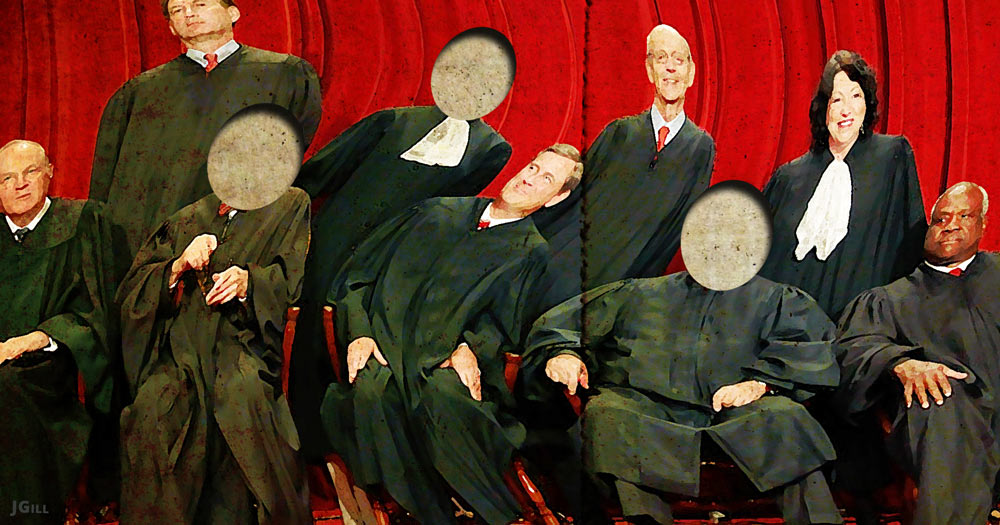
Decades ago, the Supreme Court had nixed a challenge to draft registration on discrimination lines, reasoning that since women weren’t allowed onto the front lines, there was no cause to force them to register for military conscription.

But now there are women in combat positions. So the old ruling no longer applies. If draft registration isn’t expanded to women, it’s likely to be struck down for men.

We have no draft, we are reminded, mere registration — which our government keeps in place mainly to remind men that they may be drafted.

In the House version of the bill, there’s no draft registration amendment. So there will be negotiations. Maybe a compromise can be reached where neither young men nor women face a military draft* or, likewise, signing up for one.

This is Common Sense. I’m Paul Jacob.


* For more on why to oppose the draft, see my essay “The Draft Is Slavery” in J. Neil Schulman, The Rainbow Cadenza, pulpless.com edition (1999).


Printable PDF

draft, conscription, women, servitude, military, illustration


Categories
folly general freedom ideological culture meme moral hazard national politics & policies

Nobody Could Make This Stuff Up

Today’s headline:

Radical Islamist Stages Gun Massacre in LGBT Nightclub!

Caring Progressives Demand that American Citizens be Disarmed!


Orlando shooting, gun violence, gun control, meme, illustration


Categories
Accountability ideological culture moral hazard national politics & policies political challengers too much government

Bernie’s Problem?

Sen. Bernie Sanders has a problem. With Hillary Clinton.

Asked about the Clinton Foundation, yesterday, by CNN’s Jake Tapper, host of State of the Union, Bernie re-questioned himself:

Do I have a problem when a sitting secretary of state and a foundation run by her husband collects many millions of dollars from foreign governments, governments which are dictatorships?

And Bernie answered, “Yeah, I do.”

How many roads must mainstream media reporters walk down before they investigate and report on the myriad of ethical cracks in the Clinton Foundation?

To the most obvious conflict of interest in the history of the human race, add the fact that even after promising President Obama that the Clinton Foundation would at least be totally transparent with an annual report of all donations . . . well, Hillary welched on the deal, not revealing the donors.

While Bernie’s condemnation of Hillary’s ethical shortcomings was big news, less reported were the senator’s comments regarding whether Mrs. Clinton is “too quick on the draw, too eager to use military force.”

Bernie again was clear: “I worry about that. Yeah, I do. Her support for the War in Iraq was not just an aberration.” Sanders went on to cite Secretary of State Clinton’s role in pushing President Obama to overthrow Gaddafi in Libya and to intervene in Syria.

Hillary’s judgment on issues of war and peace is questionable . . . especially when we don’t know whether or not a foreign leader or his cronies have written big checks to the Clinton Foundation.

This is Common Sense. I’m Paul Jacob.


Printable PDF

Hillary Clinton, Bernie Sanders, war, foreign policy, blood stained, death, military, illustration


Categories
ideological culture media and media people nannyism national politics & policies Regulating Protest too much government U.S. Constitution

The Long Road to Citizens United

Everybody is familiar with the standard theory regarding the Citizens United decision. Former comedian and current earnest socialist Sarah Silverman puts it this way: “Every politician takes money from Big Money, ever since it was made legal with Citizens United.”

Like most folks who talk this way, she doesn’t give a squeak of context. She barely even indicates that it was a Supreme Court case, 2010’s Citizens United v. Federal Election Commission. She does not mention at all that the ruling overturned the FEC’s act of suppressing a political movie.

But there is a much wider context than such bare facts — and if you want a good synopsis, you could hardly do better than read my friend Krist Novoselic’s calm, reasoned “look at the history of attempts to regulate independent campaign expenditures.”

This “modern history” started with what the New York Times called Richard Nixon’s “revolution in political financing.” The Federal Election Campaign Act of 1971 “required detailed disclosure of campaign contributions; set campaign contribution limits to candidates, parties and committees; set expenditure limits on campaigns, independent groups and individuals and created the first public financing of presidential campaigns and national conventions.”

And almost immediately the law began suppressing political speech and advertising. And led to a long series of court cases.

And decisions.

And revisions.

That define our times.

Krist (with whom I serve on the board of FairVote.org) provides the context you need to see through what he aptly calls “the hype” about “Citizens United,” as well as how the decision correctly removed the license given to the FEC’s role as “state censorship board.”

This is Common Sense. I’m Paul Jacob.


Printable PDF

Krist Novoselic, Citizens United, free speech, fairvote.org


Categories
education and schooling First Amendment rights ideological culture media and media people

The Controversialist

“Feminism is cancer.”

Milo Yiannopoulis is provocative. Apparently of violence as well as of thought.

Until very recently, best known for his Twitter presence (@nero) and his work at Breitbart, Mr. Yiannopoulis, a gay British man in his mid-30s, has undertaken what he calls his “Dangerous Faggot Tour,” — speaking to anti-left audiences in hired halls at the heart of the modern university.

He outrageously decries the regnant “Social Justice Warriors” of anti-capitalism and intersectional feminism, and defends free speech and the candidacy of Donald Trump.

But obviously he is egging on the student mobs. One stunt was to take a poll asking whether the subject would rather his or her daughter get cancer or become a feminist.

Cancer, Milo chortles, was the overwhelming result.

Most people hate modern feminism, he says. It’s only on campuses that the youngsters are unhinged enough to believe that

  • rich, pampered college students are “oppressed” just because they are women or gay or trans; that
  • white men are “systemically” their “oppressors” and thus “privileged”; and that
  • there exists an overarching Patriarchy in capitalist America, but not in the Mideast.

So he is shouted at and “protested” everywhere he goes. This week, Black Lives Matter protesters basically took over an event at DePaul University, with a young woman invading Milo’s personal space, apparently (you decide) hitting him in the face during a Q and A.

The university, which had charged organizers a huge fee for “extra security,” did nothing. Milo’s suing to get back that payment — for services plainly not rendered.

Some patriarchy. Some privilege.

This is Common Sense. I’m Paul Jacob.


Printable PDF

DePaul University, Black Lives Matter , Social Justice Warriors, Dangerous Faggot Tour, Milo Yiannopoulis , provocative,


Categories
Accountability free trade & free markets ideological culture moral hazard national politics & policies

Puerto Rico’s Debt, Our Problem

“We have an important choice to make,” presidential candidate and Senator Bernie Sanders recently wrote to Congress. “[D]o we stand with the working people of Puerto Rico or do we stand with Wall Street and the Tea Party?”

The bill in question has been dubbed Paul Ryan’s “first big victory as Speaker,” but was written in tandem with the White House. The plan attempts to rescue Puerto Rico, a United States territory, from financial collapse with both bailouts and austerity — the latter including a lowered minimum wage.

I hadn’t heard any Tea Party squawk about this, so that reference must be just signaling on Bernie’s part.

Puerto Rico is $72 billion in the hole. Basically, Sanders wants to partially repudiate that debt: “The billionaire hedge fund managers on Wall Street cannot get a 100 percent return on their bonds while workers, senior citizens and children are punished.”

Of course our sympathies are almost entirely with the people of Puerto Rico. But it was their government that racked up the debt, and repudiating sovereign debt is a tricky and parlous thing.

What happens when the United States itself faces similar (or worse) straits? Would Bernie then, again, plan to stick it to the government’s creditors — even after he, himself, had voted to increase spending above revenues and periodically raise the debt ceiling — and think that this wouldn’t have consequences?

Meanwhile, the possible minimum wage reduction is one of the stickiest of the issues. Bernie sees it as “sticking it” to the poor.

In truth, it would help increase employment, thus help the poor get out of poverty.

This is Common Sense. I’m Paul Jacob.


Printable PDF

Puerto Rico, debt, loan, Bernie Sanders


Categories
Accountability folly free trade & free markets general freedom ideological culture moral hazard nannyism national politics & policies property rights responsibility too much government

Fatherland, Socialism and Death!

The fall of Venezuela is an atrocity.

The comic elements are clear enough — the further you remove yourself from the poverty, chaos, and collapse. We can wallow in a bit of Schadenfreude, taking glee as some American leftists squirm to explain why the socialist paradise they ballyhooed a mere three years ago now tail-spins to the grave.

The collapse of this socialist experiment offers an enormous level of tragedy. It’s not pretty.

The country’s leader, President Nicolas Maduro, makes his predictable desperation play. Rather than confront his own errors, and the futility of making socialism work in anything like a rigorous form, he boasts. “Venezuela Leader Says US ‘Dreams’ Of Dividing Loyal Military,” reads yesterday’s Reuters report. While no doubt true, this is one of those cases where whatever we dream to the north, our dreams are better than their current reality.

Of course the Venezuelan military should turn on Maduro, Hugo Chavez’s inheritor, protecting the right of recall, which Maduro is denying. By painting the U. S. as the bad guy, Maduro hopes to unite his people — especially his armed forces — around him. That’s what a desperate demagogic dynast does. Citizens and subjects traditionally abandon skepticism about their leaders when they feel threatened from the outside.

Which is one reason it would be a mistake for the U. S. to intervene.

Reuters poetically reports that the military is still united behind the socialist government, and resists the recall referendum, singing “Fatherland, Socialism, or Death!”

Wrong conjunction. Not “or” but “and” . . . if you insist on socialism.

The government, military pressure or no, should allow the recall vote, and soon.

This is Common Sense. I’m Paul Jacob.


Printable PDF

Venezuela, store, socialism, column


Categories
folly free trade & free markets general freedom ideological culture national politics & policies

Guilt and Association?

A few days ago, the Barna Group released the results of its latest poll, asking “Americans whether capitalism or socialism align better with the teachings of Jesus,” explains The Hollywood Reporter. The results are that “socialism won 24 percent compared to 14 percent, with the rest answering ‘neither’ or ‘not sure.’”

And what about the year’s big race?

“When asked which presidential candidate’s policies aligned closest to the teachings of Jesus, Sanders was on top with 21 percent, compared to 9 percent for Hillary Clinton and 6 percent for Donald Trump.” Ted Cruz, no longer in the race, fared better than Hillary, but below Bernie, at 11 percent.

Now, it is worth mentioning that more significant polling on issues relating religion to politics has been done by Barna. Still, the commentary over at Fox on this poll was . . . interesting.

On Bill O’Reilly’s show, Monica Crowley made the crucial distinction between Jesus’ command to give to the poor and modern socialists’ demands to take from some, through taxation and by force, to give to others.

O’Reilly himself, however, went on a bizarre and joking riff about “buying his way to heaven” by leaving his wealth to charity . . . after he dies.

Looking over these poll numbers, I can only conclude that advocates of a free society have much work to do convincing Americans of the justice and benevolence of free markets, of “capitalism.”

And Christians have their work cut out for them, too . . . at the very least to disencumber themselves from the stench of socialist states and the brutal force those states inevitably rest upon.

This is Common Sense. I’m Paul Jacob.


Printable PDF

Christianity, socialism, capitalism, Christ, poll, illustration


Categories
Accountability crime and punishment folly free trade & free markets ideological culture moral hazard nannyism national politics & policies

A Vapor’s Chance in Hell

There is a big difference between government designed to protect our rights and a government tasked with protecting us from ourselves.

You couldn’t find a better example of this than the current Federal Drug Administration and its regulation of vaping.

Vaping is the imbibing of water vapor laced with nicotine and other ingredients. It is designed to replace the smoking of tobacco cigarettes. It is much, much less harmful than smoking. The genius of this innovation is that while it looks a lot like smoking, it involves no smoke. But it does involve inhaling, and blowing out wisps of . . . well, vapor.

It’s safer than smoking because smoking tobacco involves burning organic (and inorganic) matter, which puts tars and other chemical substances into one’s lungs.

But the competing companies that make the product are not allowed to tell us about its advantages.

New regulations of the e-cigarette industry from the FDA prohibit a lot of truth-telling in advertising. “Even if a few companies survive the shakeout caused by the FDA’s onerous regulations,” Jacob Sullum writes in Reason, “they will not be allowed to tell consumers the truth about their products.” It appears that “any intimation that noncombustible, tobacco-free e-cigarettes are safer than the conventional, tobacco-burning kind” places them under a category that simply must “be marketed only with prior approval.”

The legal judgments Sullum quotes will make you sicker . . . than your first cigarette puff.

Paternalistic government designed to save us from our vices ends up blocking us from actually lessening the bad effect of those vices.

Some help.

This is Common Sense. I’m Paul Jacob.


Printable PDF

vape, vaping, smoking, law, regulation, unintended consequence, illustration, photo


Photo credit: micadew on Flickr