
Categories
ideological culture

Zero/Not-Zero

Forty-four million views later, the University of Oklahoma has advised student Samantha Fulnecky that the zero her paper received won’t be factored into her final course grade.

While it’s good that the school won’t hold that zero against her, she deserves a grade — an honest, objective grade — for her work.

Fulnecky did submit a paper, contrary to what is implied by the zero. She did indeed turn in an essay on the topic of “gender, peer relations and mental health” that her class was assigned.

Perhaps the word “gender” has given you the clue. You guessed it: she took the wrong view.

The Washington Post reports that her essay “rejected the concept of multiple genders and cited the Bible to support her view that traditional gender roles should not be considered stereotypes. ‘Society pushing the lie that there are multiple genders and everyone should be whatever they want to be is demonic and severely harms American youth,’ Fulnecky wrote.”

Turning Point USA, which collected 44,000,000 views for its post about the controversy, has also posted the essay itself.

Whether Samantha Fulnecky’s work precisely follows the requirements of the assignment I don’t know; these have not been posted as well. Though not deathless prose, the essay is intelligible and on the assigned topic, if perhaps annoying to those who, like the transgender professor who assigned the paper, disagree with its Biblical perspective and non-novel view of male and female.

In other words, it’s not nothing.

This is Common Sense. I’m Paul Jacob.


PDF for printing

Illustration created with NanoBanana and Firefly

See all recent commentary
(simplified and organized)
See recent popular posts

Categories
ideological culture public opinion too much government

Looking for Work

“Social sector” workers — described by Forbes as “nonprofit organizations and the social sector at-large” — have been losing jobs because of budget cuts and corruption cuts.

Many newly unemployed are unhappy about having to job-hunt. Some complain about having to take jobs from profit-making businesses. Others lament sparse communication from prospective employers.

“When asked about barriers to finding employment, 85% of respondents cited lack of employer response as their primary challenge,” Aparna Rae’s not-very-shocking-at-all Forbes article elaborates. “The irony is stark: a sector built on human dignity subjects job seekers to dehumanizing ‘digital hiring mazes’ where qualified candidates are ghosted after final-round interviews. The disconnect between mission and practice erodes the sector’s moral authority.”

Wow. Dehumanizing to have to . . . look for work (or customers)? Worse because your last job was all about dignity — unlike all those grubby profit-sector jobs or, for that matter, jobs with nonprofits that rely only on voluntary private donations?

“I want to be seen and recognized as a human,” explains one representative job seeker. “The lack of communication and impersonal nature of the hiring process is demoralizing and makes job seekers feel devalued.”

Job hunting can be tough. It’d be nicer if qualified candidates who have been considered but lose out to other qualified candidates were always notified. Sure. But how does failure to do so represent a “disconnect” between mission and practice, and how does it “erode the [nonprofits’] moral authority”?

Job seekers might feel less demoralized if they didn’t take the impersonal aspects of the search so personally.

This is Common Sense. I’m Paul Jacob.


PDF for printing

Illustration created with NanoBanana and Firefly

See all recent commentary
(simplified and organized)
See recent popular posts
Categories
Accountability ideological culture subsidy

Red-Flagged Welfare Fraud

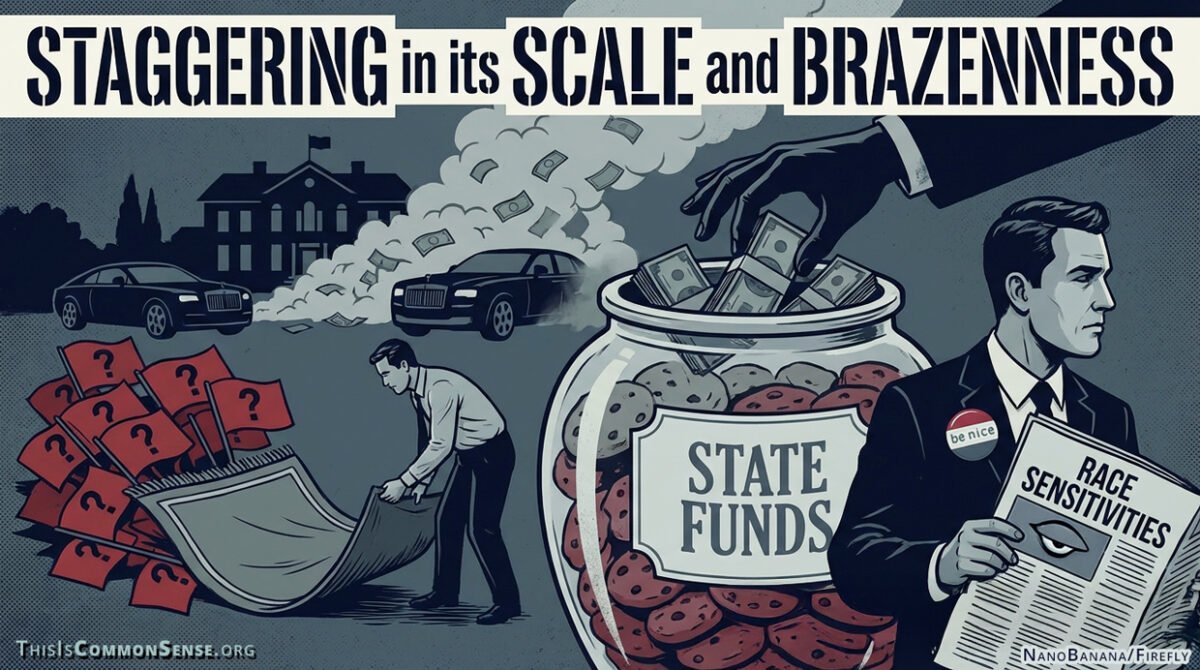
“Staggering in its scale and brazenness.” 

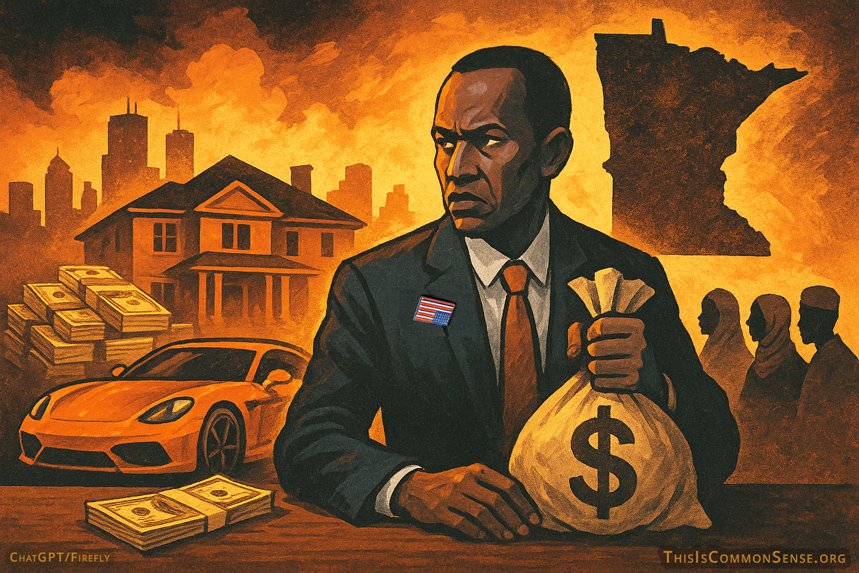
That’s how The New York Times describes the more than $1 billion in fraud that “took root in pockets of Minnesota’s Somali diaspora as scores of individuals made small fortunes by setting up companies that billed state agencies for millions of dollars’ worth of social services that were never provided.”

Quite a lucrative business model: Stealing from programs to prevent homelessness and keep children fed during the pandemic, the crooks instead “spent the funds on luxury cars, houses and even real estate projects abroad.” 

So far, prosecutors have convicted 59 people, with “all but eight of the 86 people charged” of “Somali ancestry.”

According to Ryan Pacyga, an attorney representing several defendants, The Times reports that “some involved became convinced that state agencies were tolerating, if not tacitly allowing, the fraud.”

What?

“No one was doing anything about the red flags,” argues Pacyga. “It was like someone was stealing money from the cookie jar and they kept refilling it.”

Why was nothing done?

Well . . . the federal prosecutor contends that what The Times calls “race sensitivities” (read: fear of being called racist) were “a huge part of the problem.” 

One former fraud investigator, a Somali American named Kayseh Magan, blames “the state’s Democratic-led administration” which was “reluctant to take more assertive action in response to allegations in the Somali community.”

“There is a perception that forcefully tackling this issue might cause political backlash among the Somali community,” Magan explains, “which is a core voting bloc.” 

For Democrats.

Very expensive votes.

This is Common Sense. I’m Paul Jacob.


PDF for printing

Illustrations created with ChatGPT, NanoBanana and Firefly

See all recent commentary
(simplified and organized)
See recent popular posts
Categories
ideological culture international affairs national politics & policies too much government

This Is What Businessman Rule Looks Like

President Trump is doing something many of his supporters said they wanted him to do: act not like a normal politician but like a businessman, for Americans, as if we were stockholders in a for-profit company.

Bring in the dough. Efficiently.

“Saudi Crown Prince Pledges $1 Trillion Investment in US During Meeting with Trump,” an article at The Epoch Times tells us. The Saudi potentate is boosting, the story runs, an “investment partnership with the United States from $600 billion,” and the prince in question, Mohammed bin Salman — his reputation previously sullied by the part he played in the gruesome assassination of a journalist —  explains that the “investments will focus on what he described as ‘real opportunities’ in areas such as artificial intelligence and magnets.”

The article notes that the “Saudi Foreign Ministry said in a Nov. 17 post on X that the crown prince, widely known as MBS, would meet Trump ‘to discuss bilateral relations, ways to strengthen them across various fields, and issues of mutual interest.’”

Now, that latter discussion of diplomatic issues appears normal. That is, what we expect two heads of state to do when conferring.

But all this talk of extra investment? Micromanaging foreign investment within the United States?

That’s never been the recipe for republican governance and can so easily and quickly devolve into plutocratic socialism-for-the-rich. There’s no shouting “limited government” about what Trump boasts of regarding “the deals” he makes for the U.S. 

For “us.”

But it does fit what many had hoped he would be: a businessman taking charge of the corporation that is the unitary “United States.” A fix-it man for the federal Leviathan.

This is Common Sense. I’m Paul Jacob.


PDF for printing

Illustration created with Krea and Firefly

See all recent commentary
(simplified and organized)
See recent popular posts

Categories
ideological culture too much government

Memo to Mamdani Voters

New York City is expensive. Housing is expensive, often prohibitively so. The city has crime problems. Other problems.

Answers: Unshackle the housing market? Slash regulations and taxes? Make it easier to catch and punish bad guys? No. Prevent builders from supplying more and cheaper housing. Further hobble the police. Etc. Pro-Hamas socialist Zohran Mamdani has a slew of such pseudo-solutions. 

And has a large following.

In New York’s mayoral race, decided Tuesday, the Republican candidate was excluded by the city’s heavily Democratic tilt. The incumbent mayor was also nonviable. Scandal-plagued former Governor Cuomo was the main alternative to a reputedly charming Mamdani now claiming a mandate to rob the rich.

Song Ying is a 72-year-old New Yorker who escaped the Chinese communists in 1976. She “swam for eight hours from Shenzhen, then a small fishing village, to Hong Kong,” explains  The New York Times in a report on the growing generational divide among Chinese immigrants regarding the prospect of a socialist city. Song is dismayed by the strong support among young New Yorkers for Mamdani. She says — and knows — that socialism doesn’t work.

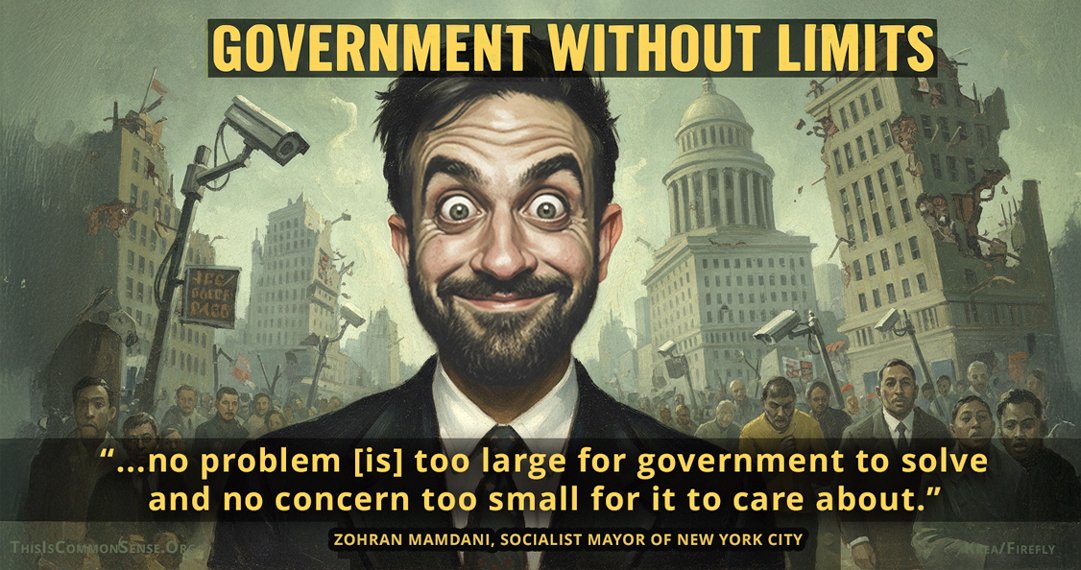
The Times belittles her concerns, stressing that Mao’s China is not the vision that Mamdani is selling. Yet upon winning, the mayor-elect asserted that his administration would prove that “no problem [is] too large for government to solve and no concern too small for it to care about.” Sounds like a government without limits.

Mamdani will not fix things. He offers as solutions more of the policies that caused current problems: more regulations; more taxes; more spending; more government in power and scope.

If a boulder is tumbling right toward you, demanding more and heavier boulders won’t stop you from being crushed.

This is Common Sense. I’m Paul Jacob.


PDF for printing

Illustration created with Krea and Firefly

See all recent commentary
(simplified and organized)
See recent popular posts
Categories
ideological culture media and media people

Defending Groupthink?

The Atlantic is a beautiful magazine, expertly designed and printed, lovely to behold: an excellent showpiece for your coffee table . . . but marred by absurdities. 

Currently, consider David Merritt Johns’s article “MAHA’s Blinkered War on ‘Groupthink’” — and when I shift to reader mode, a second title appears: “In Defense of ‘Groupthink.’”

Of course The Atlantic defends groupthink! It’s been working mightily to shore up totalitarian mob-think, woke half-think, for years!

“More than 1,300 academic papers and dozens of books have been published on” the target concept, groupthink, Mr. Johns explains. “Even after all of this time and effort, the evidence is wanting. In fact, most experts now believe that the old story of groupthink being a prime cause of bad decision making is wrong. Some don’t think that the phenomenon is even real.” 

All this is to attack the Make America Healthy Again movement — without ever addressing any (yes, any) actual argument Robert F. Kennedy, Jr., has actually made about “the jab” (various innovative coronavirus treatments from Pfizer, Moderna, etc.) in particular or the full panoply of vaccines in the various government-stamped vaccine schedules more generally (much less the disturbing rise, in America, of autism, auto-immune disorders, and obesity).

The entire essay is an elaborate evasion . . . to defend the thinking of a very large group of tax-paid/regulator-defended professionals.

“Our nation’s thinking isn’t broken,” Johns concludes, “and this administration shouldn’t try to fix it.”

The opposite is true: American political and bureaucratic culture has been corrupt and delusional for decades, at the very least.

And we should all be trying to fix it.

This is Common Sense. I’m Paul Jacob.


PDF for printing

Illustration created with Krea and Firefly

See all recent commentary
(simplified and organized)
See recent popular posts

Categories
ideological culture national politics & policies

Having a Ball

Live long enough and everything will happen, at some point. 

Even bizarre, incomprehensible things, such as Saturday’s Washington Post editorial, “In defense of the White House ballroom.” In short, a defense of, ahem . . . Trump. 

The paper began by noting the ballroom was something of a Rorschach test, with Trump’s opponents viewing his actions as “reckless” while his supporters see “a change agent unafraid to decisively take on the status quo.”

But the editors add that “it has become far too difficult to build anything in America,” before concluding: “Trump’s undertaking is a shot across the bow at NIMBYs everywhere.”

Wait. The Post has been virulently, unrelentingly anti-Trump, until it relented last November by not endorsing Democrat Kamala Harris for president. Was that or is this a sign the Post editorially is moving toward Trump? Is this influenced by billionaire owner, Jeff Bezos?

I don’t think so. In this lightning-strike instance, the capital’s premier newspaper is offering non-TDS thought. Believe it or not.

As editorial board explains:

  • “Privately, many alumni of the Biden and Obama White Houses acknowledge the long-overdue need for an event space like what Trump is creating.” 
  • Other presidents have demolished or built onto the White House: Teddy Roosevelt, Truman, Obama, etc. 
  • “Preservationists express horror that Trump did not submit his plans to their scrutiny, but the truth is that this project would not have gotten done, certainly not during his term, if the president had gone through the traditional review process.”*

For this one shining moment, The Washington Post recognizes that America’s regulatory regime does not work. So broken, in fact, that MAGA must be embraced. 

If only for one dance.

This is Common Sense. I’m Paul Jacob.


* The editorial also notes that “the White House is exempt from some of the required regulations that other federal buildings must comply with.”

PDF for printing

Illustration created with Krea and Firefly

See all recent commentary
(simplified and organized)
See recent popular posts

Categories
First Amendment rights general freedom ideological culture

Two Ways of Walking Away

“The First Amendment prohibits the government from restricting free speech,” explained Michael J. Reitz in The Detroit News. But what about individuals and non-government groups? 

“Free speech doesn’t compel you to listen. You can walk away,” Mr. Reitz goes on to say.

In the piece, reprinted by the Mackinac Center for Public Policy, Reitz wonders, however, whether this “agree to disagree” attitude is enough to keep free speech alive. He believes that “as a society, we show our commitment to free speech through our willingness to listen, discuss and debate. It’s not consistent to say I value another person’s right to speak if I refuse to engage.”

A liberal attitude — in a social, perhaps non-political sense — is what Reitz advises: tolerant of differences; not prone to anger at hearing an opposing view; engaging logically and fairly with differing opinions; but free to take it or leave it without fearing recrimination, retribution or retaliation.

This right to walk away may define free speech, but Reitz argues that we mustn’t all walk to our bubbles in anger.

An old saw, recently popularized, insists that “we have freedom of speech, but we don’t have freedom from the consequences of speech.” In a free society, you may say what you like on your property, on your dime, but some people may shun you. Or fire you. And that’s OK.

What’s not an acceptable “consequence” of freedom of speech? Being silenced by the government, or the mob, either with petty violence or maximum force. Too many people use the “no freedom from consequences” cliché as an excuse to harass people at their work. Or bank. This is where it gets difficult. 

Since one neither has a right to a specific job nor to force a bank to accept one’s money on account, purely social pressure to de-bank, de-platform, or get someone fired, fits in a free society. But is Reitz correct that, legality aside, when such social pressure is common, and one-sided, free speech is doomed?

Perhaps society is doomed, in multi-lateral wars of us vs. them. 

This is Common Sense. I’m Paul Jacob.


PDF for printing

Illustration created with Midjourney and Firefly

See all recent commentary
(simplified and organized)
See recent popular posts

Categories
ideological culture media and media people national politics & policies partisanship

Independent of the Box

Today, Karine Jean-Pierre’s “long-awaited” Independent, a book on her recent transformation into an “independent” political activist/theorist/shill, hits the bookstores, with Amazon promising to deliver the tome on the 24th.

I write about it now hoping never to have to write about it later. You guessed it: I’m not planning on reading the thing.

I did, however, cover her turn-of-coat re-alignment/what-have-you in June. “I think we need to stop thinking in boxes and think outside of our boxes,” I quoted her in “Rats-a-Jumpin’.” 

Whatever else, she had certainly not resisted cliché!

But can we be sure of her sincerity? It’s hard to imagine a paid fibber writing a book and expecting it to be taken at face value. Still, the story is her story, not the full story, so there may be some truth in it.

“The Democratic Party had defined my life, my career,” The Epoch Times quotes her in apparent sincere mode. “Everything I’d done to make people’s lives better had been connected to it. The party was the vehicle that allowed me not just to have a front seat to history, working first on [President Barack] Obama’s presidential campaign then in his administration, but also to make some history of my own as the first Black woman and openly queer person to ever be a White House press secretary. Never had I considered leaving the party until now.”

This may possibly be seen as galling to long-term independents: much ado about a latecomer’s anguish.

Tellingly, there’s no mention, in the pre-publication buzz, of Russiagate or the Epstein case — that is, something that might make the book worthwhile. Only her in-the-box account of Biden’s competence provides any interest at all.

This is Common Sense. I’m Paul Jacob.


PDF for printing

Illustration created with Krea and Firefly

See all recent commentary
(simplified and organized)
See recent popular posts

Categories
crime and punishment ideological culture national politics & policies

The FBI vs. the Anarchs

Glenn Beck got a visit from the FBI.

It wasn’t one of “those” kinds of visits, where you don’t know whether to reach for your lawyer, your publicist or your . . . Get Out of Jail Free card.

The visit was arranged by Kash Patel, Director of the Federal Bureau of Investigation. As Mr. Beck tells the tale, this was all in response to his recent analyses of Antifa. 

“So we dove in head first, and we analyzed the Antifa network and we went from the street thugs to the support groups, eventually to the funding. To say the FBI was interested in this might be an understatement,” said Beck.

Beck is enthusiastic about the president’s defining of Antifa as a terrorist organization. 

Is this good?

Yes. And maybe no.

Yes, in that watching its leaders now flee the country is a joyous occasion; and yes, in that Antifa is a terrorist organization — and treating it as such is a recognition of fact, of reality. Governments shouldn’t operate under delusions or lies.

Antifa has been very localized in practice, engaging in violence on the streets of big cities from Washington, D.C., to Portland, Oregon.

And in most of those Democrat-run cities, the authorities have turned the other way, saying (as covered last week) that Antifa “doesn’t exist” and “isn’t a real thing.”

Local law enforcement should have started rooting out this vile nest of anarchs years ago. Making federal cases out of Antifa should not be necessary.

But maybe it is — since Antifa’s mob violence supports one national party and is so often given license by that party. While police and voters are supposed to ignore the masked “protesters’” violence because “they do not exist.”

As Glenn Beck relates, this trickery does not appear to be working any longer.

This is Common Sense. I’m Paul Jacob.


PDF for printing

Illustration created with Krea and Firefly

See all recent commentary
(simplified and organized)
See recent popular posts