Categories
free trade & free markets litigation regulation

Free to Advise

People should be free to talk to each other about whatever they want as long as they’re not thereby conspiring to rob and murder and so forth. They should even be able to give advice.

Including legal advice. 

New York State disagrees. 

The Institute for Justice is asking the U.S. Supreme Court to let the non-lawyer volunteers of a company called Upsolve keep giving advice to people facing lawsuits to collect debt.

As IJ explains, New York State is trying to “protect people from hearing advice from volunteers” who have relevant training. The point is that the First Amendment “doesn’t allow the government to outlaw discussion of entire topics . . . by requiring speakers to first obtain an expensive, time-consuming license.” (That Upsolve’s advisors have relevant training is relevant but also superfluous. Even untrained talkers have the right to talk, obviously.)

In 2022, a federal district court agreed with the plaintiff that its volunteers have a First Amendment right to speak and let Upsolve operate as litigation continued. Then a court of appeals ruled against Upsolve. Now IJ and Upsolve hope that the U.S. Supreme Court will step in and put an end to the nonsense. 

We know what this is about: politicians catering to lawyers who don’t want less expensive sources of legal advice out there competing for customers. 

It’s certainly not about protecting those who would have one fewer resource to turn to were this one taken away.

This is Common Sense. I’m Paul Jacob.


PDF for printing

Illustration created with Nano Banana

See all recent commentary
(simplified and organized)
See recent popular posts

Categories
free trade & free markets regulation too much government

A Great Un-Finding

In 2009, President Obama and the EPA decided that the will-o’-the-wisp of fine-tuning the amount of greenhouse gases in the atmosphere fell under the agency’s purview. They introduced a not-so-thin wedge to pry open a vast new province of regulatory oppression.

Obama had sought congressional legislation, but Congress had balked. 

So he proceeded without any new laws; or rather, as so often happens, told an agency to issue new laws. (According to one explanation of the difference between laws and regulations, regulations are rules to implement laws. This doesn’t cover the case of regulations or “findings” that are tantamount to new laws although no elected representatives passed them.)

“Health” was at stake, the tyrants declared. 

The flourishing of industrial civilization, and thus of human beings, are also matters of health. But no matter.

One consequence of the EPA’s newfound authority was the issuance of other dire “rules,” like the Biden-era mandate that most American-made vehicles be electric by 2032.

Now things may change. 

Bigly. 

President Trump has ordered the EPA to un-find its 2009 “finding” that it has blanket authority to regulate human emission of greenhouse gases.

The change will be challenged in court. 

The Trump administration doubtless expects — perhaps even wants — the litigation. A favorable Supreme Court ruling would block the EPA from re-finding its finding during future administrations. Then legislation — actual, congressional — would be the only way to reimpose the craziness. 

A circumstance in which the people might have a say.

This is Common Sense. I’m Paul Jacob.


PDF for printing

Illustration created with Nano Banana

See all recent commentary
(simplified and organized)
See recent popular posts

Categories
free trade & free markets general freedom individual achievement media and media people social media

A Man of Learning

Facts mattered to the man who told us “facts don’t matter.”

Ideas, principles, arguments — these mattered, too.

Which is probably what I will remember most about Scott Adams, who died yesterday

He had been suffering from prostate cancer for some time. During the moment, last year, when President Joe Biden’s possible prostate cancer diagnosis became a matter of public discussion, Mr. Adams informed us that he, too, had been diagnosed with that form of cancer, and that he had not long to live.

Like most newspaper readers, I knew of Adams from his Dilbert comic strip. I missed his career in writing books, in the aughts and early teens. But I caught up with the man when he predicted, in 2015, that Donald Trump possessed a “talent stack” that would likely lead to winning the presidency — an insightful judgment — that may have helped the prophesied event to occur.

Adams became one of the more interesting podcasters, an intellectual powerhouse who urged us to reframe how we think about politics, culture, our very lives. I never became a fan, exactly, but I not only admired him, I liked him. He was quite a character; he was a man of character.

It was interesting, especially, to watch him develop in the context of our odd (transitional?) moment in history. On the late pandemic, for example, many of his early opinions and meta-opinions were misguided. But he changed his mind, as many of us have. And though, as I mentioned above, his most famous assertion was that, in matters of persuasion, “the facts don’t matter,” he was persuaded to change opinions when he learned more. 

So may we all.

This is Common Sense. I’m Paul Jacob.


PDF for printing

Illustration created with Nano Banana

See all recent commentary
(simplified and organized)
See recent popular posts
Categories
free trade & free markets regulation

Regulating Restrooms

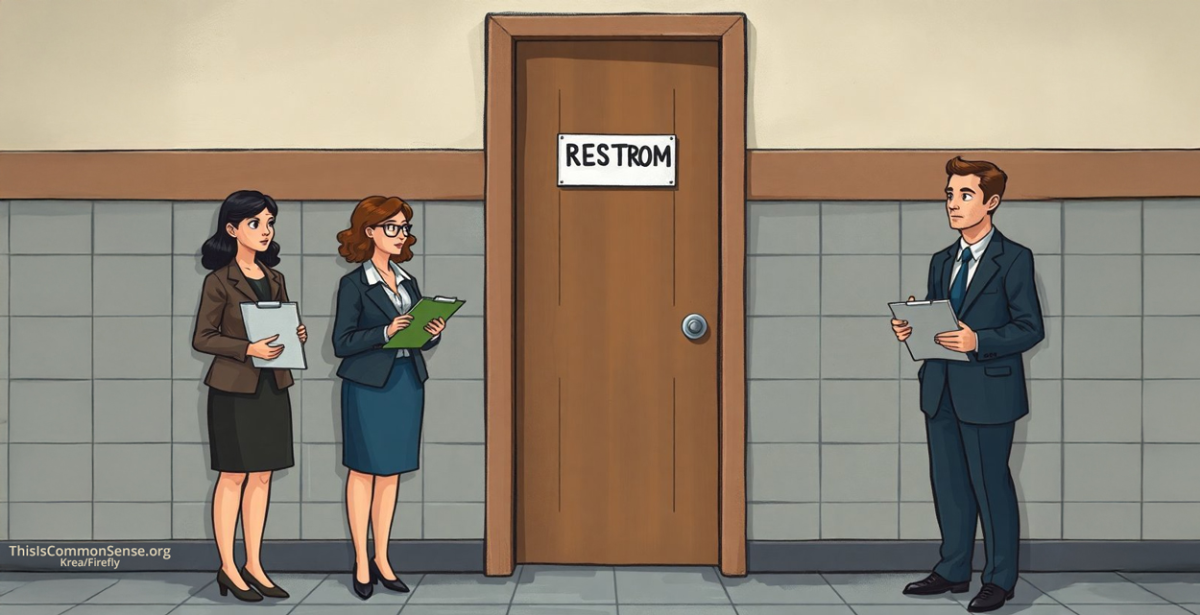
Perhaps you remember the good old days — when men were men, women were women, and private establishments could maintain men’s restrooms and women’s restrooms for the men and the women without worrying about totalitarian edicts from a Human and Civil “Rights” Commission.

Those days may not be gone forever. But it sure must feel like it to the owners of the Hideout Arcade Bar & Grille in Rehoboth Beach, Delaware.

The restaurant refused the request of a man, what news reports call a “biological man,” who wanted to use the woman’s bathroom at the restaurant. His reason was that — well, I’m not sure his exact rationale matters. Anyway, the restaurant said no, doubtless feeling that it had a right to protect the sensibilities of the women using its bathrooms and to establish rules for their use.

He must have complained, because the Delaware Human and Civil “Rights” Commission got involved and, ignoring any common-sense defense the restaurant offered, has fined the restaurant $2,000 and imposed “anti-discrimination training” — i.e., reeducation — on its employees. 

No word on whether they’ll be forced to wear dunce caps, as were some unfortunates during China’s Cultural Revolution.

Commission members might say they’re merely following the law — they just work there. Delaware enacted an Equal Accommodations Law mandating that “All persons within the jurisdiction of this state are entitled to full and equal accommodations, facilities . . . regardless of . . . sex.”

Notice that the law did not say “heedless” of sex, however.

This is Common Sense. I’m Paul Jacob.


PDF for printing

Illustration created with Krea and Fireflly

See all recent commentary
(simplified and organized)
See recent popular posts
Categories
free trade & free markets insider corruption national politics & policies

Protection from Us?

On Labor Day, National Review pointed out that less than 10 percent of all U.S. workers currently belong to unions.

This percentage has been declining for decades. Even during the Biden administration, when the president and his puppeteers did their best to pump up unions, the percentage declined.

In the private sector, only 5.9 percent of workers are union members.

This is great news because unions are typically bad news. By using government-sanctioned force to compel membership and extract wage rates above the market rate, collective bargaining reduces the number of workers who can be employed in a company or industry — thereby distributing wealth from the many to the fewer — and makes firms less efficient.

Only long-run increases in economic productivity enable wage rates to be permanently and generally increased in real terms.

Now, a union devoting itself only to helping workers cope with problems in the workplace problems like an abusive supervisor or gratuitously dangerous working conditions would be fine. But unions as we know them don’t confine themselves to such support and often don’t even offer it. Union bosses prefer to secure above-market wages perhaps because they can then siphon off some of those “rents” (as economists put it).

Meanwhile, unionism is still going strong among public employees. Although government workers constitute only about 15 percent of U.S. workers, these workers “make up about half of the population of union members,”National Review reports.

Who are these government workers protecting themselves from? 

Well, from you and me, basically. 

We might pay them less and we might fire them more often — if we could.

This is Common Sense. I’m Paul Jacob.


PDF for printing

Illustration created with Krea and Firefly

See all recent commentary
(simplified and organized)
See recent popular posts
Categories
free trade & free markets regulation

Regulating Refineries to Death

Punish them! 

That might as well be the explicit goal of California’s regulators and politicians — and all too many voters — for the results are clear enough. All who refuse to use electric cars and solar energy must suffer . . . with ever-higher gas prices, at the very least.

Two major oil refineries that provide gas for California as well as a few neighboring states have announced that they are closing their doors. They can’t hack it.

One analyst predicts that in consequence of these closures and related destruction of production, the price of gas will shoot up to $8 per gallon.

Lane Riggs, CEO of Valero Energy, which is closing a refinery near San Francisco, says the state’s tough “regulatory enforcement environment” is to blame for the loss of the sixth-largest refinery in the state.

Also throwing in the towel is a Los Angeles refinery, this one the state’s seventh-largest, operated by Phillips 66.

Brittany Bernstein notes that Phillips announced the closure “just 72 hours after California passed ABX-2, which requires refineries to hold additional inventories of finished stocks.” Yet another arbitrary burden on a company’s ability to function.

Last year, Chevron moved its headquarters from California to Texas because of the toxic environment for producers in California.

The researcher who’s predicting $8 per gallon gas, USC Professor Michael Mische, says Californians have “legislated ourselves into a situation where the costs are extraordinarily high and the political environment is extraordinarily harsh.”

Solution: reverse and undo. Please permit me to assume that this is possible.

This is Common Sense. I’m Paul Jacob.


PDF for printing

Illustration created with Krea and Firefly

See all recent commentary
(simplified and organized)
See recent popular posts

Categories
First Amendment rights free trade & free markets national politics & policies regulation

Banks Not the Only Debankers

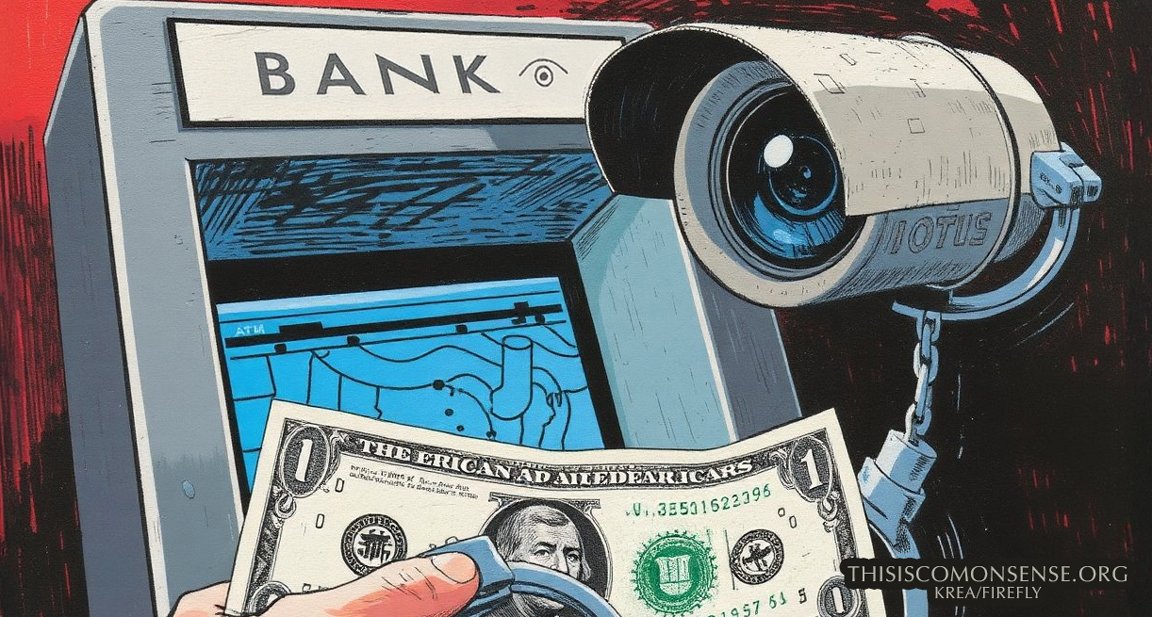
A recent executive order that President Trump issued to stop regulators from abetting and even compelling the “debanking” of bank customers for their political views is clear and on-target.  

On-target as far as debanking by banks goes.

But Reclaim the Net notes a glaring omission. The order’s identifies financial institutions willing to blacklist customers for possessing the “wrong” political opinions or missions. (“Wrong” here means not too pro-criminal or pro-terrorist but too constitutionalist, too much in favor of individual rights of the First or Second Amendment variety.)

The problem is that the order says nothing about major payment processors like Visa and PayPal.

Now, perhaps a penumbra of the new regulatory marching orders would influence the policies of the credit-card companies, whose cards are after all typically issued in cooperation with banks. But this is highly uncertain.

And Reclaim the Net thinks that Visa and Mastercard, “the twin tollbooth operators of the global payments highway,” are, like PayPal and Stripe, untouched by Trump’s order. Yet all of these payment processors have in recent years been blacklisting individuals and organizations that the processors happen to disagree with.

The practice goes back at least to the Obama administration, which instructed regulators that it could regard something called “negative public opinion” as a legitimate risk factor. 

This doctrine “quickly turned into a permission slip for politically driven account closures.” 

The government shouldn’t be issuing such “permission slips” — or implicit instructions — to banks, payment processors, or anybody.

This is Common Sense. I’m Paul Jacob.


PDF for printing

Illustration created with Krea and Firefly

See all recent commentary
(simplified and organized)
See recent popular posts

Categories
free trade & free markets regulation

Debanking Disallowed

President Trump has issued an executive order telling banking regulators to cut it out already.

The order, “Guaranteeing Fair Banking for All Americans,” takes aim at Biden-era regulations that pushed banks to “debank” clients who had the “wrong” political viewpoints: supporters of the First Amendment, the Second Amendment, or whatever aspect of individual rights and freedom the Biden administration was most insistently opposed to.

One key passage requires regulators to “remove the use of reputation risk or equivalent concepts that could result in politicized or unlawful debanking . . . from their guidance documents, manuals, and other materials . . . used to regulate or examine financial institutions over which they have jurisdiction. . . .”

The order also takes aim at banks. It requires regulators to identify financial institutions that have engaged or still engage in “politicized or unlawful” debanking practices and “to take appropriate remedial action” against the banks, including possibly “levying fines, issuing consent decrees, or imposing other disciplinary measures.”

Overall, the order represents a welcome 180 turnabout in very recent policy. The one problem I see, though, is that no clear attempt is made to distinguish between banks that were gung ho about clobbering politically unhip account holders and those that went no further than what they were pushed by Biden regulators to do.

Of course, one could always take a stand and do the right thing despite being threatened. Like the way the debanked individuals and institutions fought for what they believed in despite the risk of being debanked.

This is Common Sense. I’m Paul Jacob.


PDF for printing

Illustration created with Krea and Firefly

See all recent commentary
(simplified and organized)
See recent popular posts

Categories
free trade & free markets regulation tax policy

The New Old Coke

The President of these United States famously drinks Diet Coke.

Despite his preference, however, it’s regular Coca-Cola he’s making waves about.

“I have been speaking to Coca-Cola about using REAL Cane Sugar in Coke in the United States, and they have agreed to do so,” Donald Trump wrote on Truth Social last week. 

The Atlanta-based company has confirmed the story, but it will not be removing High Fructose Corn Syrup (HFCS) Coke from the market. 

What will change? 

“Mexican Coke” (made from refined cane sugar) is available in glass bottles right now, for a premium, in many venues. In effect, Trump is merely helping promote this currently U.S.-made product, allowing it to sit next to regular Coke just as aspartame-sweetened Diet Coke competes on the shelf with Coke Zero, which is made with a blend of artificial sweeteners, including aspartame and acesulfame potassium (Ace-K).

Maybe all Coca-Cola will really do is re-brand Mexican Coke.

To “Trump Coke”?

“I’d like to thank all of those in authority at Coca-Cola,” added the president. “This will be a very good move by them — You’ll see. It’s just better!”

Matters of taste aside, cane sugar may be marginally healthier for you than HFCS. Invented in the Fifties and Sixties in labs, it has been pushed by the USDA, which regulates its prices (as Matt Damon’s 2009 comedy The Informant! makes clear). But both are sugar, if slightly different, chemically.

Behind the proposal to switch to HFCS lies a broader reality: domestic refined cane sugar production from states like Hawaii, Florida, and Louisiana falls short of U.S. consumption needs, while protectionist policies keep its price significantly above global market levels.

For some reason, Donald Trump hasn’t been talking about reducing the sugar tariff!

This is Common Sense. I’m Paul Jacob.


PDF for printing

Illustration created with Krea and Firefly

See all recent commentary
(simplified and organized)
See recent popular posts
Categories
free trade & free markets ideological culture property rights too much government

The Big Decommodification

Tired of that rundown shack you live in — for which each month you must cough up the rent money or a mortgage payment? No doubt, you’re chomping at the bit for the chance to move into clean, spectacular, state-of-the-art government housing.

Well, you’re in luck! That is, if you live in New York City.

You see, on Tuesday evening, Sean Hannity informed his Fox News audience that Zohran Mamdani, the Democrats’ mayoral nominee, has a “plan to slowly eliminate home ownership in New York City.”

“If we want to end the housing crisis, the solution has to be moving toward the full decommodification of housing,” Mamdani declares in a 2021 video for the Gravel Institute. “In other words, moving away from the status quo, in which most people access housing by purchasing it on the market.”

He says, “We’ll have to go beyond the market.”

That “has to be” the solution? Why? Because Mamdani’s socialist/communist dogma dictates that government should be the provider of all shelter? The “decommodification” must be “full” and complete. No private home can be permitted to be bought or sold . . . or lived in anymore.

Surely that would solve our problems.

The democratic socialist suggests that the government “gradually buy up housing on the private market and convert it to community ownership,” urging the city to “fully commit to a new era of social housing . . . using our wealth to build beautiful, high-quality social housing projects that offer good homes and strong communities to everyone.”

Yes, taxpayers, get ready to invest in the sparkling future of public housing. Cabrini-Green here we all come! 

This is Common Sense. I’m Paul Jacob.


PDF for printing

Illustration created with Krea and Firefly

See all recent commentary
(simplified and organized)
See recent popular posts