Categories
free trade & free markets too much government

San Francisco Obstructionism

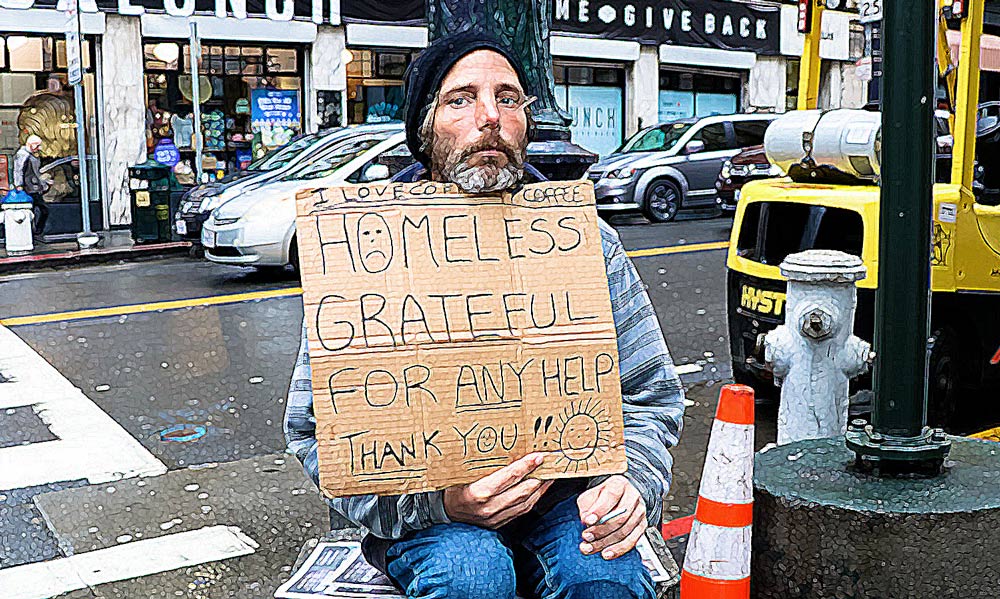
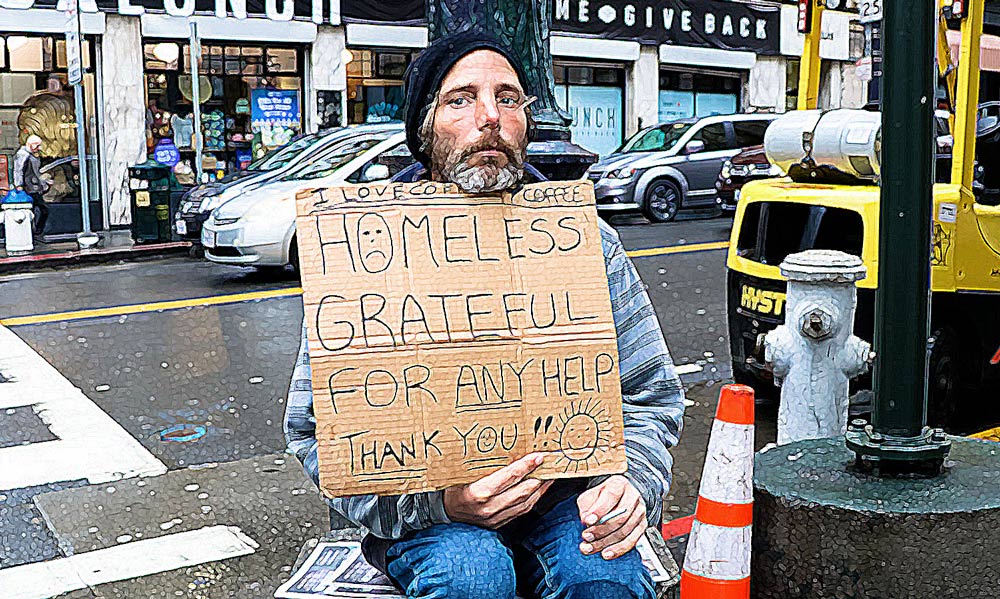
Bob Tillman wants to build a 75-unit apartment building in San Francisco.

He owns the property — a laundromat. He just wants to convert it. But although there are no good reasons why he shouldn’t, city officials and activists opposed to the property rights of developers have been blocking the project. Tillman has spent years and hundreds of thousands of dollars just trying to get started.

His plight “encapsulates the political dysfunction that’s turning San Francisco . . . into an exclusive playground for the ultra-wealthy,” says Reason magazine.

Because of the government’s general antagonism to development, and specific policies such as rent control, much less housing is getting built in the city than would have been possible in a fully free market.

The population is growing quickly, but housing isn’t keeping up. Which results in unnecessarily high rents and housing prices.

None of this is shocking if you understand basic economics. The greater the supply of a good, the cheaper the price tends to be — all other things being equal. That qualification is important. If the supply of oranges doubles but everybody suddenly starts an all-orange-juice diet, orange prices may remain the same or even rise — but less than the price would have risen without the greater supply.

Many factors, including monetary factors, can affect the price of a good. All I’m saying is that if you want the benefits of more housing, including rents that are lower than they would have been without the new housing, you must build houses and apartment complexes.

Stop something from being built and, unfortunately, it won’t be there.

This is Common Sense. I’m Paul Jacob.

PDF for printing

San Francisco, homeless, zoning, housing, regulations
Photo by Mussi Katz

See all recent commentary
(simplified and organized)
See recent popular posts
Categories
free trade & free markets ideological culture Popular

Creeping Bernie-ism

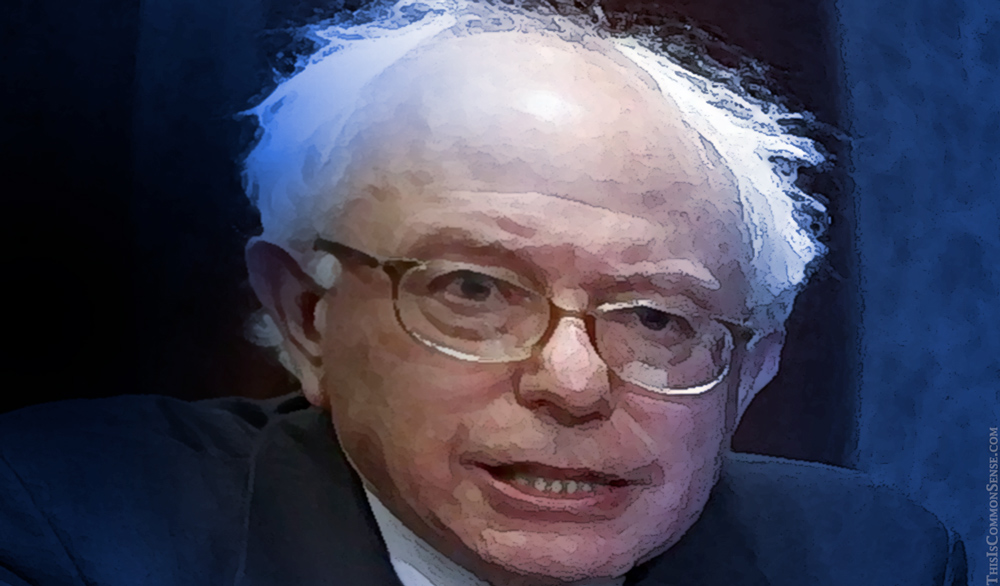
If you have been watching Tucker Carlson, recently, on Fox or in his bizarre interview with Ben Shapiro, you might have noticed something peculiar: the conservative newsman-commentator sometimes sounds awfully similar to Bernie Sanders.

Both think that if some of Amazon’s and Walmart’s employees are not paid “enough” to live without government assistance, that means the companies are being subsidized by taxpayers. 

Ryan Bourne finds this odd, too, judging it “peculiar” to suggest that, “when setting wages, a company employing low-skilled workers should ignore the value of the tasks the employee actually undertakes for them.”

It’s almost as if these guys haven’t thought it through.

“If Sanders is right that programs such as food stamps modestly subsidize employers who pay low wages,” Bourne argues, “then his hugely expensive Medicare-for-all and free-college-tuition proposals would constitute a massive subsidy to low-wage employers.”

Similarly, when Donald Trump and his allied Republicans push for what we used to call “workfare” requirements, that would mean that the jobs the recipients get also constitute subsidies.

Both Carlson and Sanders apparently assume that companies pay workers according to the needs of the workers determined by subsistence levels — presumably by the old Marxian Iron Law of Wages — and not according to their competitive productivity. That is, what they are worth.

As is common with demagogues, Sanders and Carlson both blame the only companies that are at least paying low-skilled workers something, rather than all those other companies and potential benefactors who aren’t paying them at all.

This is Common Sense. I’m Paul Jacob.


PDF for printing


» See popular posts from Common Sense with Paul Jacob HERE.


Categories
free trade & free markets national politics & policies Popular too much government

Christmas Is Coming

When I was a kid, every December day was like a rocket-launch countdown ’til Christmas.

Republicans in the House of Representatives have fewer days to tick off: the days remaining to do something before Democrats take over. Days left in session? Eight.

We know what Trump wants them to do: pass his negotiated replacement for the North American Free Trade Agreement (NAFTA).

Last week, “Trump held a high-profile signing ceremony with Canadian Prime Minister Justin Trudeau and Mexican President Enrique Peña Nieto at the G-20 summit in Argentina,” Eric Boehm writes at Reason. “The leaders of the three countries put their signatures to the final version of the United States–Mexico–Canada Agreement (USMCA), but the deal must still be ratified by each domestic government.”

And some in the Republican House are uneasy, because they “disagree with the Trump administration on trade issues and correctly see the USMCA as moving North America further from free trade.”

Though Donald Trump has given us some reason to think he might have multilateral free trade in mind as his real goal, the current state of the USMCA does not bolster that.

But it could be worse — the Democrats could scuttle the rewrite, just to spite Trump. This would allow Trump to go “nuclear” and withdraw from NAFTA unilaterally without a replacement.

“This would be disastrous for the American economy,” Senator Pat Toomey (R-Pa.) says, “and would kick off a constitutional battle between the branches over trade power.”

That sounds like a lump of coal for Christmas. But I wonder: can a constitutional battle be all bad if it raises awareness of . . . the Constitution?

This is Common Sense. I’m Paul Jacob.


PDF for printing


» See popular posts from Common Sense with Paul Jacob HERE.

Categories
free trade & free markets judiciary

The Cheese Stands “Unprotected”

Governments tempt us — with special privileges and advantages. 

You know what also tempts us?

Cheese.

Cheese? Yes. In the Netherlands, cheese is a big deal, as Baylen Linnekin relates in “Cheese Fight Ends With Court Declaring Producers Can’t Copyright Taste,” over at Reason — where I go for all my cheese-related coverage. (Don’t you?)

The tale is about two cheese companies and the European Union’s “Directive 2001/29/EC,” which tries to reconcile copyrights among member states. Specifically, it involves the legal fight between “two Dutch herbed cream cheese spread makers,” as Mr. Linnekin relates, “Heksenkaas (‘witches’ cheese’) and Witte Wievenkaas (‘wise women’s cheese’).” The former sued the latter for infringing on “its copyright on the taste of Heksenkaas.”

The case went from a Dutch court to the European Court of Justice, where the Court (Grand Chamber) ruled against Heksenkaas. There can be no copyright on “taste.”

This is of no great significance, I suppose, but in a world where the government gets involved in everything, it’s worth noticing when the government resists its temptation to tempt us.

The rationale for non-involvement, in this case, was not a move against intellectual property as such, but against the idea of property involved in subjective taste. “The taste of a food product cannot,” the Court determined, “be pinned down with precision and objectivity. . . .”

Well, sure. But what was really going on here was one company not wanting competition from another company. 

A temptation, for sure. But some temptations (like some cheeses?) must be resisted.

This is Common Sense. I’m Paul Jacob.


PDF for printing


» See popular posts from Common Sense with Paul Jacob HERE.


Categories
free trade & free markets Popular tax policy too much government

Socialists and Capitalism

New York Mayor Bill de Blasio helped snag Amazon for his city. Yes, the long-awaited destination of Amazon’s HQ2 has been determined. Amazon is not putting all its eggs into the Queens borough, though: there’s another headquarters . . . to be placed near Washington, D.C.

The mayor seems quite proud of the deal.

I’ve not been de Blasio’s biggest fan; too often he sounds like a socialist. But this deal? It’s crony capitalism.

So it is with some satisfaction that I can make common cause with a self-professed socialist, newly-elected Congresswoman Alexandria Ocasio-Cortez. Claiming that her Bronx constituency is “outraged” by the Amazon announcement — I doubt that — she expressed her outrage at the “billion-dollar company” receiving “hundreds of millions of dollars in tax breaks.”

Exactly. No company, big or small, should get special treatment from a government.

Want to attract business? Make generally good business policy. Apply liberally, that is, equally.

Alas, the socialist-elect went on to complain that “our subway is crumbling and our communities need MORE investment, not less.”

Well, Amazon is investing in the community, providing jobs.

Then came the busybodyism, demanding to know, “What’s the quality of jobs + how many are promised? Are these jobs low-wage or high wage? Are there benefits? Can people collectively bargain?”

Uh, wages will be high enough to attract workers from their current employment or out of unemployment. And so on.

Socialists feel a need to meddle.

New Yorkers, anyway, can breathe easier knowing they sent Ocasio-Cortez far away, to D.C. — de Blasio as mayor being bad enough.

This is Common Sense. I’m Paul Jacob.


PDF for printing


» See popular posts from Common Sense with Paul Jacob HERE.


Categories
folly free trade & free markets general freedom ideological culture property rights too much government

Big Government Apologetics

Journalists play different roles.

Too few report. Too many engage in elaborate apologetics for favored causes.

Like big government.

Take this headline: “Venezuela’s Crisis Is Rooted In Oil Prices — and Authoritarianism.”

Guess: reporting, or bending over backwards to save socialism?

The article’s summary of the decline and fall of Venezuela is accurate insofar as it indicates assaults on liberty, including nationalizations and monetary inflation. But neither “oil prices” nor dependence on oil spawned Venezuela’s crisis.

Every industry, city and nation will experience unfavorable markets, now and then. But what’s fundamental is their “antifragility.” And, news to journalists: socialist societies are fragile in ways that freer societies are not.

Suppose Venezuela had had a free market when oil prices dropped so precipitously. People would then have shifted, however grumpily, into enterprises now more profitable than drilling for and distributing oil.

It is no blunder to specialize, to exploit comparative advantages in knowledge, skills or resources, and to engage in local, regional or international trade. It’s fine even if an economy’s production and exports ends up being dominated by just one good. What matters is whether people are free or burdened by government controls. If the latter, how hard does government make it to cope with changing circumstances?

Unhampered market prices supply the information and incentives needed to adapt to all kinds of changes. But if an economy is chronically distorted and calcified by government controls, it becomes much harder to adapt . . . and much harder to survive.

Today’s journalists routinely adapt facts to story, rather than adjust stories to reality. Guys, give up the ideological apologetics. Go back to reporting.

This is Common Sense. I’m Paul Jacob.


PDF for printing


Categories
free trade & free markets national politics & policies too much government

More of the Same?

For those who hated NAFTA, and have supported Donald Trump in his complaints about “the very bad deal” that the North American Free Trade Agreement [allegedly] has been, I ask: what was bad about NAFTA that isn’t in Donald Trump’s new version, the United States-Mexico-Canada Agreement?

Actual question. I am not in the least bit interested in gotchas, here. I am willing to celebrate USMCA when (a) I can make sense of it and (b) it proves not just more of the same.

The thing I liked best about NAFTA was that it had “Free Trade” in the title. I like free trade. Trade is good; freedom is good. It is not generally bad to trade with Mexico and Canada — for Mexicans, Canadians, and Americans. I simply have trouble believing that politicians and their aides (along with overly-friendly lobbyists) know better than market competition what the terms of those zillions of deals should be.

But I freely admit, what I didn’t like about NAFTA was that there was more “free trade” in the title than in the agreement itself.

NAFTA was managed trade. 

As far as I can make out, so is USMCA.

Oddly, I just heard two of the three Daily Wire guys* praising USMCA for setting quotas on how much of what can be produced where.

Quotas and mandates and the like are not free trade.

“Managed trade” is just another way of saying “protectionism.” Savvy politicians don’t even like calling it “managed trade.” They call it “fair trade.” 

Free trade is fair enough. Politicians’ “fair trade” isn’t free enough.

This is Common Sense. I’m Paul Jacob.


* Andrew Klavan and Michael Knowles, recent podcasts: dailywire.com.

PDF for printing


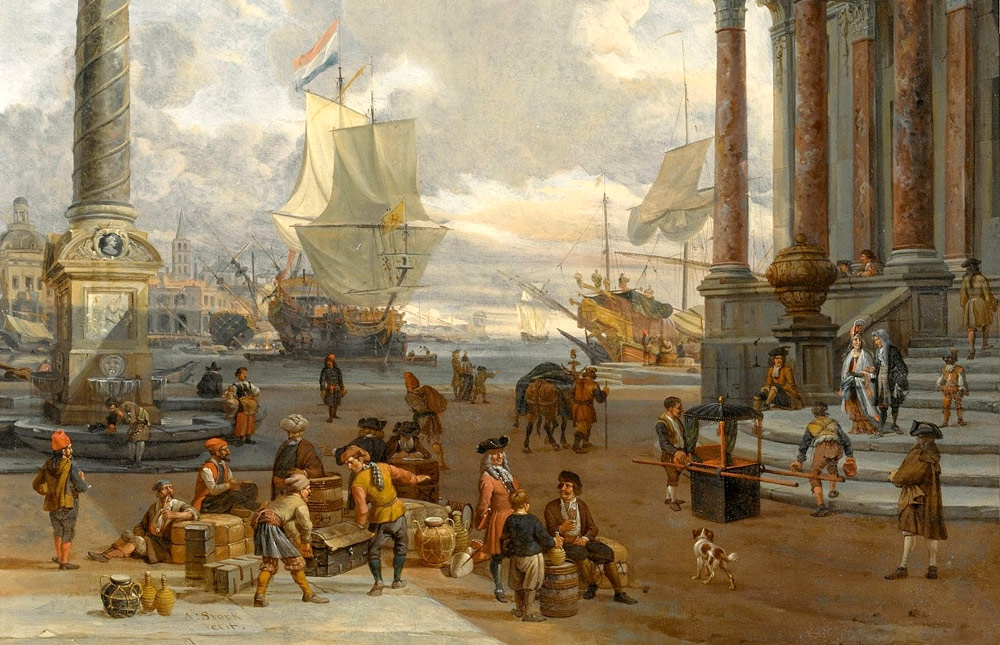
Illustration: Dutch free traders in Harbor Scene by Abraham Storck  (1644–1708)


Categories
free trade & free markets too much government

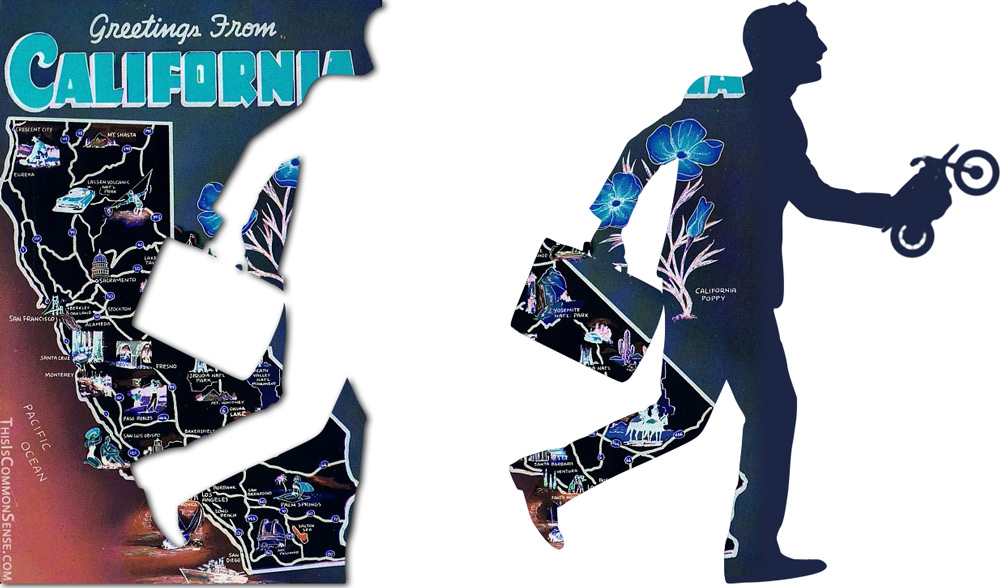
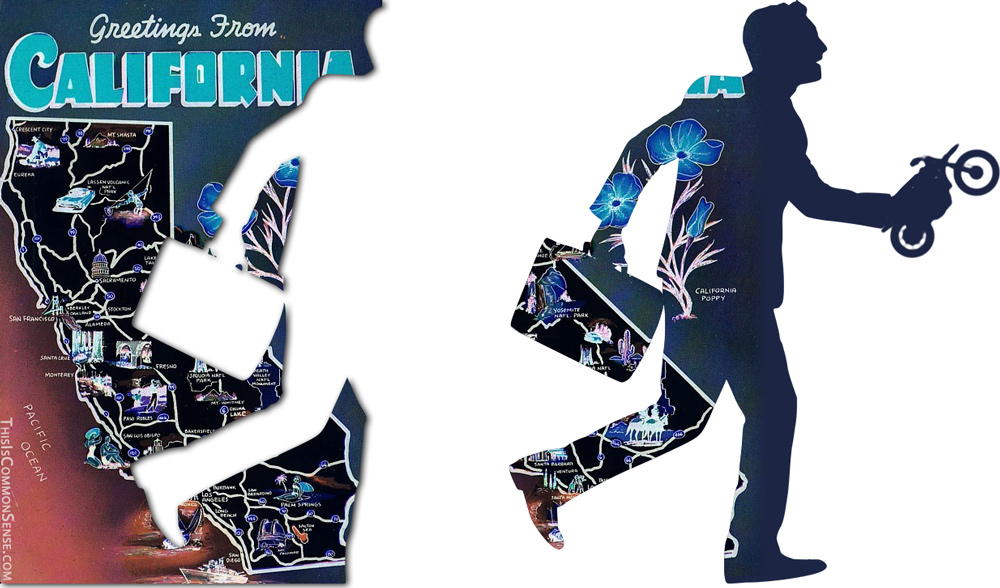
Retreat to Atlanta

“California is the place you oughta be” — or so sang Jerry Scoggins for The Beverly Hillbillies. That may still hold true, if you are an oil millionaire retiring to a pleasant climate.

But if you are trying to make your fortune, the direction is outbound.

Take, for example, the case of Yamaha Motor USA.

The company’s big bike sales — motorcycles 500cc and up — went way down during the last dozen months, 19 percent. And since Yamaha’s operations are in California, hits to revenue like that intersect alarmingly with ongoing hits to the cost of doing business. 

Which explains the decision to move the company to “just outside of Atlanta, Georgia,” as reported by Jensen Beeler in Asphalt & Rubber.

“It should be an obvious statement that California is an expensive place to operate a business,” Beeler explains. “The state isn’t known as being a tax haven for corporations, the property values are high, which means buildings are expensive, and the standard of living for Los Angeles is one of the highest in America, which means that employees have to be paid a premium as well.”

And Beeler’s report does not even mention the state’s regulatory burden.

Problem? Southern California is “where the bulk of the motorcycle industry resides,” and Yamaha will face some difficulty being so distant from its industry’s major talent pool.* But there are a few automotive and motorcycle companies in Georgia, so Yamaha is not alone.

Indeed, if politicians continue to wreak havoc on their business sector, the Golden State bike industry will lose more than just Yamaha.

This is Common Sense. I’m Paul Jacob.


* The company will keep “a small cadre of Yamaha employees” behind in Cypress, California, focusing on testing and racing.

PDF for printing


Illustration by JGill (running silhouette from Max Pixel)


Categories
free trade & free markets general freedom ideological culture too much government

The Ambit of an Ambition

“The geopolitical situation makes this Europe’s hour: the time for European sovereignty has come,” said European Commission President Jean-Claude Juncker this week, staking a big claim for the future in this year’s State of the Union Address.

Juncker wants the EU to be a shiny new “global player,” but shies from the word that comes immediately to mind: “We have to be super,” Juncker clarifies, “but not a superpower.”

The big question is how Juncker’s ramped-up globalism would serve European citizens. Juncker itches to build a “More United, Stronger and More Democratic Union,” but his biggest problem may be that the people seem increasingly iffy on this whole unity thing. 

Brexit is only the most spectacular popular rebellion.

“The Visegrad nations of Hungary, Poland and the Czech Republic,” the Washington Times noted yesterday, have balked at EU migration policies, and “all face EU legal sanctions.” Meanwhile, “Populist governments have been elected in Italy and Austria, where voters are sick and tired of the constant intrusions into their lives by Brussels.” 

And on Wednesday the EU enacted Article 13, an intrusive copyright law that Net activists have dubbed a “meme killer” capable of destroying “the Internet as we know it.”

While Juncker talks about Europe taking “destiny into its own hands,” Europeans seem more interested in taking their government into their own hands.

After all, it is not as if Europeans cannot prosper in a world economy without confederation — much less something much more, a stronger central bureaucratic authority. 

European states could, for instance, adopt free trade. It would make them richer and the world safer.

And they could, in addition, junk Juncker.

This is Common Sense. I’m Paul Jacob. 


PDF for printing


Categories
Common Sense free trade & free markets general freedom ideological culture meme porkbarrel politics too much government

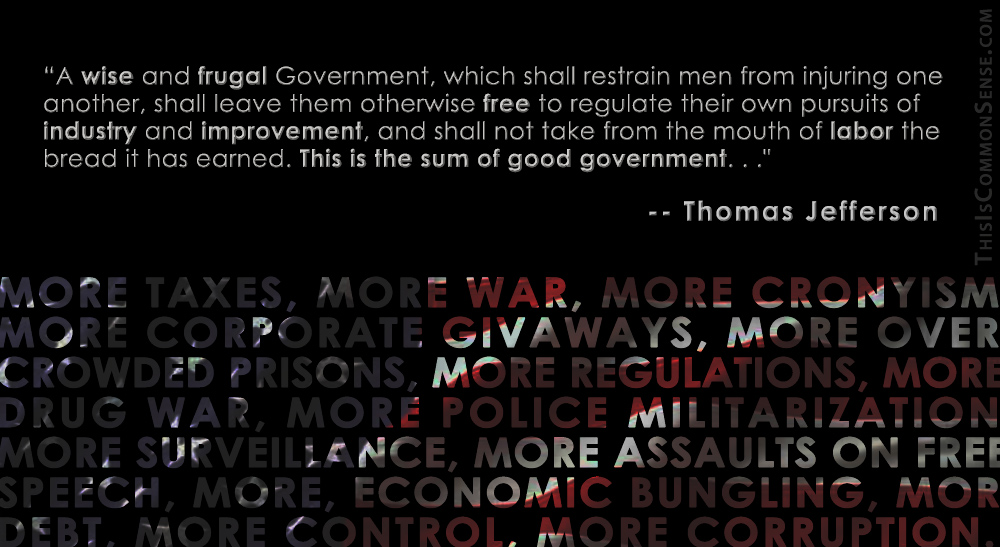
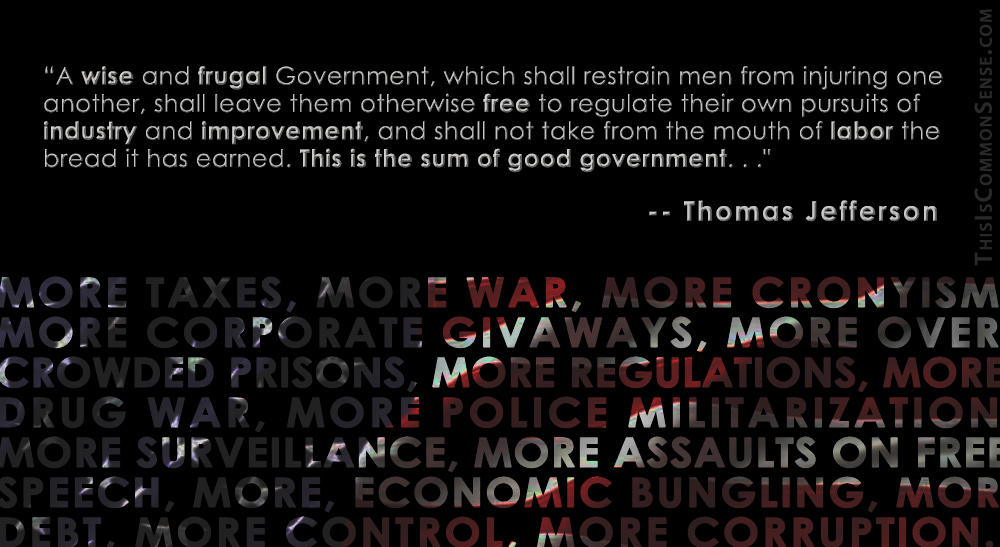
Wisdom for Labor Day

“…a wise and frugal Government, which shall restrain men from injuring one another, shall leave them otherwise free to regulate their own pursuits of industry and improvement, and shall not take from the mouth of labor the bread it has earned. This is the sum of good government…”

–Thomas Jefferson, 1801


Full quote is here