Categories
defense & war general freedom international affairs

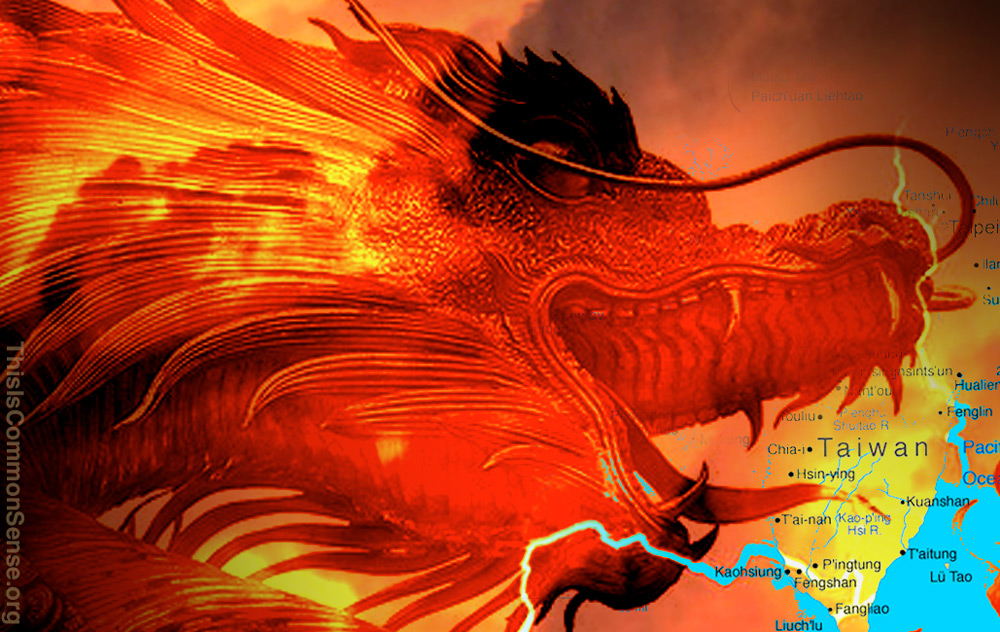
Playing With Fire?

In merely the last month . . . 

Belligerently attempting to enforce China’s illegal claim to virtually the entire South China Sea, a People’s Liberation Army jet intercepted a U.S. Air Force reconnaissance aircraft over international waters, coming within 20 feet, forcing the U.S. pilot to take evasive action to avoid a crash. 

And a war.

Which China’s continually threatened invasion of Taiwan would definitely precipitate. The sort of military assault that the PLA practiced this week, Reuters reported, sending 57 aircraft and four ships into “the sea and airspace around Taiwan, focused on land strikes and sea assaults.”  

Yet talk of a deadly conflict with China is not limited to Southeast Asia.

“Is India Getting Ready For A War With China?” was the headline of Peter Suciu’s 19fortyfive.com story last month detailing a clash between these two nuclear-armed, billion-plus-people nations sharing a disputed 2,100-mile border.*

The good news? The world may be waking up to the enormous threat posed by the Chinese Communist Party. 

Japan has announced it will double military spending — and deploy U.S. tomahawk missiles “capable of striking targets deep inside of North Korea and China.” To better counter the Chinazi threat to itself and neighboring Taiwan, the Japanese also have made “path-breaking” agreements to cooperate with the U.S. and the United Kingdom.

Take a smidgen of comfort, too, in the recent Center for Strategic and International Studies’ war games, which saw Taiwan, Japan and the U.S. “rapidly cripple the Chinese amphibious fleet” in beating back a Chinese invasion of the democratic island nation.

In renewing “its longstanding threat to attack Taiwan,” the CCP warned that foreign countries were “playing with fire.”

Correction: we’re no longer just “playing.”

This is Common Sense. I’m Paul Jacob.  


* CNN explained that the tensions between the two countries increased “sharply in June 2020 when hand-to-hand fighting . . . resulted in the deaths of at least 20 Indian and four Chinese soldiers in Aksai Chin-Ladakh.”

PDF for printing

Illustration created with Midjourney

See all recent commentary
(simplified and organized)
See recent popular posts
Categories
defense & war general freedom international affairs

An Invisibility Cloak We Can Use

It’s not quite the magical invisibility cloak worn by Harry Potter. But it’s the next best thing.

Chinese students have created apparel that human eyes can see but that hides the wearer from security cameras and recognition software.

The InvisDefense coat looks ordinary. So it won’t by itself arouse the suspicion of other people on the street. But it is designed in such a way as to foil the kind of cameras that, for example, try to identify who is protesting Chinazi lockdown insanity.

During the day, the printed pattern of the InvisDefense coat blinds cameras. At night, the coat emits heat signals that disrupt infrared. It was invented by Chinese graduate students at Wuhan University under the guidance of computer science professor Wang Zheng. Their coat won first prize in an innovation contest sponsored by Huawei.

Wang observes that “many surveillance devices can detect human bodies. Cameras on the road have pedestrian detection functions. And smart cars can identify pedestrians, roads, and obstacles. Our InvisDefense allows the camera to capture you. But it cannot tell if you are human. . . .

“We use algorithms to design the least conspicuous patterns that can disable computer vision.”

And the coat costs only seventy bucks or so.

I’m not always a fan of the algorithms. In this case, shout Hooray for algorithms and for those who put them to such good use by inventing the InvisDefense coat. 

I hope these students sell about eight billion of them.

This is Common Sense. I’m Paul Jacob.


PDF for printing

Illustration created with DALL-E2

See all recent commentary
(simplified and organized)
See recent popular posts
Categories
defense & war general freedom international affairs

Stuck in the Middle with US?

Is Taiwan, the island democracy of 24 million, really caught in the nation-state equivalent of a lovers’ triangle?

“Taiwan is caught in the middle of escalating tensions between the U.S. and China,” is how National Public Radio headlined its recent story about Communist Party-ruled China “speeding up its plans to seize Taiwan.”

“Entangled in a geopolitical power struggle between the US and China, the wants of the Taiwanese people get overshadowed,” informs CNA, the Singapore-based English language news network, pitching its weekly hour-long news program, Insight, which sought to present “the Taiwanese perspective to being caught between giants.”

Nothing new. 

“As China challenges the global dominance of the United States,” NBC News reported back in 2020, “tiny Taiwan finds itself stuck, rather uncomfortably, smack dab in the middle of the conflict between the two international giants.”

The Taiwanese are no doubt uncomfortable. In a recent survey, nearly 40 percent now believe a Chinese military invasion, killing tens of thousands or hundreds of thousands or more, to be likely. 

They are not torn, however, between two superpowers. Taiwan is — most assuredly — not preparing to defend against an armed attack by the United States. 

In fact, Taiwan is coordinating its national defense efforts with the U.S., hoping and praying for direct U.S. help in defending themselves from totalitarian China.

Taiwan is not stuck with us. Nor we with them. We are simply allies in deeply valuing societies where individual lives matter. 

Against a superpower for whom they don’t

This is Common Sense. I’m Paul Jacob.


PDF for printing

Illustration created with DALL-E

See all recent commentary
(simplified and organized)
See recent popular posts
Categories
defense & war general freedom international affairs

Getting Guns to Good Guys

No sooner had President Biden shared his somewhat soothing takeaway from a three-hour meeting with Chinese ruler Xi Jinping — Joe doesn’t think there is an “imminent” threat of China invading Taiwan — then here comes a report that Russian missiles have killed two people.

Not in Ukraine, where Russia is “arguably” at war, but in neighboring Poland, a NATO country.

I’ve repeatedly suggested we review all the military alliances and commitments our politicians and diplomats have entered into . . . “on our behalf.” But there comes a time (and it seems fast approaching) when it is too late for review and the U.S. will have to stand up and meet the commitments it has made.

While I have little doubt in the current generation of volunteer soldiers, I cannot say that about my generation of generals and politicians and bureaucrats. “We cannot manufacture and produce weapon systems fast enough,” Rep. Michael McCaul (R-Tex.) told Full Measure host Sharyl Attkisson.

Pointing to $3 billion in U.S. arms sales to threatened Taiwan, McCaul complained that it has been “three years and we haven’t delivered one of these weapon systems into Taiwan. . . . Remember, in Taiwan, they actually have purchased these weapons.” 

One step to fix this mess is the Taiwan Policy Act of 2022 (S.4428), which would allow the U.S. to transfer significant weaponry, “essentially to do for Taipei what is being done for Kyiv — but before the bullets start flying.”

Our best opportunity to keep Chinese guns silent.

This is Common Sense. I’m Paul Jacob.


PDF for printing

Illustration created with DALL-E

See all recent commentary
(simplified and organized)
See recent popular posts

Categories
defense & war general freedom international affairs

Armageddon, Anyone?

Ah, the things one hears at high-dollar Democratic Party fundraisers!

Like declaring Russia’s threat to unleash nuclear weapons against Ukraine as the most serious “prospect of Armageddon in 60 years.”

Last week, Sleepy Joe “startled many Americans” with those remarks at a closed-door meeting of big donors.

Backpedaling on Friday, “U.S. officials stressed . . . that the United States has no reason to change its nuclear posture.” No reason? We’re backing one side in a war in which nukes are on the table!

Andrea Kendall-Taylor, director of the Transatlantic Security Program at the Center for a New American Security, didn’t defend Biden’s “Armageddon” terminology but offered that it was “useful for the president and the administration to be having a conversation with the public about the risk.”

Of course, the president gave this frank evaluation to his party’s top check-writers, not the public. And that’s the second biggest problem with U.S. foreign policy: it’s totally divorced from the people. 

The biggest? Headin’ towards Armageddon. If Mr. Biden is serious about slouching towards the End Times, he should do more than make it the subject of political locker-room talk. 

Like what? How about:

  1. Seek to reduce tensions, wherever possible, and help Mr. Putin find an off ramp from his war in Ukraine; 
  2. Double- and triple-down on technologically defending the American people from the threat posed by nuclear weapons and other weapons of mass destruction; and  
  3. Speak to the people about these threats and the U.S. response.

While security concerns may dictate that information not be shared publicly, if it’s good enough to share on the rubber-chicken circuit, it good enough for ‘We the People.’

We pay the highest prices; we deserve to hear the sales pitch.

This is Common Sense. I’m Paul Jacob.


PDF for printing

Illustration created with DALL-E

See all recent commentary
(simplified and organized)
See recent popular posts
Categories
Accountability defense & war general freedom social media

Pentagon Personae

We think of Facebook and Twitter as platforms for you and me and our fellow citizens to share information and opinions and photos and just plain fun.

But our government agencies are also on those platforms, secretly as well as openly.

And not just for fun and games.

It’s a serious information war out there — with mis- and dis- elements, too — and Facebook and Twitter may be in over their heads.

“The takedowns in recent years by Twitter and Facebook of more than 150 bogus personas and media sites created in the United States,” wrote Ellen Nakashima in the Washington Post in mid-September, “was disclosed last month by internet researchers Graphika and the Stanford Internet Observatory. While the researchers did not attribute the sham accounts to the U.S. military, two officials familiar with the matter said that U.S. Central Command is among those whose activities are facing scrutiny.”

Ms. Nakashima’s report begins with the big news: “Colin Kahl, the undersecretary of defense for policy, last week instructed the military commands that engage in psychological operations online to provide a full accounting of their activities by next month,” and we are told of a “sweeping audit” to probe how the Pentagon “conducts clandestine information warfare.”

This is largely in response to Facebook and Twitter identifying and removing “fake accounts suspected of being run by the U.S. military in violation of the platforms’ rules.”

Social media companies took down actual U.S. military psy-op accounts. But it is worth noting that the report does not mention Facebook or Twitter taking down foreign equivalents, though that has happened in the past.

It might be time to reconsider all government activity in social media.

This is Common Sense. I’m Paul Jacob. 


PDF for printing

Illustration created with DALL-E

See all recent commentary
(simplified and organized)
See recent popular posts
Categories
defense & war general freedom international affairs

Fight or Flight?

Be strong or be gone. America must choose one of these two options in East Asia. 

China insists.

Let’s note at the outset that the Chinese Communist Party (CCP) did not “directly” threaten to shoot down House Speaker Pelosi’s plane on her possible upcoming visit to democratic and free Taiwan. That friendly suggestion was instead offered by a columnist for the “state-run” Global Times

On Twitter.

Which, incidentally, is banned in China.

That being said, the totalitarians are indeed “bad folks.” In addition to continually threatening the invasion of Taiwan, they’re known to rough up defenseless old folks. For instance, browbeating 79-year-old President Joe Biden last week in a multi-hour phone call, in which, according to a Chinese foreign ministry read-out, Xi Jinping warned our president about standing with Taiwan: “Those who play with fire will perish by it.”

While no one in his right mind wants war with the Dragon, to avoid war with fear and cowardice may ultimately require ceding the world’s greatest democratic success story, Taiwan (the Republic of China), to the genocidal (and misnamed) People’s Republic of China. 

Our cowardly leaders might opt to shut up and look the other way — especially if there is payola attached — but not the rest of us.

Should the United States tangle with a nuclear power over Taiwan?

Isn’t that like asking whether we should go to war over my mother or yours? Or your spouse . . . or your son or daughter?

Is one person — or a small nation of 24 million souls — worth such a risk?

When the Dragon demands a sacrifice, recognize it for what it is.

If one person, recognize it once.

If a nation, recognize it 24 million times.

Resist the Dragon.

This is Common Sense. I’m Paul Jacob.


Note: As I point out in last weekend’s podcast, Taiwan can successfully repel a Chinese invasion, especially with U.S. and Japanese assistance. And here, Ian Easton, author of The Chinese Invasion Threat, speaks to the issue.

PDF for printing

See all recent commentary
(simplified and organized)
See recent popular posts
Categories
defense & war general freedom international affairs

Does China Want War?

“WARNING,” it began, “THIS VIDEO MAY BE UPSETTING TO SOME VIEWERS.”

Just the all-caps was upsetting, I thought to myself.

Still, I was all ears and eyes for Johnny Harris’s “Here’s What Happens If China Invades Taiwan,” which garnered seven million views since February. 

Harris was “a little bit conflicted making this video,” because he “feels very against the machismo fascination with conflict,” telling viewers that “we’re talking about people’s lives” and “entire societies being ripped about by a power struggle.”

Declaring that “China doesn’t want war,” Harris hazards that Mainland China “will probably try much less violent ways to try to force Taiwan to the negotiating table before resorting to all-out invasion.” 

Masters of benevolence, the Chinese Communist Party (CCP) will . . . accept surrender!

Mr. Harris points out that the CCP has passed a law saying they “must” invade Taiwan if peaceful reunification is not possible. Explaining the dearth of support in Taiwan for joining their totalitarian neighbors, he notes “the interpretation of this law [is] more and more on the side of China should do this forcibly.”

Why, it’s “a legal imperative.”

And protecting “this far away island,” asserts Harris, “is something the American public broadly would not be into.” (Though, ahem, recent polling says otherwise.)

“I really hope that we are past needing to resort to this version of conflict to settle our disputes at this time in our history,” he concludes. “But I’m not totally convinced that we are yet.”

The CCP part of “we” is clearly not there. 

“We can talk about it,” explains Harris. “We can find creative ways to solve this.”

My take? Don’t expect too much creativity from the CCP. 

This is Common Sense. I’m Paul Jacob.


PDF for printing

See all recent commentary
(simplified and organized)
See recent popular posts
Categories
defense & war general freedom international affairs

Biden Time with Bully

What’s more provocative: visiting friends or threatening a military invasion?

House Speaker Nancy Pelosi is rumored to be visiting Taiwan in August, to see our friends who have made the most miraculous political advances of the last half century, from a repressive authoritarian society through four decades of martial law to arguably the most democratic and free nation in all of Asia.

Not to mention blossoming into an economic powerhouse that produces “roughly 90% of the world’s most advanced chips.”  

“[T]he chip industry is dominated by manufacturers in the small island of Taiwan,” informs Fortune. “Policy makers in the U.S. have started to see that as a problem.”*

What’s problematic? Well, Xi Jinping and the Chinese Communist Party (CCP), ruling over both the world’s most populous country and the world’s fastest growing armed forces, constantly threatens a military assault to conquer the “renegade Chinese province.”

They want us not to be friends with the Taiwanese. No talking. No holding hands.

Last week, Beijing warned the U.S. against allowing Pelosi’s visit. Chinese spokesman Ma Xiaoguang “said today that some people in the US government and Congress are constantly provoking and playing the ‘Taiwan card’ . . . and the mainland will ‘resolutely strike back,’” Taiwan’s government news service reported.

Asked about the possible trip, President Joe Biden offered: “Well, I think that the military thinks it’s not a good idea right now. But I don’t know what the status of it is.”

By any fair reading of all the gobbly-gook produced by our State Department over the decades, the U.S. is treaty-bound to defend Taiwan. 

Moreover, from U.S. statements and actions, all the world expects America to step up for democratic Taiwan against a violent takeover by totalitarian China.

Even China thinks so. 

And what does Pelosi think? “It is important for us to show support for Taiwan,” Pelosi told reporters.

She’s right.

This is Common Sense. I’m Paul Jacob.


* Also last week, Commerce Secretary Gina Raimondo called a disruption of the supply of computer chips from Taiwan a “scary scenario” that would lead to a “deep and immediate recession.” Invasions can be quite disruptive. Where would the chips fall, then?

NOTE: More on Taiwan at ThisisCommonSense.org.

PDF for printing

See all recent commentary
(simplified and organized)
See recent popular posts
Categories
defense & war general freedom meme

Tiananmen Square

“The same thing will happen in China that happened in Chile. Political freedom will ultimately break out of its shackles. Tiananmen Square was only the first episode. It is headed for a series of Tiananmen Squares. It cannot continue to develop privately and at the same time maintain its authoritarian character politically. It is headed for a clash. Sooner or later, one or the other will give.”

–Milton Friedman