Categories
Accountability crime and punishment folly free trade & free markets general freedom local leaders nannyism national politics & policies responsibility too much government

Kick the Addiction, Save Money

The political case for the War on Drugs has always been intuitive. “Drugs are bad” has trumped practical concerns. But the actual, responsible case for the political crusade has depended upon some concept of “social cost.”

Now that marijuana is being legalized state by state, the case against the greater War on Drugs is being taken seriously — enough to rethink all varieties of costs. Indeed, many now see the opioid epidemic as being driven, in part, by the War on Drugs, and not just as an excuse for a stronger crackdown.

Nevertheless, coming to some accounting — especially “social cost” accounting — remains difficult. This is especially true so long as its effects on freedom and the rule of law do not get figured in.

Somewhat surprisingly, even the budgetary effects of legalization have proven a bit tricky.

So it is welcome to read Harvard economist Jeffrey Miron’s study of marijuana legalization as it has occurred in the states of Washington, Oregon, and Colorado. He compares results of legalization with the predictions he had made eight years ago, in a previous Cato Institute study. It turns out that while tax revenues are far greater than expected, law enforcement costs have not gone down.

“Early experience suggests that governments will reallocate rather than reduce those expenditures,” Miron writes. “That reallocation may be beneficial, but it does not have a direct effect on the budget deficit.”

On a federal level, though, we might expect greater savings. How? We could shut down whole bureaus.

Yet, achieving such savings would require progress on Washington’s biggest addiction:  spending.

This is Common Sense. I’m Paul Jacob.


Studies cited:

Jeffrey Miron, “The Budgetary Effects of Ending Drug Prohibition,” Cato Tax & Budget Bulletin, Number 83, July 23, 2018.

Jeffrey A. Miron and Katherine Waldock, “The Budgetary Impact of Ending Drug Prohibition,” Cato Institute white paper, September 27, 2010.


PDF for printing


Categories
Accountability crime and punishment folly free trade & free markets general freedom moral hazard nannyism responsibility too much government

Taking a (Lemonade) Stand

When life hands you lemons. . . .

Once upon a time, putting up a summertime lemonade stand was the American way for kids to learn about hard work, good will, and entrepreneurship. Almost every kid had one, making some spendable profit selling the nectar.*

Some of the youngsters grew up to become Bill Gates and Steve Jobs and, well, lemonade’s one heck of a gateway drink.

But then, along came “progress” — that is, mandates and regulations slapped upon businesses. And the hordes of regulators required to enforce the morass of rules — “swarms of Officers.”

Soon lemonade stands were vanquished from our neighborhoods.

And America was made safe (at long last!) for . . . inane bureaucracy.

“Reports of kids’ lemonade stands being shut down for breaking local health or permitting laws have long left grown-ups feeling sour,” today’s Wall Street Journal informs. But the story also details how “a growing movement of adults is fighting back.”

So, when government policies hand you lemons, what do you do?

Make a map of all the lemonade stand clampdowns.

“I think the Constitution covers [lemonade stands] as written,” Dave Roland told the Journal, explaining the map he and his wife Jenifer have produced. “But if there’s any doubt about that, let’s get it fixed.” The Rolands run the Freedom Center in Missouri, but theirs is a regrettably national map.

Last month, the popular lemonade maker Country Time started “Legal-Ade,”  pledging to come to the defense of any kid “busted” for trafficking in lemonade.

Seriously.

“When life gives you arcane laws,” the company’s video says, “make lemonade.”

Taste the Common Sense. I’m Paul Jacob.


* The profit was made possible largely by pushing their costs off onto their parents. But isn’t that sorta what parents are for? And good lessons were still learned.

PDF for printing


Categories
Accountability crime and punishment free trade & free markets general freedom media and media people moral hazard responsibility

Blame the App?

Who spreads “fake news”?

Gossips, politicians, publicity agents, Twitter eggs, partisan bloggers, lying news journalists?

Or . . . the medium of communication they use?

Do envelopes, stationery, telephones, email, and messaging apps have moral agency?

And who commits the crimes that news (true or false) is used to rationalize?

A New York Times story discusses “How WhatsApp Leads Mobs to Murder in India,” which is like saying that civilization, flying lessons and boarding passes “led” terrorists to 9/11.

The Times reports that fake news about children being kidnapped — dramatized by doctored video clips and forwarded via WhatsApp, a messaging app — provoked anger and fear in many Indians. Some were then willing to attack anyone who “seemed” about to kidnap children.

In recent months, dozens of people have been murdered for being in the wrong place at the wrong time.

Without social media and the mega-popular WhatsApp, the murders probably would not have happened, at least not the way they happened. That seems certain. But this doesn’t mean that without WhatsApp, nobody in India would spread false stories or assault innocent people.

Mob violence in the country antedates the Internet.

Perhaps a thousand material circumstances directly or indirectly enable any particular act of wrongdoing. But no such prerequisites “lead to” anything without individual choices.

If someone pretends it’s okay to kill innocent persons — or persons whose guilt or innocence he doesn’t care to know — he, the killer, is the guilty party. The telecommunications network or messenger app used to provide grist for excuse-making is innocent.

Apps don’t murder people. People murder people.

This is Common Sense. I’m Paul Jacob.


PDF for printing


Categories
Accountability crime and punishment government transparency media and media people moral hazard national politics & policies Regulating Protest responsibility

The Deeply State

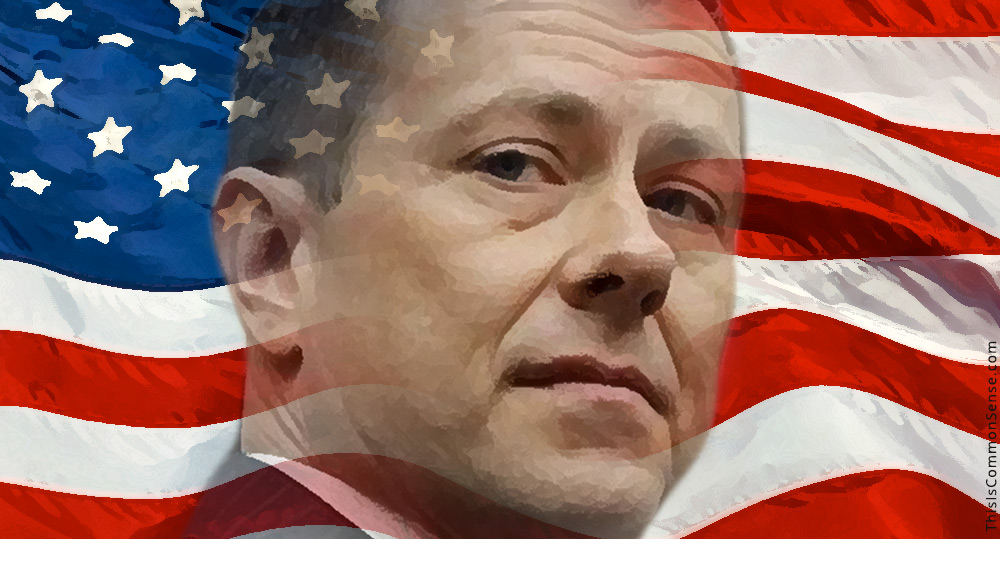
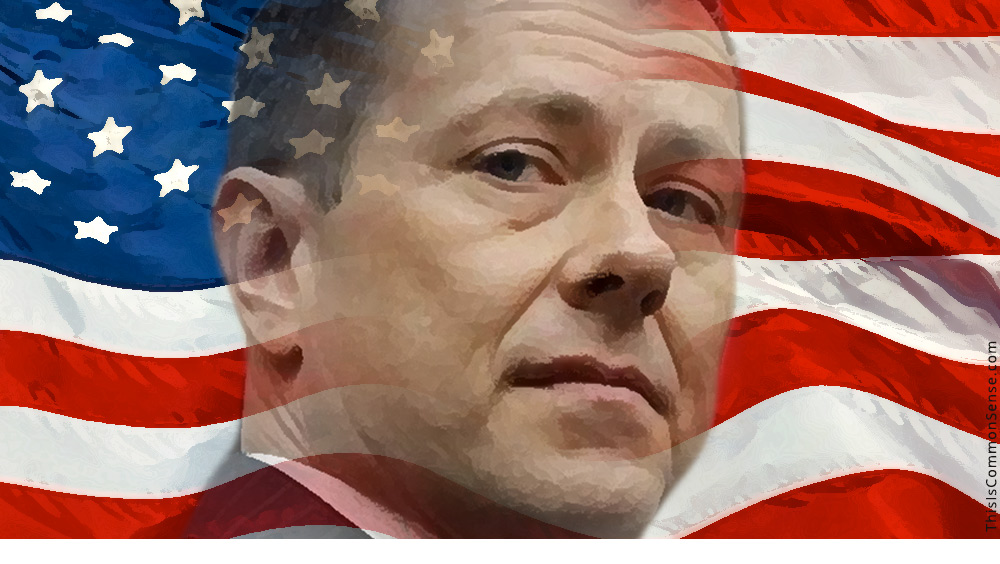
FBI agent Peter Strzok is offended.

Deeply.

He takes pains to clarify: he sent emails during the last presidential campaign expressing a willingness and readiness and commitment to preventing a Trump Presidency because he, Agent Strzok, is patriotic.

Deeply.

During yesterday’s contentious congressional interrogation, fielding questions regarding just how anti-Trump he was during the last presidential campaign, Peter Strzok denied that his obvious and admitted political bias affected his professional conduct.

“Like many people, I had and expressed personal political opinions during an extraordinary presidential election,” said Agent Strzok. “My opinions were expressed out of deep patriotism.”

But it wasn’t just a matter of expression, was it? One text message was an assurance that he would “stop” Trump’s election. When challenged on this, Strzok admitted that his memory was faulty.

Deeply?

“At no time, in any text,” Strzok said, decisively, “did those personal beliefs enter into the realm of any action I took.”

When a citizen expresses a credible threat to a president, federal agents investigate. His exchange with his “girlfriend,” Lisa Page, was not what we now call an “existential threat,” of course. Ms. Page had texted her worry about a Trump win: the man was “not ever going to become president, right? Right?!” Strzok’s reply was not vague: “No. No he won’t. We’ll stop it.” The threat is, at most, covert-political, back-room. FBI-ish. The couple were, after all, a part of an investigation into Donald Trump’s alleged Russian connection.

Though one could easily understand a married man assuring his inamorata simply to puff himself up in her eyes, this assurance sure looks different to our eyes — it cannot help but make us suspicious.

Deeply.  

This is Common Sense. I’m Paul Jacob.


PDF for printing


Categories
Accountability crime and punishment folly free trade & free markets general freedom judiciary local leaders moral hazard nannyism Second Amendment rights too much government U.S. Constitution

Ought Implies Cantifornia

“Strip away the absurdity,” writes Scott Shackford at Reason, “and it’s essentially a very technical ruling.”

Shackford is explaining a bizarre recent judgment of the California Supreme Court.

Politicians in Sacramento had, years ago, passed a gun control measure requiring gun manufacturers to “implement microstamping technology that would imprint identifying information on bullets as they were shot from semi-automatic weapons.” In 2014, Smith & Wesson announced that it would pull some guns from the California market rather than comply. Why? The technology just wasn’t ready yet.*

Since California’s Civil Code contains a section reiterating an old commonsense principle to the effect that the “law never requires impossibilities,” the National Shooting Sports Foundation sued to block the law.

But the group just lost.

The Court did say it could protect citizens from punishment, but it refused to nullify the legislation on constitutional grounds.

Unanimously.

Why do this? Apparently to protect California politicians in their ongoing social engineering schemes.

The dollar costs of trying to comply with impossible demands are huge, of course. But the biggest costs may be more subtle.

In moral philosophy, it is a truism to say that “ought implies can.” In natural law as understood long ago, an impossible law was thought not a law at all, justifiably ignored by anyone and everyone.

In a just state, flouting of maddening regulations like California’s would lead not merely to the defense of the absurdly put-upon citizen — as this court ruling still allows — but also to the nixing of the “impossible” law.

This is Common Sense. I’m Paul Jacob.


* Shackford notes that “a cynic might theorize that this is the law’s actual intent.” I wouldn’t limit that suspicion to folks given to cynicism. Pragmatists and political scientists and almost anyone else would be placing bets on that, too.

PDF for printing


Categories
Accountability crime and punishment ideological culture media and media people moral hazard national politics & policies political challengers responsibility

Black Mask Terrorism

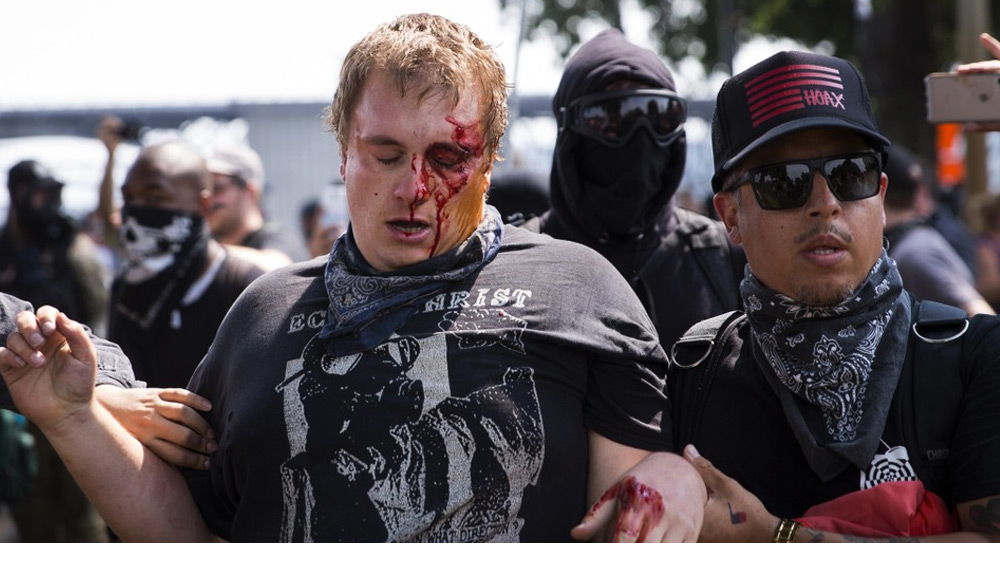
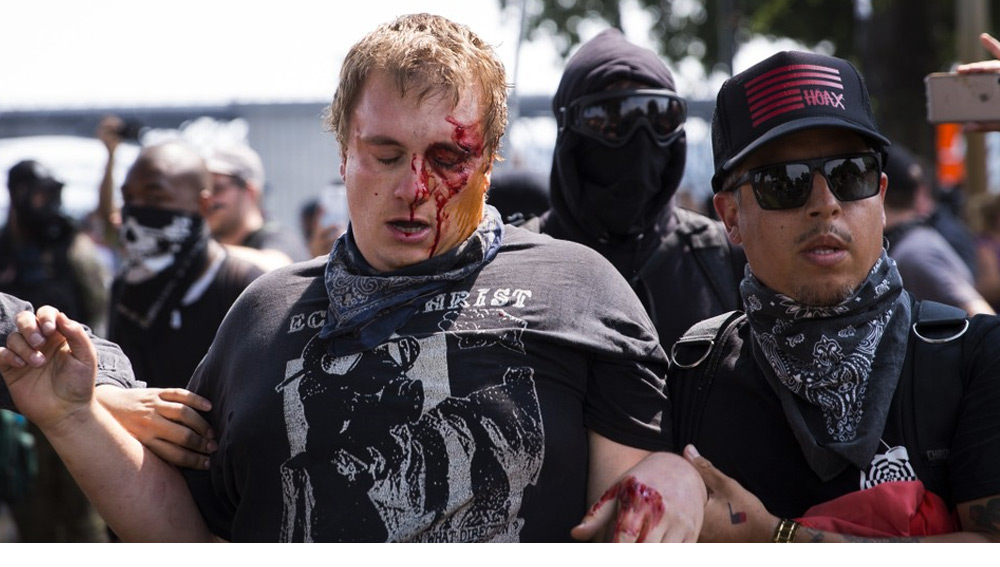
I was in Arkansas on Saturday when the downtown streets of Portland, Oregon, “exploded into its worst protest violence of the Trump era,” as The Guardian explains. “More than 150 supporters of the far-right Patriot Prayer group fought pitched street battles with scores of anti-fascist protesters. In total, nine people were arrested.”

Notice that “Patriot Prayer” — a group sponsored by a Republican Senatorial candidate, and which says it stands for free speech — was labeled “far right” while the “anti-fascist protesters” were not called “far left.”

Characteristically, The Guardian vagues it up. “Violence suddenly ‘erupted,’” noted a Romanian YouTuber of the British rag’s evasiveness. “Who started it? We don’t know.”

Well, from the videos I saw it looked like the “anti-fascists” started it. The “patriots” were marching down the street when a young man, with helmet and backpack, and a young women, dressed in black, marshaled antifa mobs towards the legal march, and then stones and bottles were thrown, and explosives, too . . . into the Patriot Prayer rally.

Note: the Patriot Prayer group had filed the paperwork for the march; antifa had not. The Portland police did not protect the licensed marchers, but did revoke their license, telling everyone to disperse (threatening “duress” to the non-compliant) after the violence broke out.

If you did not carefully look at more than one video, you might be confused. Indeed, not all videos showed the crucial break from peace to violence.

So, what other clues might one look for?

In old cowboy movies, whoever ganged up masked, and wore black, were usually the bad guys.

Antifa — thanks for providing the clues: masks, black fighting gear, and Luciferian handsigns.

This is Common Sense. I’m Paul Jacob.


Categories
crime and punishment general freedom ideological culture moral hazard nannyism political challengers privacy Regulating Protest too much government

Don’t Enable Tyrants

If I deliberately help somebody to do evil things — and nobody is holding a gun to my head — I am thereby doing evil myself.

A person should not let himself be in that position. Not even if he’s “just doing my job” and looking for a non-evil job would be demonstrably inconvenient. To have a motive for doing a bad thing is not by itself exculpatory.

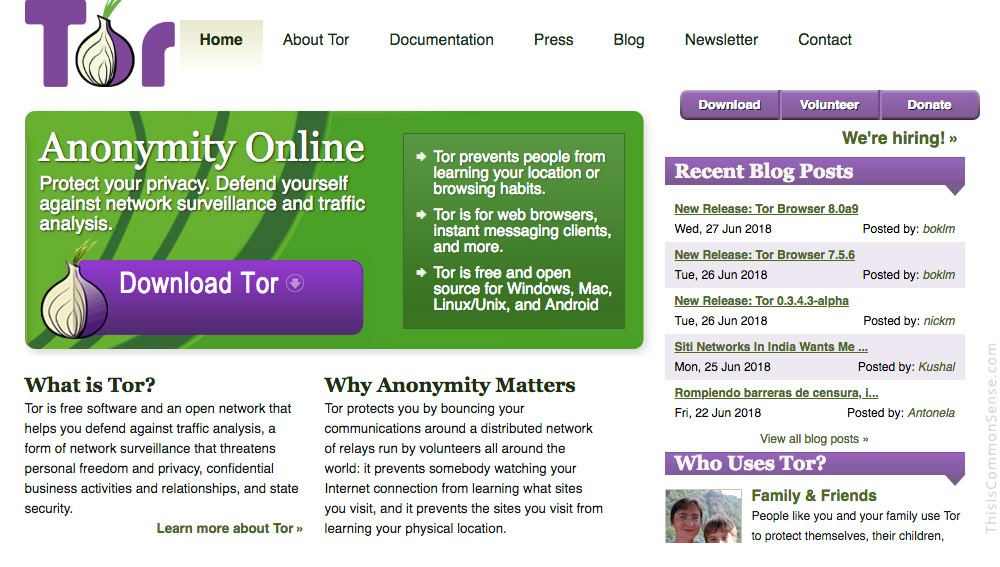
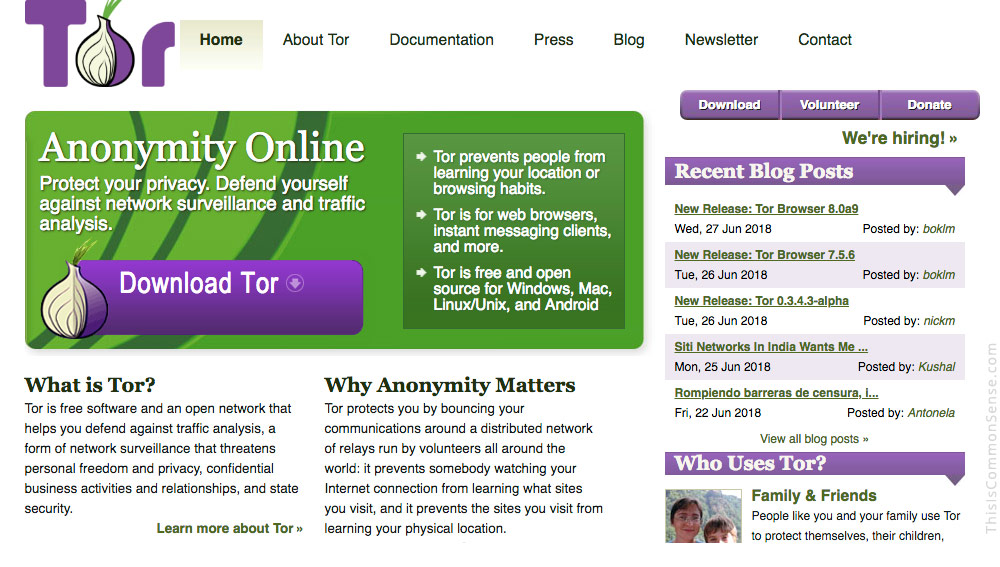
What provokes this observation is a newly amplified assault by the Venezuelan government on the rights of its citizens. The government is seeking to violate the right to peacefully read stuff on the Web by blocking Tor software, which allows users to elude government surveillance and reach banned websites.

Venezuelan dictators Chavez, now dead, and Maduro, still there, have never hesitated to stomp freedom in the name of a spurious greater good. Somebody like Maduro is certainly unscrupulous enough to go after Tor for thwarting censorship. So he fulfills that requirement. I doubt that he possesses very extensive programming ability.

Tor may not be perfect, but it’s pretty robust. You need substantial resources, such as those at the disposal of a government, to stop it. You also need to know what you’re doing. The coders on Venezuela’s stop-Tor team are probably smart enough to grasp the purpose of their work.

They and all other such collaborators should defect to the other side: that of programmers working to protect innocent people from government-sponsored cyber-assault.

This is Common Sense. I’m Paul Jacob.


PDF for printing


Categories
Accountability crime and punishment general freedom ideological culture media and media people moral hazard national politics & policies responsibility

Eighty-sixing Civility

Had Sara Huckabee Sanders been asked to leave the Washington, DC, Red Hen, rather than the restaurant of that name in Lexington, Virginia, things might’ve turned out a bit different. In the nation’s capitol, it is illegal to discriminate against customers for reasons of political affiliation.

Out in Lexington? Not so much. One can “86” a politico there with impunity, I guess.

A Yelp reviewer defended the restaurateur’s request not to serve President Trump’s Press Secretary. “Thank you for refusing to serve a person who lies to the American people for a living.”

Wait — I thought that is what all Press Secretaries do: present the official lie. Be that as it may, or not, objecting to one Administration and not another implicitly endorses the policies and lies of the Administration not censured. And the grounds given in this Red Hen cluckery — that the Trump Administration is racist, etc. — might possess a tad more plausibility had the Obama Administration not engaged in policies startlingly similar to the ones Trump and Sanders are blamed for.

The “right to refuse service to anyone” may be a right retained by the people, but since the Ninth Amendment is a dead letter, and the federal government, at least, does not recognize such rights when the refused parties fall into certain “protected groups,” talking about it at length is probably a waste of time.

While the anti-Trump side of the current political-cultural divide seems resolute in denying a right to refuse to bake specialty cakes for gay couples, refusing to serve standard meals to political enemies is apparently copacetic.

Which can only mean: that democratically elected and appointed government officials are not the right “protected group” — which is odd, isn’t it, when those doing the discriminating call themselves “Democrats”?

This is Common Sense. I’m Paul Jacob.


PDF for printing


Categories
Accountability crime and punishment education and schooling national politics & policies responsibility U.S. Constitution

Will Feds Foil Foolish Licensing?

It would be nice if the federal government used its often-abused authority over state and local governments to outlaw various forms of state and local oppression.

In his book Leviathan: The Growth of Local Government and the Erosion of Liberty, Clint Bolick argues that the federal government is not alone in hugely violating individual rights. Eminent domain, asset forfeiture, zoning, and occupational licensing are among the modes of sub-federal assault on the innocent. Even as policymakers in various regions of the land act to stop the worst of these abuses, they proceed unchecked elsewhere.

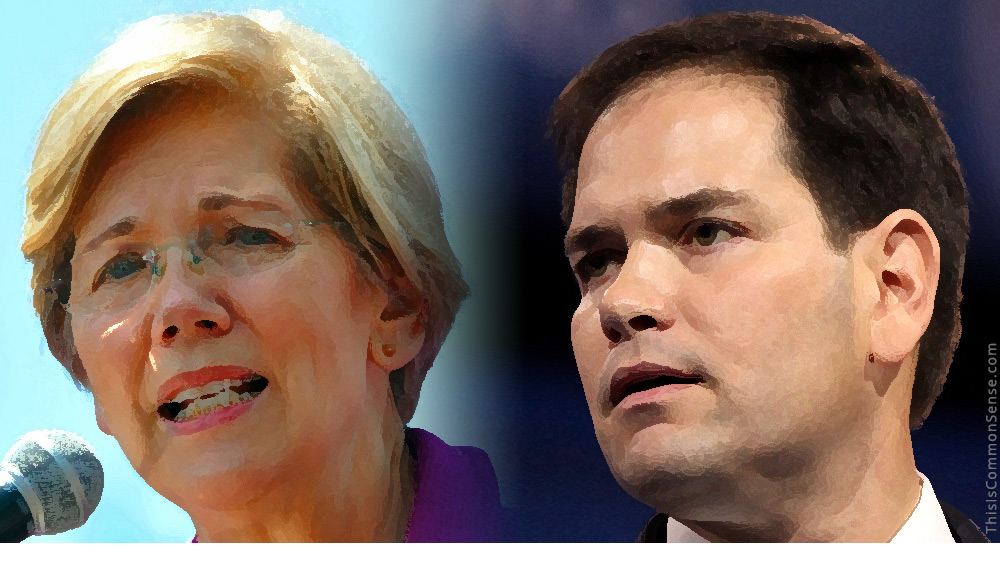
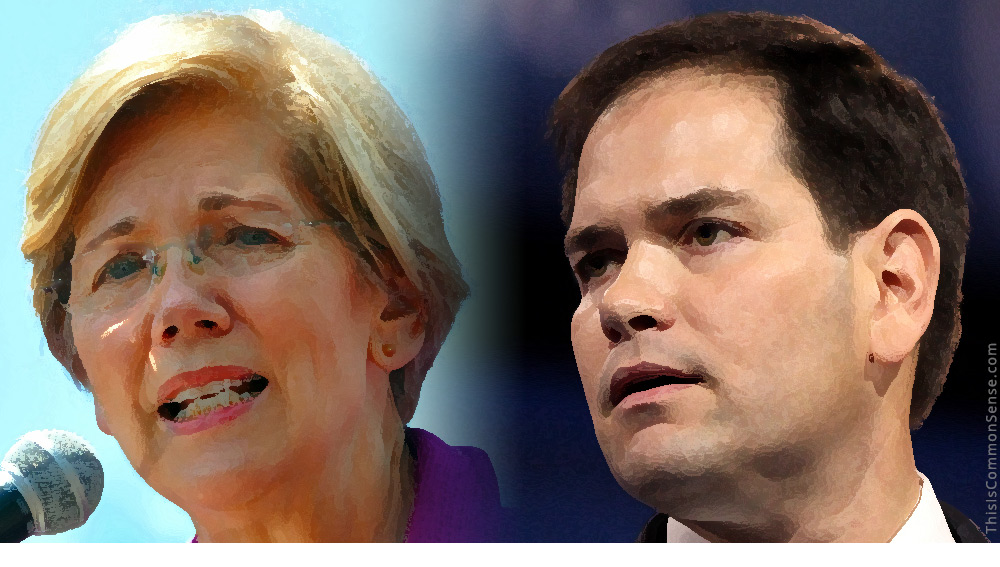
U.S. Senators Marco Rubio and Democrat Elizabeth Warren are the unlikely duo who may interrupt the now-common practice of depriving delinquent borrowers of student loans of their right to earn a living from certain trades. Rubio recently admitted on Twitter that as a Florida lawmaker, he once voted to allow the state “to suspend professional licenses of those who defaulted on student loans. I WAS WRONG. . . . How can they pay back if they can’t work?”

Yes, Rubio was wrong.

Senator Warren, for her part, agrees that the practice is “wrong and counterproductive.”

The bi-partisan duo’s bill would prohibit states from denying driver’s licenses and occupational licenses to borrowers who default on student loans.

I don’t think the legislation goes as far as it should, even in the delimited area of occupational licensing. The absurdities of occupational licensing go way beyond the scope of the proposed remedy.

But it’s a start.

This is Common Sense. I’m Paul Jacob.


PDF for printing


Photos by Gage Skidmore and Edward Kimmel


Categories
Accountability crime and punishment general freedom moral hazard nannyism privacy too much government U.S. Constitution

Social Workers: Stop Kidnapping Kids

Michael Chambers is living a nightmare.

His young daughter, Belle, has been taken away by social workers — without any reasonable cause or due process.

When Belle was two, her mother relinquished care to Belle’s grandmother. Then Michael accepted the responsibility. Periodically, his vindictive ex-wife would sic Child Protective Services on him. At first, the annoyance was as benign as such an intrusion could be. The social workers where he lived understood that there was a troublemaking ex-spouse in the picture.

But when Michael and Belle moved to a different Mississippi county, a new social worker, Kyra Reed, got involved. Reed seemed determined to intrude, make demands, and eventually remove Belle by force from Michael’s custody.

For example, Social Worker Reed early on demanded that Michael let her search his home. He was uncomfortable permitting it unless she obtained a warrant. Reed never did get one, or search the house — not even when accompanied by sheriffs. But somehow she didn’t need any legal authorization to steal Belle from Michael. Belle ended up in a foster home, where she was treated badly, before ultimately being forced to live with her mother, whom she hadn’t seen in four years.

The many ugly details of this case cannot be recounted briefly. Michael’s fight to get his daughter back is an expensive one. You can find out more about what happened and, if you like, contribute to Michael’s gofundme campaign to raise money for his legal expenses.

This is Common Sense. I’m Paul Jacob.


PDF for printing