Categories
Accountability crime and punishment government transparency moral hazard responsibility too much government

Half a Win Is Better than None

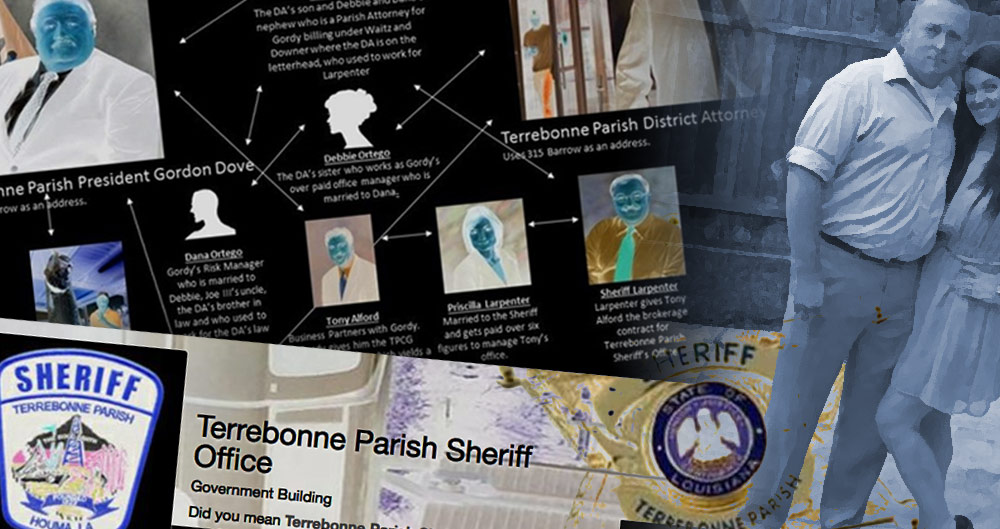
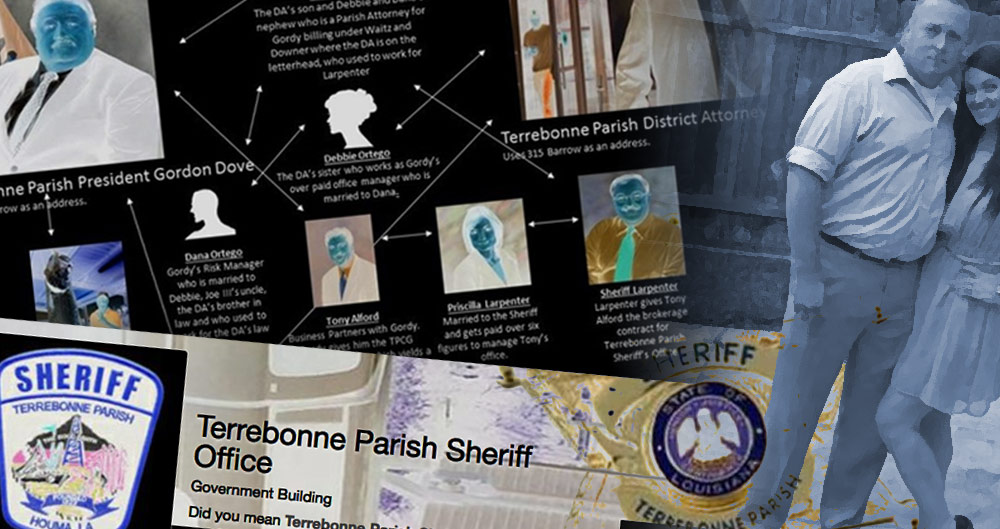
Jennifer Anderson criticized her local sheriff. Her family’s home was raided in 2016 by the sheriff as a result.

Terrebonne Parish Sheriff Jerry Larpenter’s reaction to criticism was ugly and unconscionable, but it hasn’t been allowed to stand. On the other hand, the sheriff hasn’t been adequately punished, either.

Jennifer Anderson’s pseudonymous blog ExposeDAT criticized various public figures in Terrebonne Parish, Louisiana, including with respect to the business relationships between Larpenter and others. Bridling at the criticism — which had to do with assessment of publicly available facts — the sheriff submitted warrants to Facebook and AT&T to track down the identity of the blogger. Then he sent men to raid the Andersons’ home and grab computers and cell phones.

The Andersons fought back, suing in federal court. They wanted the raid and seizure and search of their private stuff to be declared unconstitutional.

Finally, this September, the Andersons reached an undisclosed settlement with Larpenter out of court. According to its terms, the Andersons aren’t allowed to discuss it any detail. But their attorney says the settlement is “a victory for citizens’ right to be critical of their elected officials without fear of retribution.” U.S. District Court Judge Lance Africk has said that “Jennifer Anderson’s speech [in her blog] falls squarely within the four corners of the First Amendment.”

All that’s fine, but why hasn’t this sheriff also at least been kicked out of his job for his blatant abuse of power?

This is Common Sense. I’m Paul Jacob.

PDF for printing


Categories
Accountability ideological culture local leaders national politics & policies political challengers responsibility

Crazy Like a … Spoiler

Seven Republican members of Congress — three in the last two weeks — have announced their retirement.* The Democrats, needing 24 additional seats to gain a majority, see an opening.

Steve Kornacki, MSNBC’s national political correspondent, calls these seven “pure retirements.” That is, these politicians aren’t seeking another office, they suffer from no scandal, and are “pretty good at getting re-elected”; they’re “just deciding to leave.” Kornacki notes that the GOP had eight pure retirements in 2006 when they lost the House, and the Democrats had eleven when their majority was destroyed in 2010.

On his MSNBC program, The 11th Hour, an exasperated Brian Williams complained, “On top of all that, since down is up and up is down, Bannon [is] threatening to — to use the verb of the moment — primary incumbent Republicans! Which is crazy.”

Williams refers to Steve Bannon, late of the Trump administration and now back at the helm of Breitbart News. Bannon is now working, as CNN reported, with “conservative mega-donor Robert Mercer, who is prepared to pour millions of dollars into attacks on GOP incumbents.” Incumbent Republicans thwarting Trump, that is.

“I don’t think anyone should be surprised,” remarked Ned Ryun, American Majority’s CEO. “It’s a natural reaction by the base to what they’ve perceived as a perhaps intentional inability to pass any Trump agenda items.”**  

Ah, more spoilers! This week we’ve talked about Libertarian spoilers; now, pro-Trump spoilers. And, for years, non-profit groups such as the Club for Growth and U.S. Term Limits have helped a challenger against an incumbent, and been dubbed dangerous to Republican hegemony for their trouble.

Seems what connects all these anti-establishment folks is a commitment to principle over power.

This is Common Sense. I’m Paul Jacob.

 

*  The retiring Republicans are Rep. Sam Johnson (R, TX-3), Rep. Lynn Jenkins (R, KS-2), Rep. Ileana Ros-Lehtinen (R, FL-27), Rep. John Duncan Jr. (R, TN-2), Rep. Dave Reichert (R, WA-9), Rep. Charlie Dent (R, PA-15), and Rep. Dave Trott (R, MI-11).

** Steve Kornacki responded to Brian Williams: “Absolutely unheard of for a nominee in either party to have that complete lack of support from Capitol Hill and then go out there and win the nomination [for president]. . . . You have this element where all these members of Congress, even though it’s a president of their party on paper, don’t really feel they’re part of this presidency.”


PDF for printing


Categories
Accountability ballot access folly media and media people moral hazard national politics & policies political challengers term limits

If This Be Blackmail. . .

The Republican Party now boasts of more positions of power than . . . ever? And yet the GOP is in danger of falling apart.

The Democrats, now forced to endure Hillary Clinton’s new absurdity, What Happened, appear at wits’ end. They just do not “get it.”

Alas, “not getting it” is not limited to the major parties. The Libertarian Party (which is my subject this week) has been around since 1972 . . . doing the same things over and over . . . with spectacular lack of electoral success.*

Sure, the party has had no small subtle influence — perhaps most notably the change in marijuana policies. Yet it could have even more. Without electing anybody, as I argued yesterday.

But that’s just the tip of the Titanic-killer.

Not only could party organizers threaten the major parties with running — and taking away votes — based on their candidates’ positions, Libertarian organizers could also threaten to run against candidates who will not publicly take up the cause of electoral reform.

Particularly, ranked choice voting.

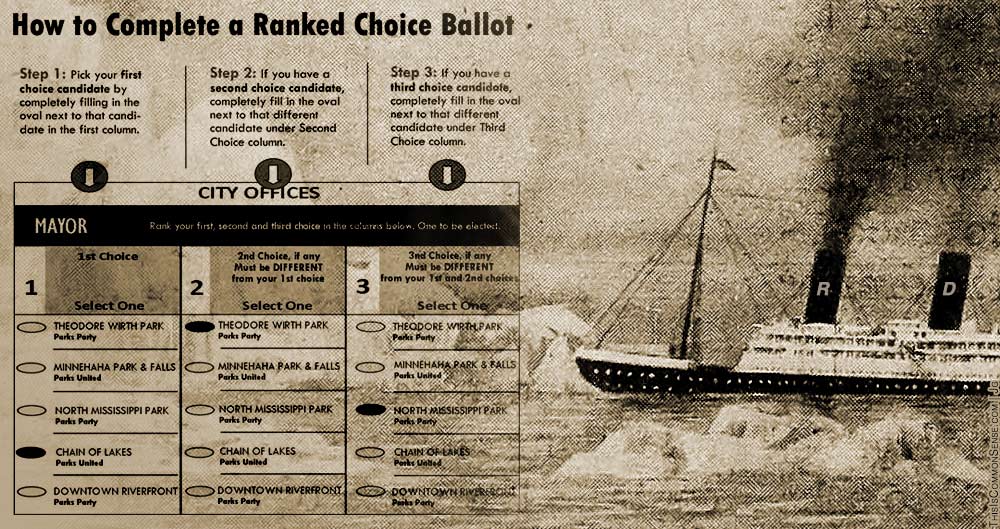
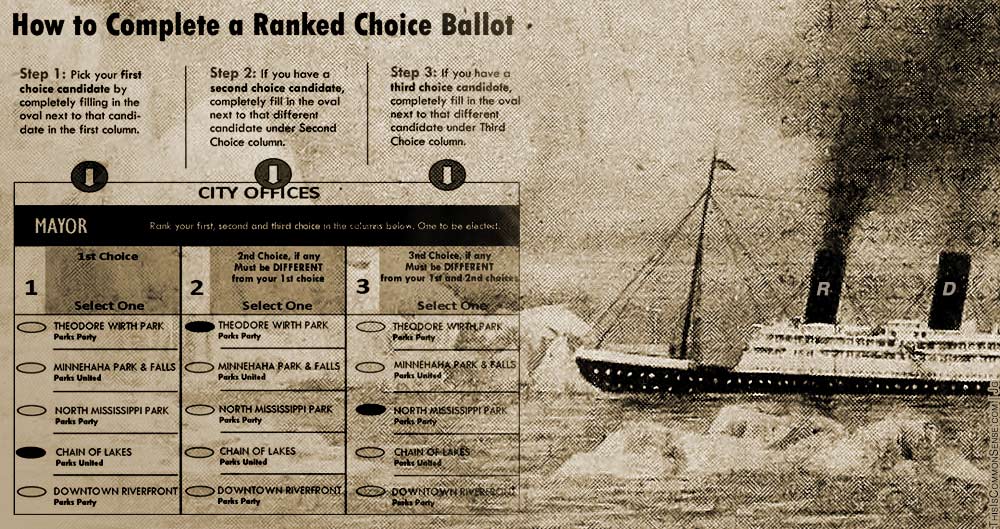
Because of our first-past-the-post elections, Libertarians tend to take away votes from those most similar to themselves. With ranked choice voting (see a sample ballot), a voter whose favorite is a Libertarian will have his second-favorite choice count** towards that candidate; minor party candidates would no longer work as spoilers.

And that would allow voters to embrace their real preferences, not pretend to like candidates they actually distrust.

Since major party candidates would, in most circumstances, be hurt less by those closest to them, they should be willing to be “blackmailed” on this.

Jumping into the briar patch of supporting fresh reform to stop the spoilers.

This is Common Sense. I’m Paul Jacob.

 

*  The 3 million odd votes for the Johnson/Weld presidential ticket, though a leap ahead from previous outings, was seen by many as a disappointment: that’s all the dynamic duo of former governors could do in a year with the unpopular duo of Trump and Clinton as R and D standard-bearers?

** That is, in cases where only a small percentage of the vote favors the Libertarian most.


PDF for printing


Categories
Accountability general freedom national politics & policies responsibility too much government

It Didn’t Last

“September 11 is one of our worst days but it brought out the best in us,” proclaimed Tennessee Senator Lamar Alexander.

Today is the 16th anniversary of that terrible day . . . arriving as Hurricane Irma smashes into Florida and with fresh memories of so many acts of kindness and heroism by first responders and minuteman citizen volunteers alike rescuing folks from the recent flooding in Houston caused by Hurricane Harvey.

“These acts of mass murder were intended to frighten our nation into chaos and retreat,” then-President George W. Bush told the American people that frightful evening. “But they have failed. Our country is strong. A great people has been moved to defend a great nation.”

He was correct about the people of this country. All kinds of folks stepped up in a myriad of ways to help.

But what about the government?

Well, the “public’s trust in government,” according to Pew Research, “which was mired in the 30% range through much of the past decade, doubled in the wake of the attacks.”

That uptick wasn’t to last. Public disgust with the federal government reverted to form. By 2015, reports Pew, “Only 19% of Americans today say they can trust the government in Washington to do what is right ‘just about always’ (3%) or ‘most of the time’ (16%).”

What happened?

Well, have you met the Washington politicians?

And can our country really be “strong,” as Mr. Bush declared, if government cannot earn the trust of even one of every five Americans?

This is Common Sense. I’m Paul Jacob.

PDF for printing


Categories
Accountability general freedom government transparency media and media people nannyism national politics & policies responsibility too much government

Ad Budget Slashed

Republican politicians, who had been running since 2010 on killing ObamaCare, did not. Not when they had a chance. Despite dominating Congress, they failed, because

  1. they opted for a goofy way to do it (the House’s AHCA plan being a terrible mess, probably worse than the monster it was trying to replace) and
  2. partly because the libertarians — along with a few “liberal” Republicans — blocked it in the Senate.

But that’s the olds; here’s the news: the Trump Administration has cut back ObamaCare’s advertising budget.

Progress?

I’m not sure. Maybe. Probably not.

The facts: ObamaCare outreach has been cut by 90 percent, and outsourcing grants to groups engaging in sign-up efforts have been cut by 40 percent:

The Trump administration downplayed the impact of boosted ad spending, noting that during 2017 open enrollment there was a decline of 5 percent in overall sign-ups. It also saw a 42 percent decline in first-time enrollment and enrollment of people who pay their premiums decline by 500,000 people.

So, it seems natural to respond to a perceived decline in “demand” with a reduction in “supply” — or any attempt to drum up more “customers” for subsidized policies.

Also natural is the partisan fall-out, with Democrats crying “foul” over the decided lack of support for their program. As Peter Suderman noted over at Reason, ObamaCare became partisan because it started out partisan.

But it was always — from conception in the Heritage Foundation braintrust* to its current choking gasps — an unworkable monstrosity.

And folks of all parties — and none — should be able to understand that.

This is Common Sense. I’m Paul Jacob.
 

* Note: the Heritage folks not unreasonably distance themselves from their past association with some of ObamaCare’s core notions, and others are skeptical of the distancing.


PDF for printing


Categories
Accountability free trade & free markets general freedom national politics & policies property rights Regulating Protest

Union Dues, Don’ts

You may soon be able to shred your union card — if you are careful.

By “you” I mean You, the reluctant union member.

If you’re not one, though, perhaps you know somebody who is, someone who’d be happy to learn that the Supreme Court is on the verge of dealing a huge setback to coercive unionism.

John Hinderaker explains at Power Line. The Supreme Court is expected to soon decide a major case in a way that “bar[s] public employees from being forced into unions, or from being required to support unions via the fiction of ‘fair share contributions.’ ” (Much of that money goes straight to Democratic Party coffers.) With Neil Gorsuch now on the bench, a 4-4 holding pattern is expected to become a 5-4 decision in favor of plaintiffs suing for freedom from mandatory union membership.

Sounds good.

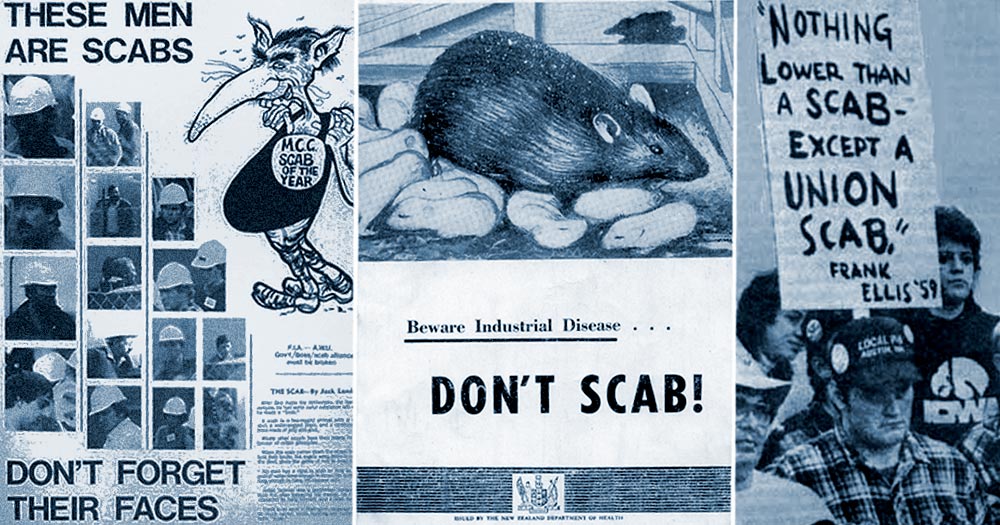
Problem is, though, that union officials are working to trick members into paying dues in perpetuity. For example, Education Minnesota is trying to con its 86,000 teachers into signing “Membership Renewal” forms assenting to automatic renewal of fees – unless the signatory makes a special effort to opt out.

The union hopes members will sign the cards and forget about them, continuing to fund the unions, and Democratic politics, indefinitely — even if the high court rescues everyone from mandatory membership.

So, if you happen to be trapped in a union at the moment — watch what you sign. And watch the news.

This is Common Sense. I’m Paul Jacob.


PDF for printing


Categories
Accountability crime and punishment folly general freedom ideological culture local leaders media and media people moral hazard national politics & policies political challengers property rights Regulating Protest responsibility

Alt-Comparisons

“There is no comparison,” concluded Washington Post columnist Margaret Sullivan, after spending her entire column doing just that, i.e. comparing Antifa, the so-called “alt-left,” with Nazis and white supremacists, the so-called “alt-right.” 

When Trump spoke about Charlottesville violence on both sides, Sullivan argued, “He was comparing things that aren’t the least bit equal, neither in scale nor in intent.”

Sullivan trumpeted statistics compiled by the Anti-Defamation League. The U.S. had 372 politically motivated murders between 2007 and 2016, with 74 percent committed by right-wing extremists and only 2 percent by left-wing extremists.*

Yet, those perpetrating 2 percent of such slayings can legitimately be compared to those perpetrating 74 percent — and also likened to thugs who beat down opponents in the street (thankfully without murdering them).  

All of the above use violence to achieve political goals.** Some are more deadly than others, but the violent actions of all should be condemned. 

Sullivan acknowledged that “it’s safe to say that most news consumers, if they know anything about antifa, know what the president has told them, and what they’ve gleaned from the club-wielding protesters shown endlessly on TV . . .”

Are citizens not supposed to take note of the violence in living color right before their eyes?

And why are folks uninformed? Could the mainstream media’s failure adequately to cover, say, previous Antifa rioting at Berkeley and elsewhere have something to do with it?

Lastly, Sullivan called on the media “to resist conflating [Antifa] with liberal groups.” Agreed. And let’s have the same fairness in not conflating Nazis and the KKK with conservatives.   

This is Common Sense. I’m Paul Jacob. 

 

*  By the process of elimination, “moderate extremists” are apparently committing close to a quarter of all political killings.

** I’ve not drilled down into these stats, or figured out what, precisely, qualifies as “political.”


PDF for printing


Categories
Accountability general freedom initiative, referendum, and recall local leaders political challengers Regulating Protest too much government

Know Your BS

“Help me get my B.S. in the voters pamphlet,” read the subject-line of Tim Eyman’s email

Eyman is a practitioner of the art of the voter initiative, foremost in his state, Washington, and one of the most effective nationwide.*

This particular call to action concerns the voter pamphlet statements about a tax increase placed on Washington State’s November ballot by the mayor and city council in Tim’s hometown of Mukilteo.

“In the pro statement,” Eyman explained, “they wrote that the need for the tax increase was ‘indisputable.’” Which his rebuttal countered with: “Politicians always say the need for higher taxes is ‘indisputable.’ We call B.S. on that.”

It is rather to the point.

But soon he received word from the city that, “The Auditor feels the language is inappropriate and would like you to choose different wording.” Rather than “We call B.S. on that,” it was suggested that he might use: “We call foul.”

Eyman objected. He pointed out that B.S. is used ubiquitously; he sent the city examples.

“I called the ACLU,” his email noted, and “they thought it was B.S. for the government to say you can’t say B.S.”

Eyman’s own attorney, Stephen Pidgeon, sent the city a detailed letter pointing out that this is exactly the speech protected under the First Amendment.**

The City of Mukilteo has yet to announce a final decision. Tim Eyman invites all of us to send an email to encourage the city to Let Eyman Keep his B.S. in the Voters Pamphlet.

This is Common Sense. I’m Paul Jacob.

 

* He was once even dubbed “America’s No. 1 freedom fighter” — by me.

** Pidgeon also offered, “While the pious may construe the inference of these two alphabetic avatars as meaning something crude, my client may very well have been referencing an ancient Latin phrase ‘Bubulum Stercus’ which no average voter would ever find inappropriate.”


PDF for printing


Categories
Accountability folly free trade & free markets general freedom ideological culture media and media people nannyism national politics & policies too much government

Political Regroupings

What’s true for hurricanes is true for the Democratic Party.

After a disaster, it takes a while to regroup, really get a handle on what went wrong. Men and women take some time to absorb new realities.

A few interesting think pieces have come out of the left and center-left, recently, trying to digest what is wrong with the Democrats that they lost so much ground last year — even to someone like Donald Trump. To serious people, the “Russians did it” and “the Deplorables!” are not exactly winners.

Hillary Clinton may be stuck in that mode, but the Democratic Party needn’t be.

The more radical response came from John B. Judis, whose name was big in lefty magazines when I was young. His article “The Socialism America Needs Now,” in his old stomping grounds, The New Republic, tried to make the case for a vague leftism that could be called socialism, if you stretch the term, emphasizing bigger government without seeming too . . . Marxist.

Meanwhile, Mark Lilla has a new book of a somewhat more perceptive nature. Interviewed in Salon, Lilla makes much of the fact that while “smack in the middle” of the GOP’s website “is a list of 11 principles” . . . the Democratic Party could sport “no such statement.” Just a bunch of interest groups.

Interesting. Because, today, I went to GOP.com and saw no such principles list. But I did find a lot of Trump stuff . . . and a bunch of links to “identity groups.”

Talk about regrouping!

This is Common Sense. I’m Paul Jacob.


PDF for printing


Categories
Accountability ideological culture local leaders media and media people moral hazard nannyism national politics & policies

The Eye of the Storm

Hurricane Harvey has been amazing in its devastation. All that rain, all that flooding — what  a frightening time it must be for those caught within it.

While Harvey’s winds brought in waves and rain and floods, for most of us, far away and snug in our homes, it brought an occasion to donate, and . . . nostalgia.

Nostalgia? It’s not the disaster element so much as an old-time exhibition . . . of journalism. For more than just a few hours, we watched reporters actually report. We saw them stand waist-deep in water. We saw them cover actual events.

And we read them deal in facts . . . like the heroic efforts of the “Cajun Navy.”

Of course, this opinion-free window of media coverage did not last long. The talking heads and Twitter-journos and partisan hacks came flooding back not long after the worst.

Did Trump do enough? Or the right thing?

Did Houston’s no-zoning policy lead to the disaster?

Doesn’t “price gouging” really suck?

Did . . . Enough. It was and is too early for finger-pointing and “Brownie, you’re doing a heckuva job.”

Of course, the Houston zoning discussion is interesting. It is worth noting that there are building rules and governments in Houston, as well a national rules that made homes and businesses there less safe. And economists have already come to their usual defenses of “price gouging” and criticisms of disastrous government programs.

Still, the enormous relief efforts remain the biggest human interest story — thousands of individuals taking the initiative and their boats to join first responders and the National Guard in rescuing thousands trapped by flooding.

So, before we explain it all, let’s luxuriate in what remains of the fact-based reporting.

And help.

This is Common Sense. I’m Paul Jacob.

PDF for printing