
Categories
tax policy too much government

For a Thousand Years

Time for a gas-tax holiday. 

When the people lie prostrate, when the people groan under heavy burdens, when the people just can’t take it anymore — and when an election is coming up — that is the time for politicians to relieve everyone’s burden.

A bit.

Treasury Secretary Janet Yellen favors considering a temporary gas-tax holiday to emulate some of the states. Reviving the Keystone oil pipeline — no, not something to consider, she says. But she’s okay with a brief gas-tax break.

Let’s do better.

I propose a millennium-long gas-tax holiday, government-barriers-to-drilling holiday, regulation-of-all-industries holiday. Under my plan, government gets all the way out of the way of all markets so we can all be as prosperous as possible, whether or not a big economic crisis is underway.

But would there be any such crises — long-term and intractable economy-wide crises, I mean — if my plan were enacted?

When government does everything possible to injure the economy and prevent recovery, it takes a long time for markets to bounce back from shocks. If ever.

Un-fetter the markets, though, and economic actors would be able more rapidly to adjust to major jolts. If gas imported from overseas plummets, producers could then quickly adapt by expanding production. They cannot readily do so now because government imposes so many barriers.

The politicians’ preference for modest, namby-pamby reprieves are not only substantially weak, they send the wrong signals. They get doled out as if government were doing us a special favor . . . by not beating us up so badly for a very little while.

We need freedom. On an ongoing basis.

This is Common Sense. I’m Paul Jacob.


PDF for printing

See all recent commentary
(simplified and organized)
See recent popular posts
Categories
free trade & free markets too much government

Do More Than Baby Steps

Major disruptions such as pandemic policy in China and the Russian invasion of Ukraine obviously crimp trade and supply chains. But given such impacts, should governments here in the United States be making things better or making things worse?

Oil is one example of a good that would be more abundant and cheaper had the government left it alone — stopped blocking domestic production and the flow of oil from Canada.

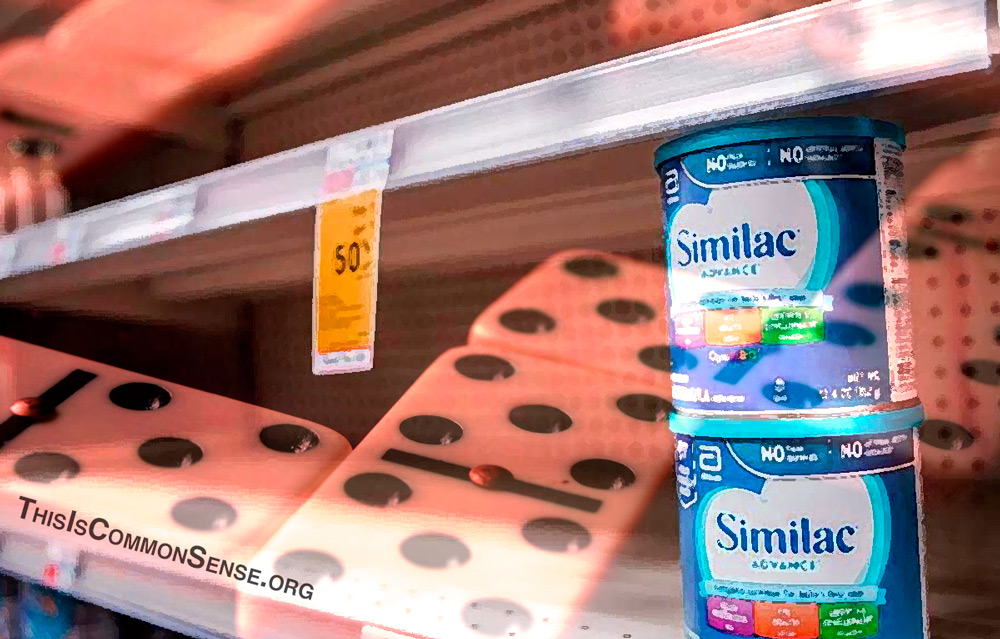
Now parents are having trouble getting baby food.

A proximate cause of the shortage is the closure of a single major factory producing baby formula. But Kevin Ketels, a professor who studies the global supply chain, argues that restrictions on production had set things up so that a blow like this would be crippling.

For one thing, only a few companies, Abbott, Reckitt, and Nestlé, are allowed to participate in a government program to provide baby formula to low-income families. This is not a minor program. The federal government provides substantial grants to the states to fund it.

More importantly, only a few manufacturing facilities are allowed to produce baby formula, and “startups don’t have the volume required to produce in these facilities.”

High tariffs on baby-food imports have also reduced supply.

You would think, then, that the first thing to do would be to remove governmental barriers to production and imports.

And all, not just some.

So why isn’t that what we are hearing about now?

Well, politicians do not gain their power, prestige, and insider trading advantages by leaving well enough alone. Admitting that their stock in trade — regulation and tariffs and the like — is the cause of this problem might suggest to distracted minds that it is the cause of most, if not all, our problems.

This is Common Sense. I’m Paul Jacob.


PDF for printing

See all recent commentary
(simplified and organized)
See recent popular posts
Categories
international affairs too much government

Rebellion in Shanghai

For months now, Ratta, a Shanghai-based firm that makes an e-ink writing tablet called the Supernote, has been blocked from shipping its products as usual. Ratta’s shipping warehouse has been locked down to combat the COVID-19 pandemic.

Finally, when the lockdown proved endless, the company was able to move much of its shipping operations in-house and begin fulfilling long-delayed orders.

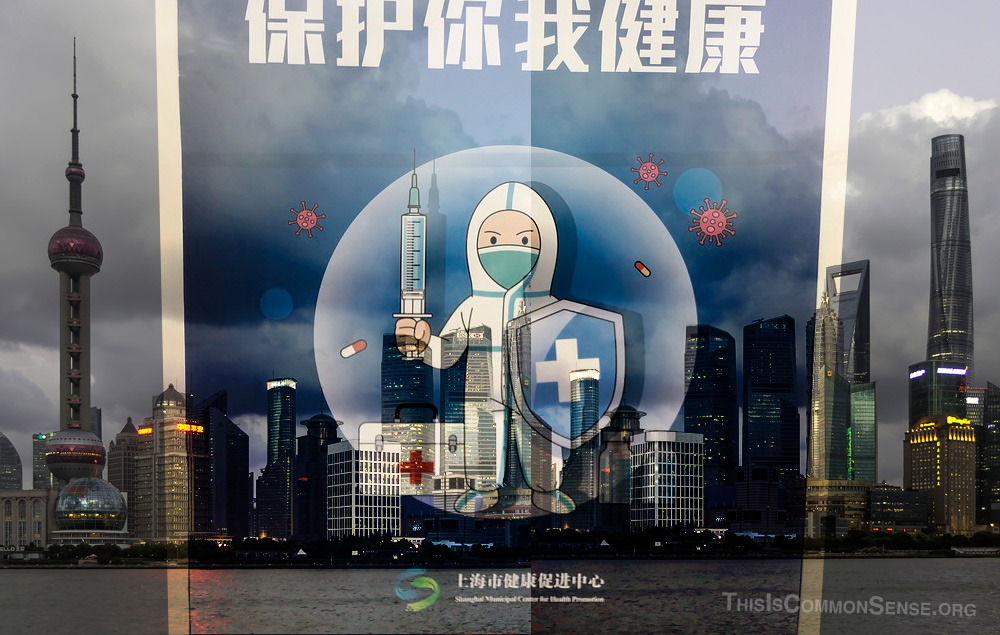
In Shanghai, life has become almost impossibly difficult. The city’s 26 million residents must resort to sometimes desperate measures to even eat.

Employees permitted to work at a company office are often prohibited from leaving that office. The government fences off apartment buildings when any residents test positive for COVID-19. Similar tyrannical measures are imposed in other Chinese cities.

It’s a classic non-cure-worse-than-disease scenario. The mild but super-infectious omicron version of COVID-19 has eluded all totalitarian expedients. Nevertheless, people are being killed to save them.

Shanghai residents have started to rebel, banging pots and pans from their balconies, pulling down the makeshift barbed-wire fences designed to confine them, taking to the streets to protest, producing songs and videos that go viral despite what National Review calls “the CCP’s watertight censorship.”

Singing China’s national anthem, now being censored, has also become an act of rebellion. It has a line about refusing to be slaves.

Can the protests succeed?

No government, no matter how powerful, is omnipotent. Ultimately, its ability to impose its will depends on the resistance of the people.

This is Common Sense. I’m Paul Jacob.


PDF for printing

See all recent commentary
(simplified and organized)
See recent popular posts

Categories
general freedom international affairs too much government

The Population Implosion

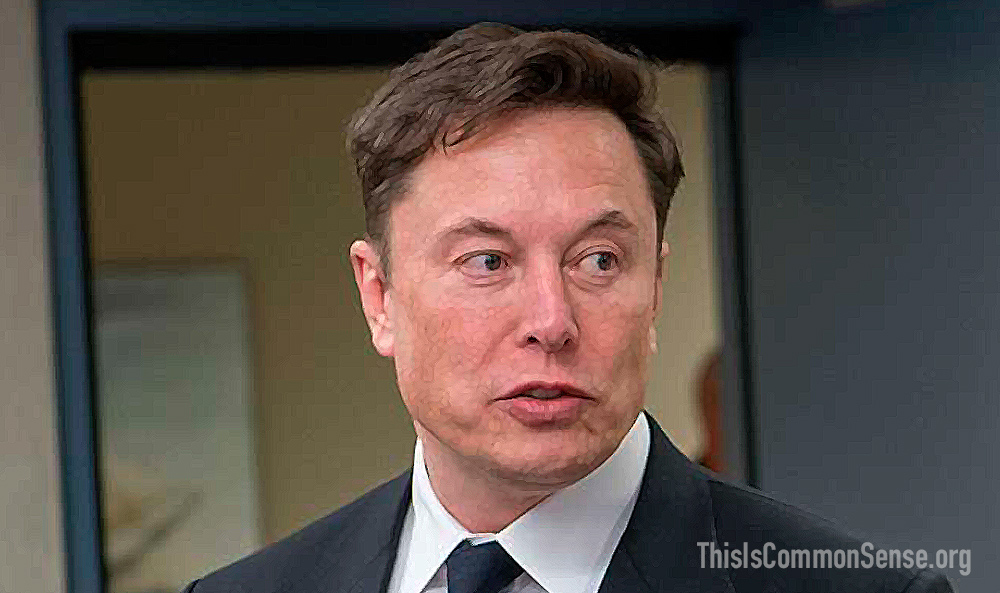
At the risk of turning Common Sense with Paul Jacob into Common Sense About Elon Musk, consider the second best thing about Musk’s Twitter preoccupation: his own tweets.

“At risk of stating the obvious, unless something changes to cause the birth rate to exceed the death rate, Japan will eventually cease to exist,” Musk posted on Saturday. “This would be a great loss for the world.”

A very significant observation, at odds with so much of the Official Narrative of Approved Subjects and Opinions.

Recognizing that depopulation is the big problem for the developed nations of the world, not over-population rubs up against most of what we’ve been told for years.

But it’s true.

Japan is not alone, here, in showing a demographic collapse. It’s merely the most advanced in population decline. Russia is in a bad way, and many European countries’ native populations are in zero population growth. The United States, too, is growing only because of immigration, legal and illegal.

Behind the numbers, though, is a disturbing reality: the instability of our welfare state policies. In America, and in most advanced nations, government-run social pension programs require a growing population to properly service. Yet, Social Security, by removing the need to have children as a natural safety net (where we beget offspring to help take care of us in old age), actually disincentivizes the population growth that might make the system sustainable.

 Elon Musk did not offer a fix. But by pointing to a very real problem, he’s done us a great service, speaking simple truth instead of propaganda.

This is Common Sense. I’m Paul Jacob.


PDF for printing

See all recent commentary
(simplified and organized)
See recent popular posts
Categories
general freedom too much government

Worse Than Shanghaied

Two years into the pandemic, we in America are now mostly arguing about masks.

We’ve suffered pretty repressive measures, here. But we haven’t had to cope with:

● Being literally imprisoned in your home. Stopped from going out even to get food.

● Having fences erected around your home. “What if a fire breaks out?” one Shanghai resident asked a reporter. “I don’t think anyone in their right mind can seal person’s homes.” (Well, fire is not a virus.)

● Being ejected from your home and forced into public barracks for people infected with COVID-19.

● Being ejected from your home so that it can be disinfected.

● Being subjected to a “zero COVID-19” policy, zero common sense.

This is the fate of millions in Shanghai and elsewhere in China.

In the U.S., maybe you were harassed for conducting unmasked church services or keeping your shop open. Maybe you got arrested for paddle boarding, alone, in the Pacific Ocean.

It got pretty bad. But what we are seeing in Shanghai is the reality of a totalitarian regime when it chooses to fully exercise its power to repress. At any moment, the Chinazi state may make it impossible for millions to take the simplest steps to survive.

Shanghai residents may not even complain about their fate. To the extent they have voiced any complaints publicly, the Chinese government has struggled to eliminate all traces of the complaints.

Here, at least, we can gripe. 

But what does a people do when not allowed to protest or argue against their oppressors?

They scream. At night, the people of Shanghai yell out their windows.

Think of it as the soundtrack of mass misery.

This is Common Sense. I’m Paul Jacob.


PDF for printing

See all recent commentary
(simplified and organized)
See recent popular posts
Categories
crime and punishment First Amendment rights too much government

Four of Five Doctors Disagree

“Thank goodness I don’t live in X,” we may say as we follow the news.

Billions live in Russia, Ukraine, China, Xinjiang, Tibet, Hong Kong, Cuba, New York, Chicago, Seattle, California, Canada, and other statist hellholes. The rest of us live elsewhere. Perhaps we congratulate ourselves on our wise choices of birth location and/or subsequent residencies.

But people are copycats.

As producers, we are often inspired by great achievements and seek to emulate them. The destroyers among us, somewhat similarly, are eager to adopt the latest in fashionable assault on what the producers are doing.

So we don’t necessarily escape if, say, California prohibits physicians from discussing things medical whenever their judgment conflicts with state-approved doctrine. Because next thing you know, lawmakers in Tennessee or Virginia will be saying, “Gee, that’s right, gag the doctors. Why didn’t I think of that?”

Legislative masterminds in California now want to harass doctors who recommend a non-government-approved treatment for COVID-19. If AB 2098 is passed, it would authorize California medical boards to discipline doctors for “dissemination of misinformation” related to COVID-19.

The bill implies that no doctor can legitimately disagree with another about a particular case. (Yeah? See the history of medicine.)

When I say that this legislation assaults truth and truth-seeking — which requires freedom of speech as a necessary corollary of freedom of thought in medicine or in any field — I speak for Californian doctors and California patients.

I speak also for us all.

This is Common Sense. I’m Paul Jacob.


PDF for printing

The Witch Trial of George Jacobs by Thompkins. H. Matteson

See all recent commentary
(simplified and organized)
See recent popular posts
Categories
general freedom government transparency too much government

The Allure of the Mask

Early on in the pandemic, I promoted mask-wearing as something we could do to protect ourselves, loved ones, and our communities.

But as the pandemic progressed, we learned some things.

Over time, I became more skeptical of much good coming from mask-wearing.

Now that the panic portion of the pandemic is mostly over — and what a long panic it was! — we should be able to more calmly review.

Two months ago, Vinay Prasad, an actual epidemiologist, looked carefully at the CDC’s study allegedly showing a high medical efficacy in universal mask-wearing during a major contagion. The study, he argued, was plagued with “very poor quality data, insufficient to support community masking, particularly for years on end. Cloth masks had especially bad data. Data to support masking kids was absolutely absent.” And the CDC’s own reporting of what its study actually found was unreliable and . . . well, dishonest.

Take the case of Dr. Anthony Fauci. “Pre-pandemic, community masking was discouraged because the pre-existing evidence was negative,” explained Prasad. “This is why Fauci was critical of it in early March 2020 on 60 minutes.” 

But many of us were perhaps unduly pro-mask because Fauci appeared to be protecting the supply of masks used by medical professionals, thus, lying for a strategic reason. It was hard not to learn a . . . dubious . . . lesson: Fauci lied to protect professional mask use, so masks for the masses likely worked well.

Then he changed tune. And went off the deep end, ignoring his previous statements and advocating double- and triple-masking!

Still, the most ominous issue about mask mandates is how it became “a marker of politics. Good liberals wear them and bad conservatives don’t.”

Prasad does not go where Matthias Desmet and others have: showing how mask mandates became a means to induce panic and the politicization of medicine.

Voluntary masking without mandates — as has been commonly the case in Japan, for example — provides important signals about infection rates, and allows people to negotiate their own physical distancing. Universal mask mandates spoil the informative aspect and instead serve tyrants and mass hysteria.

This is Common Sense. I’m Paul Jacob.


PDF for printing

See all recent commentary
(simplified and organized)
See recent popular posts
Categories
porkbarrel politics subsidy too much government

Up-to-Date in Kansas City?

Eight-hundred million bucks. 

That’s the investment that “Meta” — the umbrella outfit that owns Facebook, Instagram and WhatsApp — has agreed to invest in a patch of land in Kansas City’s Northland. The plan is to build a data center at an 882-acred development site. 

“Political leaders who gathered at Union Station heralded the news as a major development for Kansas City and the state.” This private investment “would far surpass the scale of recent projects in the region . . . said Missouri Gov. Mike Parson,” The Kansas City Star relates.

But there’s more.

“Meta spokeswoman Melanie Roe said the company could invest as much as $40 billion at the site in land acquisition, construction, and development of a larger data center.” This is to be a “long term partnership.”

Make that a Big Business/Big Government partnership. The biggest ever, perhaps.

The Kansas City Council had unanimously approved a development plan for the site last April, with data centers there enabled to access to more than $8 billion in local tax incentives. “Incentive watchdog group Good Jobs First says such an incentive award would be the largest ever in American history,” The Kansas City Star explains.

Take it as a word of caution. This is not laissez faire capitalism. This is not “the free market.” It is favoritism. It unites big business and big government.

And even as an investment in future taxes — which is the ostensible justification for the subsidies — the data complex is slated to employ about a hundred workers.

Politicians don’t make the best investors. But they do make easy marks for big corporations.

This is Common Sense. I’m Paul Jacob.


PDF for printing

See all recent commentary
(simplified and organized)
See recent popular posts

Categories
free trade & free markets too much government

Production, It’s a Gas

Is this a news story?

“Electric-car baron Elon Musk calls for increasing U.S. oil and gas [production] to combat Russia.”

It’s news because of Russia’s invasion of Ukraine (and because gas has gotten awfully expensive) and because Musk is a major industrial figure. But a businessman calling for deregulation of an industry — is that also headline-worthy stuff?

Unfortunately, yes, given how businessmen so often want liberty for themselves along with ever-expanding restrictions for competitors (or the same restrictions for everyone as long as competitors end up getting hurt more).

I want a world in which we can make no sense of the word “but” in this opening paragraph:

“Tesla may be the world’s leading seller of plug-in electric vehicles, but CEO Elon Musk wants the U.S. oil-and-gas industry to ramp up production.” 

“But”?

Musk’s statement-by-tweet doesn’t help: “Hate to say it, but we need to increase oil & gas output immediately. Extraordinary times demand extraordinary measures.”

These words are not super-clear about what Elon Musk believes the government’s attitude should be toward markets during non-extraordinary times. War or no war, government policies safeguarding markets should not be resorted to only as emergency measures. No matter how much some may welcome sustained efforts to hobble an industry.

It’s rare that our businessmen clearly enunciate the principles of free enterprise that they are thought themselves to practice. We’re lucky if we get a tendency in that direction. 

I guess that’s better, at least, than a fervent statism that seeks to wipe out all economic freedom all the time.

This is Common Sense. I’m Paul Jacob.


PDF for printing

See all recent commentary
(simplified and organized)
See recent popular posts

Categories
deficits and debt free trade & free markets national politics & policies too much government

Inflation Evasion…Depression

Going into the lockdowns and bailouts, a consensus of politicians and their court wizards, the economists, had belittled the specter of inflation.

Nowadays, when folks use the term “inflation,” they really mean upward movement on the consumer price index (CPI). Some economists, who have a sense of history,* reserve the word not for price level increases, but for increases in the supply of money. And the two concepts are tightly linked. 

But a whole lot of people seek to blame CPI rate increases on anything but monetary policy, as Veronique de Rugy notes in an article at The American Spectator.

“Theories for why we shouldn’t worry abounded,” de Rugy writes. “It was caused by a base-effect price increase, supply-chain restraints, a drought in Taiwan — everything but the Fed’s expansionary policies and Congress’ overspending, in part because some of these experts had cheered for these actions all along.”

And then inflation came back.

Big time.

While expressing some humility and an unwillingness to make predictions, de Rugy insists that “the amount of money printed, borrowed, and spent during the last few years led to a one-time price level rise, and we may have a way to go until we are done.” 

She also insists that the Pollyanna phrase “transitory inflation” is no comfort: “inflation was always going to be transitory. Even the inflation of the 1970s ended in the ’80s. What mattered is whether transitory inflation meant a few weeks, months, or years.”

And, I cautiously add, how de-stabilizing it is. Consumers rightly worry about rising prices, but inflation doesn’t hit all sectors the same. Credit expansion leads to imbalances that are hard to correct. 

And the correction is “depression.”

This is Common Sense. I’m Paul Jacob.


* Including the history of their own discipline. Readers of Austrian economists such asF.A. Hayek get a better sense of past debates than from other economists.

PDF for printing