Sen. Rand Paul (R-Ky.) gets grilled by the Face the Nation grillmistress. Her continued pushing of one point is interesting to behold. Jake Tapper’s grilling of the senator, on CNN, is even more egregious, perhaps. You decide.
Our mind . . . functions on a dualistic model of perceiving and organizing the world into mutually-exclusive categories. We organize our experiences, through both formal and informal methods of learning, around “either-or” concepts. Something is either “A” or “non-A,” “animal” or “vegetable,” “hot” or “cold,” a process that unavoidably leads us to see the world as a series of divisions. That the rest of the universe functions in an indivisible manner, without any apparent awareness of the partitions into which our minds have organized it, is a further limitation on our capacities for understanding.
When I wrote about the Donald’s change of troop positions abroad last week, it was less than completely clear that the US President aimed to withdraw troops from Afghanistan as well as Syria. But multiplereports on the day I posted “Strategic Disengagement” make it clearer: about half of America’s 14,000 troops stationed there are scheduled to exit.
Why not all?
Well, you can see how entrenched foreign intervention is for American leaders. While most of the GOP policy establishment howled at Donald Trump’s betrayal of the cause (whatever that cause is, exactly), so, too, did many of the Democrats. And they seem awfully earnest. More earnest than one has reason to expect from the objectors to “George W. Bush’s wars.”
Even Noam Chomsky came out saying that the U.S. should stay in Syria to save the Kurds, and Howard Dean tweeted that American troops must remain in Afghanistan for the sake of women’s rights.
What we are witnessing are eternal programs that do not ever — and cannot ever — fulfill their basic purpose. No amount of occupation of Syria or Afghanistan or Iraq is going to give us what the neoconservatives promised: freedom and democracy and jubilation in the streets.
Freedom and democracy do not work that way.
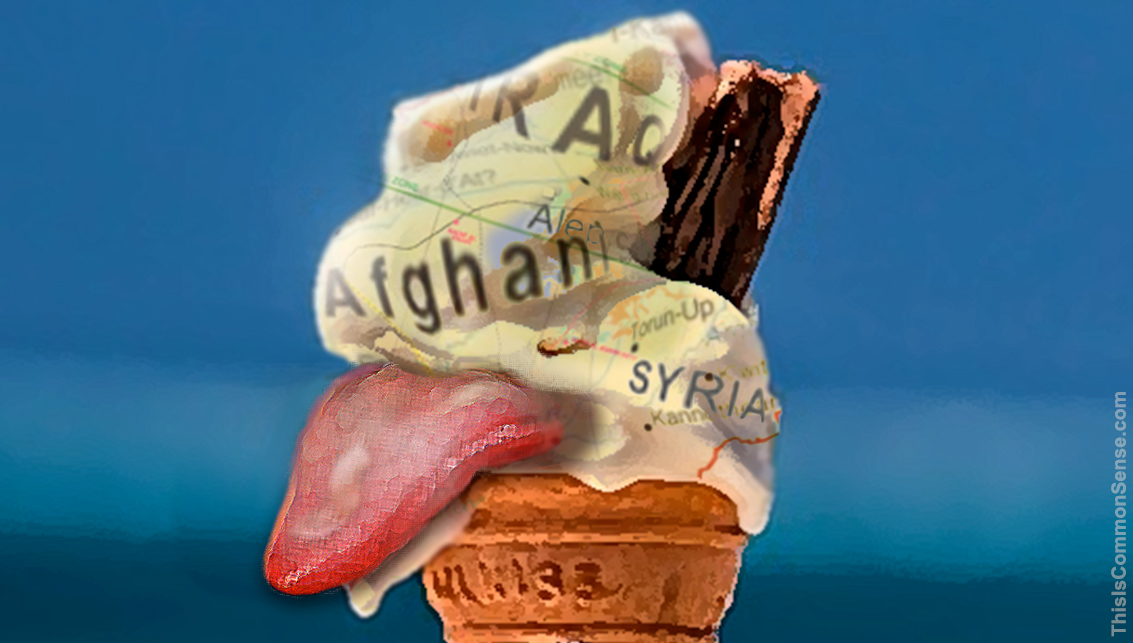
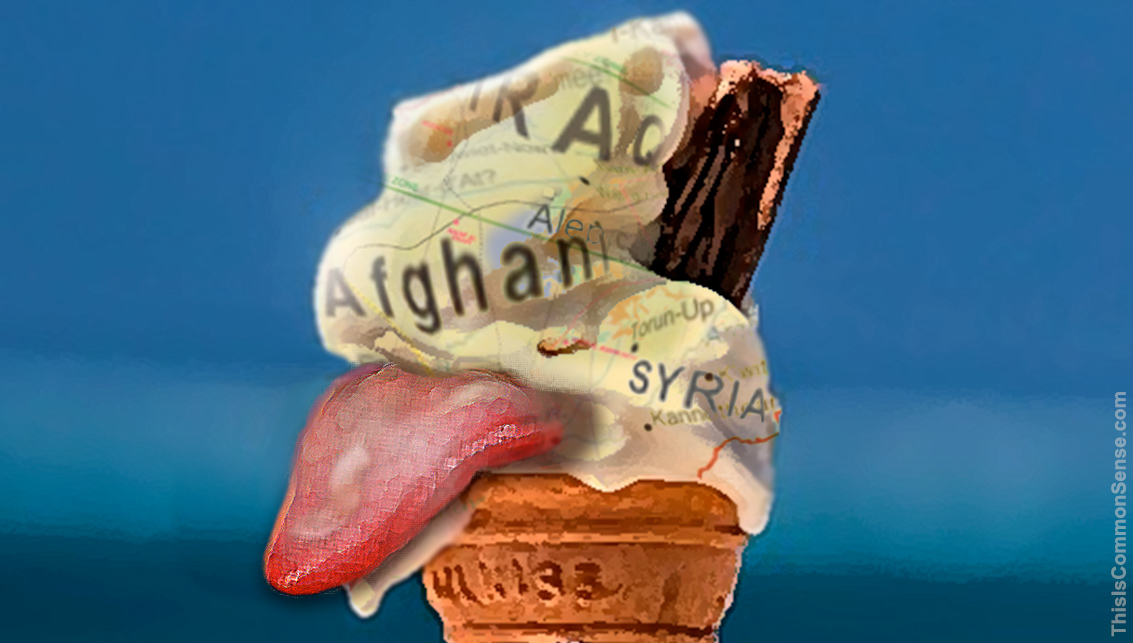
There is a term for such impossible-to-win/impossible-to-stop policy messes: “self-licking ice cream cones.”
The term means a “self-perpetuating system that has no purpose other than to sustain itself,” which is just standard operating procedure for domestic bureaucracies.
On December 28, 1797, Thomas Paine was arrested in France for treason, after being tried in absentia on December 26 and convicted. Before moving to France, Paine had been an instrumental figure in the American Revolution as the author of Common Sense. Paine then moved to Paris to become involved with the French Revolution, but the chaotic political climate turned against him. Paine had not earned friends in the Revolution with his vocal opposition to capital punishment.
“During the whole of my imprisonment,” Paine later wrote, “prior to the fall of Robespierre, there was no time when I could think my life worth twenty-four hours, and my mind was made up to meet its fate. The Americans in Paris went in a body to the convention to reclaim me, but without success.”
Paine’s imprisonment in France caused a general uproar in America. Future President James Monroe used all of his diplomatic connections to get Paine released in November 1794.
With the publication of Paine’s The Age of Reason — a great part of which he wrote in French prison — the American population turned against him,and he died penniless in New York in 1809.
On this date in 1832, John C. Calhoun (pictured above, in his most famous but hardly most becoming portrait) resigned as Vice President of the United States, the first to do so.
On the difference between citizen control and a cheap imitation. . .
Rob Port likes something I do not: North Dakota’s Senate Concurrent Resolution 4001.
I have previously applauded Port in this space, for his excellent political commentary on Say Anything Blog, columns for the Forum News Service, and on his WDAY AM-970 radio show in Fargo.
Today? Boos.
The constitutional amendment, pre-filed for next year’s session by Sen. David Hogue (R-Minot), would require any future constitutional amendment petitioned onto the ballot by citizens and then passed by voters in a statewide General Election to . . . pass the Legislature twice — in two separate sessions — to be enacted.
Hogue’s amendment exterminates the power of the people to bind their representatives constitutionally, arming the Legislature with a veto to overrule the people.
Port worries that the ballot initiative process has “become an avenue by which deep-pocketed, mostly out-of-state interests” are “buying their way onto the ballot and drowning out opposition with expensive marketing.”
He points to Measure 1, an ethics amendment, funded by “Hollywood activists.” In full disclosure, Liberty Initiative Fund contributed$250,000 from “out of state” to help a North Dakota committee place Measure 2 for “citizen only voting” onto last November’s ballot. But these measures were sponsored and voted for by the citizens of North Dakota, who have every constitutional right to work with folks from outside the Peace Garden State. Even me.
This is worse than the “overkill” Port admits. It changes the rules so that the people could no longer check their elected officials, but only beg those officials for any desired reform.
Thus defeating the very purpose of the citizen initiative process.