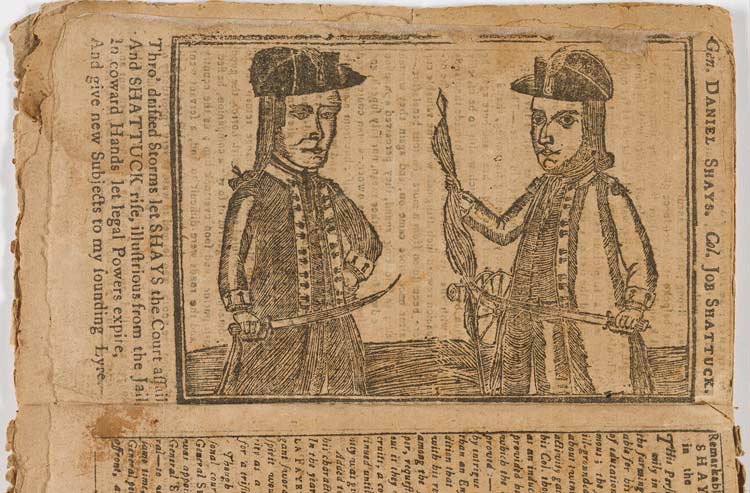
On January 25, 1787, Shays’s Rebellion experienced its largest confrontation, outside the Springfield Armory, with four of the rebels dead, 20 wounded.
The rebellion was a key moment in United States history. Daniel Shays and his followers objected to Massachussetts’s high taxes and rampant cronyism. The revolt, which was completely suppressed, led to the adoption of the U.S. Constitution and drawing George Washington from his retirement.
Smirking is a subset of smiling. But what is a grimace?
Nick Sandman, the offending Covington, Kentucky, Catholic high school student who triggered so much outrage last weekend, smiled. The effrontery!
Seeing a snippet of video, a social media mob formed, leaping to the conclusion that young Mr. Sandman was being disrespectful of an older Native American man who — chanting and drumming right up in his face — should have been “shown respect.”
And not smiled? Instead, what: frowned? Cried? Bowed?
Smirks are irksome. Sure. But the young man’s facial expression seemed to me an attempt, only half-successful, to smile — a covered-over grimace.
Understandable. The Covington youngsters — waiting to be picked up — had been targeted earlier by a group of nutty “Black Hebrew Israelites” who taunted at them for being . . . white. And the Native American man, Nathan Phillips, had singled Mr. Sandman out, violating his personal space. A grimace could be accounted for as putting “a brave smile on the situation,” as we used to say.
But that was not how the Twitter mobs interpreted it. And of course the young Catholic students were wearing “MAGA hats” (pro-Trump “Make America Great Again” baseball caps) which were later said to be racist. And the pro-life rally he and his friends attended was said to be sexist.
Can we all calm down? If we disagree on so much that even smiling is scandalous, maybe take a breath.
In the midst of it all, economist Bob Murphy reminded us of the previous culture-war fracas, the Gillette “toxic masculinity” ad, tweeting “if you see a mob picking on a boy, Gillette wants you to intervene.”
On January 24, 1732, French playwright, watchmaker, inventor, musician, diplomat, fugitive, spy, publisher, horticulturalist, arms dealer, satirist, financier, and revolutionary (both French and American) Pierre-Augustin Caron de Beaumarchais was born. He proved instrumental in securing armaments for the America Revolution, but remains best known for his three “Figaro” plays, Le Barbier de Séville, Le Mariage de Figaro and La Mère coupable. The plays remain memorable today chiefly for their operatic settings by Mozart and Rossini.
She demands to know why only “useful ideas,” like hers, get challenged that way. “Where were the ‘pay-fors’ for Bush’s $5 trillion wars and tax cuts, or for last year’s $2 trillion tax giveaway to billionaires?”
Where? Here!
And anywhere there’s common sense.
Hockney has his own retort, though, retrieving from the peanut gallery of economics an idiocy called “Modern Monetary Theory” (MMT).
“Congress will authorize necessary spending, and Treasury will spend,” he writes. Government funds are “never ‘raised’ first” because “federal spending is what brings that money into existence.”
Look, the United States has indeed come to rely upon debt financing. But it wasn’t always the rule. More importantly, the widespread and long-term effects are where post-gold standard monetary creation gets tricky.
So are MMT advocates. Tricky, that is. What they hide are the dispersed costs, many of which we pay in higher prices.
Their main “contribution” — as stated in the National Review, of all places, yesterday — is that “When a government issues its own currency, as our federal government does, it is in a financial situation different from those of most institutions or households.”
Not really. When a household writes checks it knows will bounce, it does pretty much the same thing.
When governments rely upon debt money, someone is still getting ripped off. With government, though, it isn’t the businesses holding bad checks, it is all of us.
This is Common Sense. I’m Paul Jacob.
N.B. This episode of Common Sense has been corrected from the email version: the author of the Forbes article is not the painter David Hockney.
On January 23, 1783, journalist and novelist Marie-Henri Beyle, known by his pen name Stendhal (pictured above), was born. Stendhal was a follower of Destutt de Tracy and an attendant at the count’s salons. His most famous works include the novel The Red and the Black and a treatise on romantic love.
Stendhal died March 22, 1842.
On January 23, 1860, the Cobden–Chevalier Treaty was signed between France and Great Britain. The treaty was named after the two main proponents of the agreement, Richard Cobden (in England) and economist Michel Chevalier (in France). The treaty had been suggested the year earlier, in British Parliament, by Cobden’s colleague John Bright, who saw the measure as a peace measure, and an alternate to a military build-up.
Our youthful rebels are anything but inarticulate; and though they utter a great deal of nonsense, the import of what they are saying is clear enough. What they are saying is that they dislike — to put it mildly — the liberal, individualist, capitalist civilization that stands ready to receive them as citizens. They are rejecting this offer of citizenship and are declaring their desire to see some other kind of civilization replace it.
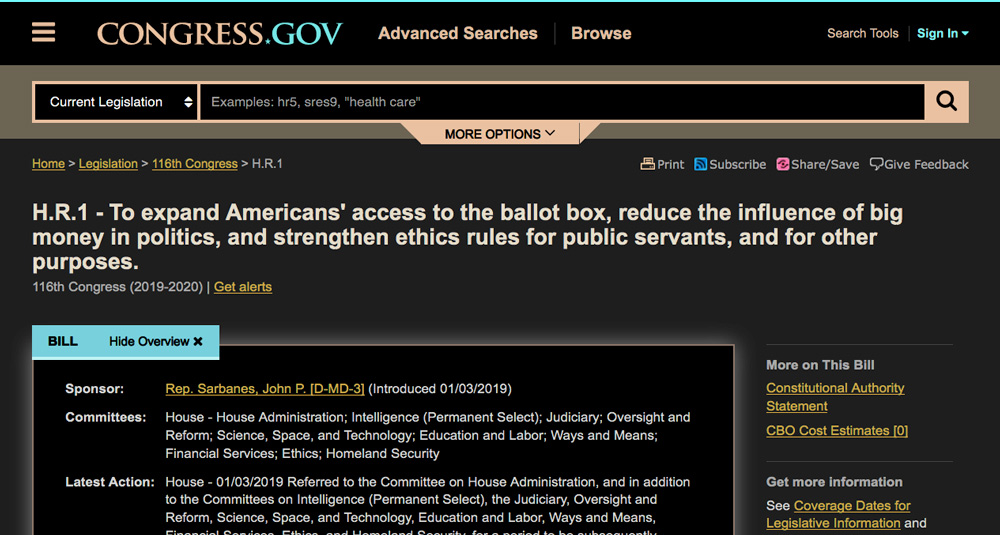
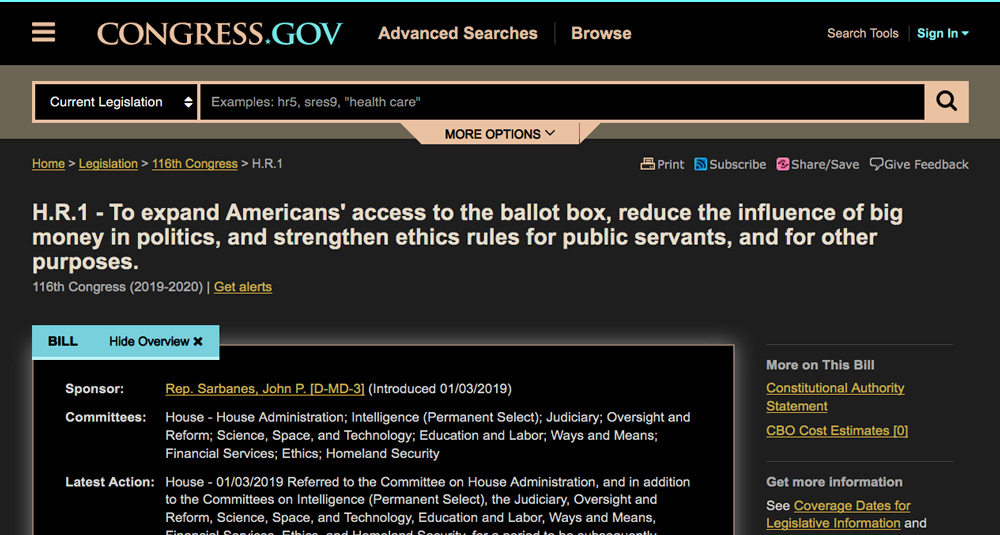
Surely there’s something good in the first legislation put forth by the brand-new Democratic House majority — though nothing jumps to mind.
The 571-page smorgasbord bill “addresses voting rights, corruption, gerrymandering and campaign finance reform,” writes Thomas Edsall in The New York Times, “as well as the creation of a Select Committee on the Climate Crisis — a first step toward a ‘Green New Deal.’”
H.R. 1 would mandate that states adopt automatic voter registration, a step too far. It establishes a system of public subsidies for candidates running for Congress, with taxpayers forking over a six-to-one match on donations of $200 or less.
The legislation also empowers* the Federal Election Commission, including by ending its supposedly “neutral” composition, i.e. an equal number of Democrat and Republican commissioners. This would either allow the FEC to be more “decisive” or unleash the dogs of partisan political witch hunts . . . depending on the case and/or your politics.**
Speaker Nancy Pelosi (D-Calif.) and Rep. John Sarbanes (D-Md.), the lead sponsor of the legislation, bill it as the best way “to rescue our broken democracy.”
“It should be called the Democrat Politician Protection Act,” argues Senate Majority Leader Mitch McConnell in the Washington Post.
David Keating, president of the Institute for Free Speech, tellsNPR, “A lot of [H.R.1] looks to be unconstitutional.”
No problem, for one provision calls for a constitutional amendment to partially repeal the First Amendment, so to authorize Congress to regulate campaign spending and speech.
Remember: the First Amendment is a single sentence, a mere 45 words.
Succinct and effective.
The former does not apply to this new bill, and the latter, I hope, does not apply to this new Congress.
This is Common Sense. I’m Paul Jacob.
* Let’s not give greater power to the FEC, which, according to a federal judge, “acted arbitrarily and capriciously and contrary to law” in the 2016 election.
** Of course, for Ross Perot in the 1990s or Libertarians, Greens and independents today, that “bipartisan” make-up isn’t neutral but stacked like a Star Chamber
Life is not a series of gig lamps symmetrically arranged; life is a luminous halo, a semi-transparent envelope surrounding us from the beginning of consciousness to the end.
Virginia Woolf, “Modern Fiction,” The Common Reader (1925).