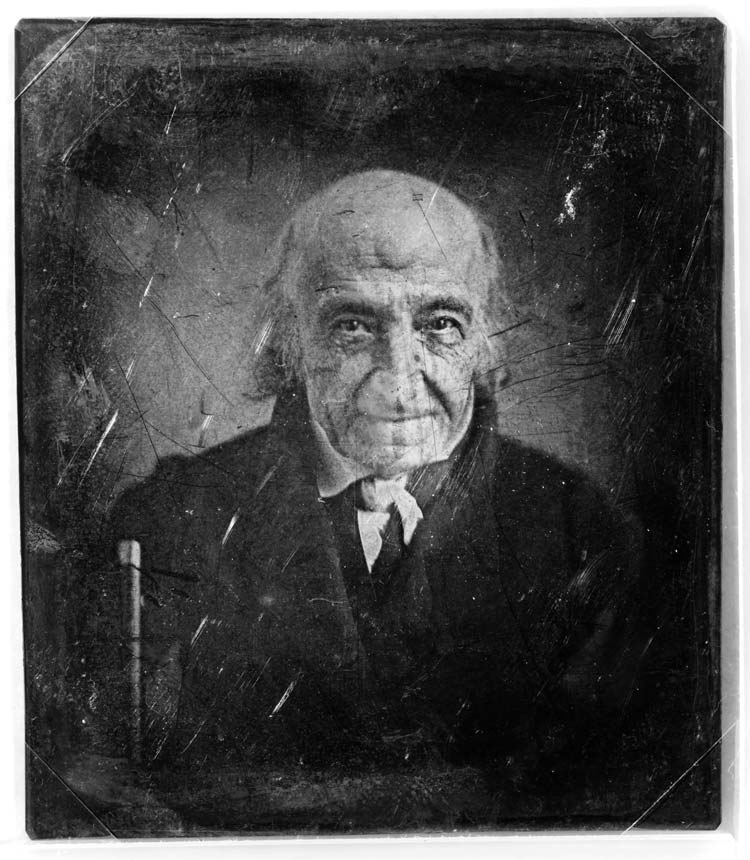
Scientific method consists in applying to those subjects which lie without the range of our immediate experience those same common-sense methods of reasoning which successful men of the world apply in judging of matters which concern their own interests.
Simon Newcomb, Principles of Political Economy (1886), chapter III, “Of Scientific Method”
On February 1, 1835, slavery was abolished in Mauritius. Twenty-six years later, in the American Civil War, Texas seceded from the United States. On this date in 1865, President Abraham Lincoln signed a Joint Resolution from Congress formally submitting the proposed Thirteenth Amendment to the United States Constitution to the states for ratification.
This Amendment abolished chattel slavery throughout the union.
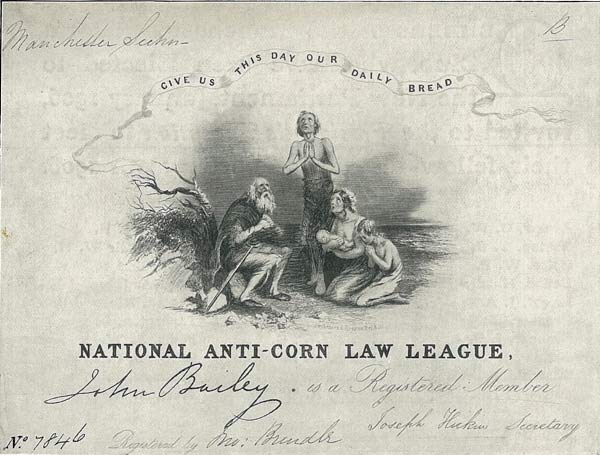
On January 31, 1849, the Corn Laws were abolished in the United Kingdom, one of the most impressive and far-reaching anti-protectionist moves of all time. “Corn” stood for all grains, including wheat, oats, barley, etc.; the free-trade agitation by John Bright and Richard Cobden was one of the main impetuses for the reform.
On Jan. 31, 1865, the United States Congress proposed the Thirteenth Amendment to the U.S. Constitution, submitting it to the states for ratification. The Amendment’s main section reads: “Neither slavery nor involuntary servitude, except as a punishment for crime whereof the party shall have been duly convicted, shall exist within the United States, or any place subject to their jurisdiction.”
On Jan. 31, 1990, the first McDonald’s fast food restaurant opens in the Soviet Union. Having once traveled to Moscow, I’m exceedingly thankful for this.
One of the things many people no longer understand about these United States is its — their — peculiar genius: decentralism.
The extreme of this is that contentious notion of state nullification of federal law, which most “smart” people deride (contra Jefferson and Madison) as itself made null and void by the Supremacy Clause of the Constitution.
And yet even nullification skeptics often support some form of nullification, like fighting marijuana prohibition or ObamaCare at the state level. State initiatives, especially, have driven much of this resistance to centralist, top-down regulation.
But a state initiative in Washington State, I-1639, passed last year, has devolved the nullification idea to where it gets even trickier. The gun control measure passed last year 60-40, but residents of rural counties are none too pleased. As reported in The Guardian, many of the sheriffs in the 27 counties that voted against the measure are not enforcing the law, which they see as unconstitutional.
“The refusal of law enforcement officers to enforce the new restrictions plays into a longer history of so-called ‘constitutional’ sheriffs resisting the gradual tightening of gun laws,” says The Guardian, which goes on to mention “the doctrine of ‘county supremacy,’ long nursed on the constitutionalist far right, which holds that county sheriffs are the highest constitutional authority in the country.”
Whatever its legal merits, this form of resistance to state law enjoys a deep American tradition.
As regular readers know, I am a big proponent of initiative and referendum rights. And one reason to support them is to add a countervailing power against central authorities dominated by special interests and political elites.
In Washington state, a freshly implemented ballot initiative and a raft of new bills may produce some of the tightest firearms regulations in the US. But standing in the way is a group of rural law enforcement officers who say point blank that they won’t enforce any of it.
The Klickitat county sheriff, Bob Songer, is one of them. He told the Guardian that the initiative passed last November “is unconstitutional on several grounds. I’ve taken the position that as an elected official, I am not going to enforce that law”.
Songer also cited ongoing litigation by the National Rife Association gun industry lobby and others which aims to demonstrate the laws violate both the second amendment and the state’s constitution. He also said that if other agencies attempted to seize weapons from county residents under the auspices of the new laws, he would consider preventively “standing in their doorway”.
In November, the state’s voters handily passed an initiative, I-1639, which mostly targeted semi-automatic rifles. As of 1 January, purchasers of these weapons must now be over 21, undergo an enhanced background check, must have completed a safety course, and need to wait 9 days to take possession of their weapon. Also, gun owners who fail to store their weapons safely risk felony “community endangerment” charges.
Feeling the wind at their backs after the ballot, gun campaigners and liberal legislators have now gone even further in the new legislative session. Bills introduced in the last week to Washington’s Democrat-dominated legislature look to further restrict firearms. Some laws would ban high capacity magazines and plastic guns made with 3D printers. Others would mandate training for concealed carry permits, and remove guns and ammo during and after domestic violence incidents.
Washington’s attorney general, Bob Ferguson, who proposed several of the bills, said in an email: “Now is the time to act. Washingtonians have made it clear that they support common-sense gun safety reforms.”
Kristen Ellingboe, from Washington’s Alliance for Gun Safety, which has long campaigned for more firearms restrictions, said that “for a long time our elected officials thought that gun violence protection was somehow controversial, but they have been behind where the people of Washington are on this issue”.
But like other west coast states, Washington exhibits a deep cultural and political divide between its populous, coastal cities and its more sparsely populated rural hinterland.
I-1639 passed on a roughly 60-40 split; in the big, blue counties west of the Cascade Mountains, such as King county, where Seattle is located, the margins were even bigger.
However, 27 of Washington’s 39 counties rejected the ballot measure. Many of those counties are in the state’s more rural, sparsely populated districts.
It is in these counties that many – including sworn officers – are promising to resist the laws.
In Ferry county in eastern Washington, more than 72% of voters rejected I-1639. In the county’s only incorporated city, Republic, the police chief Loren Culp asked the council in November to declare the city a “second amendment sanctuary”. That vote has been delayed until March, but in the meantime, like Songer, Culp says he will not enforce.
The sheriff in Ferry county, Ray Maycumber, told the Guardian that he would not be enforcing the laws either, at least until the NRA’s litigation is completed.
“There’s a window of time when I get to make the assessment”, he said. Should the NRA not succeed, he said, he would “consider if I want to go on in the job”.
The “sanctuary” idea has caught on with other rightwing activists. Matt Marshall is the leader of the Washington Three Percent, a patriot movement group which has held several open carry rallies in downtown Seattle in the last year.
Marshall is attempting to persuade rural Washington counties to adopt local second amendment sanctuary ordinances. Next week, together with the Patriot Prayer founder and former Senate candidate Joey Gibson, he is addressing a meeting of Lewis and Pierce counties to try to persuade them to adopt resolutions which would mean that the gun laws were not enforced.
The refusal of law enforcement officers to enforce the new restrictions plays into a longer history of so-called “constitutional” sheriffs resisting the gradual tightening of gun laws. There are also hints, in the stance, of the doctrine of “county supremacy”, long nursed on the constitutionalist far right, which holds that county sheriffs are the highest constitutional authority in the country.
Such notions have long been promoted by figures like sheriff Richard Mack, who leads the Constitutional Sheriffs and Peace Officers Association. As gun laws throughout the west have gradually tightened in recent decades, resistance along these lines has become prevalent in areas with strong political support for gun rights.
Since the initiative passed, and they made their positions public, both Songer and Culp have been lionized in conservative media. Earlier this month, Songer detailed his position on the Alex Jones show, where he appeared with Gibson.
On this resistance to the new wave of gun restrictions in Washington, Ellingboe, the gun safety campaigner, said that “it’s disappointing that the gun lobby is trying to undermine the will of Washington voters”.
As 2019 begins…
… we’re asking readers to make a new year contribution in support of The Guardian’s independent journalism. More people are reading our independent, investigative reporting than ever but advertising revenues across the media are falling fast. And unlike many news organisations, we haven’t put up a paywall – we want to keep our reporting as open as we can. So you can see why we need to ask for your help.
The Guardian is editorially independent, meaning we set our own agenda. Our journalism is free from commercial bias and not influenced by billionaire owners, politicians or shareholders. No one edits our editor. No one steers our opinion. This is important as it enables us to give a voice to those less heard, challenge the powerful and hold them to account. It’s what makes us different to so many others in the media, at a time when factual, honest reporting is critical.
Please make a new year contribution today to help us deliver the independent journalism the world needs for 2019 and beyond.
Some rural sheriffs in Washington State say they will not enforce the state’s new gun laws — which could wind up being some of the strictest in the country — arguing that they are unconstitutional, the Guardian is reporting.
Some of The Country’s Strictest Gun Laws
In the wake of recent mass shootings — including one at a Las Vegas music festival in 2017 and another at a Parkland, Florida high school last year — Washington’s voters passed initiative I-1639 in 2018, which by-and-large regulates semiautomatic rifles. Since January 1, 2019, purchasers of such weapons must be 21 years of age or over, must undergo an enhance background check and complete a safety course, and must wait nine days to take possession of their weapons. Further, weapons must be stored properly, or their owners will face felony endangerment charges.
Washington’s legislature, now controlled by Democrats, has demonstrated a willingness to take things even further when it comes to gun laws. Some proposals recently introduced into legislature would ban high capacity magazines and plastic guns made with 3-D printers. Other initiatives would require training for concealed carry permits, and remove guns and ammo during and after domestic violence incidents.
The Deep Divide Between Washington’s Rural And Urban Population
Like other liberal West Coast states, Washington isn’t all blue. In fact, the political and cultural divide between the state’s urban, liberal voters and conservative, rural voters, is almost palpable. Of Washington’s 39 counties, 27 of them – the least-populated, most rural – all rejected I-1639 handily. Statewide, however, the initiative passed by 60 percent to 40 percent.
Refusing To Enforce The New Laws
It’s in these rural counties where county sheriffs say they won’t enforce the new laws. One of them is Klickitat County Sheriff Bob Songer.
“[I-1639] is unconstitutional on several grounds. I’ve taken the position that as an elected official, I am not going to enforce that law.”
Songer went on to claim that if another Washington State agency tried to enforce gun laws against citizens in his county, he would stand in their doorway as a barrier between the citizen and the agent.
Over in Ferry County, Sheriff Ray Maycumber said that until the National Rifle Association’s (NRA’s) lawsuit against Washington’s new laws is resolved, he won’t be enforcing the laws, either. And if the NRA fails, he’ll consider whether or not he wants to remain in law enforcement.
2nd Amendment Sanctuary Cities
Taking a cue from the illegal immigration debate, some elected officials in rural Washington are calling for towns and counties in the state to be “2nd Amendment Sanctuary Cities,” where law enforcement would simply not enforce the new gun laws, and where residents would be protected by local law enforcement against arrest and confiscation of their weapons.
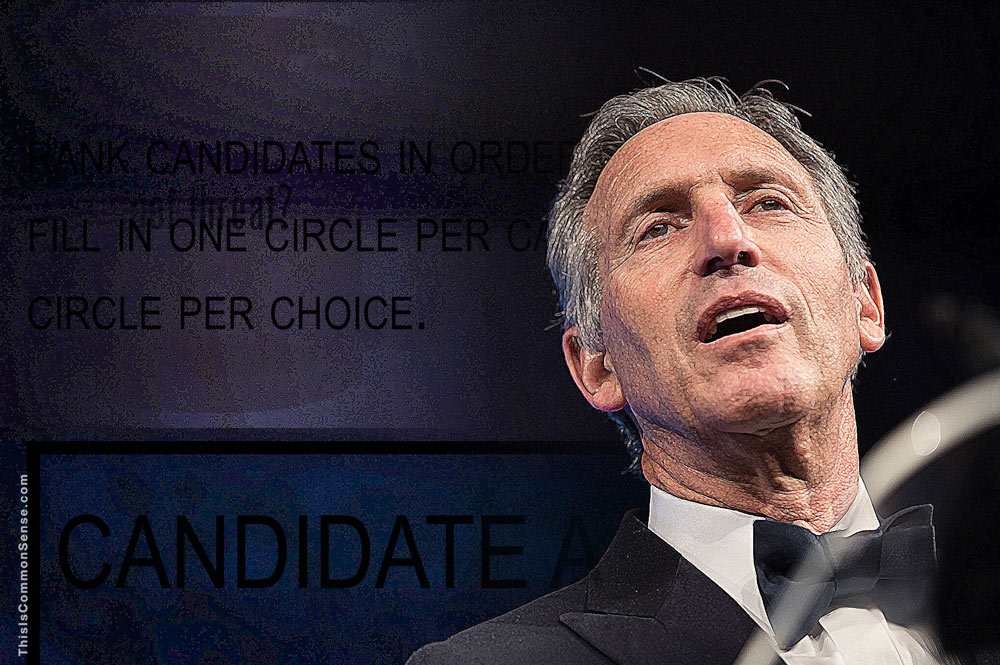
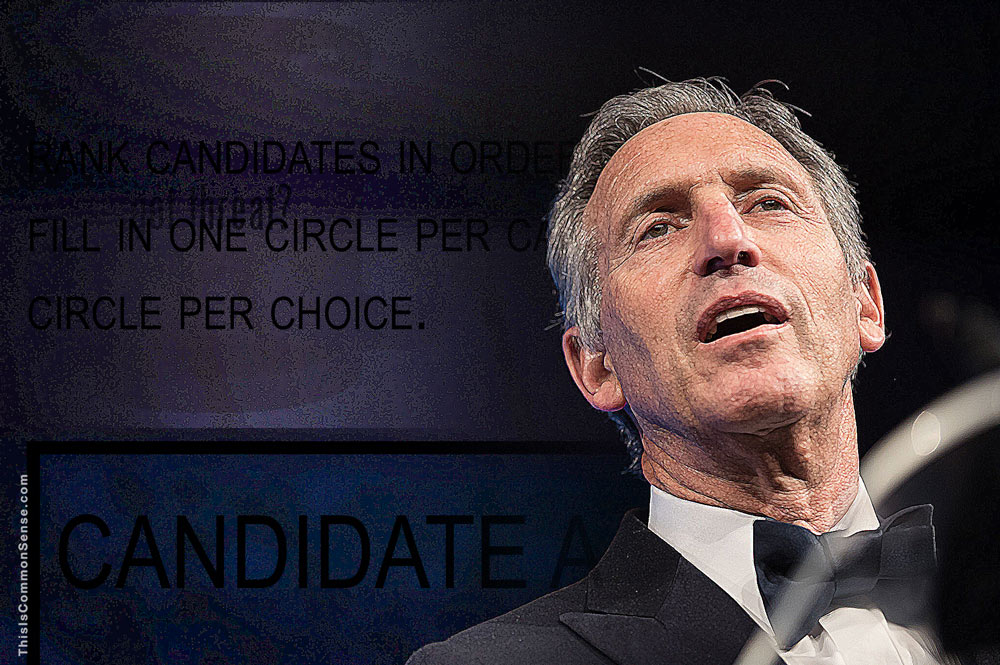
Howard Schultz’s recent announcement that he might run for president “sent a shiver through the Democratic Party,” writes David Siders at Politico, “terrifying party officials who fear a well-funded, third-party candidate could siphon votes from the Democratic nominee and hand a second term to Trump.”
Schultz is the former Starbucks Coffee CEO, whose success with customers in the marketplace is hard to quibble with. Nonetheless, his “welcoming” into the contest has been less than friendly.
President Trump taunted that he lacked the “guts” to run. Democrats — appalled that the billionaire, a lifelong Democrat, who has given nearly $200,000 to candidates sporting the D on their chests, would consider an independent run — called it “half-baked” and yet “an existential threat.”
Note that Mr. Schultz has stated he will not run if he thinks he cannot win.
As I’ve long argued, there’s a better way to prevent spoilers: use ranked choice voting, like they do in Maine, so that voters can better express themselves, and not help elect the candidate they like least by voting for the candidate they like most.
At this point, Howard Schultz’s impact is to expose the socialistic impulses of Democrats running for president. The liberal Schultz has already taken on Sen. Elizabeth Warren’s wealth tax idea and bashed Sen. Kamala Harris’s Medicare-for-all. He opposes free college as something “we can’t afford.”
Among the battalion of Democrats already seeking or likely to seek the party’s presidential nomination, is there even one able to articulate that there might be something “we can’t afford”?
Democrats much prefer a comparison with Trump to a comparison with Schultz.
On Jan. 30, 1948, Indian leader Mohandas K. Gandhi, known for his non-violent, non-cooperation struggle for freedom and national independence, was assassinated by a Hindu extremist.
On Jan. 30, 1956, Martin Luther King, Jr.’s home was bombed in retaliation for his work on the Montgomery Bus Boycott.
On Jan. 30, 1972, British soldiers killed fourteen unarmed civil rights marchers in Northern Ireland in what came to be known as “Bloody Sunday.” Soldiers shot 26 unarmed protesters and bystanders – 13 males, seven of whom were teenagers, died immediately, while another man died of his injuries nearly five months later. In the immediate aftermath, an investigation by the British Government largely cleared the soldiers and British authorities of blame. A second investigation begun in 1998, released a report in 2010 declaring that all of those shot were unarmed, and that the killings were both “unjustified and unjustifiable.”
Not quite fitting today’s “non-violence elicits violence” theme, on January 30, 1835, Richard Lawrence attempted to shoot former military leader and then-President Andrew Jackson, but failed. He was subdued by a crowd, including several congressmen. That marked the first attempt on the life of a sitting U.S. president.
I will concede — at least “arguendo” — that President Trump is awful. But I will not concede that he is uniquely awful. His Tweets and signature verbal provocations aside, he is arguably better than his predecessors.*
Arguably.
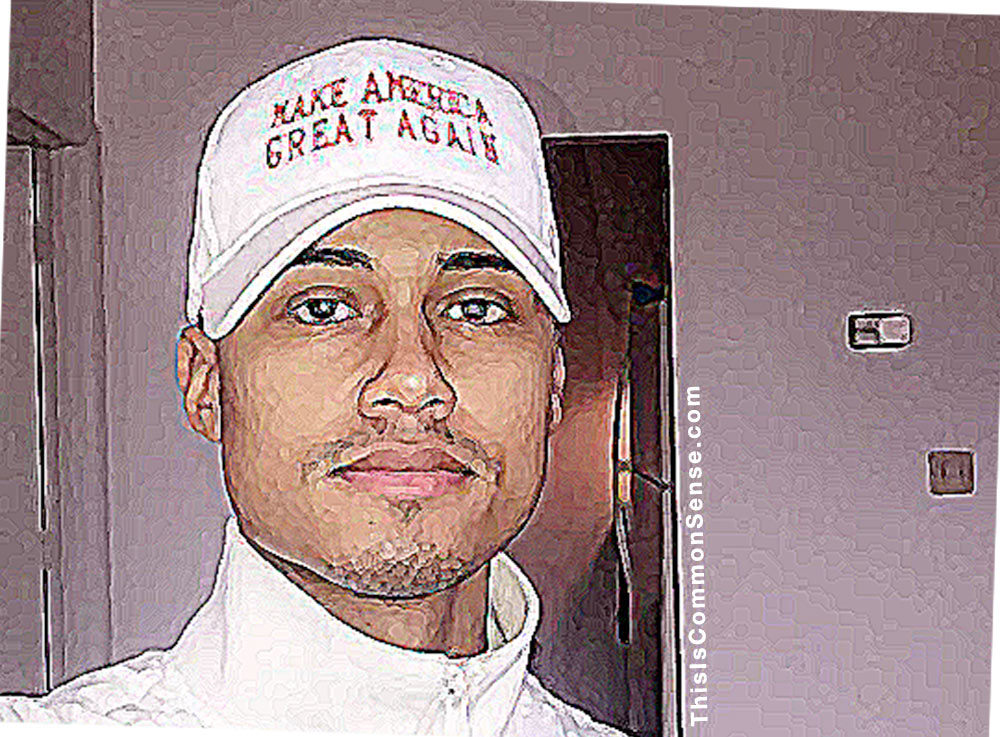
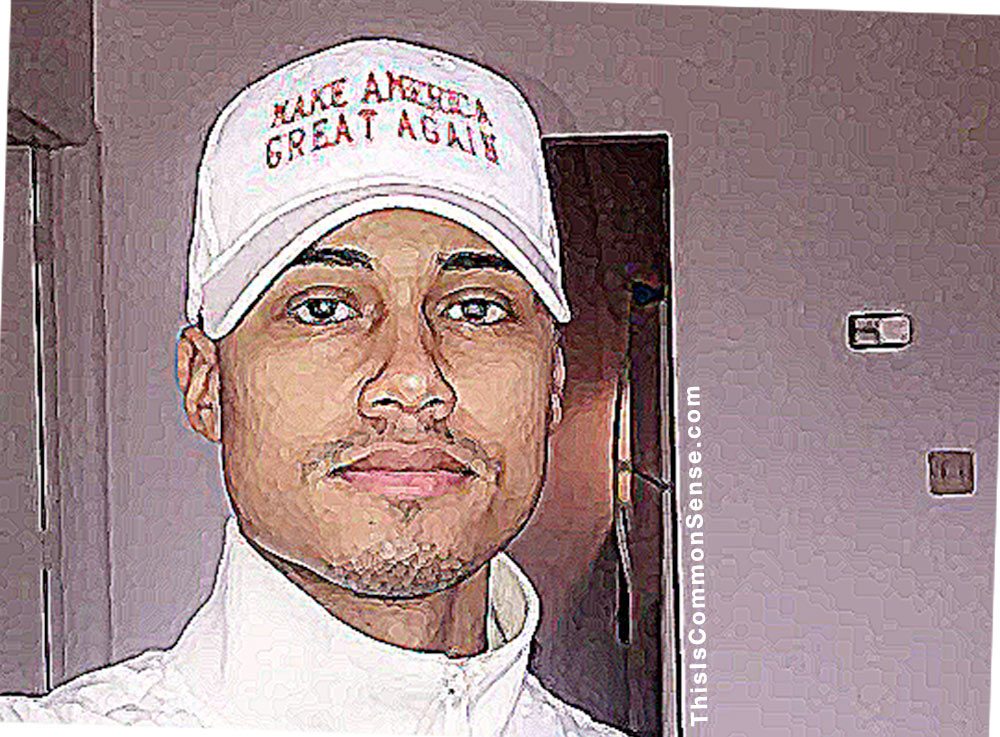
Which means that his cribbed campaign slogan, “Make America Great Again,” affixed to an ultra-simple red hat, is the last thing we should fixate on.
You know, as a symbol of “hate.”
Even Andrew Sullivan, in lambasting the media — and the left in general — over their insane over-reaction to the Covington kids’ non-existent “racism” and “disrespect” (“The Abyss of Hate Versus Hate, Intelligencer), could not help himself when it comes to the MAGA hat. Amidst his defense of the lads, Sullivan wrote that “they should not have been wearing MAGA hats to a pro-life march.”
Why not?Mr. Trump has taken pro-life action.
“They aren’t angels,” Sullivan went on, “they’re teenage boys.”
The President is no angel either. But he was duly elected. And he hasn’t started any unconstitutional wars** or suppressed the freedom of the press.
MAGA is said to be a statement of “white supremacy,” but, well, there are non-whites who find that absurd. For good reason.
This all indicates a deeper problem: an over-indulgence in symbolism— real and contrived.
In the immortal words of “motorist” Rodney King, “can we all JUST get along? Can we get along? Can we stop making it, making it horrible for the older people and the kids?”
On January 29, 1761, Albert Gallatin was born. Gallatin served as the fourth United States Secretary of the Treasury — a post in which he served longer than any other in American history — advanced the anthropological and linguistic study of native Americans, and became the subject of a biography by Henry Adams. Called the “father of American ethnology,” he has been honored with a 1967 U.S. stamp as well as many place names, including the Gallatin National Forest in Montana.