One who would influence the masses must have recourse to the art of advertisement. The clamor of puffery is to-day requisite even for an intellectual movement.
Categories
Karl Jaspers

One who would influence the masses must have recourse to the art of advertisement. The clamor of puffery is to-day requisite even for an intellectual movement.

On February 22, 1632, Galileo’s Dialogue Concerning the Two Chief World Systems was published. The manner in which the great scientist chose to marshal the heliocentric theory of the solar system in that work was especially vexing to the Vatican, and it led to his trial by the Inquisition.
Galileo Galilei (1564-1642) was one of the major intellectual figures at the dawn of the modern age, and his treatment by the Catholic Church has served as a marker in the fight for freedom of thought, speech, and press ever since. Galileo, the son of composer and lutenist Vincenzo Galilei, was born on February 15, 1564. He died January 8, 1642.
On the same date in 1819, Spain sold Florida to the United States for five million U.S. dollars. Exactly 70 years later President Grove Cleveland signed a bill to admit North Dakota, South Dakota, Montana
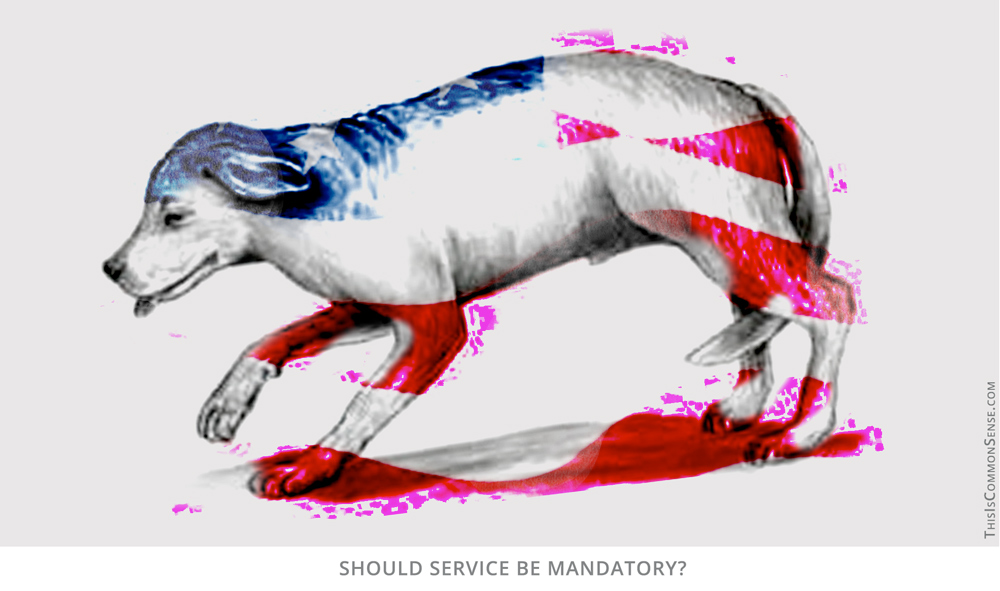
It can happen here. Congress could simply identify a group of citizens and pass a law forcing them into servitude.
At least, Congress thinks it has this incredibly abusive power . . . even though the 13th Amendment specifically prohibits it.*
In fact, the idea of conscription — not merely for military service, but also for performing the most routine civilian government functions — is this very day being debated in Washington by a congressionally-empowered body: The National Commission on Military, National and Public Service. The commission is charged with advising Congress on whether to expand draft registration to women or end it for men, as well as whether or not to create a mandatory “national service” program for young people.**
“Should Service be Mandatory?” is the title of the afternoon hearing at American University.
The Brookings Institution’s William Galston and author Ted Hollander will advocate for drafting all young Americans and sentencing each to a year of compulsory service to the federal government. Thank goodness, my friend Doug Bandow, a senior fellow at the Cato Institute, will speak against mandatory national service, as will soon-to-be-friend Lucy Steigerwald, a contributing editor at Antiwar.com.
The public can comment for up to two minutes, and I certainly will demand the commission abandon any contemplation of assaulting the freedom of young people under the false claim of “national service.”
True public service is not involuntary servitude to the government. And vice-versa. Americans, even young Americans, have rights.
Tell the Commission to tell Congress: No forced service.
This is Common Sense. I’m Paul Jacob.
TELL THE COMMISSION: NO
MY STATEMENT: Leave Those Kids Alone
* Regarding the military draft, the U.S. Supreme Court has somehow sidestepped the Amendment’s very clear language.
** No surprise that politicians and “experts” are targeting the politically least established adult age group.
See all recent commentary
(simplified and organized)
See recent popular posts

Some writers have so confounded society with government, as to leave little or no distinction between them; whereas they are not only different, but have different origins. Society is produced by our wants, and government by our wickedness; the former promotes our happiness positively by uniting our affections, the latter negatively by restraining our vices. The one encourages intercourse, the other creates distinctions. The first is a patron, the last a punisher.
Tom Paine, Common Sense (1776).
On Feb. 21, 1848, Karl Marx and Friedrich Engels published The Communist Manifesto.
On Feb. 21, 1916, the Battle of Verdun began with German bombardment of the city of Verdun, France. For ten months, the longest single engagement of the First World War, German forces attacked the French along a 20-kilometer front crossing the Meuse River. When the battle ended, with no change in the strategic position of either army, the combined death toll was over 300,000 (out of over 700,000 casualties).
On Feb. 21, 1965, Malcolm X was gunned down by rival Black Muslims while addressing his Organization of Afro-American Unity in New York City.

Do your young adult children need the government to take over their lives for, say, a year, to whip them into tip-top citizenship shape?
Forced service could be the new rite of passage into adulthood. Right after our kids finally get through high school or college, slap 12 months of “service to the nation” on them to help foster appreciation for the freedom . . . they had, instead, hoped to start enjoying.
Sound good?
No. Not even to the folks at the National Commission on Military, National and Public Service (NCMNPS). Appointed to advise Congress on whether to end draft registration or expand it to women, and whether to force all young people to give up a year of their lives doing military or civilian “national service” for the federal government, the commissioners seem to eschew compulsion.
Their emails, their website address expresses “inspire2serve.gov” . . . not “force2serve.gov.” Because inspiring people is noble, while conscription is despicable and wrong.
Commissioners talk about a “personal commitment,” “a culture of service,” and the “overwhelming desire to serve” they’ve found among young people. Is it all just a rouse in route to a recommendation to Congress that young people should be forced against their will into government service?
And not even to repel invading hordes, not for any real emergency, but for basic government make-work and pretend nation-building.
Tomorrow at American University in the nation’s capital, the commission is holding a public hearing entitled, “Should Service be Mandatory?”
No. Involuntary servitude is a stupid idea. And the opposite of freedom.
This is Common Sense. I’m Paul Jacob.

See all recent commentary
(simplified and organized)
See recent popular posts

The great difficulty which history records is not that of the first step, but that of the second step. What is most evident is not the difficulty of getting a fixed law, but getting out of a fixed law; not of cementing (as upon a former occasion phrased it) a cake of custom, but of breaking the cake of custom; not of making the first preservative habit, but of breaking through it, and reaching something better.
Walter Bagehot, Physics and Politics (1872).

Beginning on Feb. 20, 1944, and lasting through Feb. 25, 1944, the United States Strategic Air Forces (USSTAF) launched a series of missions against the Third Reich that became known as “Big Week.” In six days, the Eighth Air Force bombers based in England flew more than 3,000 sorties and the Fifteenth Air Force based in Italy more than 500. Together they dropped roughly 10,000 tons of bombs. The daylight bombing campaign was also supported by RAF Bomber Command operating against the same targets at night. The campaign helped the Allies achieve air superiority, so the invasion of Europe could proceed. While U.S. industrial might could entirely replace losses during the “Big Week,” Germany was unable to do so.
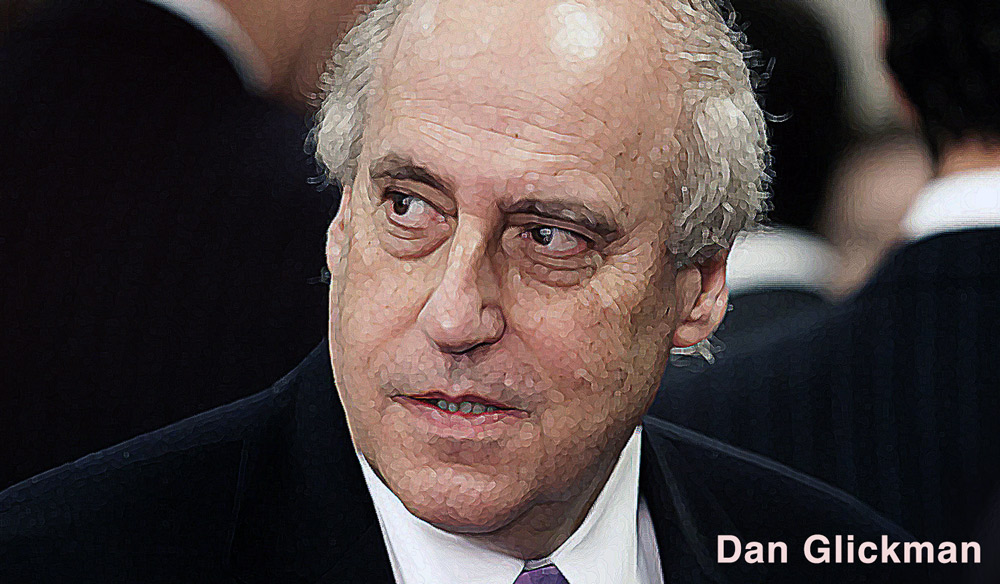
Stay calm. Dan Glickman has discovered serious problems.
“Washington is a divided town in a very politically divided nation,” Glickman wrote in The Hill last year. “From the confirmation of Brett Kavanaugh, to the extreme rhetoric on social media, to the bombs mailed to public officials, to the mass shooting in Pittsburgh, to the inability of our elected leaders to reach consensus on nearly all major issues facing the country, it is not easy to see a way out of this mess.”
Nonetheless, he’s found one: less freedom.
Specifically, he wants to take away young people’s freedom.
For how long? Say a year or so, he argues, right after high school or college, when they don’t have a hold yet in society and are less able to fight back; force them to join the military or some non-military federal conscript workforce. It’ll be good for the little buggers. And very egalitarian.
Always-adult-acting Washington knows best.
“Not only does this benefit the individual,” asserts this current Executive Director of the Aspen Institute Congressional Program and former Cabinet Secretary,* “but helps our national community move away from division and towards a more cohesive society.”
Wait a second. The exceptionally well-connected Glickman and friends screwed up our world. So, make young people pay for their mistakes?
And where does Congress conjure up such power?
This Thursday, a congressional commission debates mandatory “national service” for young people.**
It would make more sense to draft 74-year-old Glickman, who actually helped cause the problems . . . or even 58-year-old me, who couldn’t stop him.
This is Common Sense. I’m Paul Jacob.
* Glickman’s career path, prior to his current position, has been illustrious: a former nine-term congressman; Secretary of Agriculture under President Clinton; Director of the Institute of Politics at Harvard University’s John F. Kennedy School of Government; and Motion Picture Association of America Chairman.
** Please go here to submit your own comments on forcing young people to give up a year of their life to the federal government.
See all recent commentary
(simplified and organized)
See recent popular posts

February 19, 1942, was a sad day for constitutional rights, with President Franklin D. Roosevelt signing Executive Order 9066, authorizing the Secretary of War to prescribe certain areas of the country as military zones. These zones were used to incarcerate Japanese Americans in internment camps.