While it is well enough to leave footprints on the sands of time, it is even more important to make sure they point in a commendable direction.
James Branch Cabell, Beyond Life (1919).
Categories
James Branch Cabell
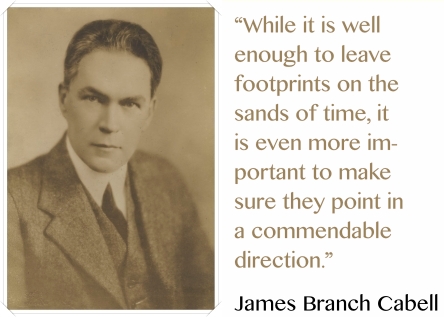
While it is well enough to leave footprints on the sands of time, it is even more important to make sure they point in a commendable direction.
James Branch Cabell, Beyond Life (1919).

Paul Jacob has diet advice for the short time before Election Day:

Paul Jacob re-caps the big stories of the week. But first? A bite to eat!
If one awakens in men the idea of freedom then the free men will incessantly go on to free themselves; if on the contrary, one only educates them, then they will at all times accommodate themselves to circumstance in the most highly educated and elegant manner and degenerate into subservient cringing souls.
Max Stirner, The False Principle of Our Education: or; Humanism and Realism (1842).
Most Americans appreciate the truth of Lord Acton’s venerable dictum: “Power tends to corrupt and absolutely un-term-limited power corrupts absolutely.”
I’ve slightly reworded it.
Sorry, Baron.
Anyway, instead of presuming, said John Emerich Edward Dalberg-Acton, 1st Baron Acton, that powerful men “like Pope and King” can do no wrong, we should presume the opposite. The more power a person can freely exercise, the more likely he will abuse it. “There is no worse heresy than that the office sanctifies the holder of it.”
Americans tend to agree. So we see the wisdom of regularly depriving incumbents of power that increases the longer they are in office, even as they become more inclined to abuse this power.
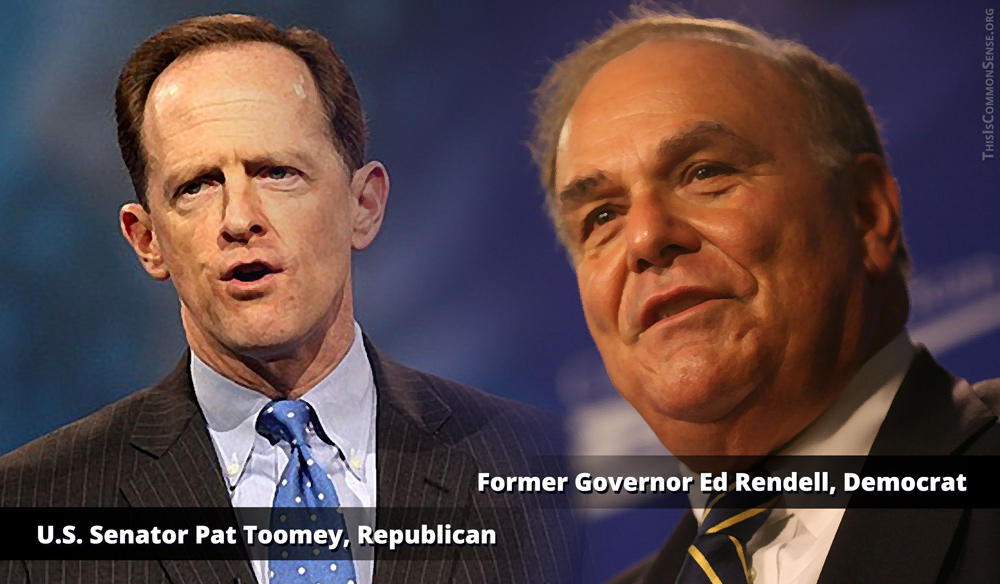
Most incumbents hate term limits. Yet we’ve also seen strong bipartisan support for the reform from many eminent politicians — for example, U.S. Senator Pat Toomey, Republican, and former Governor Ed Rendell, Democrat, both of Pennsylvania.
“Entrenched politicians have been steering the ship of state for decades and . . . we’re about to hit a $25 trillion national debt iceberg. It’s time for a new approach,” they say in a recent op-ed. “Our elected representatives seem afraid to do anything that would jeopardize their reelection. Term limits allow them to operate without that pressure, secure in the knowledge that they are not risking the position that could be a lifetime career.”
The two experienced elected officials, Rendell retired and Toomey retiring in 2022, also support a convention of states as the most practical constitutional method of term-limiting Congress.
Americans are coming together, right now, over term limits.
This is Common Sense. I’m Paul Jacob.
Photo of Governor Ed Rendell by Center for American Progress
See all recent commentary
(simplified and organized)
See recent popular posts
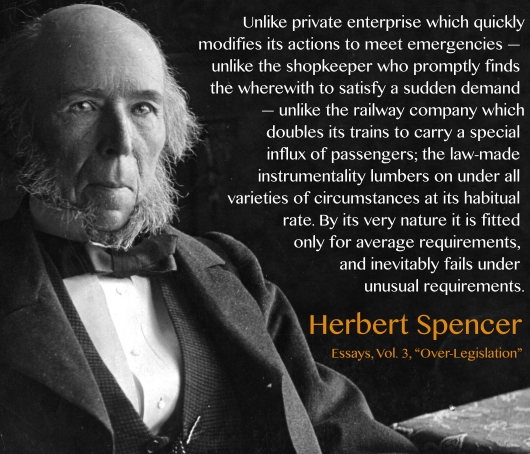
Unlike private enterprise which quickly modifies its actions to meet emergencies — unlike the shopkeeper who promptly finds the wherewith to satisfy a sudden demand — unlike the railway company which doubles its trains to carry a special influx of passengers; the law-made instrumentality lumbers on under all varieties of circumstances at its habitual rate. By its very nature it is fitted only for average requirements, and inevitably fails under unusual requirements.
Herbert Spencer, Essays: Scientific, Political, and Speculative (1891), Vol. 3, Ch. VII, “Over-Legislation.” See also Spencer’s essay “Specialized Administration.”
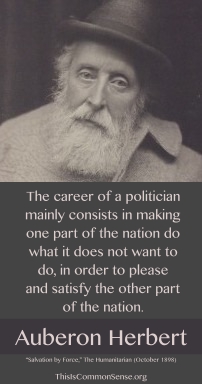
The career of a politician mainly consists in making one part of the nation do what it does not want to do, in order to please and satisfy the other part of the nation.
Auberon Herbert, The Right and Wrong of Compulsion by the State, and Other Essays, “Salvation by Force.”

Would the likes of H.L. Mencken and Jonathan Swift be free to say much on the “open” platforms of modern social media — that is, before being suspended, blocked, demonetized, stomped?
Depends.
Imagine: 1920s-vintage tweets by Mencken lambasting literary Puritanism and “chiropractic” or 1720s-vintage tweets by Swift pummeling prejudice against poor people — neither would likely inspire high-tech gendarmes to swoop in swinging their truncheons very immediately.
President Trump would also be an acceptable target.
But let HLM or JS skewer Democratic Party panjandrums, and the skill of the skewering would constitute the first bill of indictment. Especially during the last days of a presidential election.
As the often funny and spot-on Babylon Bee has learned, plenty of faux-high-minded rationalizations would be spouted from Twitter, Facebook, and Google mouthpieces as the social media behemoths go about suppressing the satiric discourse . . . as if scripted by satirists!
Thus, Facebook has just demonetized the Bee for “inciting violence.” And how was this violence incited? By spoofing the silliness of a senator.
Are such suppressors of satire somehow led by — say — an invisible hand to . . . self-satirize?
Apparently, yes.
But what is the answer to invidious discrimination by “neutral” platforms?
Andrew McCarthy of National Review is not alone in wondering whether the giant tech firms are abiding by the terms of Section 230 of the Communications Decency Act, which protects them from prosecution for the speech of others on their “open” platforms. But maybe the bottom line is . . . we should just outlaw punch lines.
They’re pretty painful if you’re the one getting punched. I mean, c’mon, man. “Punch” line? Pretty violent.
This is Common Sense. I’m Paul Jacob.
See all recent commentary
(simplified and organized)
See recent popular posts

So what do you do if you don’t know? How do you manage your risk if you don’t know? . . . The thing that you can default to is freedom. Because the one thing we know is that if we were to lose our freedom to anything, screw it: we’re out of here. Right? We’d all just close the planet and starve to death. If we lose our freedom we don’t even want to be here.
If you say to me ‘I can give you your freedom back but there’s a one percent change that you’ll die,’ I’m in; I’ll take my freedom. ‘I’ll give you your freedom back but there’s a one percent change your grandmother might die a few years early,’ I’m in; ‘sorry, Grandma.’ I’m gonna talk to Grandma, first, but you know what? She agrees. Grandma doesn’t disagree. Grandma wants me to be free; Grandma wants to be free. . . .
If you don’t know what’s the right thing to do, you have to default to the primary human needs. And we have a primary human need for freedom.
Real Coffee with Scott Adams, Periscope Episode 1151, “Trump Slaughtermeter Pinned 100%. Swiss Coronavirus Mystery. Who Reversal.”

San Diego’s school district is weakening its grading system because of “racial disparities.”
Yearly averaging of grades will end. Why? The practice, it is said, has penalized students who do poorly early in the year, presumably unfairly.
Teachers will also be prohibited from taking into account whether homework is submitted on time and how students behave in class. These aspects of performance will instead be incorporated into a “citizen grade.”
Richard Barrera, VP of the school district, says “to be an anti-racist school district, we have to confront practices like this that have gone on for years and years.”
Student behavior has sometimes been called “deportment.” Grading it separately is nothing new. But San Diego’s rationale for doing so is bad. And eliminating a yearly average (or semester average) discourages students from working diligently all year long.
What if, under the hobbled system, grades still exhibit “racial disparities”? The logical conclusion is an end to grades and to merit-based distinctions.
Many reasons for academic disparities among different groups are possible. But let’s say that kids of certain color tend to have lousier home lives than kids of other color, and therefore do worse in school.
If so, disparities in performance cannot be attributed to attempts to objectively assess schoolwork.
And the problems won’t disappear if grades disappear.
Any silver lining?
Well, if you’re a substandard teacher, meaningless grades for students will also make it harder to know when you, the teacher, are doing substandard work.
Though the metal most apt, here, is much baser than “silver.”
Lead seems about right.
This is Common Sense. I’m Paul Jacob.
See all recent commentary
(simplified and organized)
See recent popular posts