Categories
education and schooling

Grades Versus Feelings

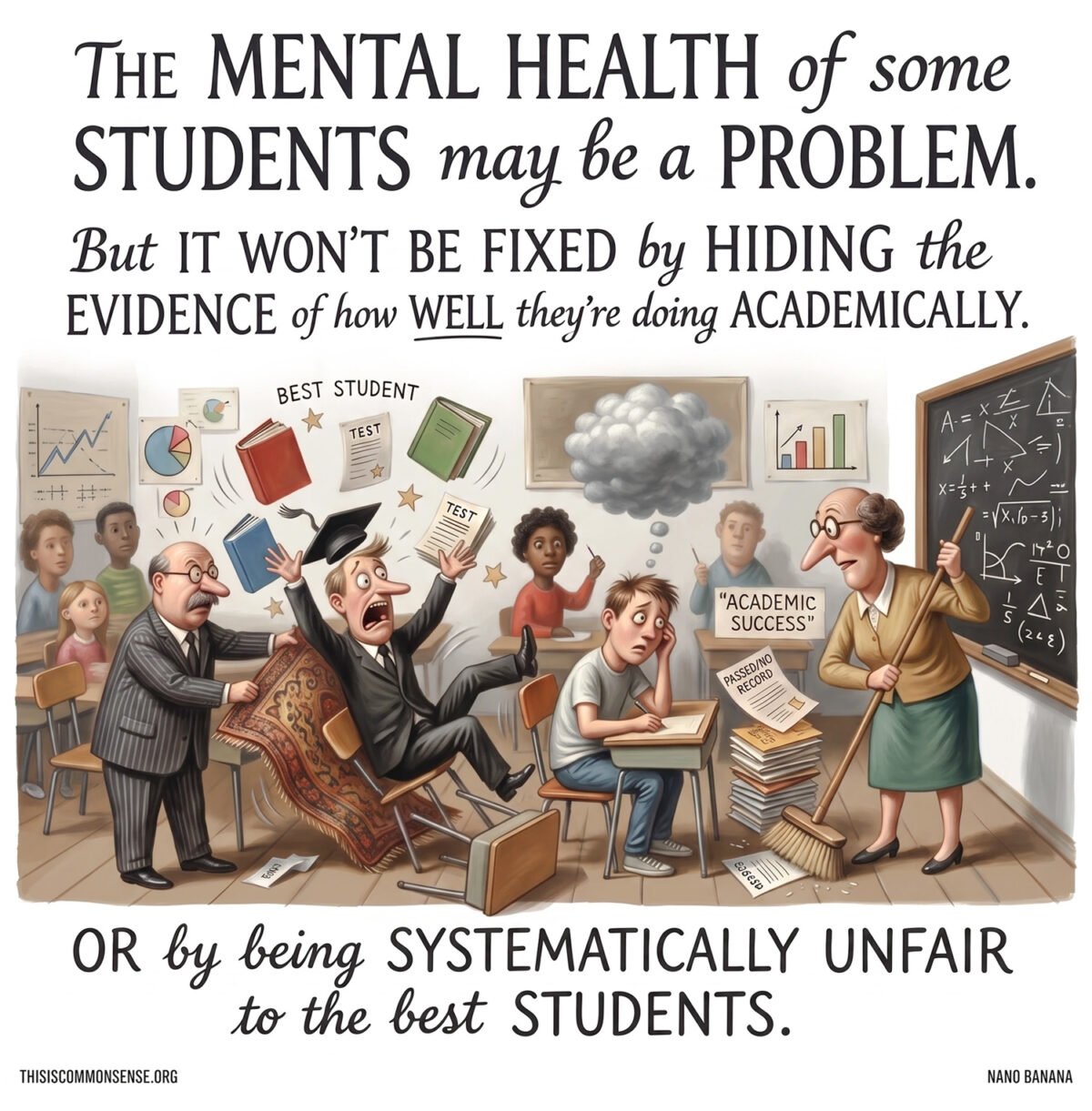
In the 1960s, MIT introduced a “Pass or No Record” system for the first semester of freshman year. The idea? Help students adjust to greater workloads and “variations in academic preparation and teaching methods.”

You’d think that letter grades themselves would help students adjust by providing information about how well they are learning and adjusting — assuming that the grades are at least a roughly objective indication of mastery not yet rendered useless by grade inflation.

Some universities let first-semester freshmen convert a poor letter grade into a pass/no credit “grade.” Only a few have sweepingly replaced letter grades with the pass/no credit system in the first semester.

Now University of Michigan has joined those few. One reason: to “curb the mental health crisis unfolding.”

Why not at least make the pass/no credit “grade” optional for the sake of students who do want their academic achievement to be more specifically recorded on their transcript?

Well, this would “defeat the purpose of facilitating students’ transition to campus.” See, if “covered grades are optional, covering [hiding] an individual’s grades will inadvertently become equated with [their] not doing well in a class.”

Sounds like a reason for keeping letter grades. And what if the mental problems persist into sophomore year? Junior? Senior?

The mental health of some students may be a problem. But it won’t be fixed by hiding the evidence of how well they’re doing academically. Or by being systematically unfair to the best students.

This is Common Sense. I’m Paul Jacob.


PDF for printing

Illustration created with Nano Banana

See all recent commentary
(simplified and organized)
See recent popular posts

Categories
education and schooling

Merit No More

San Diego’s school district is weakening its grading system because of “racial disparities.”

Yearly averaging of grades will end. Why? The practice, it is said, has penalized students who do poorly early in the year, presumably unfairly.

Teachers will also be prohibited from taking into account whether homework is submitted on time and how students behave in class. These aspects of performance will instead be incorporated into a “citizen grade.”

Richard Barrera, VP of the school district, says “to be an anti-racist school district, we have to confront practices like this that have gone on for years and years.”

Student behavior has sometimes been called “deportment.” Grading it separately is nothing new. But San Diego’s rationale for doing so is bad. And eliminating a yearly average (or semester average) discourages students from working diligently all year long.

What if, under the hobbled system, grades still exhibit “racial disparities”? The logical conclusion is an end to grades and to merit-based distinctions.

Many reasons for academic disparities among different groups are possible. But let’s say that kids of certain color tend to have lousier home lives than kids of other color, and therefore do worse in school. 

If so, disparities in performance cannot be attributed to attempts to objectively assess schoolwork. 

And the problems won’t disappear if grades disappear.

Any silver lining? 

Well, if you’re a substandard teacher, meaningless grades for students will also make it harder to know when you, the teacher, are doing substandard work.

Though the metal most apt, here, is much baser than “silver.”

Lead seems about right. 

This is Common Sense. I’m Paul Jacob.


PDF for printing

See all recent commentary
(simplified and organized)
See recent popular posts

Categories
education and schooling folly ideological culture

Grading on the Progressive Curve

It used to be a joke.

Tom Lehrer made it about his military experience. “One of the many fine things (one has to admit) is the way that the Army has carried the American democratic ideal to its logical conclusion … not only do they prohibit discrimination on the grounds of race, creed and color, but also on the grounds of ability.”

Now it’s becoming reality. At least at the University of Wisconsin at Madison.

A fairly recent set of directives from the august institution’s faculty senate called for “proportional participation of historically underrepresented racial-ethnic groups at all levels of an institution, including high status special programs, high-demand majors, and in the distribution of grades.”

We’re told that these goals were buried in a huge document, and the academics who approved it may not have known what they were approving, exactly.

Sounds like they’re ready for Washington, DC, where lack of reading skills can be compensated for by spin skills.

The idea that the thing to be achieved is some sort of demographic microcosm of the social macrocosm, proportioned at all levels, doesn’t hold water. Apparently, if 5 percent of the population were Lower Slobovian, the institution simply must mirror that five percent in its ranks.

Including a proportion of Slobovians getting high grades.

Whether this “proportionality” means what Katherine Timpf says it means — “good grades should be distributed equally among students of different races” — I don’t know.

But I do know the standards being scuttled here: ability, achievement, merit.

It’s obvious: trendy, “progressive-minded” academics and activists have so little sense of proportion (and so little sense of humor) that they can’t tell when their earnest efforts are themselves nothing more than jokes.

This is Common Sense. I’m Paul Jacob.