Categories
Today

Will Rogers

On November 4, 1879, American humorist Will Rogers was born. Aside from his cowboy act, and his work as an actor in Hollywood, he gained much fame for being a topical comedian “just reporting what’s in the papers.” Among his most famous quips? “Be thankful we’re not getting all the government we’re paying for.”

Categories
Thought

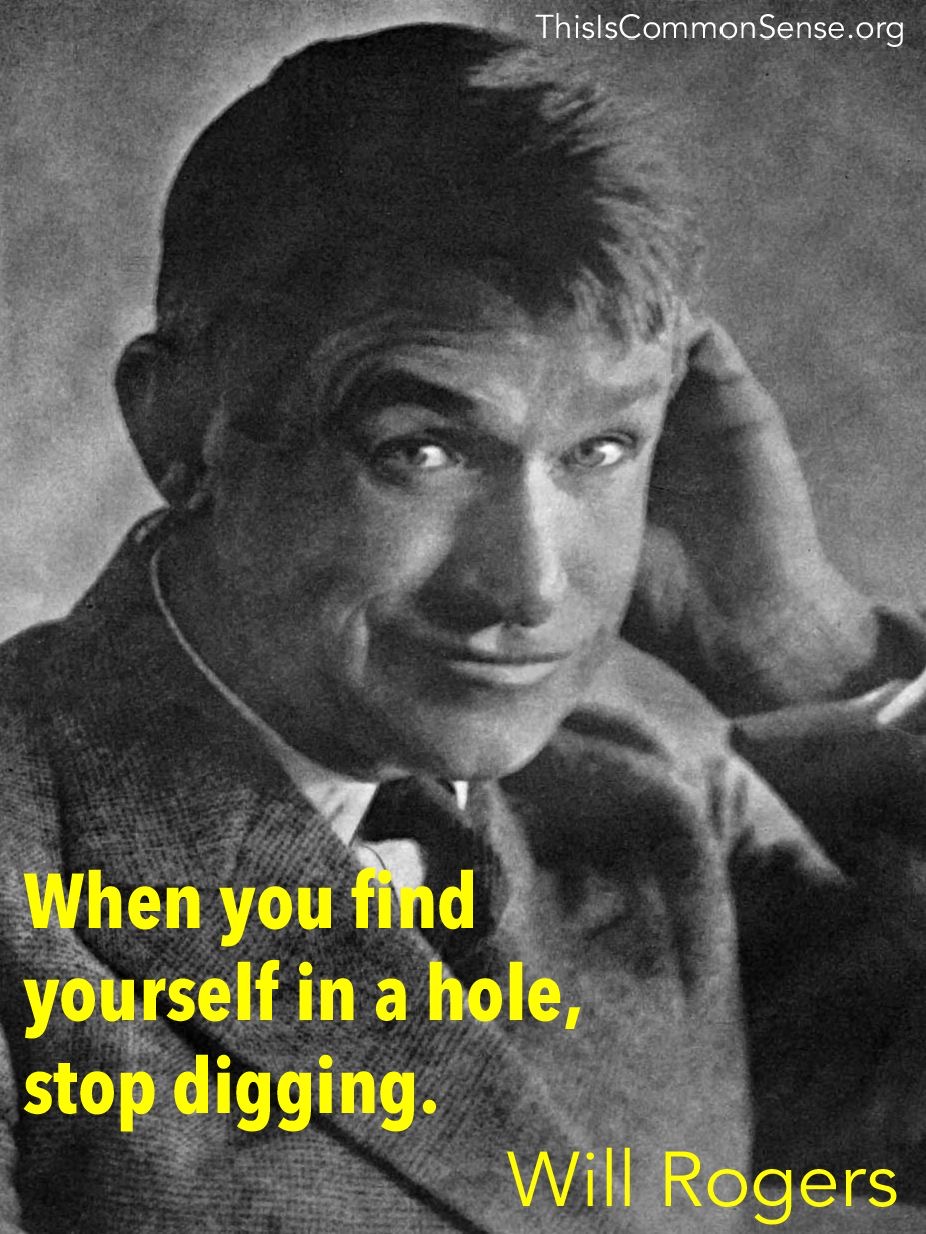
Will Rogers

When you find yourself in a hole, stop digging.

Categories
Thought

Yves Guyot

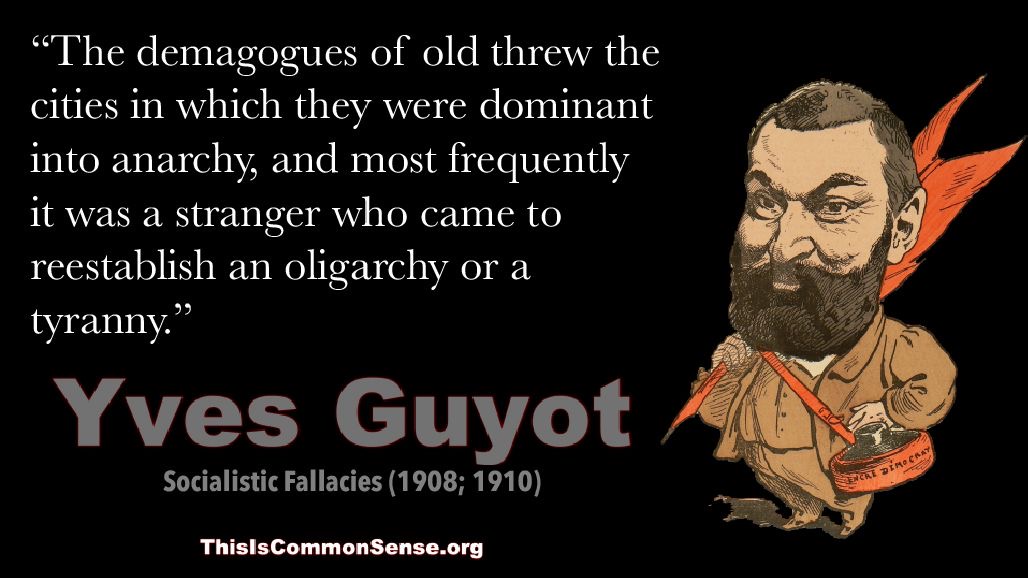
The demagogues of old threw the cities in which they were dominant into anarchy, and most frequently it was a stranger who came to reestablish an oligarchy or a tyranny.

Yves Guyot, Socialistic Fallacies (1908; 1910).

Categories
by Paul Jacob video

Watch: The Menace at the Top?

Paul covers the big stories of the week during this episode of the weekend podcast:

This Week in Common Sense, October 31, 2020.
Categories
audio podcast

Listen: The Menace at the Top of the Stairs

Paul Jacob knows a menace when he sees it. But sometimes one must choose the lesser of two menaces!

This Week in Common Sense, October 31, 2020.
Categories
Thought

Joseph Addison

The great art in writing advertisements is the finding out a proper method to catch the reader’s eye; without which a good thing may pass over unobserved, or be lost among commissions of bankrupt.

Joseph Addison, The Tatler (1711-1714), No. 224.
Categories
initiative, referendum, and recall

A Referendum to Reinstate Racism

Fighting racism should be at least conceptually easy.

The California Assembly referred to Golden State voters Proposition 16, a constitutional amendment that would repeal a previous constitutional amendment voters had authorized in 1996, with Proposition 209. 

That amendment “stated that discrimination and preferential treatment were prohibited in public employment, public education, and public contracting on account of a person’s or group’s race, sex, color, ethnicity, or national origin,” Ballotpedia explains. “Therefore, Proposition 209 banned the use of affirmative action involving race-based or sex-based preferences in California.”

But important and well-monied interests really want to “use affirmative action programs that grant preferences based on race, sex, color, ethnicity, and national origin. . . .” 

The list of supporters is a veritable Who’s Who of California Democrat pols and corporations and major lobbying organizations. They’ve spent almost $20 million and counting. 

The opposition, organized as Californians for Equal Rights, consists of a smattering of Republican pols and a few non-partisan organizations such as Students for Fair Admissions, and has spent about $1.2 million.

While fighting racism with a prohibition on discrimination in government hiring, and the like, is simple, clear, and across-the-board, fighting racism by preferring individuals of some races over those in others is cumbersome. And nutty.

And wrong.

Usually billed as “compensation” for past ills, it fosters a politics of resentment and inevitably leads to society-wide racial feuding.

Why so popular among “blue” pols? 

There’s money in divisiveness, pitting one group off another.

Over 16 times more money, apparently.

Think of Prop 16 as a litmus test. Will “blue” California buy into the politics of racial division? 

Or will Golden State voters stick with the color-blind principles most Americans favor?

This is Common Sense. I’m Paul Jacob.


PDF for printing

See all recent commentary
(simplified and organized)
See recent popular posts

Categories
international affairs national politics & policies

In Deep with Biden

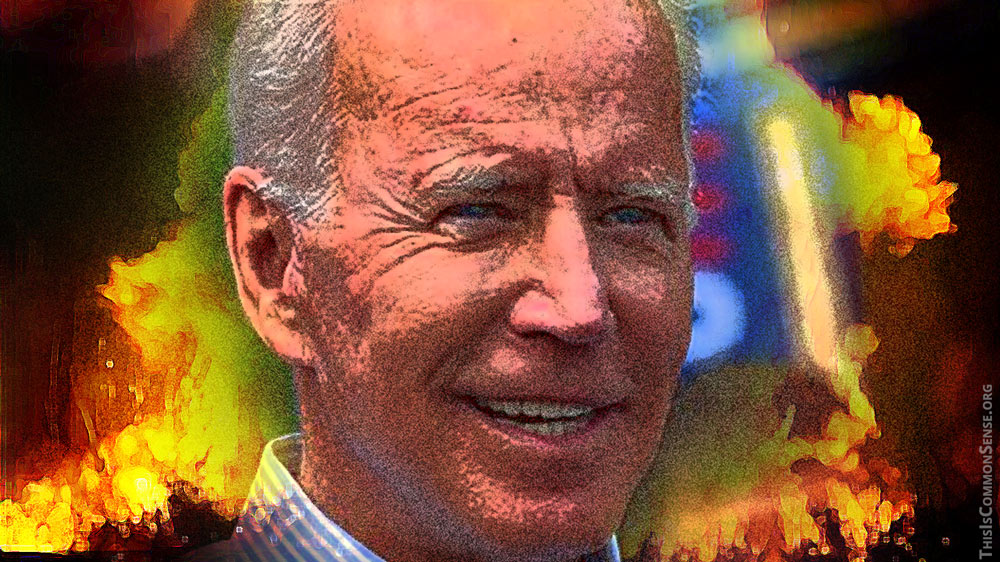
On Election Day, “the Empire hopes to strike back,” writes Daniel McCarthy for The Spectator. “Joe Biden personifies the foreign policy of endless war that Democrats and neoconservatives pursued for 25 years, from the end of the Cold War until the election of Donald Trump in 2016.”

McCarthy argues that “Biden’s overall record is one of foreign policy interventionism,” but Biden’s Senate voting record is iffy-fifty: Biden “voted for the Iraq War, but he also voted against the 2007 surge.” He voted for the 1999 Serbian war, which destabilized relations with Russia, allowing the rise of Putin. But Biden voted against 1991’s Persian Gulf adventure which set the stage for post-Cold War American megalomania.

Nevertheless, McCarthy argues that “Joe Biden is an archetypal liberal interventionist of the post-Cold War variety. He understands war in the same terms as domestic policy: as an occasion to expand the power wielded by experts in Washington, whose moral and rational qualifications are beyond question — no matter how disastrous the consequences of their policies.”

Such a plausible case. War is certainly government “activism.”

McCarthy has spotted a real problem in “progressive liberalism,” and understands the “peer pressure” that so oppressively rules in the corridors of power. But he misses — perhaps merely for reasons of space — the sheer institutional power of the Deep State. It holds the secrets, it controls vast amounts of money, its immensity overpowers rational thought.

It is the government we cannot get to; it is the government that tried to “get” Trump.

Perhaps our “right to petition the government” can skip Congress and go right to the source, the Deep State.

Which really wants Biden to win.

This is Common Sense. I’m Paul Jacob.


PDF for printing

See all recent commentary
(simplified and organized)
See recent popular posts
Categories
Thought

James Branch Cabell

The optimist proclaims that we live in the best of all possible worlds; and the pessimist fears this is true.

The character “Coth of the Rocks,” in James Branch Cabell, The Silver Stallion: A Comedy of Redemption (1926).

Categories
national politics & policies political challengers

Right at the Top of the Stairs

“I’m appalled by the choice that we have been delivered,” political humorist P.J. O’Rourke told Reason TV last week, referring to the two major-party presidential nominees.

“Biden’s campaign platform is 564 pages long. It promises everything to everybody,” bemoans the 72-year-old author of a new book of essays, A Cry from the Far Middle: Dispatches from a Divided Land. “It’s full of unicorns and flying ponies and candy-flavored rainbows and pixie dust.”

As for President Trump, “I think we’re done with this experiment of having the inmates run the asylum,” O’Rourke jabs, calling Trump a “dangerous and unpredictable man” and “rude.” 

“It isn’t so much exactly what Trump has done,” admits the comedic writer, who while panning Trump’s immigration policies, lauded his lowering of corporate tax rates and his raising of “awareness that China is not our friend.”

Instead, O’Rourke argues “it’s a matter of what [Trump] can do” in a second term, calling him “a toddler at the top of the stairs.”

Speaking of . . . P.J. turned back to the Democratic ticket: “They seem to be wrong, all wrong, quite wrong, about everything.” 

He’s not wrong.

“But” of Biden and Harris, O’Rourke contends they are “wrong between normal parameters of wrong.” Adding that, “There’s wrong and there’s damn wrong.” Meaning Trump is “damn wrong.” 

But not wrong on taxes, right P.J.? Or China. Or picking Supreme Court justices — Trump has the best batting average for nominating to the High Court of any president in the last five decades. 

And Mr. Trump is the first president in two decades not to drag the U.S. into a regime change war.

“Wrong on everything” or “a toddler at the top of the stairs”?

This P.J. thinks the better choice is Common Sense. 


PDF for printing

See all recent commentary
(simplified and organized)
See recent popular posts