Categories
Accountability local leaders tax policy

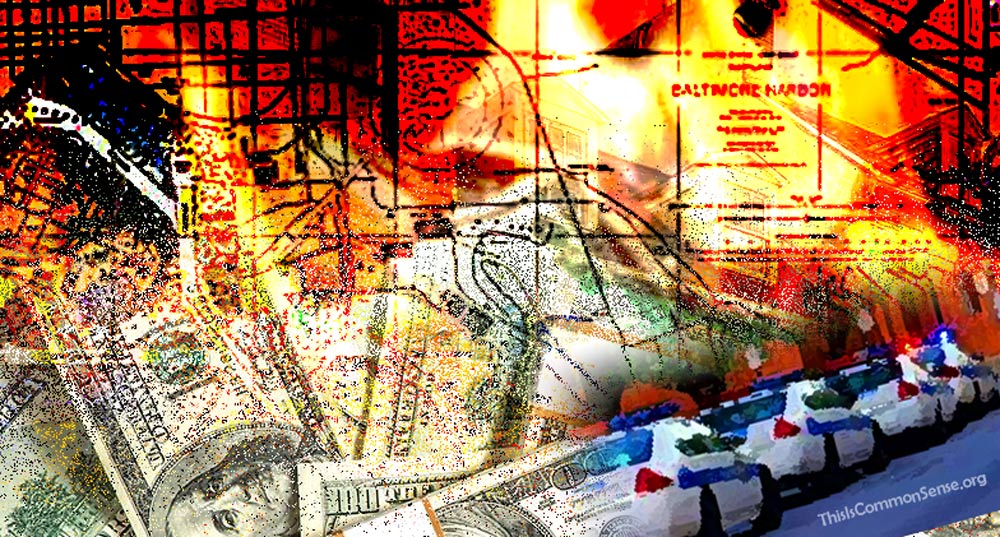
Balking in Baltimore

So far, the besieged businessmen of the Fells Point area of Baltimore are only threatening to withhold payments of taxes and fees to the city.

If and when they follow through, the plan is to place the withheld funds in escrow. The money would then be turned over to the city government if and only if the city again meets minimal standards of performance. 

Tax resistance? Sure. But not in the usual mode.

Fells Point shop owners are rebelling against a “culture of lawlessness” in their streets, streets managed or mismanaged by the city. They want police to do more — be free to do more — about crime.

In a letter to Baltimore Mayor Brandon Scott and other officials submitted not long after several shootings in the area, thirty-seven Fells Point businessmen demand that the city “Pick up the trash. . . . Enforce traffic and parking laws. . . . Stop illegal open-air alcohol and drug sales. . . . Empower police to responsibly do their job. . . . Please do your job so we can get back to doing ours.”

What will happen? I fear that, despite this worthy protest, city officials will continue to turn a blind eye. I fear that they will regard the protest as a PR problem, one that will go away and allow them to go on with the usual business of government — the way they see it. Their evasive initial responses to the letter are not encouraging.

Baltimore businesspeople are not trying to dodge city taxes here. They understand very well that one cannot expect to get something for nothing. They just want to get something.

This is Common Sense. I’m Paul Jacob.


PDF for printing

See all recent commentary
(simplified and organized)
See recent popular posts
Categories
Thought

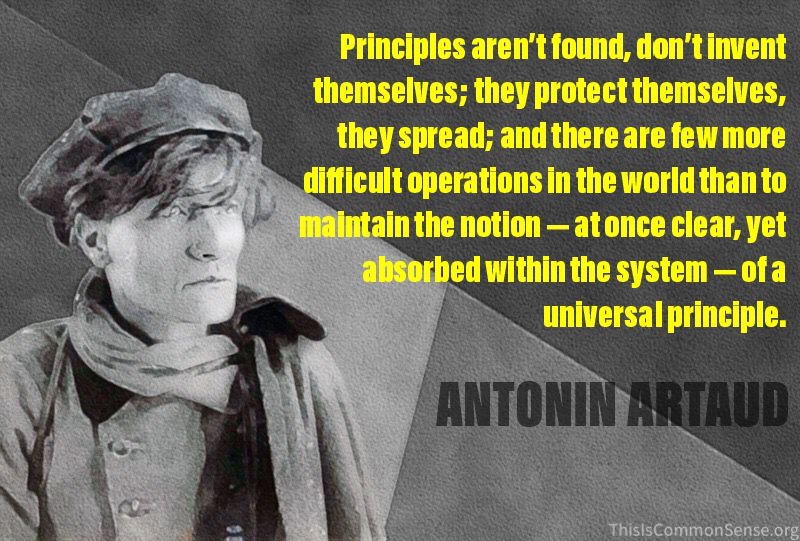
Antonin Artaud

Principles aren’t found, don’t invent themselves; they protect themselves, they spread; and there are few more difficult operations in the world than to maintain the notion — at once clear, yet absorbed within the system — of a universal principle.

Antonin Artaud, Heliogabalus: The Crowned Anarchist (1934).

Categories
term limits

Senatorial Senility

“We have the oldest Senate in American history,” Roxanne Roberts writes in The Washington Post

Roberts rattles off the five octogenarians — Sen. Diane Feinstein (D-Calif.), age 88; Sen. Charles Grassley (R-Iowa), age 87; Richard Shelby (R-Ala.), age 87; Sen. James Inhofe (R-Okla.), age 86; and Sen. Pat Leahy (D-Vt.), age 81 — and tells us that “Twenty-three members of the Senate are in their 70s,” noting that “only one is under 40.”

That fledgling 34-year-old whippersnapper is newly elected Georgia Democrat Jon Ossoff. But being 30 years younger than the current Senate average doesn’t make him better, that’s for sure.

Age isn’t the problem. Not exactly.

My issue with octogenarian Senators Feinstein, Grassley, Shelby, Inhofe and Leahy is that they’ve been politicians in Washington for the last 28, 40, 43, 34, and 46 years, respectively.

That’s way too long. They stop being one of us, representing us. And, left, right or in-between, we know it.

“Senior senators often stay for decades,” Roberts argues, “because voters are reluctant to give up the perks of incumbency: Seniority, committee chairmanships and all the money poured into their states.”

Ha! The idea that actual voters are unwilling to “give up the perks of incumbency” is laughable. It’s the incumbents themselves who leverage their votes in Congress to dramatically out-fundraise their challengers. 

Voters rarely get much choice.

No wonder, then, that when people got a chance to vote to term-limit their own congressmen — they did so enthusiastically

President Truman once quipped that legislative term limits would help “cure senility, and seniority — both terrible legislative diseases.” He understood that the Senate’s age problem is not time on the planet. It is the time in office.

This is Common Sense. I’m Paul Jacob.


* Another example was the late Sen. Thad Cochran, who thankfully decided to step down in 2018 — at 80 years of age after 44 years in Congress — none too soon.

PDF for printing

See all recent commentary
(simplified and organized)
See recent popular posts

Categories
Today

Nineteen Eighty-Four

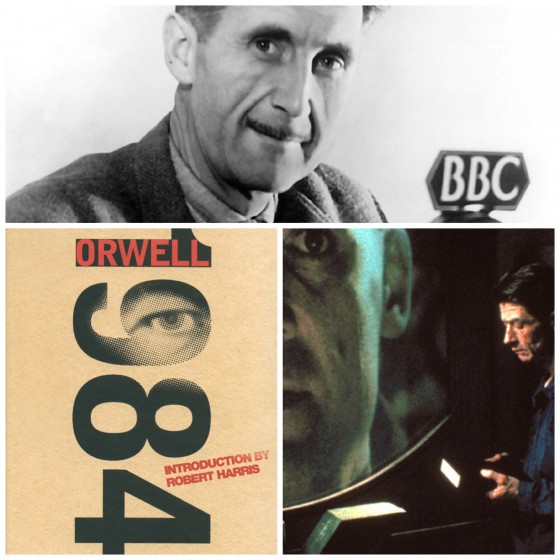
On June 8, 1949, George Orwell’s dystopian novel Nineteen Eighty-Four was published.

Categories
general freedom international affairs

June 4: Tiananmen 32

Will truth ever be bought-off or beaten-down enough to satisfy Chinese President Xi Jinping and the Butchers of Beijing?

The ‘Butchers’ nickname came 32 years ago today — from the clearing of Tiananmen Square by soldiers and tanks in the early morning hours of June 4th, and in opening fire on and murdering thousands of Chinese citizens outside the square. 

Someone may object that Xi, the General Secretary of the Chinese Communist Party (CCP) since 2012, can’t be blamed. He wasn’t in charge back in 1989.

Xi didn’t give the order for troops to kill the unarmed students and workers who filled Tiananmen Square for weeks with as many as a million people protesting for freedom and democracy. Nor did he have thousands more arrested and imprisoned after the massacre. In fact, Xi’s father “condemned the use of force against protesters during the 1989 Tiananmen Square protests,” informs U.S. News

But Xi cannot escape the taint of Tiananmen. Not only does Human Rights Watch charge that government repression under his unlimited rule is “at its worst level since the Tiananmen Square massacre,” Xi and today’s CCP are on a mission to memory-hole Tiananmen. 

How? 

By massacring any public memorial of the massacre.

While the truth about Tiananmen has always been verboten in China, freer folks in Hong Kong held massive memorials each year. “Last year’s vigil was banned for the first time because of the coronavirus,” Yahoo News explains, “but thousands defied police and rallied anyway.”

This year, however, the new national security law threatens five years in prison for attending an unauthorized rally. Chanting “Democracy for China!” could land a Hongkonger in prison for life.*

Thankfully, in America today we have the freedom to condemn the Chinazis

And remember June 4. 

This is Common Sense. I’m Paul Jacob.


* And it has already begun: “Hong Kong cracks down on Tiananmen commemorations, arrests vigil organiser.”

PDF for printing

See all recent commentary
(simplified and organized)
See recent popular posts
Categories
Thought

Veuillot’s Law

When I am weaker than you, I ask you for freedom because that is according to your principles; when I am stronger than you, I take away your freedom because that is according to my principles.

Louis Veuillot, as quoted by Frank Herbert, Children of Dune (1976).
Categories
Today

Citizenship

On June 2, 1924, President Calvin Coolidge signed the Indian Citizenship Act into law, granting citizenship to all Native Americans born within the territorial limits of the United States.

Categories
Thought

Nassau Senior

When we read of African and Asiatic tyrannies, where millions seem themselves to consider their own happiness as dust in the balance compared with the caprices of their despot, we are inclined to suppose the evils of misgovernment to be the worst to which man can be exposed. But they are trifles compared to those which are felt in the absence of government. The mass of the inhabitants of Egypt, Persia, and Burmah, or to go as low as perhaps it is possible, the subjects of the Kings of Dahomi and Ashantee, enjoy security, if we compare their situation with that of the ungoverned inhabitants of New Zealand. So strongly is this felt, that there is no tyranny which men will not eagerly embrace, if anarchy is to be the alternative. Almost all the differences between the different races of men, differences so great that we sometimes nearly forget that they all belong to the same species, may be traced to the degrees in which they enjoy the blessings of good government.

Nassau William Senior, Esq., Political Economy (Third Edition: 1854), p. 75–6.
Categories
education and schooling ideological culture

Asian Privilege?

Seventy-three.

That’s the number that stood out to me in George Will’s Sunday column, “Anti-Asian racism disguises itself as ‘diversity.’”

Seventy-three percent of the smart students at Thomas Jefferson High School happen to be Asian. TJHS is a highly-rated STEM magnet school in Virginia’s Washington, D.C. suburbs, where entry had, until recently, been based on an admissions exam. 

That’s more than three times the percentage of Asian Americans among Fairfax County, Virginia, public school students

European-American students make up the largest racial block at 38 percent, but account for only 18 percent of attendees at this elite high school. Hispanics represent 27 percent of all students and African Americans 10 percent, but garnered, respectively, 3 and 1 percent of the coveted slots.

Are educators specifically advantaging Asian kids? 

Well, more than 80 percent of Fairfax County teachers are white, 7 percent black and only 5 percent Asian, says a separate Post report. Asian privilege seems unlikely.

So . . . what are Asian American students doing differently?

Studying? 

Will recounts complaints by the county superintendent about Asian American parents spending too much on test preparation and the Virginia Secretary of Education compared such studying to using “performance enhancing drugs” in sports.

Another factor in having “crazy” parents who obsess about their children doing well in school could be doubling the odds by having not one, but two parents — not to mention an extended family structure. Among blacks, Hispanics and whites, out-of-wedlock births account for 69, 52 and 28 percent of all births, respectively. But for Asian Americans, out-of-wedlock births are under 12 percent.

One can jigger the rules for getting into TJ High. Sure. 

Jiggering the rules for getting ahead in life? Much harder.

This is Common Sense. I’m Paul Jacob.


PDF for printing

family / mind / JG

See all recent commentary
(simplified and organized)
See recent popular posts

Categories
Thought

Nassau Senior

It is obvious, however, that the division of labour on which government is founded, is subject to peculiar evils. Those who are to afford protection must necessarily be intrusted with power; and those who rely on others for protection lose, in a great measure, the means and the will to protect themselves. Under such circumstances, the bargain, if it can be called one, between the government and its subjects, is not conducted on the principles which regulate ordinary exchanges. The government generally endeavours to extort from its subjects, not merely a fair compensation for its services, but all that force or terror can wring from them without injuring their powers of further production. In fact, it does in general extort much more: for if we look through the world we shall find few governments whose oppression does not materially injure the prosperity of their people.

Nassau William Senior, Esq., Political Economy (Third Edition: 1854), p. 75.