Categories
obituary

Jane Jacob (1934–2022): In Memoriam

My mom, Jane Jacob, passed away yesterday, peacefully, at 88 years of age. She was the best person I’ve ever known and she loved life with a passion. I’ll miss her, but she will always be with me.

I could re-title this “My Mom for Heaven,” but as a good friend put it: “I just wish her a good trip; I’m certain her ticket is punched.”  

In her honor, I’m re-publishing this commentary that first appeared on April 14, 2015.

My mom for president

My Mom for President

My musing, yesterday, about Hillary Clinton’s hat throw into the presidential ring failed to recognize that yesterday was also my mother’s 81st birthday.

Jane Jacob is not yet an announced presidential candidate, but when I think of a hard-working, organized, smart and always-optimistic woman — someone who keeps promises and looks out for the other person; someone with commitment to principle — I think of her.

Not Hillary Clinton.

Maybe Mrs. Clinton would have put in the hours playing catch with me as a tyke. But can Hillary even catch? My mom can. And throw too. (Not like a — well, incorrectly, either gender.)

My mom has a soft heart. I remember coming home from school and seeing her crying from watching a soap opera.

Nonetheless, she can dish out tough love. During a family clean-up effort (like a Bataan death march, but in English) she asked if one of us six kids could do something or other. I stepped forward to say, “I’ll try.”

Mom looked at me plainly and explained, “I need someone to do it, Paul, not just try.”

She is still full of fun and passion. Her deep love and concern for America’s freedom has certainly had an enormous impact on my life.

Too bad my mom’s not running.

Hillary Clinton has demonstrated none of the presidential timber my mom has, and yet Clinton is very likely to enjoy a large electoral advantage among women voters. So, here’s my idea: the Democratic Party’s competition should each nominate a woman for the top of the ticket. There are plenty of women qualified to serve as president. Not just my mom.

May the best woman win.

Have I started a stampede to office supply stores to buy binders?

This is Common Sense. I’m Paul Jacob.

April 14, 2015


PDF for printing

See all recent commentary
(simplified and organized)
See recent popular posts

Categories
Thought

Joel Feinberg

[T]rue understanding of human nature requires freedom, since without liberty there will be little diversity, and without diversity all aspects of the human condition will be ascribed to fixed nature rather than to the workings of a particular culture.

Joel Feinberg, Social Philosophy (1973), p. 22.
Categories
Today

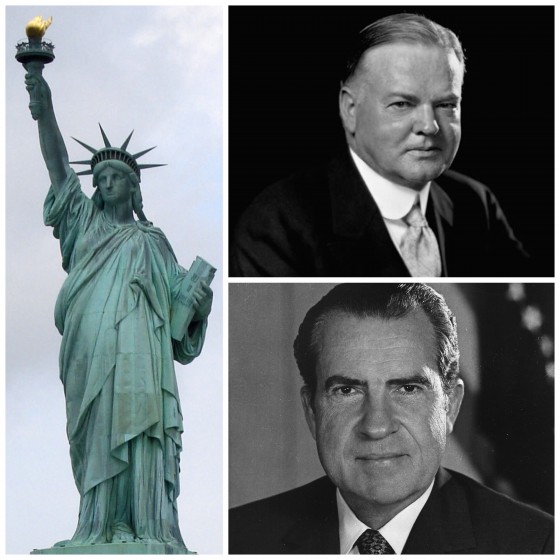
The Statue of Liberty

The Statue of Liberty arrived in New York Harbor on June 17, 1885.


On the same day in 1930, progressive Republican President Herbert Hoover — eager to please agricultural states, and confident that protectionism would yield greater wealth — signed the Smoot-Hawley Tariff. The Great Depression deepened, ratcheting up as each provision of the bill took effect.

Three years later, investment author and two-time Libertarian Party presidential candidate Harry Browne was born

On June 17, 1944, Iceland declared independence from Denmark.

On this day in 1971, President Richard Nixon declared a “War on Drugs,” which steadily decreased civil liberty and the rule of law in America.

Exactly one year later, five men were arrested for attempted burglary on the offices of the Democratic National Committee in the Watergate complex in Washington, D.C., igniting the Watergate scandal that ultimately led to the resignation of U.S. President Richard Nixon more than two years later.

Categories
First Amendment rights international affairs Internet controversy

The Coffee Connection

We have another indication now that the Internet of Things can be a mixed blessing. Perhaps not every gadget in our homes should be linked to the Worldwide Everything?

The great thing about a coffee maker with a Wi-Fi or Bluetooth connection is that you can set things up with a few taps on your smartphone. Brewing times, strength, temperature, etc., can all be arranged without ever having to trudge from bedroom to kitchen.

The horrible thing, though — in addition to the slim possibility that a hacker will take your coffee machine hostage — is that a Wi-Fi-capable coffee maker made in China may be spying on you on behalf of the Chinazi government.

This is the conclusion of Christopher Balding, a researcher who finds evidence that coffee machines manufactured by Kalerm in Jiangsu, China, collect a diverse array of data.

About their users. 

Stuff like the users’ names and general locations as well as usage patterns.

Balding doesn’t know for sure that the company simply turns over such data to the government. But Chinese companies must cooperate with any government demands, and Balding notes that China often gathers as much data as possible and figures out what to do with it later.

The data-scavenging of the Chinese government is not exactly unique. Think Ed Snowden and the program he revealed, for example. But “the breadth and depth of their data-collection efforts” are in a class by themselves, Balding says.

It seems that my lack of a connected coffee machine, coupled with my chronic dependence on Starbucks, is proving very wise indeed.

This is Common Sense. I’m Paul Jacob.


PDF for printing

See all recent commentary
(simplified and organized)
See recent popular posts
Categories
Thought

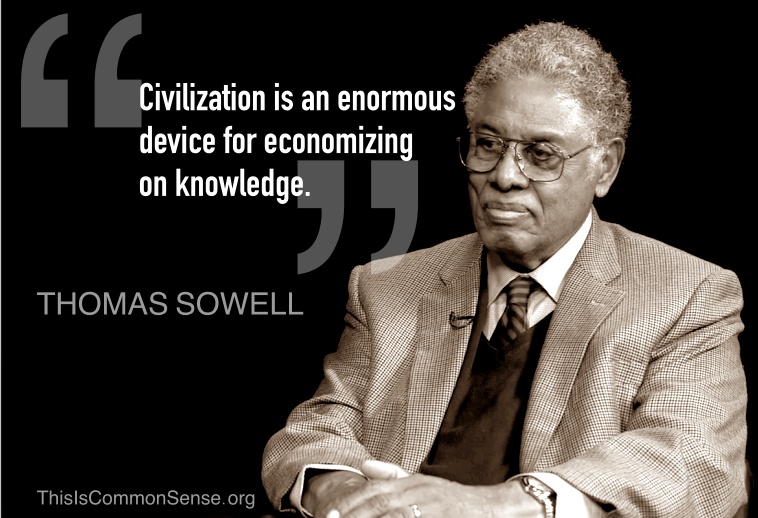
Thomas Sowell

Civilization is an enormous device for economizing on knowledge.

Thomas Sowell, Knowledge and Decisions (1980; 1996.
Categories
Today

To Freedom

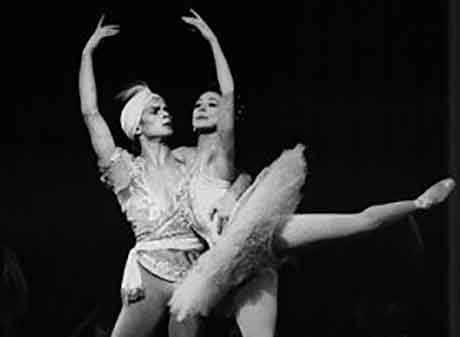
On June 16, 1961, dancer Rudolf Nureyev defected from the Soviet Union.


The great Scottish moral philosopher, political economy pioneer, and Enlightenment intelectual Adam Smith (1723-1790), best known for authoring the 1776 masterwork The Wealth of Nations, was born on June 16.

On June 16, 1858, Abraham Lincoln delivered his “House Divided” speech in Springfield, Illinois.

On this date in 1963, the Soviet Space Program achieved a first with the Vostok 6 mission, placing Cosmonaut Valentina Tereshkova into orbit as the first woman in space.

June 16th is Bloomsday, a celebration of the life and work of Irish expatriate author James Joyce (1882-1941). The date was selected because June 16, 1904, was the date in which Joyce’s 1922 novel Ulysses was set. The ceremonial day is named after the character Leopold Bloom.

Categories
government transparency

Now A Straight Answer?

Last week, the National Aeronautics and Space Administration (NASA), “America’s civil space program and the global leader in space exploration,” got in on the UFO disclosure racket.

Why that word, “racket”? 

UFO skeptics and mockers have been using that sort of word to describe the subject itself — unidentified advanced aerial phenomena on the planet — but now we hear UFO “nuts” useit to describe NASA’s announcement. 

“A crock,” says Tyler Glockner of the popular SecureTeam10 channel, reminding us of NASA’s nickname: “Never A Straight Answer.”

Many UFO researchers believe that NASA has been “in” on “the UFO cover-up” from the beginning of its mission.

I know nothing about that, but I do know that we cannot trust government. 

While rumors about NASA programs to scrub photos of the Moon and Mars to get rid of alien structures on the surfaces of those two bodies, as well as alien craft, are outlandish, so to speak — it surely looks like something is going on regarding UFOs.

While NASA insists that it “is not part of the Department of Defense’s Unidentified Aerial Phenomena Task Force or its successor, the Airborne Object Identification and Management Synchronization Group,” which have so far dominated recent UFO news headlines, it does proclaim that it is coordinating with other agencies. 

More significantly, physicist Michio Kaku recently changed his tune on UFOs, and is talking of an independent research group that confirms the physical reality of UFOs darting about with advanced physical attributes.

Not new, I know: same thing French scientist Jacques Vallee wrote in the 1960s, and General Twining apparently memo’ed in the ’40s. 

In covering this issue for the last few years, my point has been: government transparency. Let’s remember the long history of government agencies stringing us opaquely along.

This is Common Sense. I’m Paul Jacob.


PDF for printing

See all recent commentary
(simplified and organized)
See recent popular posts

Categories
Thought

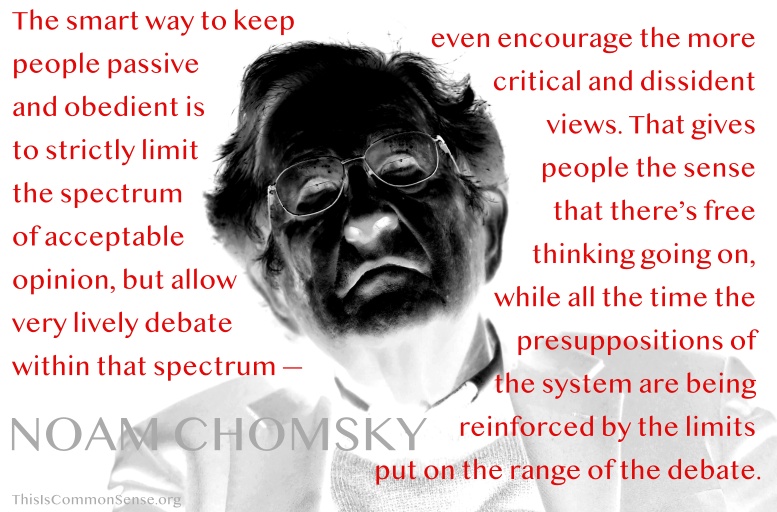
Noam Chomsky

The smart way to keep people passive and obedient is to strictly limit the spectrum of acceptable opinion, but allow very lively debate within that spectrum — even encourage the more critical and dissident views. That gives people the sense that there’s free thinking going on, while all the time the presuppositions of the system are being reinforced by the limits put on the range of the debate.

Noam Chomsky, The Common Good (1988).
Categories
Today

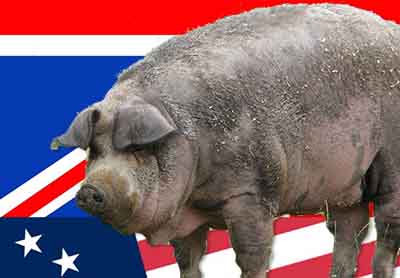
Pig War!

The Oregon Treaty, signed June 15, 1846, established the boundary between Great Britain’s Canadian territory and the United States of America, from the Rocky Mountains to the Strait of Juan de Fuca, using the 49th Parallel as the handy marker. However, the treaty was not exactly clear on the territorial status of the San Juan Islands, so exactly 13 years later, to the day, a war erupted . . . over a shot pig.

An American farmer shot a pig rooting through his garden. The pig belonged to an Irishman. The two did not agree upon compensation, and “the authorities” were called in, with infantry mustering from the south and the Governor of Vancouver Island instructing marines to land on San Juan Island — though the rear admiral in charge refused to comply with the order, on the reasonable grounds that war over a pig was not worth it. Local troops from both sides lined up against each other, but under command to defend themselves only and not shoot first. All that was exchanged in this war were insults. It turned out to be a bloodless war, discounting the pig, so it might qualify as the best war in American history.

Categories
media and media people term limits

Meet the Personal Interest

“Poll after poll finds American voters believing the country is on the wrong track,” Chuck Todd, host of NBC’s Meet the Press, told viewers last Sunday. “And if there’s one other thing that Democrats and Republicans have in common these days, it’s that they don’t trust Washington to fix it.”

Is this a smart electorate or what?

Todd compared today’s public mood to October 2001, just after the 9/11 terrorist attack. Back then, solid majorities of both Democrats and Republicans “had trust in that Republican control of government. Twenty years later, these numbers have collapsed among both parties. . . . Republicans down to just 9 percent trust in government to do what’s right most or all of the time.

“It’s a Democratic government,” he added. “That’s why the Democratic number’s a little higher here [29%], but this is really troubling.” 

And then Mr. Todd even posed the right question: “How did we get here?”

Calling the public “very cynical” — shouldn’t you be, if paying attention? — Todd explained that most Americans don’t believe “that most candidates that run for office . . . do it to serve the community. Only 21% think people run for office in order to worry about the greater good — 19% of Democrats think this, 24% of Republicans.

“A full 65% think most candidates run for office to serve their personal interests, nothing else,” he added. “And this is across the board — 66% of Democrats believe this, 63% of Republicans.”

Todd suggested “this may be bigger than any polarization problem that we have.”

It is bigger. But it’s an easy problem to solve. Just takes two words to bring back public trust in those who represent us, in them not just representing themselves, their personal career interests.

Term limits.

This is Common Sense. I’m Paul Jacob.


PDF for printing

See all recent commentary
(simplified and organized)
See recent popular posts