Categories
Thought

Ludwig von Mises

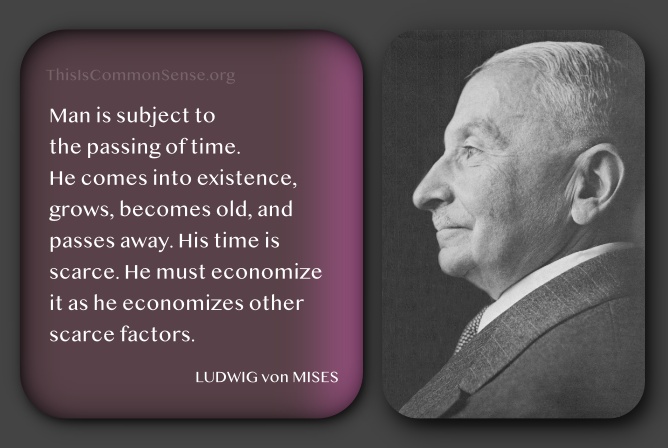
Man is subject to the passing of time. He comes into existence, grows, becomes old, and passes away. His time is scarce. He must economize it as he economizes other scarce factors.

Ludwig von Mises, Human Action: A Treatise on Economics (1949).
Categories
Today

Stars and Stripes

On June 14, 1777, U.S. Congress adopted the Stars and Stripes as the United States Flag.

Categories
crime and punishment general freedom Second Amendment rights

Dis-Armoring the Public

According to the government of New York State, it should be as easy as possible for a mass shooter to do the job.

No, this is not the stated goal of the “landmark legislative package” signed by Governor Hochul. It is merely what the result will be . . . to the extent that these new laws further prevent innocent persons from arming and armoring themselves.

You see, determined killers have no qualms about evading gun-control laws, or much difficulty evading them. In New York, these laws now include a prohibition on selling body armor to anyone not a member of “specified professions” like the military and law enforcement.

Lawmakers and the governor ignore the slew of categories of other people who may have reason to especially protect themselves in public: unpopular people, famous people, wealthy people, people living in crime- or riot-ridden areas, and nervous people who, in the judgment of somebody else, may be going overboard.

All have a right to protect themselves.

But that’s a right not now defended in New York, whose politicians prefer to enact silly “performative” legislation banning “devices incapable of offensive  use.” New Yorkers are just not supposed to notice that, in preparing to commit their crimes, bad guys do often use many of the same tools used by good guys to defend themselves . . . or just to eat steak (knives have been used to commit crimes) or go to the store (as cars can kill on purpose as well by accident).

It seems unlikely that governments will one day also restrict sales of steak knives and four-wheeled vehicles to members of specified blessed professions. But the dictates of mere common sense provide no assurance here.

This is Common Sense. I’m Paul Jacob.


PDF for printing

See all recent commentary
(simplified and organized)
See recent popular posts

Categories
Thought

Milton Friedman

Inflation is always and everywhere a monetary phenomenon in the sense that it is and can be produced only by a more rapid increase in the quantity of money than in output.

Milton Friedman, The Counter-Revolution in Monetary Theory (1970).
Categories
Today

Anti-slavery

On June 13, 1774, Rhode Island became the first British colony in the Americas to prohibit the importation of slaves.

Categories
by Paul Jacob video

Watch: U-Turn on a Long, Wrong Road

Paul Jacob’s back from his long stint “on the road,” and he begins talking about a Turkish proverb and its significance for politics in these bizarre, dangerous times.

Categories
Thought

Ludwig von Mises

If social conditions did not fulfill the wishes of the reformers, if their utopias proved unrealizable, the fault was seen in the moral failure of man. Social problems were considered ethical problems. What was needed in order to construct the ideal society, they thought, were good princes and virtuous citizens. With righteous men any utopia might be realized.

The discovery of the inescapable interdependence of market phenomena overthrew this opinion. Bewildered, people had to face a new view of society. They learned with stupefaction that there is another aspect from which human action might be viewed than that of good and bad, of fair and unfair, of just and unjust. In the course of social events there prevails a regularity of phenomena to which man must adjust his actions if he wishes to succeed. It is futile to approach social facts with the attitude of a censor who approves or disapproves from the point of view of quite arbitrary standards and subjective judgments of value. One must study the laws of human action and social cooperation as the physicist studies the laws of nature. Human action and social cooperation seen as the object of a science of given relations, no longer as a normative discipline of things that ought to be — this was a revolution of tremendous consequences for knowledge and philosophy as well as for social action.

Ludwig von Mises, Human Action: A Treatise on Economics (1949).
Categories
Today

Rights

In 1776, on June 12, the Fifth Virginia Convention at Williamsburg, Virginia, unanimously adopted a Declaration of Rights, several weeks prior to the adoption of the state’s constitution. George Mason (pictured above), who drafted the document, stated clearly in the preamble that rights must be “the basis and foundation of Government.”

The first four planks run as follows:

I. That all men are by nature equally free and independent, and have certain inherent rights, of which, when they enter into a state of society, they cannot, by any compact, deprive or divest their posterity; namely, the enjoyment of life and liberty, with the means of acquiring and possessing property, and pursuing and obtaining happiness and safety.

II. That all power is vested in, and consequently derived from, the people; that magistrates are their trustees and servants, and at all times amenable to them.

III. That government is, or ought to be, instituted for the common benefit, protection, and security of the people, nation or community; of all the various modes and forms of government that is best, which is capable of producing the greatest degree of happiness and safety and is most effectually secured against the danger of maladministration; and that, whenever any government shall be found inadequate or contrary to these purposes, a majority of the community hath an indubitable, unalienable, and indefeasible right to reform, alter or abolish it, in such manner as shall be judged most conducive to the public weal.

IV. That no man, or set of men, are entitled to exclusive or separate emoluments or privileges from the community, but in consideration of public services; which, not being descendible, neither ought the offices of magistrate, legislator, or judge be hereditary.

Categories
audio podcast

Listen: U-turn Time

The big stories of the week revolve around big government, which mean big theft, which is not unrelated to socialism:

Categories
Thought

Ludwig von Mises

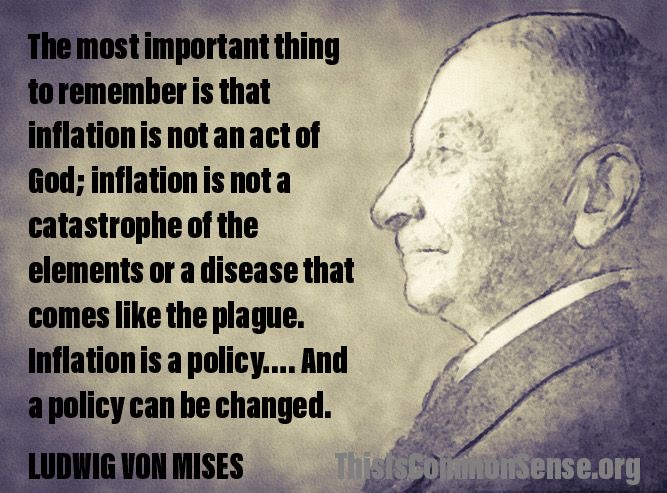
The most important thing to remember is that inflation is not an act of God; inflation is not a catastrophe of the elements or a disease that comes like the plague. Inflation is a policy — a deliberate policy of people who resort to inflation because they consider it to be a lesser evil than unemployment. But the fact is that, in the not very long run, inflation does not cure unemployment.

Inflation is a policy. And a policy can be changed. Therefore, there is no reason to give in to inflation. If one regards inflation as an evil, then one has to stop inflating.

Ludwig Edler von Mises, fourth lecture from Economic Policy: Thoughts for Today and Tomorrow (1979; 1995; 2006).