Categories
Thought

Thoreau

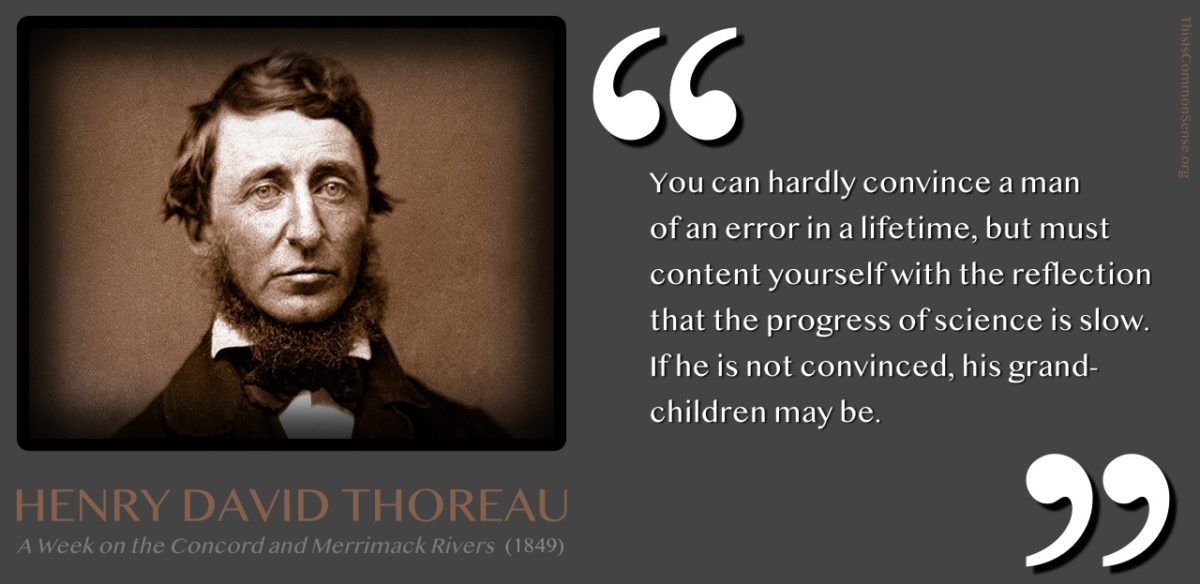
You can hardly convince a man of an error in a lifetime, but must content yourself with the reflection that the progress of science is slow. If he is not convinced, his grandchildren may be.

Henry David Thoreau, A Week on the Concord and Merrimack Rivers (1849).
Categories
Today

“Malaise”

On July 15, 1976, Jimmy Carter accepted the nomination of the Democratic Party to run for the presidency.

Three years later, as president, he gave his infamous “malaise” speech, in which he focused on energy but did not mention the one thing that actually helped turn the 1970s’ energy crisis around: the phased deregulation of oil prices that had started three months earlier, under his own directive. Instead of touting this deregulatory effort, Carter did the politic thing, promising a number of new government programs while extensively grinding a “crisis of confidence” message and vaguely speaking of a spiritual challenge.

The deregulation was startlingly effective, in the long run — though the immediate effect was a rocketing of prices. These high prices presented profit opportunities, and (lo and behold!) domestic production greatly increased, allowing for many, many years of lower prices. Those high prices would have worked better as market signals had not Carter and Congress also established “windfall profits” taxes, to take away those temporary gains to existing business.

Had Carter deregulated prices earlier, he would probably have been re-elected president. Had he emphasized deregulation, he probably would have beat back Ronald Reagan’s free market rhetoric — with actual action.

The price controls had been put in place earlier in the decade by the Republican president at the time, Richard M. Nixon, with the great help of his aides Dick Cheney and Donald Rumsfeld.

Categories
national politics & policies too much government

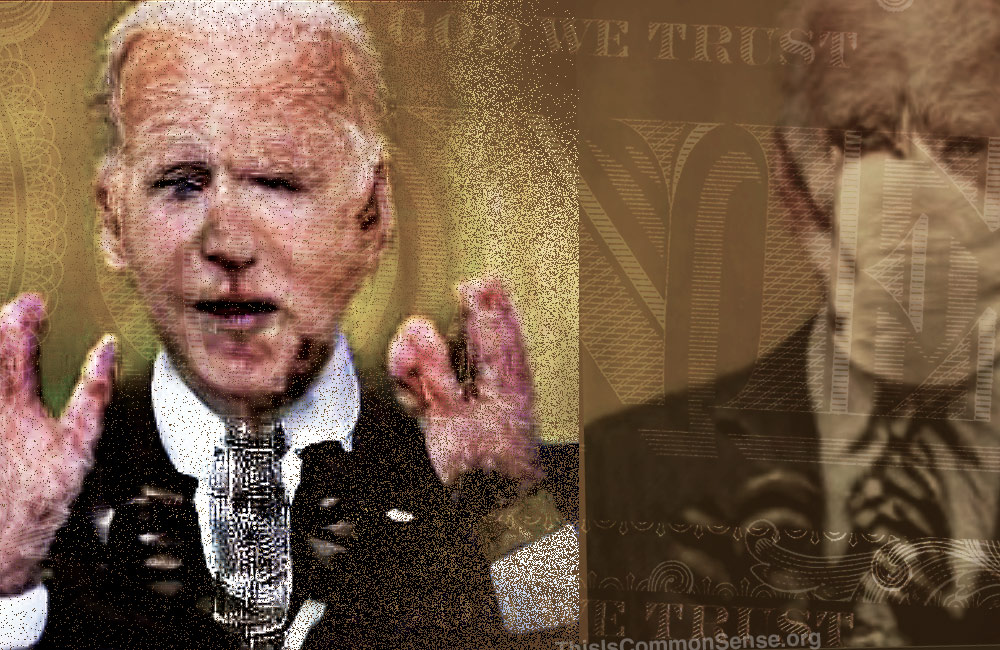
Biden’s Peculiar Odor

William F. Buckley used to say that there is always a presumptive case for order.

Philosopher Joel Feinberg argued that there’s always a presumptive case for freedom.*

This notion of a strong case for or against something prior to specific data can keep philosophers and economists and folks like you and me awake at night.

Here, I’m just going to bring it down to the politics.

Of inflation.

Why are prices — especially fuel prices — rising so?

The Biden Administration has been trying to argue that it’s caused by the war in Ukraine, and Americans’ need to sacrifice to defend that beleaguered country. 

But, as with his talk of “food shortages,” the war is almost certainly an exacerbating, not the prime, factor. Both fuel price spikes and bare shelves demonstrated an alarming trend before Putin invaded Ukraine. 

The cause seems obvious. Do we really need careful studies to show that both were caused by (a) COVID lockdowns and (b) a blizzard of lockdown bailout checks during Trump’s term in office and eagerly pushed also by the current president?

And Biden’s current kick, of demanding that gas stations (!) freeze or reduce prices to “match the cost of production,” has all the odor of cranky, old-fashioned soapbox socialism.

There is a presumptive case that inflation is caused by monetary policy, just as shortages are usually caused by regulations. Trump and Biden and Congress all contributed to over-spending, financialization, and regulatory hits.** But the stink of the growing mess must also affix especially to Biden. After all, one of his campaign promises was to cut production of oil on all government lands and offshore.

This is Common Sense. I’m Paul Jacob.


 * Joel Feinberg, Social Philosophy (1972), pp. 20-22. Where Buckley discussed his presumptive case is your guess or mine. Probably a column back in the 1970s or ’80s.

 ** A few weeks ago an interesting exchange occurred in this website’s comments section, between two friends of this program.

PDF for printing

h/t crAIyon

See all recent commentary
(simplified and organized)
See recent popular posts
Categories
Thought

Martial

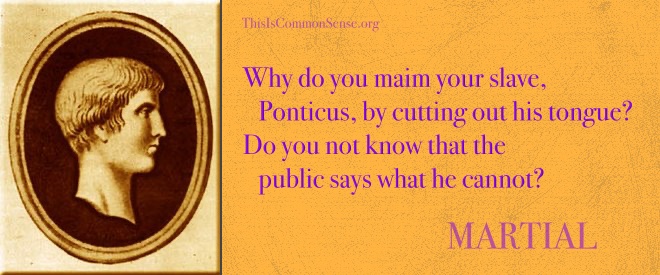
Why do you maim your slave, Ponticus, by cutting out his tongue? Do you not know that the public says what he cannot?

Marcus Valerius Martialis, Epigrammata (80–104 A.D.).
Categories
Today

The Bastille and Beyond

On July 14, 1789, Paris citizens stormed the Bastille.

On the same date nine years later, in America, the Sedition Act prohibited the writing, publishing, or speaking false or malicious statements about the United States government.

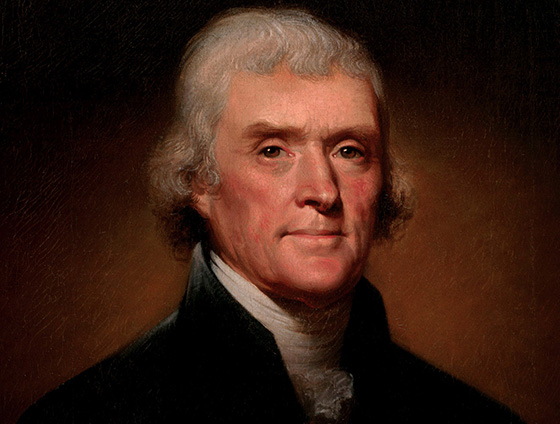
The passage of this repressive law spurred the formation of the first opposition party in the United States, with Thomas Jefferson [above] as its leader and figurehead.

Categories
education and schooling First Amendment rights general freedom

Squelched in Quebec

It’s a Université Laval thing; a Quebec thing: a Canada thing.

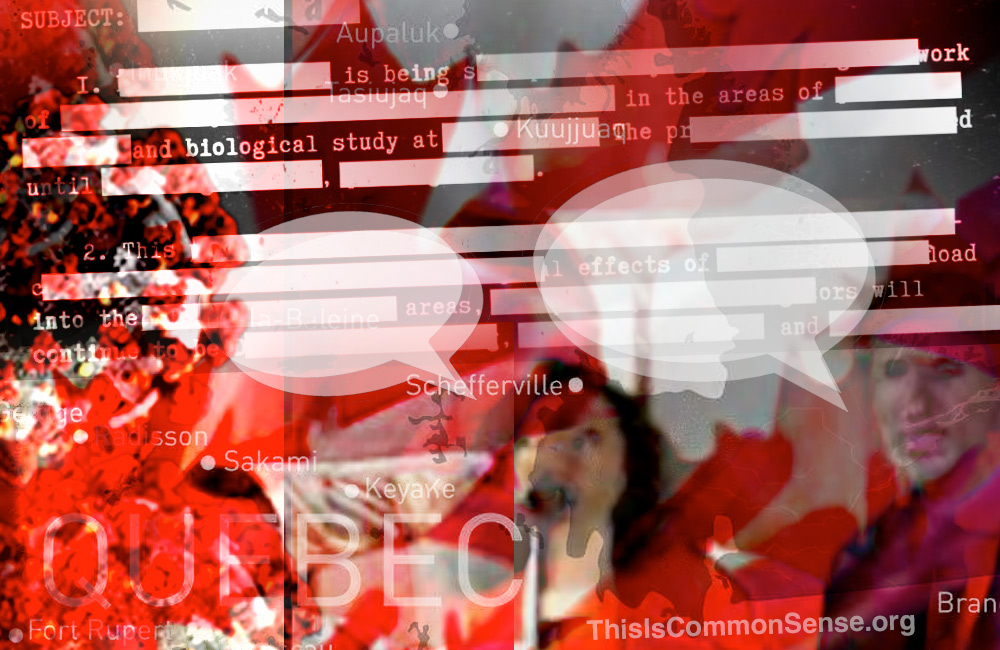
These are no places to be if you want to debate questions about pandemics and vaccines now “settled” by government-mandated consensus. Professors Patrick Provost and Nicolas Derome, who both teach at Laval, recently got the message in spades.

Provost, professor of microbiology and immunology, has been suspended for two months without pay for doubting the wisdom of giving COVID-19 vaccines to children. Kids face only a very low risk of serious consequences from the disease and a nonzero risk of being hurt by vaccination.

A newspaper that quoted his thoughts on the data and on free speech has cravenly deleted the offending article, stressing that “we can’t subscribe to” Provost’s views.

Laval also suspended Derome, professor of molecular biology, for expressing doubts about the value of vaccinating kids.

Canada’s authoritarians enjoy no monopoly on smothering academic and other speech. Many governments strive to more diligently repress their citizens. But Canadian officials fancy themselves pioneers in this area, and perhaps they are.

The hazards of squelching discourse about life-and-death matters should be obvious. It’s in our interest that scientists and everybody be able to freely investigate and discuss facts and interpretations without worrying whether an unauthorized assertion will cost the speaker two months of salary.

Or worse.

But some care nothing about logic and evidence — or, apparently, how useful these are to both individuals and to society at large.

It’s not an attitude consistent with . . . Common Sense.

I’m Paul Jacob.


PDF for printing

See all recent commentary
(simplified and organized)
See recent popular posts

Categories
Thought

Bentham

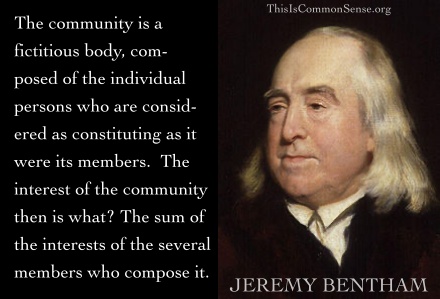
The community is a fictitious body, composed of the individual persons who are considered as constituting as it were its members. The interest of the community then is what? The sum of the interests of the several members who compose it.

Jeremy Bentham, An Introduction to the Principles of Morals and Legislation (1789; 1823), Chapter 1: “Of the Principle of Utility.”
Categories
Today

The Nixon Tapes

On July 13, 1973, the minority (Republican) counsel on the Senate Watergate investigative committee, Donald Sanders, asked Nixon aide Alexander Butterfield if he knew of any recordings made in the Nixon White House, and Butterfield responded, “everything was taped” at least while Nixon was in attendance, and that “there was not so much as a hint that something should not be taped.”

This revelation of the Nixon Tapes transformed the Watergate scandal into a major legal as well as political event, and proved to be one of the most astounding examples of “government transparency” in modern times — indeed, it helped demystify and desanctify the Office of the Presidency, a very republican (if not pro-Republican Party) development.

Categories
Internet controversy social media

All a-Twitter

On Friday, Elon Musk bowed out of his attempt to take over Twitter.

And Twitter stock plummeted over 10 percent in trading on Monday.

Citing the woke corporate social media company’s non-disclosure of information that he had been requesting for many, many weeks, Mr.Musk withdrew his offer.

The big issue, here, is the possibility that Twitter is over-valued because the company has allowed “bots” to proliferate. That is, accounts run by computers and AIs and scammers who create accounts and then just crank out content that have no value for advertising — which is how the company makes most of its money.

“Twitter claims that only 5 percent of its monetizable daily active user (mDAU) base consists of bots,” explains Nicholas Dolinger at The Epoch Times, “but Musk has argued that the number is much higher, and that Twitter, in misrepresenting the total number of bots, has misled him in such a way as to void the agreement.”

The best part of the story may be the “meme” Musk shared about it, “implying that Twitter would face embarrassment at having to disclose information about the prevalence of bots on the platform in court.”

Twitter user @ZanderfromNOLA offers an image that shows that bot problem: multiple accounts for healthcare professionals all saying the exact same thing, word for word, pushing the COVID vaxxes. It could be a propaganda campaign from Big Pharma. Or it could be the CIA. Or China. Or even Russia! Who knows? But the wealth of duplicate and obviously suspect content on the platform suggests that Musk’s initial offering of $44 billion was way too generous.

The humiliation that Twitter has suffered may be well-deserved.

But will humiliation nudge along any decent reforms?

This is Common Sense. I’m Paul Jacob.


PDF for printing

See all recent commentary
(simplified and organized)
See recent popular posts
Categories
Thought

Martial

Simpliciter pateat vitium fortasse pusillum:
Quod tegitur, magnum creditur esse malum

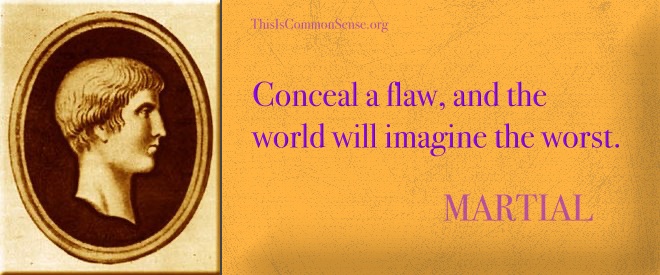
Conceal a flaw, and the world will imagine the worst.

Marcus Valerius Martialis, Epigrammata (80–104 A.D.).