Make yourselves sheep, and the wolves will eat you.
Benjamin Franklin, letter to Thomas Cushing (1773).
Categories
Poor Richard
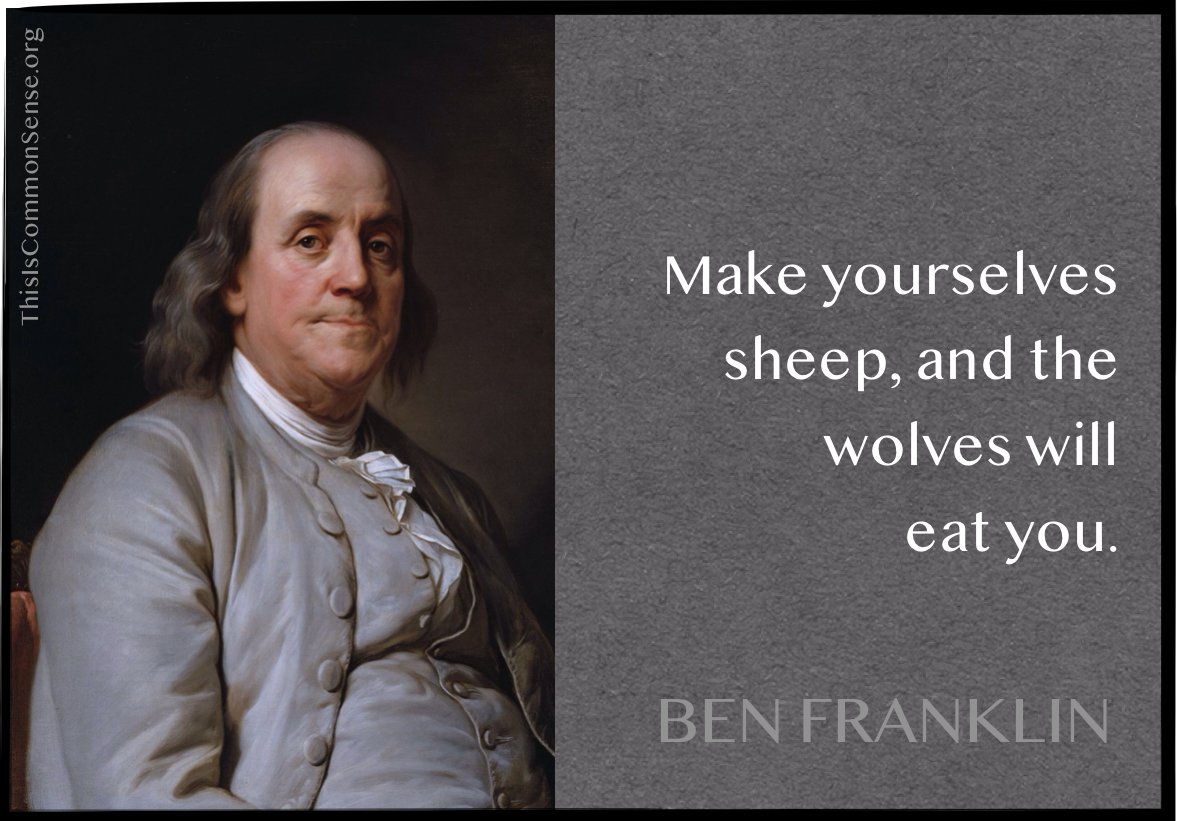
Make yourselves sheep, and the wolves will eat you.
Benjamin Franklin, letter to Thomas Cushing (1773).
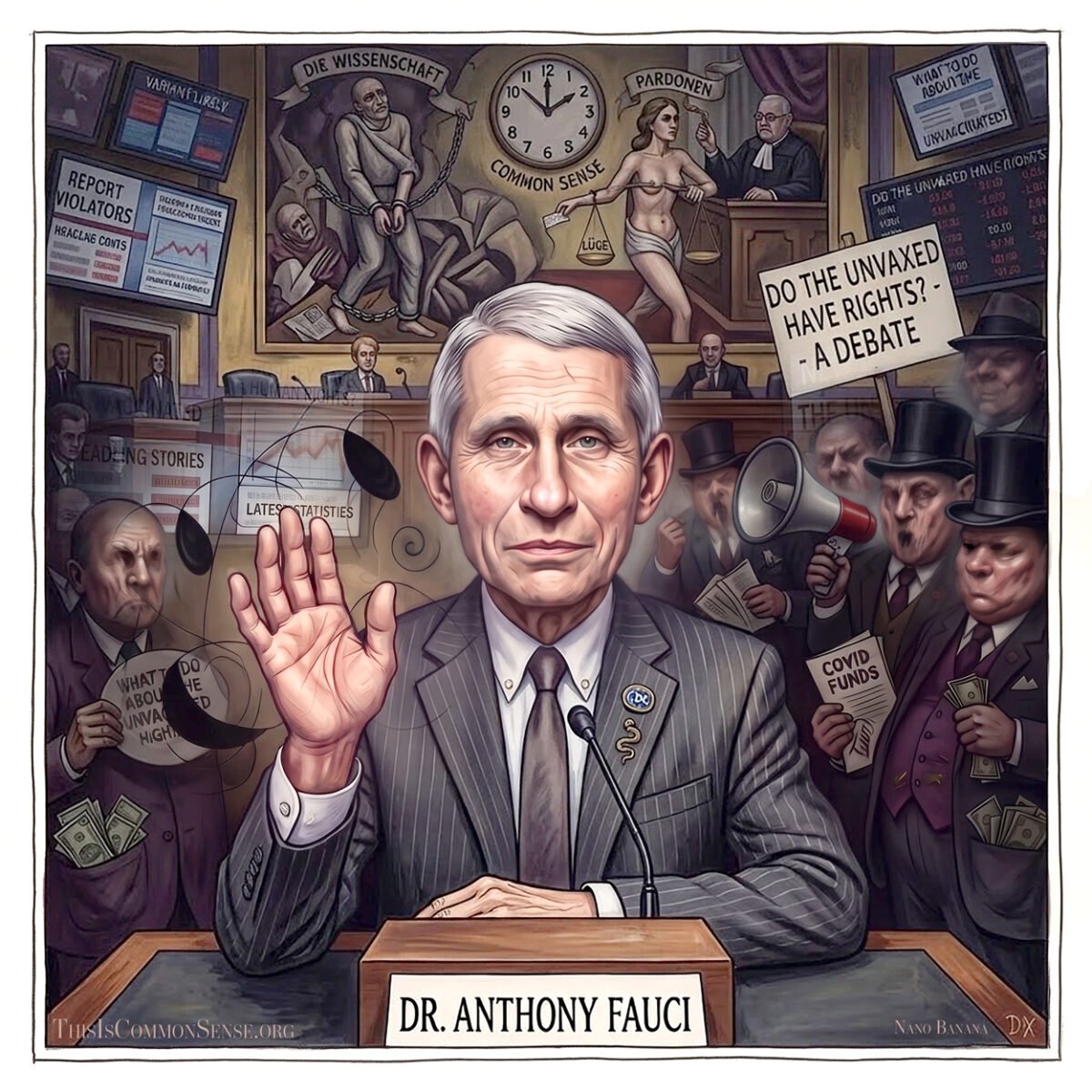
The multi-millionaire former “public servant” received a full and unconditional pardon “FOR ANY OFFENSES against the United States which he may have committed or taken part in . . .”
Courtesy of Mr. Biden — or his auto-pen.
“Biden backdated the pardon to 2014, a date nearly six years before the first cases of SARS-CoV-2 emerged,” Newsweek reported a year and a half ago.
Why? Come on, man! Because it “shields Fauci from allegations tied to U.S.-funded gain-of-function research in addition to his work during the COVID-19 pandemic.”
So, Fauci is immune from prosecution for
So when Fauci — formerly known as “the Science” — asserted his Fifth Amendment right against self-incrimination 111 times before Congress (NBC says 106), refusing to answer questions about his past role as a government official, it was illegitimate. Because on those matters, he cannot be incriminated.
“No person,” reads the amendment, “shall be compelled in any criminal case to be a witness against himself.” There can be no criminal case brought for his past lies.
But the problem for Dr. Fauci is that he can be prosecuted for telling those lies again to Congress. Like at yesterday’s hearing.
Past lies? You’re pardoned, Doc.
But Fauci cannot repeat his lies. That would be a new crime.
And since he wants those falsehoods to stand, he will not speak.
This is Common Sense. I’m Paul Jacob.
Illustration created with Nano Banana
See all recent commentary
(simplified and organized)
See recent popular posts
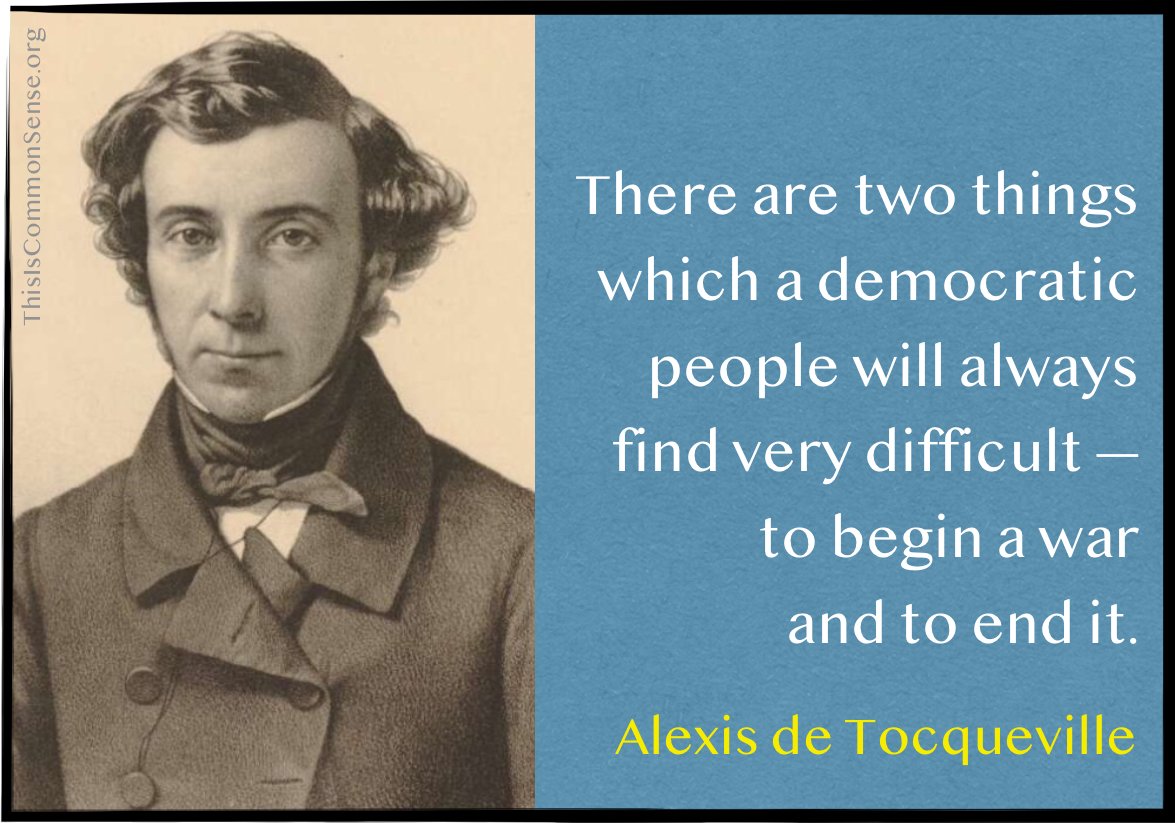
There are two things which a democratic people will always find very difficult — to begin a war and to end it.
Alexis de Tocqueville, Democracy in America, Vol. II (1840), Book Three, Chapter XXII.
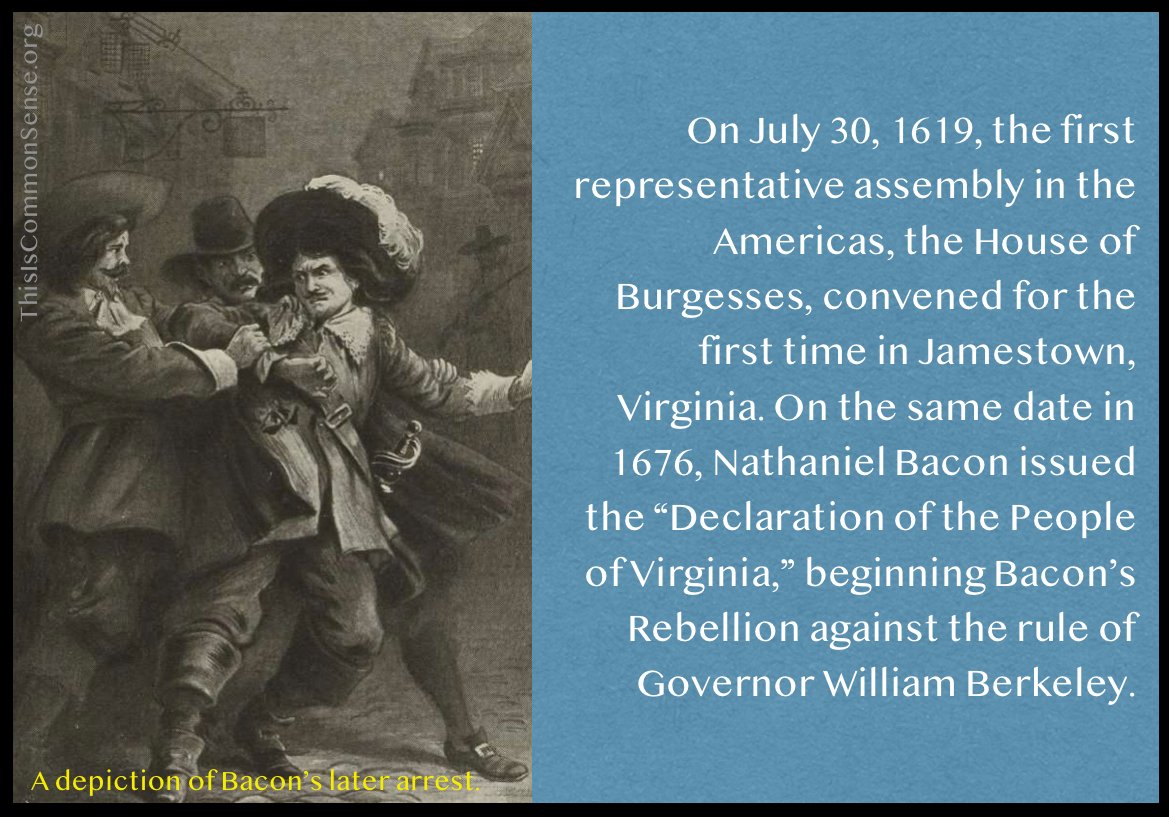
On July 30, 1619, the first representative assembly in the Americas, the House of Burgesses, convened for the first time in Jamestown, Virginia.
About a month later, a group of “twenty and odd” captives from what is now Angola landed in Hampton; this is what most Americans, today, refer to as the significant event in American history for the year “1619.”
On the same late day in July, 1676, Nathaniel Bacon issued the “Declaration of the People of Virginia,” beginning Bacon’s Rebellion against the rule of Governor William Berkeley.

The Institute for Justice observes that the decision protects the right “to be secure on their land” of all Pennsylvanians “and marks a final victory with no further appeal available.”
The decision is a big deal. For decades, courts have accepted the “open fields doctrine” advanced in a 1924 U.S. Supreme Court decision. According to this rule — or rationalization — officials may conduct warrantless searches on any land beyond that which immediately surrounds a home. Even if the open-field land is clearly marked as private property.
This, despite the fact that the Fourth Amendment prohibits warrantless searches and the issuing of warrants without probable cause.
Other courts have routinely followed the 1924 precedent. The result, says IJ, has been that “about 96% of all private land in the country, and over 90% of all private land in Pennsylvania, was previously exposed to warrantless searches and surveillance.”
The present case arose because officials of the Pennsylvania Game Commission conducted frequent fishing expeditions on the lands of IJ’s clients, the Punxsutawney and Pitch Pine hunting clubs.
Like the Institute, the president of the Punxsutawney Hunting Club, Frank Stockdale, is confident that the ruling “is a victory for all landowners in Pennsylvania.”
This same logic should be pushed throughout the union, curbing government and providing owners the same common-sense protections in every state.
This is Common Sense. I’m Paul Jacob.
Illustration created with Nano Banana
See all recent commentary
(simplified and organized)
See recent popular posts
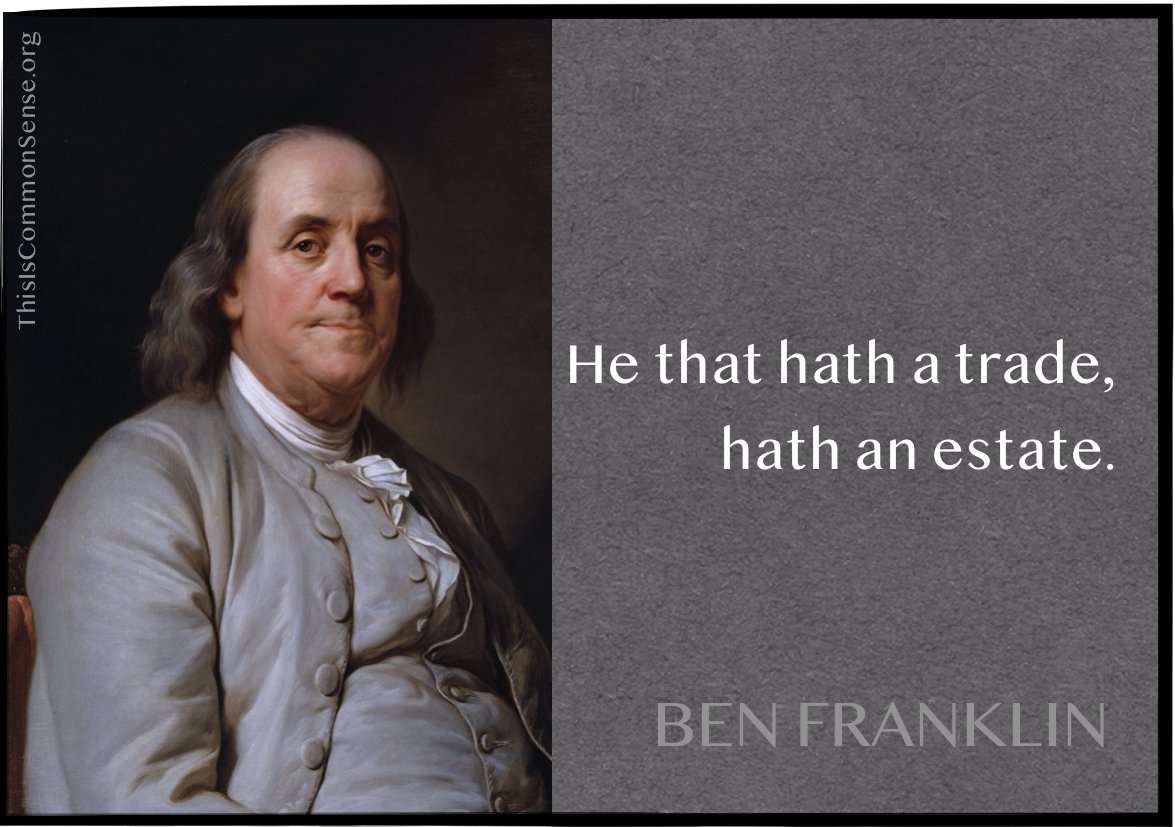
He that hath a trade, hath an estate.
Benjamin Franklin, in Poor Richard’s Almanack (1772).

King Umberto I of Italy was assassinated by the anarchist Gaetano Bresci on July 29, 1900. After shooting the monarch multiple times, Breschi was wrestled to the ground and almost lynched. Upon his arrest, he said “I did not kill Umberto. I have killed the King. I killed a principle.” This did not prove immediately true, for Umberto’s 31-year-old son, Victor Emmanuel III, succeeded his father to the throne. What Bresci spawned was the terrorist craze of anarchists trying to kill heads of state and captains of industry, itself a kind of self-defeating principle, since the peoples of the world turned decidedly against the anarchists.
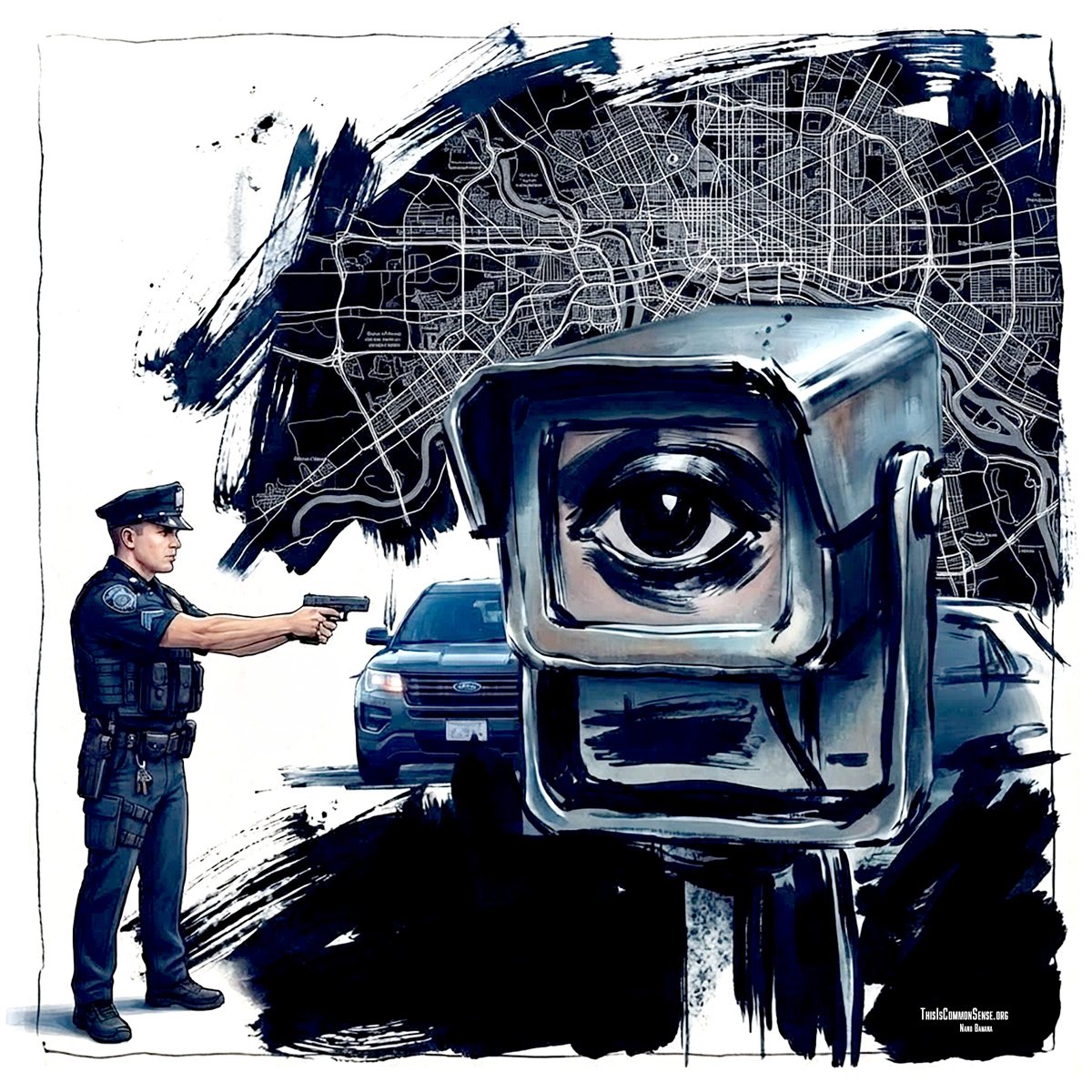
For decades, cameras have been installed on American roads to snap pics of speeding (or not-speeding) vehicles so that fines can be mailed to the guilty (or innocent) motorists.
These cameras are supposedly about ticketing for speeding. But they have also often been used as a means of revenue extraction.
Now there’s a new angle.
Super-smart, super-dumb artificial intelligence is being merged with street cameras.
The main company behind them is Flock Safety. Its cameras record license plates and also a vehicle’s make, model, and color, but, says Flock, nothing about individuals. When the AI can relate the plate number to a criminal suspect, law enforcers get a hit when searching for the number.
Then officers act on this information, often without any double-checking, to stop cars and force drivers out of their cars. Sometimes at gunpoint.
Even aside from the issues of privacy invasion raised by the sweeping surveillance, there’s the fact that the automated license plate recognition (ALPR) makes mistakes. Supplemented by officers’ mistakes. Innocent drivers and other occupants may be terrorized, arrested, even jailed before the mistake is realized.
Flock says that its cameras accurately capture 93 percent of license plates. As the Institute for Justice points out, even this “low” error rate means “well over a billion inaccurate readings per month” when Flock is scanning over 20 billion license plates per month.
Many locales that try Flock cameras end up pulling them down. None should ever begin to use them.
This is Common Sense. I’m Paul Jacob.
Illustration created with Nano Banana
See all recent commentary
(simplified and organized)
See recent popular posts
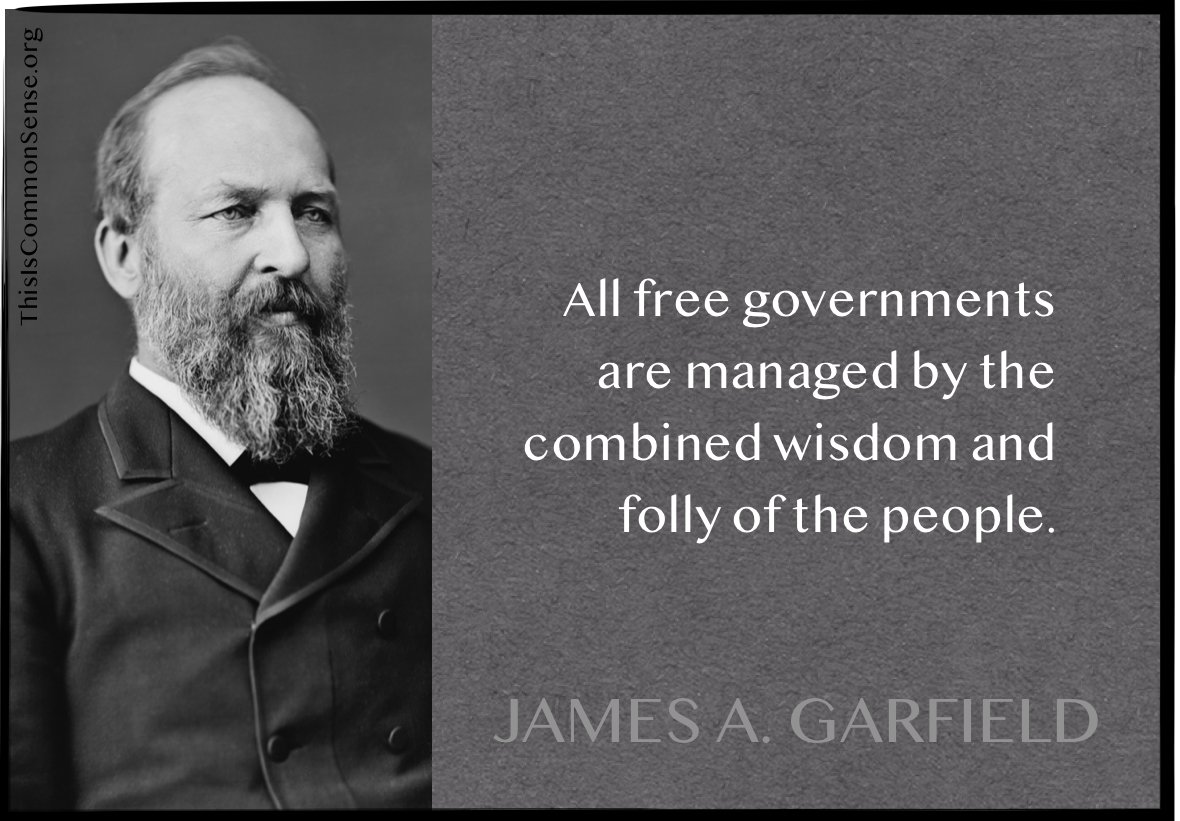
All free governments are managed by the combined wisdom and folly of the people.
James A. Garfield, 20th president of the United States, as quoted in Many Thoughts of Many Minds: A Treasury of Quotations from the Literature of Every Land and Every Age (1896), edited by Louis Klopsch, p. 116.
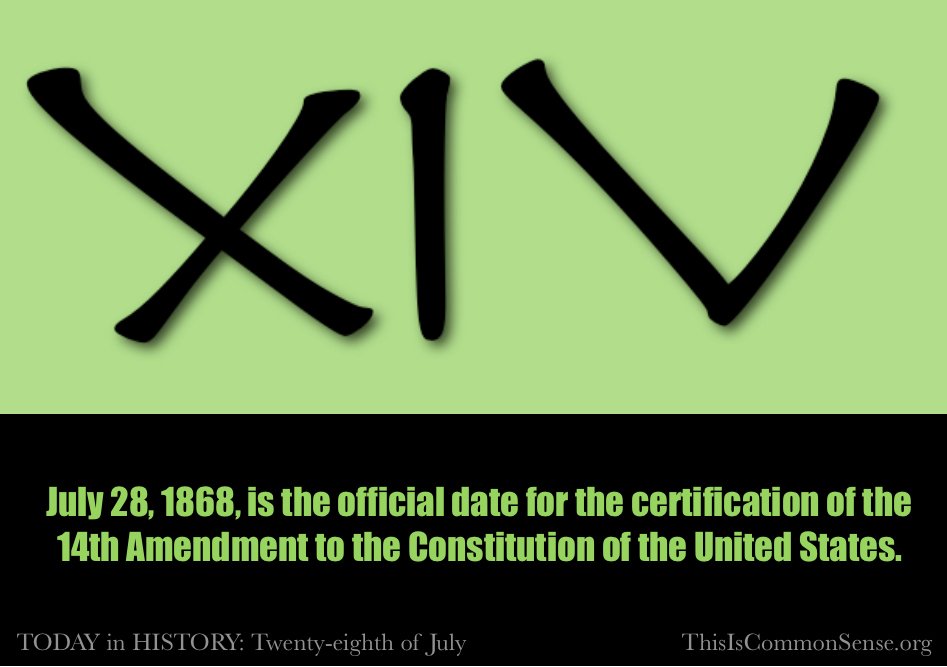
July 28, 1868, is the official date for the certification of the 14th Amendment to the Constitution of the United States.
Section 1. All persons born or naturalized in the United States, and subject to the jurisdiction thereof, are citizens of the United States and of the State wherein they reside. No State shall make or enforce any law which shall abridge the privileges or immunities of citizens of the United States; nor shall any State deprive any person of life, liberty, or property, without due process of law; nor deny to any person within its jurisdiction the equal protection of the laws.
Section 2. Representatives shall be apportioned among the several States according to their respective numbers, counting the whole number of persons in each State, excluding Indians not taxed. But when the right to vote at any election for the choice of electors for President and Vice President of the United States, Representatives in Congress, the Executive and Judicial officers of a State, or the members of the Legislature thereof, is denied to any of the male inhabitants of such State, being twenty-one years of age, and citizens of the United States, or in any way abridged, except for participation in rebellion, or other crime, the basis of representation therein shall be reduced in the proportion which the number of such male citizens shall bear to the whole number of male citizens twenty-one years of age in such State.
Section 3. No person shall be a Senator or Representative in Congress, or elector of President and Vice President, or hold any office, civil or military, under the United States, or under any State, who, having previously taken an oath, as a member of Congress, or as an officer of the United States, or as a member of any State legislature, or as an executive or judicial officer of any State, to support the Constitution of the United States, shall have engaged in insurrection or rebellion against the same, or given aid or comfort to the enemies thereof. But Congress may, by a vote of two-thirds of each House, remove such disability.
Section 4. The validity of the public debt of the United States, authorized by law, including debts incurred for payment of pensions and bounties for services in suppressing insurrection or rebellion, shall not be questioned. But neither the United States nor any State shall assume or pay any debt or obligation incurred in aid of insurrection or rebellion against the United States, or any claim for the loss or emancipation of any slave; but all such debts, obligations and claims shall be held illegal and void.
Section 5. The Congress shall have power to enforce, by appropriate legislation, the provisions of this article.