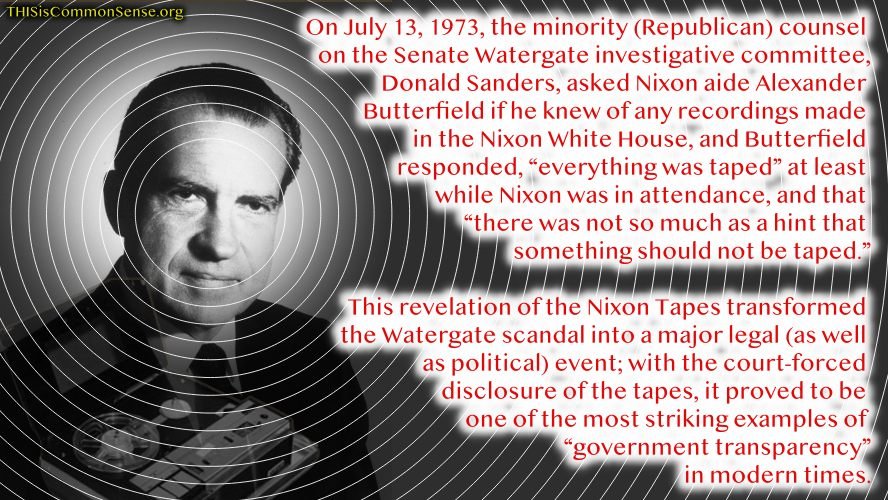
On July 13, 1973, the minority (Republican) counsel on the Senate Watergate investigative committee, Donald Sanders, asked Nixon aide Alexander Butterfield if he knew of any recordings made in the Nixon White House, and Butterfield responded, “everything was taped” at least while Nixon was in attendance, and that “there was not so much as a hint that something should not be taped.”
This revelation of the Nixon Tapes transformed the Watergate scandal into a major legal (as well as political) event; with the court-forced disclosure of the tapes, it proved to be one of the most striking examples of “government transparency” in modern times.
The latest batch of disclosed UFO documents has been released on war dot gov. In the first SIGN report, one hundred sightings were recorded and appraised, from July 1947 to January 1948. The persistent data of the most peculiar incidents were not easily explained:
This report from Air Materiel Command HQ, dated “23 APR 1948,” shows that eight decades ago the American military was taking the UFO subject seriously. The report shows military personnel and hired academics debating and tabulating witnesses’ reports and puzzling over the mysterious data with no small amount of seriousness.
On the Fourth of July a dozen UFO sightings were reported in the Pacific Northwest, and duly tabulated. Here are three from Oregon:
Note that these were reported 20 days before the “flying saucer” craze began further north, near Mount Rainier, in the most famous UFO sighting of all time (because much was made of it at the time; because we got the term “flying saucer” from a misunderstanding in the reportage; and because the event is often cited). Nineteen forty-seven was a busy year for UFO sightings, and the Kenneth Arnold observation and report of nine wobbly-but-super-fast craft while flying over the Cascades in Washington State made the national new. Here it is reported merely as sighting no. 17:
Towards the end of the report a determination on one incident was made that it was, indeed, a hoax. Appended to the report is a long article on “The Biology of the Flying Saucer,” which is not what you might suspect from the title.
On July 12, 1917, vigilantes kidnapped and deported nearly 1,300 striking miners and others from Bisbee, Arizona. This came to be known as the Bisbee Deportation.
On the same day in 1948, Israeli Prime Minister David Ben-Gurion ordered the expulsion of Palestinians from the towns of Lod and Ramla.
“America appears to be in the midst of an outbreak of — I’m sorry, but there’s no better way to say this — explosive diarrhea.”
That was not the first sentence of Nicholas Florko’s July 11, 2026, reportage in The Atlantic. But perhaps should have been.
The article is titled “America’s Home-grown Parasite Problem.”
And no, it is not about the politics of the transfer state. You may have heard that The Atlantic has lately been turning away from its decade-long bout of woke diarrhea, but analysis of parasitism and subversion in a sociological sense — say, along the lines of Herbert Spencer, Franz Oppenheimer, or Stanislav Andreski — is too much to hope for.
The article is about something more, uh, down-to-earth: the parasite known as Cyclospora cayetanensis. Which can cause an illness, cyclosporiasis. It is all gruesome stuff, and can be read about in The Atlantic.
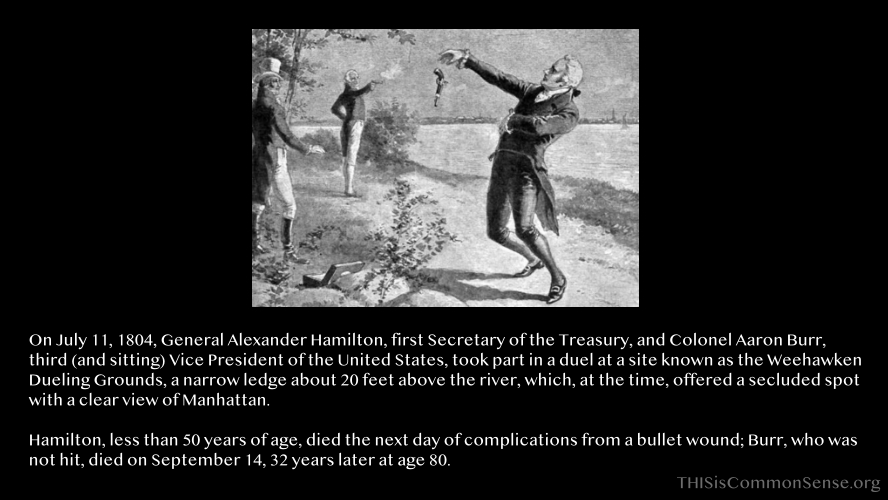
On July 11, 1804, General Alexander Hamilton, first Secretary of the Treasury, and Colonel Aaron Burr, third (and sitting) Vice President of the United States, took part in a duel at a site known as the Weehawken Dueling Grounds, a narrow ledge about 20 feet above the river, which, at the time, offered a secluded spot with a clear view of Manhattan.
Hamilton, less than 50 years of age, died the next day of complications from a bullet wound; Burr, who was not hit, died on September 14, 32 years later at age 80.
The ledge eroded away later, as has the practice of dueling.
On July 11, 1804, General Alexander Hamilton, first Secretary of the Treasury, and Colonel Aaron Burr, third (and sitting) Vice President of the United States, took part in a duel at a site known as the Weehawken Dueling Grounds, a narrow ledge about 20 feet above the river, which, at the time, offered a secluded spot with a clear view of Manhattan.
Hamilton, less than 50 years of age, died the next day of complications from a bullet wound; Burr, who was not hit, died on September 14, 32 years later at age 80.
Is it possible to discriminate against a Jew for being a Jew without knowing that this is what one is doing?
Yoni Birnbaum, a Jewish man and rabbi, reports on what happened after he reserved a vacation rental in France.
The property owner emailed to say that he had noticed the word “rabbi” in Birnbaum’s email address and therefore felt it necessary to inquire whether Birnbaum was sufficiently critical of Israel before letting the booking stand. If not, the reservation would be cancelled.
This wasn’t a litmus test to which all prospective renters of the property were being routinely subjected. The owner acknowledged that only because he had noticed that Birnbaum was Jewish was he demanding to know his views on Israel.
Birnbaum replied, in part: “No doubt, you wrote your email to me out of some kind of twisted sense of virtue. But it seems clear to me that what lies at the heart of your demand for me to declare my views on the conflict in the Middle East, is that to you, before anything else, I am a Jew. Therefore, at the very least, you feel you have to test me and family. . . .
“In other words, you wished to subject me to a purity test. Am I one of the ‘good Jews’ or one of the ‘bad Jews’?”
Not the worst thing that can happen to somebody. But it has something in common with the very worst that can happen.