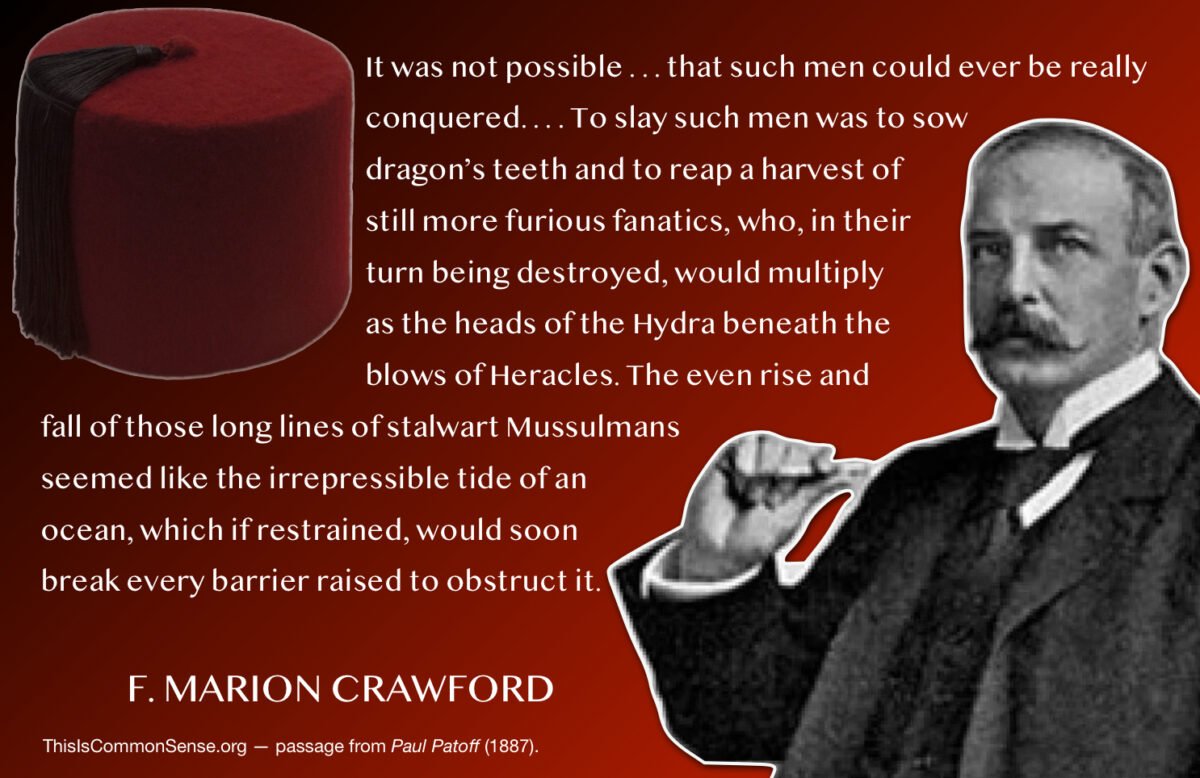
Alexander Patoff stood by his brother’s side, watching the ceremony with intense interest. He hated the Turks and despised their faith, but what he now saw appealed to the Orientalism of his nature. Himself capable of the most distant extremes of feeling, sensitive, passionate, and accustomed to delight in strong impressions, he could not fail to be moved by the profound solemnity of the scene and by the indescribable wildness of the Imam’s chant. Paul, too, was silent, and, though far less able to feel such emotions than his elder brother, the sight of such unanimous and heart-felt devotion called up strange trains of thought in his mind, and forced him to speculate upon the qualities and the character which still survived in these hereditary enemies of his nation. It was not possible, he said to himself, that such men could ever be really conquered. They might be driven from the capital of the East by overwhelming force, but they would soon rally in greater numbers on the Asian shore. They might be crushed for a moment, but they could never be kept under, nor really dominated. Their religion might be oppressed and condemned by the oppressor, but it was of the sort to gain new strength at every fresh persecution. To slay such men was to sow dragon’s teeth and to reap a harvest of still more furious fanatics, who, in their turn being destroyed, would multiply as the heads of the Hydra beneath the blows of Heracles. The even rise and fall of those long lines of stalwart Mussulmans seemed like the irrepressible tide of an ocean, which if restrained, would soon break every barrier raised to obstruct it.
Francis Marion Crawford, a passage from his 1887 novel Paul Patoff, Chapter Two.
Categories
F. Marion Crawford