Categories
ballot access crime and punishment election law

Elections Overturned & Undermined

Sure, democracy is a messy affair. But it does require several fine balances. One of them is that elections must be trustworthy: neither rigged nor gamed.

In recent years, many elections have been charged to be somehow “stolen.” Hillary Clinton accused Donald Trump of “stealing” the 2016 presidential election; Donald Trump, in turn, accused the Democrats of stealing the 2020 election, in which he was given his walking papers.

Now reports by Roman Balmakov, at Epoch TV, show that election irregularities at the local level can not only be contested, but elections overturned. 

Sans “insurrection.”

“In a shocking turn of events,” explains Balmakov, “a judge in Connecticut overturned a primary election because the evidence of fraud was just so overwhelming.” Video captured late-night ballot box stuffing, with identifiable government-employee perps. The judge overturned Bridgeport’s Democratic primary race for mayor.

In a sheriff’s race in a Louisiana parish an even more extraordinary set of events occurred. An election wherein a candidate lost by one vote was challenged; a recount adjusted the figures but the single-vote spread remained. Another challenge led the state Supreme Court to appoint a judge to look into the mess, and he found one: clear evidence of massive voting irregularities. He demanded a new election.

But Roman Balmakov’s report from yesterday may spark wider interest. It was about a thorough Rasmussen poll of 2020 voters: “1-in-5 people who voted by mail committed some type of voter fraud.” You might say they confessed as much in how they answered the poll. 

All three stories cast a dark light on the state of American democracy. But the poll may be the most troubling. 

If not how little interest the Rasmussen survey has garnered from major media.

This is Common Sense. I’m Paul Jacob.


PDF for printing

Illustration created with PicFinder and Firefly

See all recent commentary
(simplified and organized)
See recent popular posts

Categories
Thought

Harlan Ellison

Of all liars, the smoothest and most convincing is memory.

Harlan Ellison, The City on the Edge of Forever: The Original Teleplay.
Categories
Today

Rights, Wets, and Whites

On December 15, 1791, the United States’ Bill of Rights became constitutional law when ratified by the Virginia General Assembly.

On December 15 in 1933, the Twenty-first Amendment to the United States Constitution officially became effective, repealing the Eighteenth Amendment that had, by enabling the Volstead Act, prohibited the sale, manufacture, and transportation of alcohol for any other than medical and industrial uses.


December 15 birthdays include that of Pehr Evind Svinhufvud af Qvalstad [pictured above], 1861, first Head of State of independent Finland, serving in this capacity first as leader of the Senate and then as Protector, or Regent. In 1930 he became Prime Minister, and in 1931 was elected President, leaving office in 1937.

During the Civil War of 1918, his anti-socialist refugee government, Valkoiset, or “Whites,” opposed the “Reds,” a Social Democrat Party faction, for control of the government as it transitioned from Russian rule as a Grand Duchy, to independent status.

He died in 1944.

Categories
education and schooling First Amendment rights general freedom international affairs

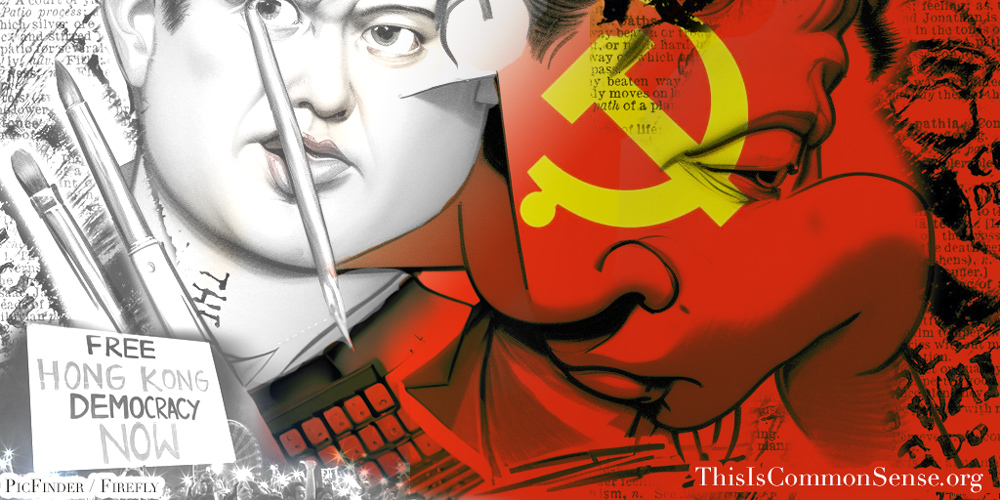
Cold Climate in Hong Kong

“There is no ‘red line,’” says an anonymous thirty-something Hong Kong humanities professor. “If they want to come after you, everything can be used as an excuse.”

Grace Tsoi, writing for the BBC, shows what happens when political correctness returns to its roots in totalitarianism. As it has in Hong Kong, in the “People’s [sic] Republic [sic] of China [sick].” The young academic Ms. Tsoi is quoting elaborated the situation: “He says his nightmare is being named and attacked by Beijing-backed media, which could cost him his job, or worse, his freedom.”

Political correctness can cause academics in America their jobs, of course. But as relentless as our woke media and online mobs may be to “de-platform” people they disagree with, it’s harder to go all the way.

Under a totalitarian state, it’s easier to be more thorough.

That’s why totalitarianism is the modish form of tyranny that tyrants aspire towards.

More power.

“In the academic year 2021/22, more than 360 scholars left Hong Kong’s eight public universities,” Ms. Tsoi explains. “The turnover rate — 7.4% — is the highest since 1997, when Hong Kong returned to Chinese rule, according to official data. Foreign student enrolments have dropped by 13% since 2019.”

The chilling effect is arctic. Self-censorship has become the rule, in advance of expected censure, censorship, or worse. Hong Kong academics blame all this on 2020’s National Security Law, which “targets any behaviour deemed secessionist or subversive, allowing authorities to target activists and ordinary citizens alike.”

It’s worth remembering that while “secession” is a dirty word for the powerful, and subversion the enemy of all, it does depend on context: secession from a tyrannical state is liberation; subversion of an unjust system is justice.

This is Common Sense. I’m Paul Jacob.


PDF for printing

Illustration created with PicFinder and Firefly

See all recent commentary
(simplified and organized)
See recent popular posts
Categories
Today

King Väinö

On December 14, 1918, Friedrich Karl von Hessen, a German prince elected by the Parliament of Finland to become King Väinö I, renounced the Finnish throne.

In 1939, on this date, the Soviet Union was expelled from the League of Nations for invading Finland and starting the Winter War.


On December 14, 1819, Alabama became the 22nd state of these United States.

Categories
Thought

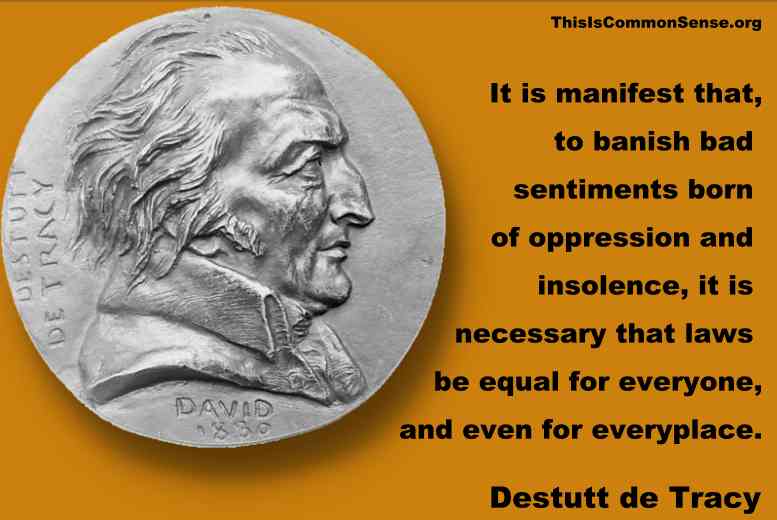
Destutt de Tracy

It is manifest that, to banish bad sentiments born of oppression and insolence, it is necessary that laws be equal for everyone, and even for everyplace.

Destutt de Tracy, as quoted by Mme. Victor de Tracy, Death Notice on Destutt de Tracy (translated by Iris Hartman, 1852).
Categories
general freedom international affairs national politics & policies too much government

To End the Great Declension

“Today begins a new era in Argentina,” said Javier Milei in his inaugural address as the new president of Argentina. “Today we end a long and sad history of decadence and decline and begin the road to the reconstruction of our country.”

President Milei has focused on a problem — the decadence of mass poverty — and identified it with a basic view of government: interventionism in markets, central control and bureaucratic proliferation. These, once established, start a cycle that must end in decay, decline. “The outgoing government has left us with hyperinflation, and it is our top priority to make every effort to avoid a catastrophe that would push poverty above 90 percent and indigence above 50 percent,” he explained.

Milei is not hesitant; gradualism’s not his bag, for the country does not “have margin for sterile discussions. Our country demands action and immediate action.”

At some point, the argument runs, you have to boldly cut government. Not just cut the rate of government growth, which is about all American Republicans have achieved — often allowing others to take the credit, as with Bill “The Era of Big Government Is Over” Clinton.

Milei’s first act as president was an executive order reducing the number of government ministries from 21 to nine. If this move actually succeeds in paring down the size of Argentina’s state apparatus and workforce, it will be something of a miracle.

In a country that needs miracles. 

Here in these United States, we may not have hyperinflation, as such, but we do face a crisis. The deficits are persistent, and majorities in both parties seem utterly unconcerned about the $34 trillion debt, rushing at us fast. Costing more to service than we spend on defense.

Only Vivek Ramaswamy has pushed specific ways to cut government.

But, unlike Milei in South America, here in North America Vivek’s just not that popular.

This is Common Sense. I’m Paul Jacob.


PDF for printing

Illustration created with PicFinder and Fireflly

See all recent commentary
(simplified and organized)
See recent popular posts
Categories
Thought

Harlan Ellison

The two most common elements in the universe are hydrogen and stupidity.

Harlan Ellison, Introduction to Blast Off : Rockets, Robots, Ray Guns, and Rarities from the Golden Age of Space Toys (2001) by S. Mark Young, Steve Duin, Mike Richardson, p. 6, who went on to say that it was often misquoted: “I don’t so much mind that they pirated it, but what does honk me off is that they never get it right. They render it dull and imbecile by phrasing it thus: ’The two most common things in the universe are…’ 
Not things, you insensate gobbets of ambulatory giraffe dung, elements! Elements is funny, things is imprecise and semi-guttural. Things! Geezus, when will the goyim learn they don’t know how to tell a joke.’
Categories
Today

Jury Duty

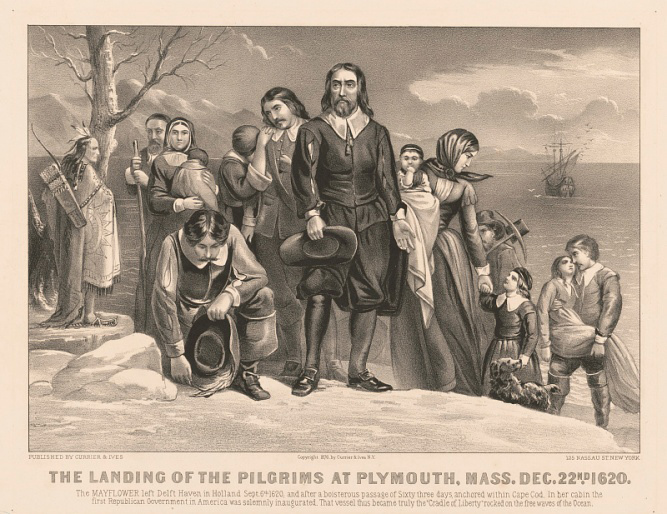
On December 13, 1623, Plymouth colonists established the system of trial by twelve jurors.

Categories
government transparency national politics & policies

Two Roadblocks, and Their Names

Meandering through social media, a popular meme with several variants runs something like this:

“Hey, this guy says the government believes in UFOs!

“See, nobody cares. Now show us the Epstein client list.”

The gist: the Jeffrey Epstein story is a bigger, more important story than the on 70-plus years of government control of the UFO story.

Well, we now know precisely why we cannot have either: a few specific politicians are blocking disclosure, one Democrat on the Epstein story and a handful of Republicans on the UFO story.

Hillary Vaughn of Fox News asked Senator Dick Durbin (D-Ill.) why he — the chair of the Senate Judiciary Committee — won’t subpoena Epstein’s flight logs to and from his private Caribbean island wherein sex trafficking with under-age females and males went on. His response? “I don’t know anything about his flight logs” and “This has never been raised by anyone.”

This is untrue. 

UFO/UAP transparency, on the other hand, has gone much further than the Epstein — probably because there are fewer politicians implicated in crimes. Yet two major disclosure elements in a recent defense bill have been nixed by Mike Turner (R-Oh.) and Mike Rogers (R-Ala.). Journalist Ross Coulthart, who has covered this story best, ascribes this pair’s opposition to disclosure to their respective military-industrial complex constituencies. And Coulthart adds that Senator Mitch McConnell (R-Ky.) also had a hand in disclosure suppression.

Both the Epstein and the UFO story reveal a lot about our government, which wants us to know the truth about neither.

And as for the notion that these issues must be played off each other, the proper memed response would be “Why can’t we have both?”

This is Common Sense. I’m Paul Jacob.


PDF for printing

Illustration created with PicFinder and Firefly

See all recent commentary
(simplified and organized)
See recent popular posts