Categories
Accountability general freedom ideological culture insider corruption media and media people property rights Regulating Protest

Ortega’s Got to Go

Sometimes “if it bleeds, it leads” fails us. Only a few news outlets have given much attention to Nicaragua’s ongoing atrocities.

Weeks ago, mothers of some of the 76 people, mainly students, already killed protesting despot Daniel Ortega, were leading a march demanding justice . . . “when gunmen opened fire on the crowd.” The Washington Post report continued, “Witnesses have accused police and their civilian allies of initiating the violence that left as many as 18 people dead and more than 200 wounded.”

The June 2 headline summed up the last seven weeks: “At least 100 killed in Nicaragua as political violence intensifies.”

But time and tyranny march on. “Every day they’re killing more people,” an attorney with the Nicaraguan Center for Human Rights told the Post. Friday, the group updated the death toll to 137.

Then on Saturday, the English-language Today Nicaragua informed that a 60-year-old man was cut down by a government sniper in Masaya, the former Sandinista stronghold, which is “now under almost total rebel control.”

What can we do?

We can educate ourselves on what’s happening — and pester more news organizations to cover Nicaragua.

We can learn from the experiences in Cuba, in Venezuela, and now in Nicaragua, that leaders seeking awesome powers to remake society to supposedly benefit the poor are ultimately batting zero in helping the poor. Instead, they’re busy at the plate for themselves.

And we can add our voices to Amnesty International’s condemnation of what it calls “the systematic ‘shoot-to-kill’ policy of President Ortega’s government.”

When governments open fire on peaceful protesters, it is past time for those governments to go.

This is Common Sense. I’m Paul Jacob.


PDF for printing


Categories
crime and punishment folly free trade & free markets general freedom initiative, referendum, and recall local leaders nannyism national politics & policies privacy

Legalize Cancer Fighting

“Do all former congressmen have to get cancer before we’re gonna get medical marijuana or recreational marijuana?”

That’s what Reason TV’s Nick Gillespie asked Billy Tauzin at the Cannabis World Congress and Business Exposition. Tauzin’s a former Representative for Louisiana’s 3rd District. He moved from Congress to lobbying for Big Pharma — I mean, PhRMA, a drug lobbying group — and then to Lenitiv Scientific, where he works now.

The company produces “a line of innovative, high quality cannabis and hemp-derived CBD products,” its website informs. These products, says the former Republican politician, are so effective that he now expresses some regret that he could not have had access to such drugs when he was fighting cancer more than a decade ago. Today’s cancer patients have it easier, because of cannabis-derived products, including CBD.

Hence Gillespie’s question — which almost answers itself.

With a No.

The number of states that have legalized or decriminalized marijuana for recreational or medicinal uses (or both) is growing all the time, usually without the help of politicians with or without cancer.

The movement has mostly been carried on by We, the People through initiative and referendum. Especially the crucial early steps.

But politicians are beginning to follow our leadership.

Which, in a society where citizens are in charge, is all to the good.

Though powerful opposition remains, Tauzin speculates, “I think if we took a silent vote, secret ballot, we’d win tomorrow easily.”

So, given a little more time for Congress to catch up with the culture, freedom can prevail, no cancer necessary.

This is Common Sense. I’m Paul Jacob.


PDF for printing


Categories
general freedom incumbents local leaders national politics & policies political challengers U.S. Constitution

The First Shall Be Last

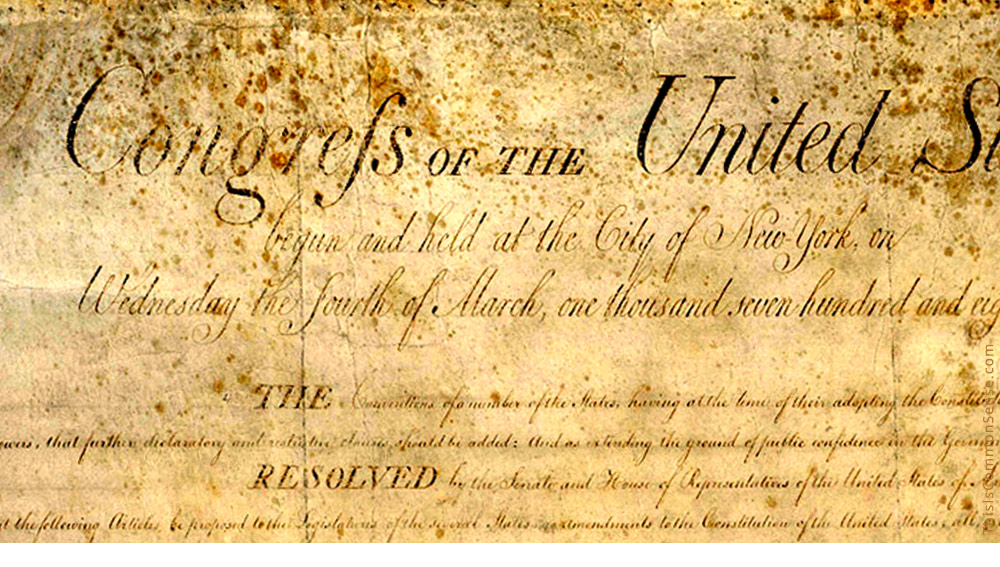
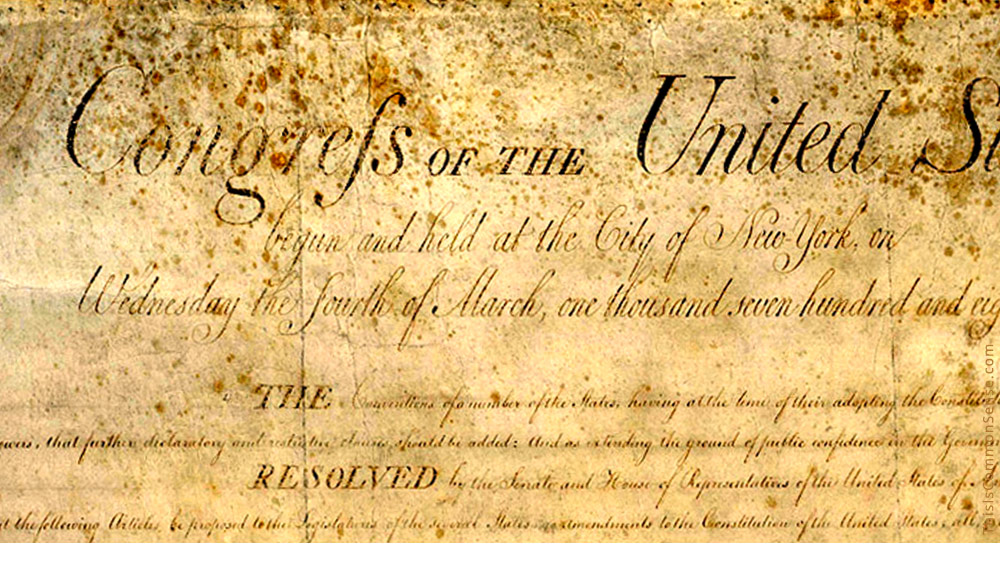
We were taught in school that the first ten amendments to the Constitution make up the Bill of Rights. True enough.

But not completely true — as I pointed out at Townhall.

In 1789, Congress passed and sent to the states twelve constitutional amendments, called “articles.” Our current First Amendment was billed as Article the Third.

The first two of the original batch did not pass at that time: Article the First and Article the Second. That latter article, after more than two centuries of wandering around legislatures, was finally ratified by the necessary three-fourths of the states as the 27th Amendment to the Constitution. In 1992.*

As for the rejected Article the First, last Tuesday, Eugene M. LaVergne filed a motion, pro se, before a federal three-judge panel convened in the D.C. Circuit to hear his challenge to “the validity and Constitutionality of the 2010 Apportionment of the U.S. House of Representatives.” He and four other rabble-rousing New Jersey citizens are challenging the courts to acknowledge a surprising truth: the original Article the First was actually ratified.

On June 21, 1792, Kentucky’s legislature voted to ratify, making it the twelfth of fifteen states at that time to do so.

It’s a complicated story. One of the elements is a clerical error.

But rectifying this old mistake would have huge repercussions.

How huge? Currently the lower house of Congress has a mere 435 members. Were this amendment acknowledged, that number would soar to over 6,150 members.

And that would be a good thing.**

This is Common Sense. I’m Paul Jacob.


* Sadly, its sensible prohibition — “No law, varying the compensation for the services of the Senators and Representatives, shall take effect, until an election of representatives shall have intervened” — was immediately rendered toothless by the automatic cost of living salary adjustments congressmen had already provided themselves.

** Skeptical? Well, click here for a preview of more detailed arguments to come.

PDF for printing


Categories
crime and punishment general freedom moral hazard nannyism national politics & policies privacy responsibility too much government U.S. Constitution

Too Healthy to Play

Cannabis oil can prevent the seizures of at least some victims of epilepsy. But the hope this medicine provides is too often undercut by fear.

I discussed, a few days ago, the case of 15-year-old David Brill, whose life is in danger because officials forcibly removed him from the care of his parents. His mom and dad had (illegally) let him smoke pot — which stopped his seizures. Now they’re fighting to recover custody of David and save his life.

Somewhat different is the plight of an aspiring football player at Auburn University.

Early in 2017, the would-be safety in question, C.J. Harris, began taking cannabis oil to stop epileptic seizures. He has suffered no seizures in all the months since. And he’s in no legal trouble.

But Auburn University’s football team has rescinded its offer to join the team. Exactly why he won’t be allowed to play is unclear. One would guess it is because of the National Collegiate Athletic Association’s ban on cannabis oil, even if prescribed. But the team’s medical personnel says they’re only concerned about his health given his history and the roughness of football.

Does Auburn apply the same standard to all players who have recovered from major physical setbacks? Or, rather, does the team typically let players return to play as soon as they’re ready and able?

Whatever is keeping him off the field, the factors that should decide the question are being shunted aside.

One, is C.J. Harris healthy enough and skilled enough to play for Auburn?

Two, is C.J. Harris willing to accept the risks involved?

This is Common Sense. I’m Paul Jacob.


PDF for printing


Categories
Accountability crime and punishment folly general freedom government transparency local leaders moral hazard nannyism porkbarrel politics privacy property rights responsibility tax policy too much government

Progress, DC-Style

Is the black, Democratic mayor of Washington, D.C., actually a “racist”? What about the city council, which is 46 percent African-American, 85 percent Democrat, and 100 percent liberal/progressive?

That’s what a lawsuit argues — the DC ‘powers that be’ are racist in their development and housing policies. Filed on behalf of several African-American DC residents, it alleges that Mayor Muriel Bowser and the council have been striving mightily, as the Washington Post reported, “to ‘lighten’ African American neighborhoods and break up long-established communities.”

“Every city planning agency,” states the complaint, “... conspired to make D.C. very welcoming for preferred residents and sought to displace residents inimical to the creative economy.”

Nothing that a billion dollars couldn’t make right, of course — for which the plaintiffs ask.

But is gentrification a crime?

As American University professor Derek Hyra told the Post, “Developers want to maximize their return. This is not a conspiracy. This is capitalism.”

But no, this certainly isn’t laissez faire “capitalism.” It could be described as dirigisme — or “state capitalism” or “crony capitalism” or just a bad old-fashioned mercantilism, revised to work at the city level, where governments partner up with particular groups to extract as much wealth for the insiders as they can. Professor Hyra acknowledges that Bowser and the council were “providing subsidies” to bring in richer citizens and push out poorer ones.

Most importantly, we discover yet again that the power politicians claim they need to help the poor, is used to help the rich.

Way to go, “progressives.”

This is Common Sense. I’m Paul Jacob.



Note: The mayor is a Democrat and the 13-member council is composed of eleven (11) Democrats and two (2) independents. There are no Republicans.

PDF for printing


Categories
crime and punishment free trade & free markets general freedom ideological culture media and media people moral hazard national politics & policies privacy property rights responsibility U.S. Constitution

Wouldn’t Freedom Be … Easier?

To bake or not to bake, that is the question.

Actually, the question was may a state discriminate against Christians in regulating “public accommodations”? The Supreme Court has decided, in a supermajority 7-2 ruling, that the Colorado Civil Rights Commission wrongly prosecuted a Christian baker who would not make a special wedding cake for a gay couple — while the Commission shrugged when it came to bakers who wouldn’t bake Bible verse cakes.

The ruling came down along the lines I suspected in December: Equal protection. This narrow ruling focused “on what the court described as anti-religious bias on the Colorado Civil Rights Commission when it ruled against baker Jack Phillips,” Fox News informs us.

In his majority opinion, Justice Anthony Kennedy censured the “Commission’s hostility” to Phillips. And Kennedy recognized the root problem, the “difficult questions as to the proper reconciliation of at least two principles”:

  1. “the authority of a State and its governmental entities to protect the rights and dignity of gay persons”;
  2. “fundamental freedoms under the First Amendment, as applied to the States through the Fourteenth Amendment.”

Ah, discrimination. Has picking at this, like a scab, really increased comity? It sure would be easier were we to stick to freedom of association.

Wouldn’t that dredge up less animus?

States should not engage in invidious discrimination. Sure. Vital.

But businesses? Must they serve anyone and everyone? Even when it requires the baker or florist to create something custom — or the pianist to perform? Especially when customers can easily go to a competitor?

Besides, in Colorado, anti-discrimination laws were used by government to persecute Christians.

This is Common Sense. I’m Paul Jacob.



PDF for printing


Categories
Accountability crime and punishment folly general freedom moral hazard nannyism national politics & policies privacy too much government

Good Pot, Bad Law

Should you let your son suffer, perhaps even die, if the medicine he needs — the only medicine that helps — is illegal to administer?

The question answers itself. It’s the answer that Matthew and Suzeanna Brill acted on when they let their 15-year-old son David smoke marijuana to help control his epileptic seizures. Nothing else was doing the job.

“For 71 days our son rode his bike, woke up, went to school, played with friends, played outside; and the terror for his life that gripped our hearts and souls began to lift,” says Suzeanna. “We were breaking the law. We saved our son.”

But because the Brills did what they did — and because a thoughtless therapist tattled on them — Georgia’s Family and Children Services took David away, with the help of the sheriff’s office of Twiggs County. So David has been living in a group home, forcibly separated from his parents and presumably from any effective treatment for his life-threatening seizures.

“Whatever the law is, it’s my job to enforce it,” says Sheriff Darren Mitchum in rationalizing his deplorable conduct. (Whatever the law is?) After all, “somebody’s got to stand up for the child’s welfare.” Because, as everyone knows, preventing destructive seizures could not possibly be in the best interest of the person suffering from those seizures . . . right?

Fighting to get their son back, the Brills are raising money for the legal costs through a GoFundMe campaign.

Let’s help them succeed. Fast.

This is Common Sense. I’m Paul Jacob.



PDF for printing


Categories
Accountability general freedom incumbents insider corruption local leaders moral hazard political challengers Regulating Protest term limits

Missouri Shows Article V Action

There’s good news and there’s good news from the Show Me State.

First the good news. The Missouri House declined to follow the lead of the Missouri Senate during its recent legislative session in advancing a ballot measure to make a travesty, mockery and sham of state legislative term limits.

The proposed weakening of the limits would have doubled maximum legislative tenure from eight years to 16 years. Further, it would also have excluded terms already served from counting toward the new limit.

Had the measure ultimately been enacted, some incumbents would have been able to sit in a single seat for up to 24 years. This assault on term limits is dead . . . at least until next year.

Now the good news. The lawmakers deserve high praise for issuing a formal call for an amendment convention to consider the single subject of congressional term limits, making Missouri the third state to do so (after Florida and Alabama). In mid-May, the resolution for a Term Limits Convention easily passed in both chambers.

Thanks to a provision in Article V of the Constitution, if two thirds of the states (34 states) submit a similar application to convene a term limits amendment convention, the convention must be convened. The amendment that the convention produces would then be submitted to the states for ratification. Three fourths (38) are required to ratify.

We’re only in the first-steps stage here, but first steps are crucial.

Thanks for showing us how to do it, Missouri.

This is Common Sense. I’m Paul Jacob.



PDF for printing

Missouri, show me, Article V, term limits, legislature, congress,


Categories
Accountability crime and punishment folly moral hazard nannyism national politics & policies Popular responsibility too much government U.S. Constitution

Where the Beef Is

In South Florida, two McDonald’s customers are suing the fast food behemoth for charging them for cheese they say they do not want.

“According to a class-action lawsuit filed in Fort Lauderdale federal court on May 8,” informs the Miami Herald, “Cynthia Kissner, of Broward County, and Leonard Werner, of Miami-Dade, say they have had to pay for cheese they don’t want on their Quarter Pounder sandwiches.”

Before you upchuck every last greasy, chemical-infused/extra-beef morsel of this story, let’s look at the facts:

The Quarter Pounder went national in 1973.

The fast-food franchise used to charge extra for the cheese.

But “at some point” the junk food purveyor stopped “separately displaying these products for purchase on menus.” These days, only the Quarter Pounder with Cheese and the Double Quarter Pounder with Cheese are listed.

McDonald’s joints in Florida, at least, provide no discount for removing the cheese.

Rip-off, say these two customers. How big? A $5 million injury!

That’s what they are suing for.

It’s mad. The lawsuit, that is. You are not entitled to set the pricing and menu policies of stores you do not own.

In a celebrated analysis of loyalty in markets, an economist revealed that consumers have a continuum of options, including “voice” and “exit.”

“Voice” is what you express when you argue your case in a family or a democracy — and fast food provisioners. Decent people will, if disgruntled, choose “exit,” driving down the street to a Wendy’s.

McDonald’s could rightly charge extra for withholding the cheese.

That it doesn’t do so? Chalk it up to savvy.

This is Common Sense. I’m Paul Jacob.



PDF for printing


Categories
Accountability crime and punishment folly free trade & free markets insider corruption media and media people moral hazard national politics & policies porkbarrel politics property rights responsibility too much government

Déjà vu All Over Again

One of the stand-bys of the post-2008 mortgage finance bust, at least from left-of-center policy mavens, has been to ask: why has no banker gone to prison? They played a game of fraud and got rich. What a protected class — Cronyism! Plutocracy! Capitalism!

The why is much easier to understand if you read up on Round Two of the aughts’ boom-bust scenario, as in Prashant Gopal’s coverage in Bloomberg, “Getting Rich on Government-Backed Mortgages.” Gopal spotlights a non-bank mortgage broker, Angelo Christian, who is making a killing selling houses to people with horrible credit, just as happened before 2008.

“Christian can do this kind of deal because he is, in effect, making the loan on behalf of the federal government through its most important affordable housing program,” Gopal writes. “It’s a sweet deal: He gets his nearly risk-free commission. [His client] puts no money down. If things go south, the government ultimately bears the risk.”

So, should he go to jail?

Not really. He’s merely doing Congress’s bidding.

Gopal notes that it is not banks that dominate this round. They are under too much scrutiny. But non-banking loan intermediaries like Mr. Christian are swarming like flies on a cow’s behind.

There’s a problem in Gopal’s account though. “No one is saying the system is close to another collapse.”

Well, plenty of people are saying that.

The Cassandras are just not being heeded.

Of course, they don’t know when the bust will happen.

They just know it will.

This is Common Sense. I’m Paul Jacob.



PDF for printing

Photo by Images Money on Flickr.