Categories
nannyism national politics & policies political challengers too much government

Precedents for Hillary

That grin. That cackle. Please: No more!

While there is much to be said against Donald Trump, and I’ve said some of it, the sheer unlikability and . . . distastefulness . . . of Hillary Clinton is . . . precedented.

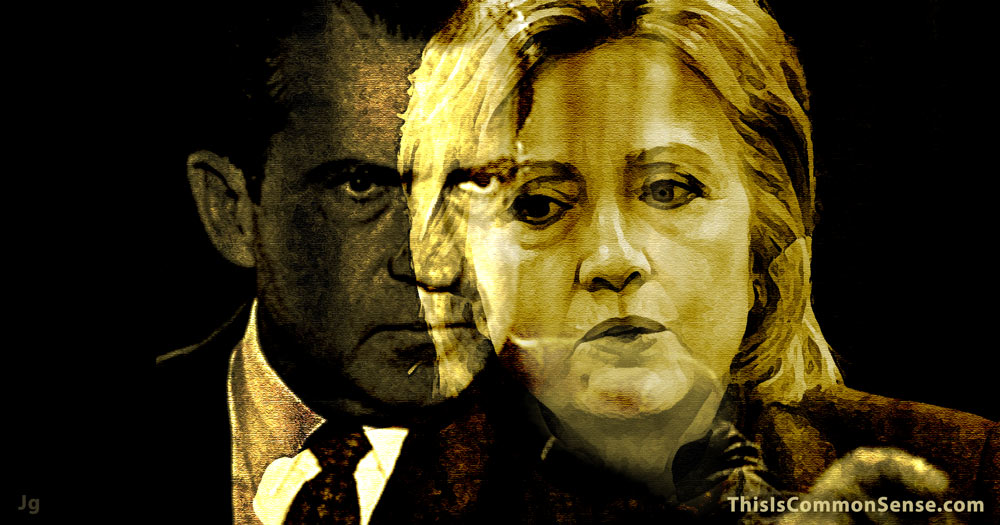
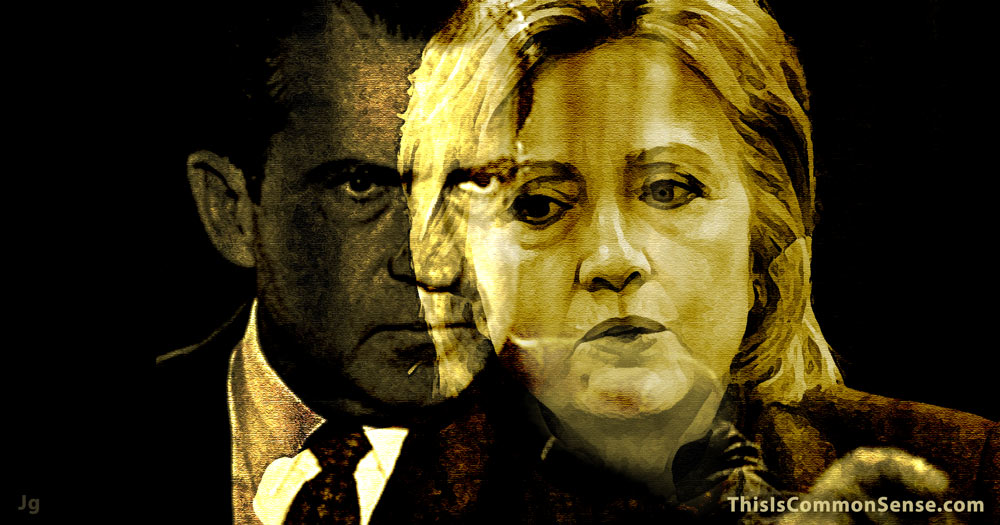
Historically, she reminds me of two past Republican presidential candidates: Richard Milhous Nixon (1913-1994) and James G. Blaine (1830-1893).

Nixon was a power-lusting careerist — just like Mrs. Clinton. Both made runs for office and were brushed aside before ultimate success. Clinton lost the Democratic nod to Obama in 2008; Nixon famously lost the presidential race to John F. Kennedy in 1960, and then went on to lose a governor’s race in California — to the current governor’s father.

But he got in when the Democratic Party was divided over the Vietnam War. If Clinton gets in it will be largely the result of Republican disarray, not her own sparkling personality and charm.

‘Crooked’ Hillary, like ‘Tricky Dick,’ demonstrates extreme social awkwardness as well no small trouble keeping her temper, and being likable. Both are probably best defined as misanthropes. That was Florence King’s judgment of Nixon, and I’d concur regarding Hillary.

But, in terms of corruption, could Hillary be worse than Nixon?

Surely, she’s not as corrupt as James G. Blaine was. Indeed, it was this Maine politician’s outrageous corruption that led to his undoing, and to the election of Democrat Grover Cleveland — despite Cleveland’s sex scandal.

Win or lose, Hillary will have made history, but it won’t be for her gender. Instead, for her striking similarity to past . . . deplorables.

This is Common Sense. I’m Paul Jacob.


Printable PDF

Hillary, Nixon, president, awkward, hated, illustration


Categories
Common Sense

Nobody There. . .

When the two candidates bickered over who would be better at military intervention in the affairs of other countries. . .

. . . there was no one on stage to question the basic assumption.

Categories
Accountability folly media and media people national politics & policies political challengers

The Un-gaffe-able Hillary Clinton

What a troublesome election season. My wife and I have argued for days . . . over which one of us first blurted out that Clinton’s statement about Mosul, Iraq, in the final presidential debate, was flat-out wrong.

Geographically. Map-wise.

Iraqi and Kurdish troops (with U.S. “advisors” and air cover) have set out to re-take Iraq’s second-largest city, under Islamic State control since June 2014. So both presidential candidates were questioned about it.

“What’s really important here is to understand all the interplay,” stated the former Secretary of State, authoritatively. “Mosul is a Sunni city. Mosul is on the border of Syria.”

The problem for Sec. Clinton?

Mosul is not on the Syrian border.

Syria is 100 miles to the west; Turkey, 75 miles north. Mosul is actually closer to the border of Turkey than Syria.

“It going to be tough fighting, but I think we can take back Mosul and then move on into Syria and take back Raqqa,” Mrs. Clinton asserted. “This is what we have to do.”

Really?

“Mrs. Clinton’s comments were uttered in the context of her strategic plan to take on ISIS,” explains Justin Raimondo of Antiwar.com. “If she really thinks that taking Mosul will somehow provide a gateway to ‘press into Syria,’ then she is in for a big surprise.”

Over at Reason.org, Anthony Fisher found that “Hillary Clinton’s foreign policy gaffe at Wednesday’s debate was noticed by almost no one in the mainstream political commentariat.”

Libertarian Gary Johnson of “What is Aleppo?” fame sure noticed, dubbing the massive coverage of his gaffe and the complete non-coverage of hers “a very hypocritical double standard.”

(Psst — they want her to win.)

This is Common Sense. I’m Paul Jacob.


Printable PDF

Hillary Clinton, Gary Johnson, Mosul, Syria, Turkey, illustration


Categories
Common Sense

Laws vs. Regulations. . .

2015 was a record-setting year for the Federal Register, according to numbers the Competitive Enterprise Institute in Washington, D.C., released Wednesday.

This year’s daily publication of the federal government’s rules, proposed rules and notices amounted to 81,611 pages as of Wednesday, higher than last year’s 77,687 pages and higher than the all-time high of 81,405 pages in 2010 — with one day to go in 2015.

—The Hill

Code of Federal Regulations (Wikipedia)

Regulation Run Amok—And How to Fight Back (Wall Street Journal)

Ten Thousand Commandments 2016 (An Annual Snapshot of the Federal Regulatory State from CEI)


Categories
meme

There must be. . .

There must be a less excruciating way to find the least qualified person in the country.

Categories
meme

You had one job America. . .

Categories
Accountability insider corruption media and media people national politics & policies responsibility

Hillary Futures

Trust must be earned; Hillary Rodham Clinton hasn’t earned it.

And yet, if the polls hold, Mrs. Clinton will be elected the next president of these United States — the first-ever female commander-in-chief, sure, but viewed by a clear majority of Americans as untrustworthy.

Part of the problem is her husband Bill. The former president has been accused of inappropriate sexual advances and liaisons . . . and even sex crimes. Hillary’s campaign rightly keeps reminding people that he is not on the ballot. But wasn’t Hillary going to have Bill “run the economy”?

Besides, what’s most relevant is how she defended her philandering husband against his women accusers, with threats, intimidation, and a decided lack of feminist solidarity.

Older folks remember “Travelgate” (a self-serving gaucherie); even Millennials should recall the Bosnian “sniper fire” (self-aggrandizing fib). Then there’s Benghazi. Documents obtained by Congress show Mrs. Clinton immediately telling her daughter that the attack was a planned terrorist attack by an al-Qaeda affiliate. Nonetheless, Hillary publicly blamed the attack on an Internet video.

It was “extremely careless” for Hillary to have set up a private email server, vulnerable to foreign hacking. But how sly to use BleachBit to destroy her hard drive, erasing any money trail. And then, she responded to reporters asking if she wiped her server: “Like with a cloth or something?” Chutzpah.

Ugliest, though, was one of the earliest: cattle futures.

Evidence convinces me that Hillary took a nearly $100,000 bribe disguised as profits from trading cattle futures that she did not actually trade. James Blair, “who at the time was outside counsel to Tyson Foods Inc., Arkansas’ largest employer,” helped Clinton supposedly “out of friendship, not to seek political gain for his state-regulated client.”

The windfall profit was more than lawyer Hillary and Attorney General (and then Governor) Bill earned together annually from their two fulltime jobs. Quite a risky “gamble.” Does Hillary seem like a reckless gambler?

So many scandals and lies. From the next president.

This is Common Sense. I’m Paul Jacob.


Printable PDF

Hillary Clinton, lies, truth, untrustworthy, immigration, trade, drug war, war, Bosnia, Surveillance, Gay Rights, illustration


Categories
ballot access national politics & policies political challengers

Question 5 Fixes Flaw

This week, Krist Novoselic, rock-n-roll bassist of Nirvana fame and fellow board member of FairVote.org, appeared on Fox Business’s Kennedy to explain ranked choice voting.

Krist compared a single ranked ballot under the proposed system to two ballots under the current method. Often, a voter will mark the ballot for one candidate in the primary, and, if the candidate doesn’t make the cut, for another in the general election.

Ranked choice voting sort of collapses multi-candidate primaries and the shorter list of the general election into one, allowing voters to rank their choices so that when their first choice doesn’t make it, their less valued candidates get counted.

So if you prefer a candidate unlikely to win you aren’t “wasting” your vote by marking that candidate first, as today in most American elections, because your vote goes to your second choice.

The current system encourages “strategic voting,” where we deny our preferences to work around the defects of the electoral system. We end up voting for candidates we do not like, to avoid even worse, promoting mediocre and downright bad elected officials.

In Maine, Question 5 on the November ballot, sets up a ranked-choice ballot system for “the offices of United States Senator, United States Representative to Congress, Governor, State Senator and State Representative for elections held on or after January 1, 2018.” It has a not insignificant amount of support, from Mainers across the political spectrum.

But not from the state’s governor (and voicemail-performance-artist) Paul Le Page. He dubs it a way for “loser” candidates to get a “second chance.”

Just like a politician! He focuses on politicians’ chances not voters’ options.

This is Common Sense. I’m Paul Jacob.


Printable PDF

fairvote, Krist Novoselic, Nirvana, voting, democracy, illustration


Categories
Accountability folly national politics & policies responsibility

Successful Strategy Fails

A dark cloud hangs over tonight’s debate.

Not the sex assault scandals. Not the WikiLeaks email apocalypse. Not even the banning of Gov. Gary Johnson from the debate stage. I refer, instead, to the obvious failure of American foreign policy.

Last week, U.S. warships in the Red Sea received missile fire. Not from a “policy disaster” country, mind you, but flowing from the fruits of our flagship foreign policy success!

In September of 2014, President Barack Obama spoke directly to the nation about how he would fight ISIS, pointing to the “strategy . . . we have successfully pursued in Yemen and Somalia for years.”

Roughly four months later, Yemen’s U.S.-supported government fell to Houthi rebels allegedly backed by Iran. Still, the Orwellian oasis that is the state department continued to “stand by” the president’s declaration of success there.

Then, Saudi Arabia and a number of other Sunni-run states began bombing and blockading (and then invading) Yemen. With U.S. military support. Amnesty International, aid groups and Congressman Ted Lieu (D-Calif.) allege war crimes, as the bombing campaign targets civilians and medical facilities. Barely a week ago, an errant strike killed 140 members of a funeral party.

Meanwhile, as the U.S. shoots Tomahawk missiles at Yemeni radar installations, our war department spokesman refers to the return fire as “not connected to the broader conflict in Yemen.”

Sure.

And what of Somalia, Obama’s other success? In recent weeks, al-Shabab fighters have twice attacked U.S. soldiers, and a U.S. air strike mistakenly killed 22 Somali soldiers in the country’s north.

Blindly pursuing a failed strategy, Obama’s undeclared wars go on and on. So where does the likely next president stand?

This is Common Sense. I’m Paul Jacob.

Printable PDF

foreign policy, Obama, election, president, illustration


Categories
Accountability general freedom nannyism national politics & policies responsibility too much government

Report from the Lab

The State of Idaho does something the federal government should emulate. The only state I can think of that has a popular candy bar named after it has a legislature that regularly nixes regulations made by the state’s executive branch.

Think of it as a line-item veto for the legislature.

Now, at this point, if you know the Constitution but not today’s “living Constitution,” you might wonder: Don’t legislatures write the regulations? Alas, at the federal level, as in most states, the legislative branch has granted to bureaucrats in the Executive Branch a great deal of leeway to cook up what sure feel like “laws.”

“Last year the Federal Register,” Wayne Hoffman explains in theWall Street Journal, “which publishes agency rules, proposals and notices, exceeded 80,260 pages — the third-highest in its history, according to a report from the Competitive Enterprise Institute.”

Idaho provides a good model for taking back such ceded legislative power.

Let’s remember the idea of “the several states” experimenting with new and old ideas separately, heralded in a famous phrase, “laboratories of democracy.”

This allows good practices to spread slowly throughout all the states . . . based on results.

Meanwhile, Mr. Hoffman informs us, Idaho’s practice is traditional, not hallowed in the state’s constitution. A 2014 referendum narrowly failed to get Idahoans to change the constitution to incorporate this “best practice” into explicit law — the legislature had not adequately explained the situation to the public first time around — Idaho solons are trying again.

Make representatives responsible for regulations, and therefore more accountable.

This is Common Sense. I’m Paul Jacob.


Printable PDF

bureaucrats, regulation, laws, Idaho, illustration


Illustration: Golconda by René Magritte