Categories
Thought

F. Marion Crawford

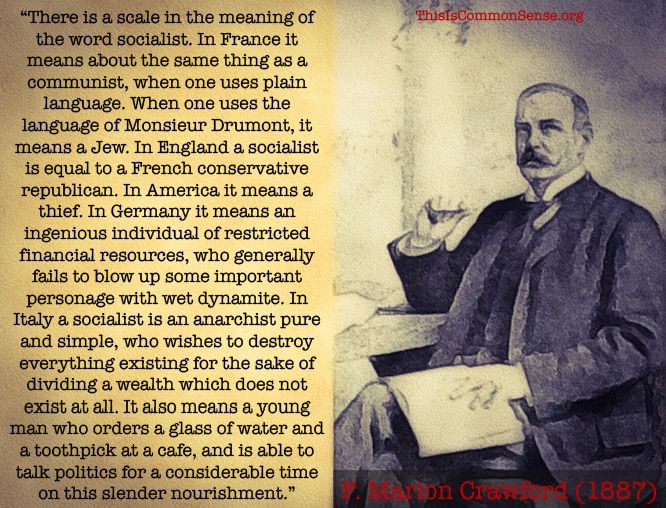
There is a scale in the meaning of the word socialist. In France it means about the same thing as a communist, when one uses plain language. When one uses the language of Monsieur Drumont, it means a Jew. In England a socialist is equal to a French conservative republican. In America it means a thief. In Germany it means an ingenious individual of restricted financial resources, who generally fails to blow up some important personage with wet dynamite. In Italy a socialist is an anarchist pure and simple, who wishes to destroy everything existing for the sake of dividing a wealth which does not exist at all. It also means a young man who orders a glass of water and a toothpick at a cafe, and is able to talk politics for a considerable time on this slender nourishment.

Francis Marion Crawford, Marzio’s Crucifix (1887).
Categories
Today

Belated Amendment

On May 7, 1992, the State of Michigan ratified a 203-year-old proposed amendment to the United States Constitution, thereby fulfilling the terms of amending the document, adding it as 27th Amendment. The amendment had been written by James Madison. He had presented it as part of the original twelve amendments that became the ten making up the Bill of Rights. It bars the U.S. Congress from giving itself a pay raise until after the next election, so that voters have a chance to decide whether those voting for the raise would remain in Congress to receive it.

Categories
Accountability crime and punishment

Bodycam vs. Phonecam

When an LA County Sheriff’s deputy pulled over a woman driving a Mercedes, she went on a tear that quickly become infamous. “You’re always gonna be a Mexican,” she scolded the cop, “you’ll never be white, you know that, right?”

Undoubtedly, this racist taunt from a black female motorist, confirmed by Fox News to be an area teacher, was in the name of anti-racism. Wokely, assuming that to be Latino and a cop must mean he “wants to be white.”

She claims that she became afraid of the deputy, who she kept calling a “murderer,” so she started recording him. Indeed, he pulled her over because she had been using her cell phone to record . . . while driving! After the stop, she continued to record him, which she (correctly) said she had every right to do. He persevered and gave her a ticket for having used her phone while driving.

He had a bodycam on, which his department does not require. The video he sent Fox journalist Bill Melugin no doubt got in front of The Narrative.

The woman, a serial complainer about police, did indeed file a complaint about his behavior.

Folks who earnestly worry about police abuse — and not, like this woman, who did so in a paranoiac and ideological and racist manner — might consider getting something for road altercations themselves: one for the dash, but also one on their very own person. And something that is not a phone! At least when driving.

Has the utility of the “cop cam” ever been better demonstrated?

This is Common Sense. I’m Paul Jacob.


PDF for printing

Photo by Yannick Gingras

See all recent commentary
(simplified and organized)
See recent popular posts

Categories
Thought

Søren Kierkegaard

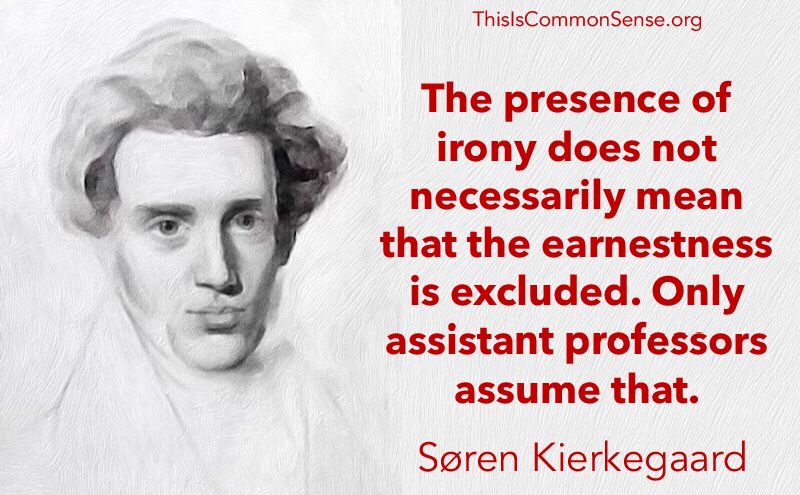
The presence of irony does not necessarily mean that the earnestness is excluded. Only assistant professors assume that.

Søren Kierkegaard, Concluding Unscientific Postscript to Philosophical Fragments (1846), Appendix: A Glance at Contemporary Effort in Danish Literature.
Categories
Today

Good Sailing

On May 6, 1862, American author, philosopher and abolitionist Henry David Thoreau died, after many years of tuberculosis. 

Aware he was dying, Thoreau’s last words were “Now comes good sailing,” followed by two lone words, “moose” and “Indian.” Bronson Alcott planned the service and read selections from Thoreau’s works, and Ralph Waldo Emerson wrote the eulogy spoken at his funeral. 

His remains, as well as those of members of his immediate family, were eventually moved to Sleepy Hollow Cemetery in Concord, Massachusetts.

His most famous works are An Essay on Civil Disobedience (1849) and Walden (1854).

Categories
local leaders term limits

Term Limits Trek

Izzy Israel lost his job. He had been working in Nashville’s music industry, but the coronavirus pandemic upset those plans. In the induced depression of the pandemic lockdowns, he decided to try to make a wider impact. He went walkabout.

Or, more properly, trek.

He set out to walk from the Florida Keys across country to Cape Flattery in Washington State . . . for a cause.

The cause?

Term limits. “We have people in Congress that are making policies and laws for their entire lifetimes,” he argues. “I think that’s highly corruptible. Big money is guiding our policies. You can see it. I think it’s time for term limits and I wanted to be a part of that change.”

According to the account in Alabama’s Pike County newspaper, The Messenger (troymessenger.com), “He began his cross-nation odyssey on Dec. 22, 2020, and hiked up the Florida panhandle solo until he reached Tallahassee. While generating some publicity for his cause, he attracted the attention of the national organization, U.S. Term Limits.”

Specifically, my old colleague Jeff Tillman.

“Once I met this guy,” Jeff says of Izzy, “I was amazed at how dedicated he was.”

The Messenger goes on to relate how Tillman’s support has made Izzy’s long march for limits on politicians easier and more effective.

Izzy points out that Congress is “having a hard time” term-limiting “itself.” Thankfully, explains Jeff, the Constitution provides a path for 34 states (two thirds) to call a convention to propose an amendment, bypassing Congress.

Four states — Alabama, Florida, Missouri, West Virginia — have passed an application for the single-subject convention advocated by U.S. Term Limits. Another 15 states have passed calls for a multi-subject convention, which includes term limits.

Let’s . . . enact some Common Sense. I’m Paul Jacob.


PDF for printing

See all recent commentary
(simplified and organized)
See recent popular posts

Categories
Thought

President Grover Cleveland

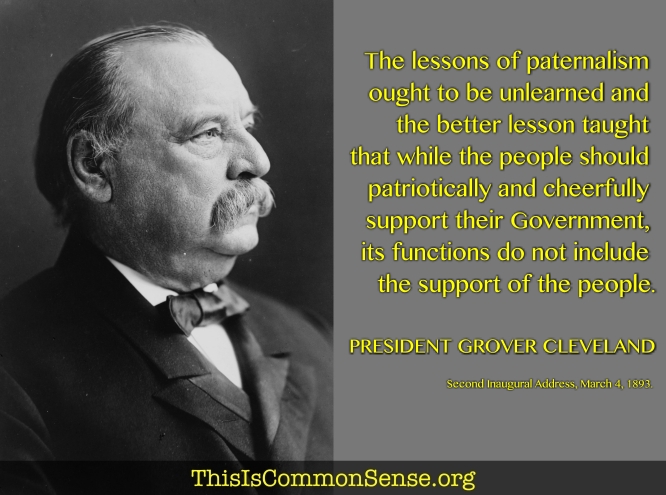
The lessons of paternalism ought to be unlearned and the better lesson taught that while the people should patriotically and cheerfully support their Government, its functions do not include the support of the people.

Stephen Grover Cleveland, Second Inaugural Address, March 4, 1893.
Categories
Today

Cinco de Mayo

In 1862, troops led by Ignacio Zaragoza stopped a French invasion in the Battle of Puebla in Mexico — an event leading to the popular “Cinco de Mayo” celebration.

No cause for celebration, however, is the anniversary of Karl Marx’s birth 201 years ago.

Categories
national politics & policies tax policy

The Six-Trillion Dollar Man

“Mr. Biden is making a six-trillion dollar bet that promoting popular programs will be popular,” offered NBC Meet the Press host Chuck Todd on Sunday, “and that he’ll be rewarded for getting things done, long before the actual bill comes due.”

That “Six trillion dollars”? New splurging “on social spending, infrastructure, climate change, health care and more.” 

The host intoned that this constitutes the “return of big government.” 

“We have to prove democracy still works, that our government still works,” Joe Biden, the 47th president, implored Congress last week, “and we can deliver for our people.”

Spend = Deliver. 
Deliver = Democracy. 
Democracy = Spend!

So goes a federal “democracy” wherein voters never get a straight, democratic choice on how much government should spend and tax.* Instead, politicians opt for their beloved “deficits forever” method. Purchase votes today — “People like it when you give them money” — and leave for future generations of voters the tax burden needed to pay that bill. No pain, all gain. 

Smart re-election strategy, some say. 

“Democratic strategists are betting that the infighting in the Republican Party, the extremism on display during the Jan. 6 attack . . . and the sheer scale of the trillion dollar programs Democrats have pushed through this year,” reports The Washington Post, “leads to a reorienting of partisan divisions that can overcome historical patterns.” Meaning Democrats avoid the traditional loss of congressional seats for a president’s party.

“Will voters care about the scope of Mr. Biden’s plans?” Todd inquired. “. . . care about the price tag?” 

Likely to the degree they notice paying that price. 

“President Trump and the Republicans may have made it a bit easier for Mr. Biden by spending big themselves,” reminded Todd.

He’s not wrong there.

This is Common Sense. I’m Paul Jacob.


* Colorado voters have such a choice: a vote on any tax increase and on government spending increases. It’s called the Taxpayer Bill of Rights (TABOR) and was passed by citizen initiative back in 1992. The politicians and lobbyists just hate it, as I detail here

PDF for printing

Photo by Anno Málie

See all recent commentary
(simplified and organized)
See recent popular posts
Categories
Thought

Gustave de Molinari

War has ceased to be productive of security, but the masses, whose existence depends upon the industries of production, are compelled to pay its costs and suffer its losses without either receiving compensation or possessing means to end the contradiction. Governments do possess this power, but if the interests of governments ultimately coincide with the interests of the governed they are, in the first instance, opposed to them.

Governments are enterprises — in commercial language, “concerns” — which produce certain services, the chief of which are internal and external security. The directors of these enterprises — the civil and military chiefs and their staffs — are naturally interested in their aggrandizement on account of the material and moral benefits which such aggrandizement secures to themselves. Their home policy is therefore to augment their own functions within the State by arrogating ground properly belonging to other enterprises; abroad they enlarge their domination by a policy of territorial expansion. It is nothing to them if these undertakings do not prove remunerative, since all costs, whether of their services or of their conquests, are borne by the nations which they direct.

Gustave de Molinari, The Society of To-morrow (1899)