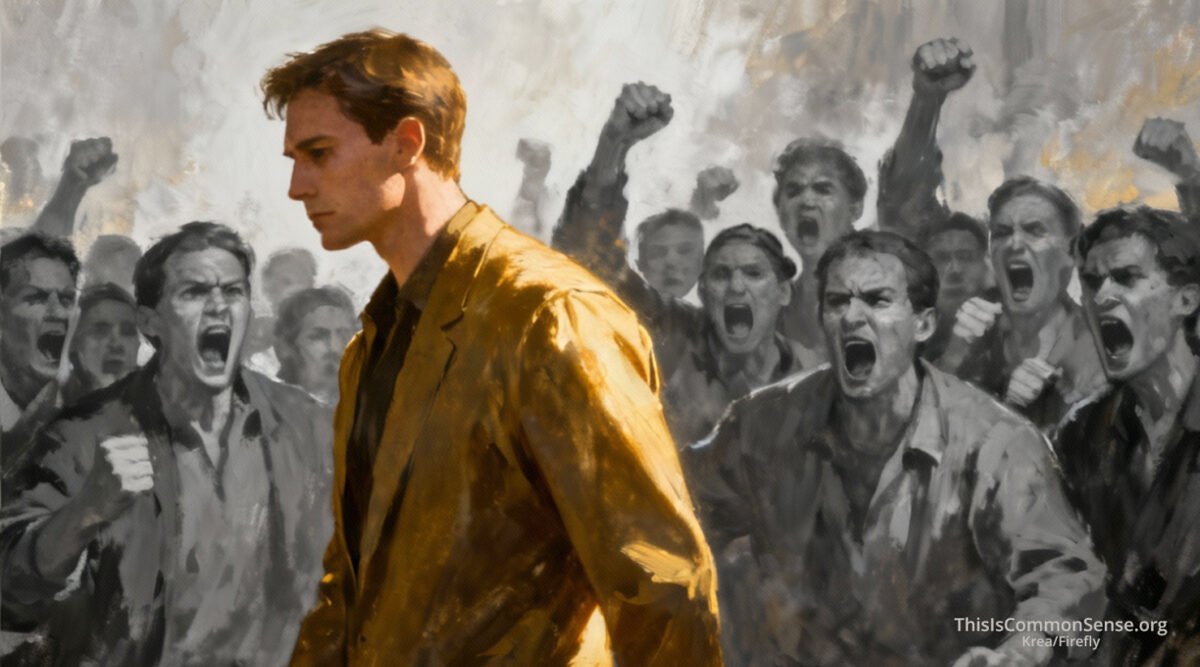
“The First Amendment prohibits the government from restricting free speech,” explained Michael J. Reitz in The Detroit News. But what about individuals and non-government groups?
“Free speech doesn’t compel you to listen. You can walk away,” Mr. Reitz goes on to say.
In the piece, reprinted by the Mackinac Center for Public Policy, Reitz wonders, however, whether this “agree to disagree” attitude is enough to keep free speech alive. He believes that “as a society, we show our commitment to free speech through our willingness to listen, discuss and debate. It’s not consistent to say I value another person’s right to speak if I refuse to engage.”
A liberal attitude — in a social, perhaps non-political sense — is what Reitz advises: tolerant of differences; not prone to anger at hearing an opposing view; engaging logically and fairly with differing opinions; but free to take it or leave it without fearing recrimination, retribution or retaliation.
This right to walk away may define free speech, but Reitz argues that we mustn’t all walk to our bubbles in anger.
An old saw, recently popularized, insists that “we have freedom of speech, but we don’t have freedom from the consequences of speech.” In a free society, you may say what you like on your property, on your dime, but some people may shun you. Or fire you. And that’s OK.
What’s not an acceptable “consequence” of freedom of speech? Being silenced by the government, or the mob, either with petty violence or maximum force. Too many people use the “no freedom from consequences” cliché as an excuse to harass people at their work. Or bank. This is where it gets difficult.
Since one neither has a right to a specific job nor to force a bank to accept one’s money on account, purely social pressure to de-bank, de-platform, or get someone fired, fits in a free society. But is Reitz correct that, legality aside, when such social pressure is common, and one-sided, free speech is doomed?
Perhaps society is doomed, in multi-lateral wars of us vs. them.
This is Common Sense. I’m Paul Jacob.
Illustration created with Midjourney and Firefly
See all recent commentary
(simplified and organized)
See recent popular posts
5 replies on “Two Ways of Walking Away”
A right to freedom of speech is a right to control one’s resources for purposes of expression without constraint concerning concerning the expressive content as such. One is protected in this use of that in which one has property just as one is protected in other uses — against anyone and everyone, whether they style themselves as the state, as the community, or as representatives of religious truth.
The right may have some instrumentalist usefulness — helping to prevent dogma from displacing truth and so forth — but its foundation is just that of all rights.
Instrumental usefulness is certainly to be found in going beyond acknowledging the rights of others to express themselves, and actually attending to what they have to say. In particular, if what they say discomforts us, yet we are unable to make counter-arguments based upon principles of logic and of evidence, then we are likely to learn, one way or another, from intellectually and verbally wrestling with their expressions.
But, none-the-less, a right to shun those whose expressions one detests is an aspect of one’s right to control one’s property for expressive purposes.
Here’s another axiom: your rights end where mine begin. The mob cannot deprive me of my rights under the law. But what about de-banking, de-platforming, etcetera? Whether they are legal or not, I consider them a violation of the social compact. They seem to violate equal access rules. We may shun individuals or businesses on a personal level, but we should not deprive them of the tools needed to function in current society. The rule of law would become irrelevant. That would ultimately lead to the disintegration of society as a whole.
Well said
“nor to force a bank to accept one’s money on account”
Banks only exist as extensions of the government via government issued charter, and as such, should be forced to serve all people equally
At present, the banking system is fascistically integrated with the state, but in a free society money and banking with be utterly denationalized; and then we would confront the question of whether bankers should ever refuse to offer service to someone on the basis of what he or she said.