Categories
free trade & free markets regulation too much government

Thought Deserts

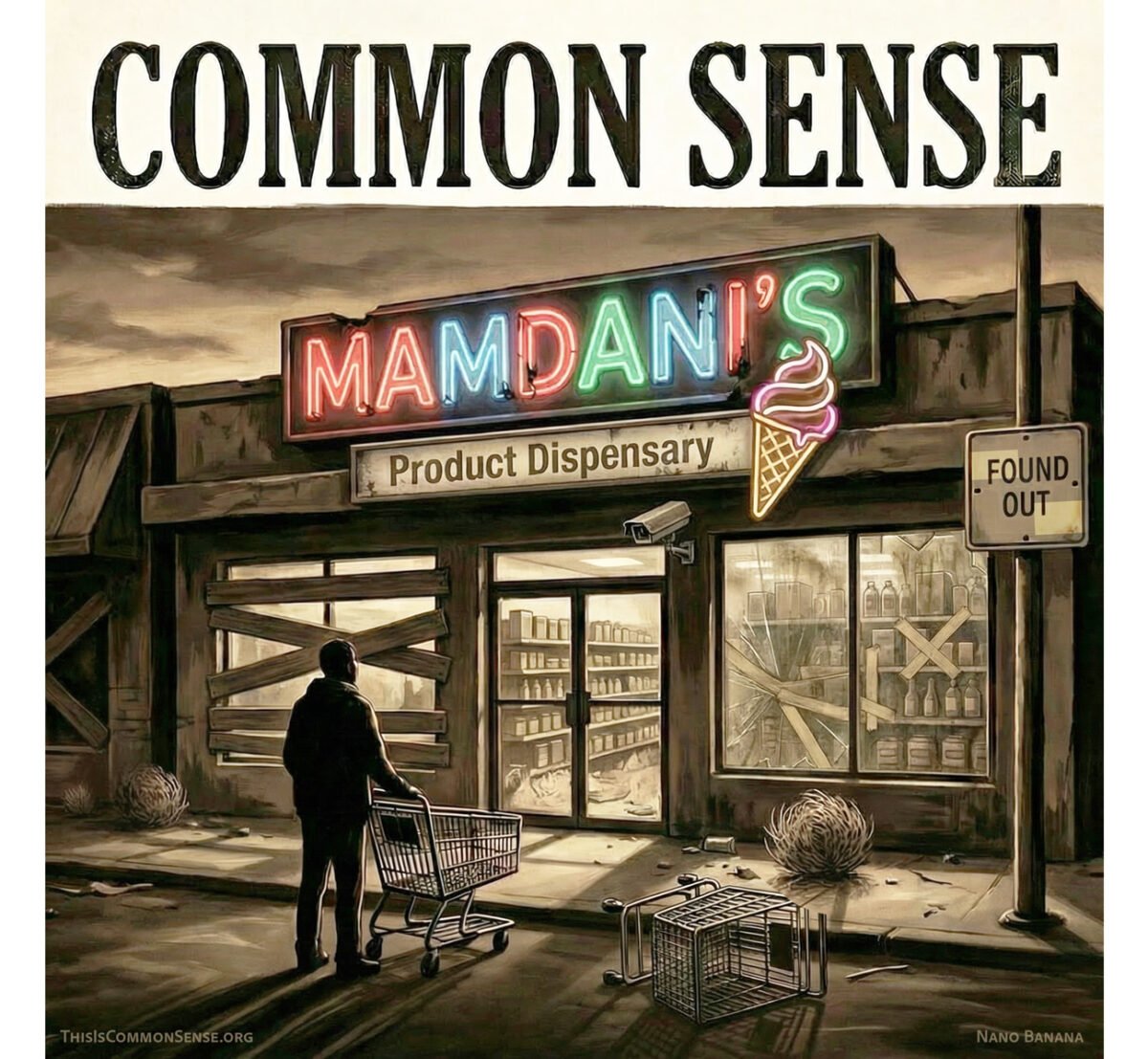
The U.S. is at war — a war that Trump had warned against; and UFOs/drones are again seen over New Jersey. But Senator Ben Ray Luján (D-N.M.) has something else on his mind, something a little closer to home: regulating grocery store pricing and marketing.

He has co-sponsored S. 3892, dubbed the “Stop Price Gouging in Grocery Stores Act of 2026.”

What is price gouging? Selling or offering items at a “grossly excessive price,” which the Federal Trade Commission is tasked with defining. But Luján’s real focus seems to be his distrust of surveillance in stores, which he fears will be used to adjust prices individually.

He somehow doesn’t mention why stores have increased surveillance of customers.

One word: thievery.

But Lujan isn’t alone, fecklessly fighting the food-market market. In Washington State and elsewhere, socialists and other politicians are trying to force grocers to stay open, even if their corporate owners have good reason to shut down a specific store. Seattle’s new mayor, Katie Wilson, says Seattle must not “allow giant grocery chains to stomp all over our communities, close stores at will, and leave behind food deserts.”

A south Tacoma neighborhood Safeway closed, so a state senator cooked up a bill to “give communities time to respond to grocery store closures.”

Truth is, of course, that grocery stores operate on slim margins. The more regulations piled on, and the more criminals you throw at them, the fewer groceries your community will have.

And the “liberals” who vote for such nonsense? They will not like the Mamdani stores they are left with — the subsidized product deserts that only now look good . . . 

In socialist dreams.

This is Common Sense. I’m Paul Jacob.


PDF for printing

Illustration created with Nano Banana

See all recent commentary
(simplified and organized)
See recent popular posts
Categories
crime and punishment fraud too much government

Oz in Fraudland

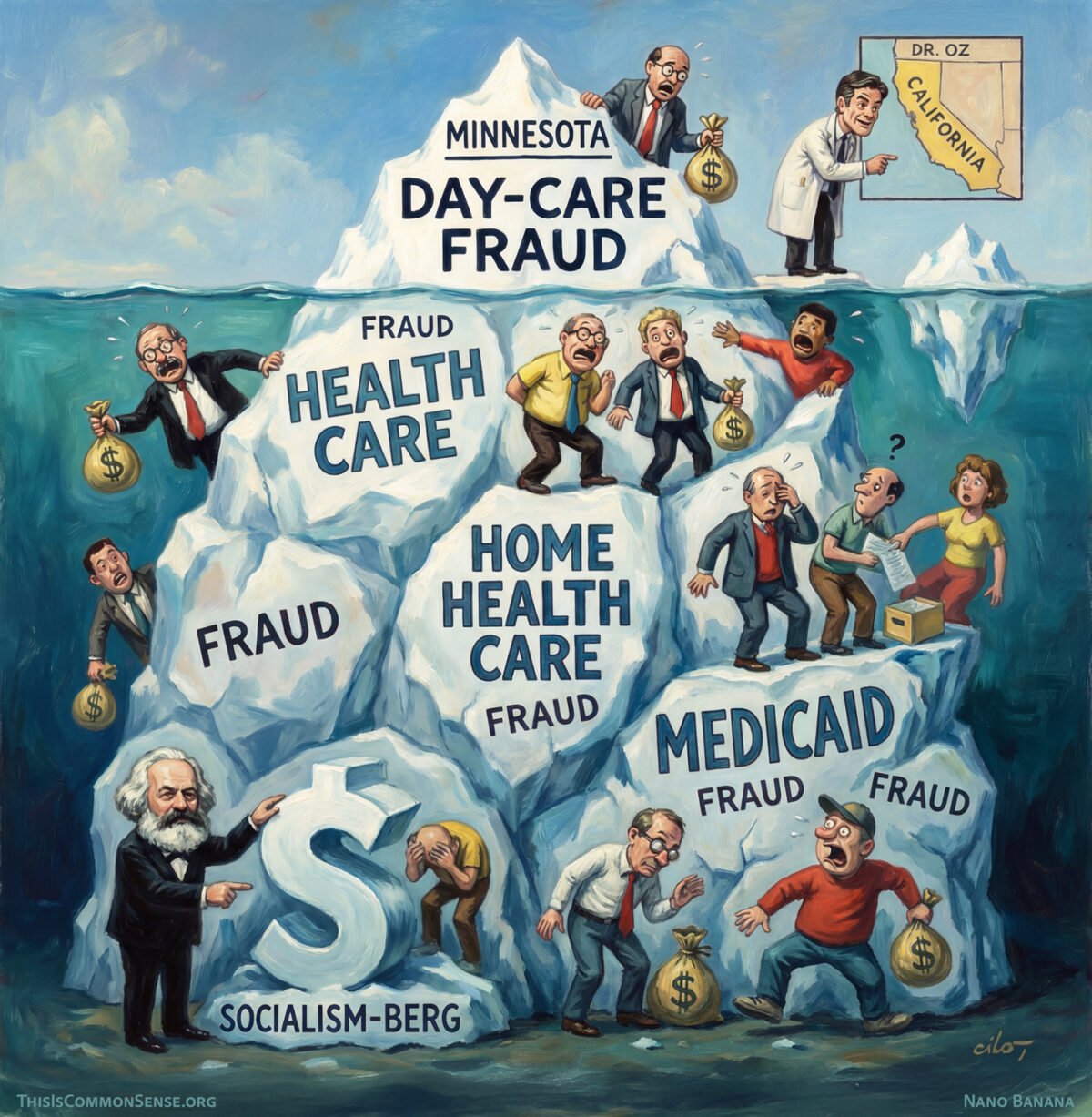
Ten days ago, I quoted Veronique de Rugy, warning that Minnesota’s day-care fraud scandal was “only the tip of the iceberg.” 

Beyond subsidized daycare? Health care, home health care, Medicaid. 

Fraud, fraud, fraud.

But it wasn’t just a lone Reason scholar saying it. “What we’re seeing in Minnesota … is dwarfed by what I saw in California,” The Epoch Times quotes Dr. Mehmet Oz, administrator of the Centers for Medicare and Medicaid Services. 

Minnesota, Dr. Oz said, “is just the tip of the iceberg.”

Just in California’s hospice and home health care, Oz figures, fraud rockets up to at least $4 billion.

Add a few billion here and there and soon you’re talking real money.

I titled my commentary quoting Ms. de Rugy “The Tip of the Socialism-berg.” Remember Mr. Socialism? Karl Marx? He introduced to the world a complicated, rather magical theory of exploitation in market society focusing on “surplus value.” While I have trouble making heads or tails of his theory — seems utterly nuts — I do know something about its origin. 

Marx nabbed it from classical liberal French scholars who preceded him. But they said the exploitation was through government mechanisms: it’s those who skim off of taxes who exploit the masses. 

Marx turned it upside down.

So let’s turn things right-side up: we all know that when it comes to policy, good intentions don’t make up for bad consequences. And those who de-fraud the taxpayers don’t have “good intentions.” 

They’re thieves. 

This is Common Sense. I’m Paul Jacob.


PDF for printing

Illustration created with Nano Banana

See all recent commentary
(simplified and organized)
See recent popular posts
Categories
meme Thought

The Warmth of Collectivism

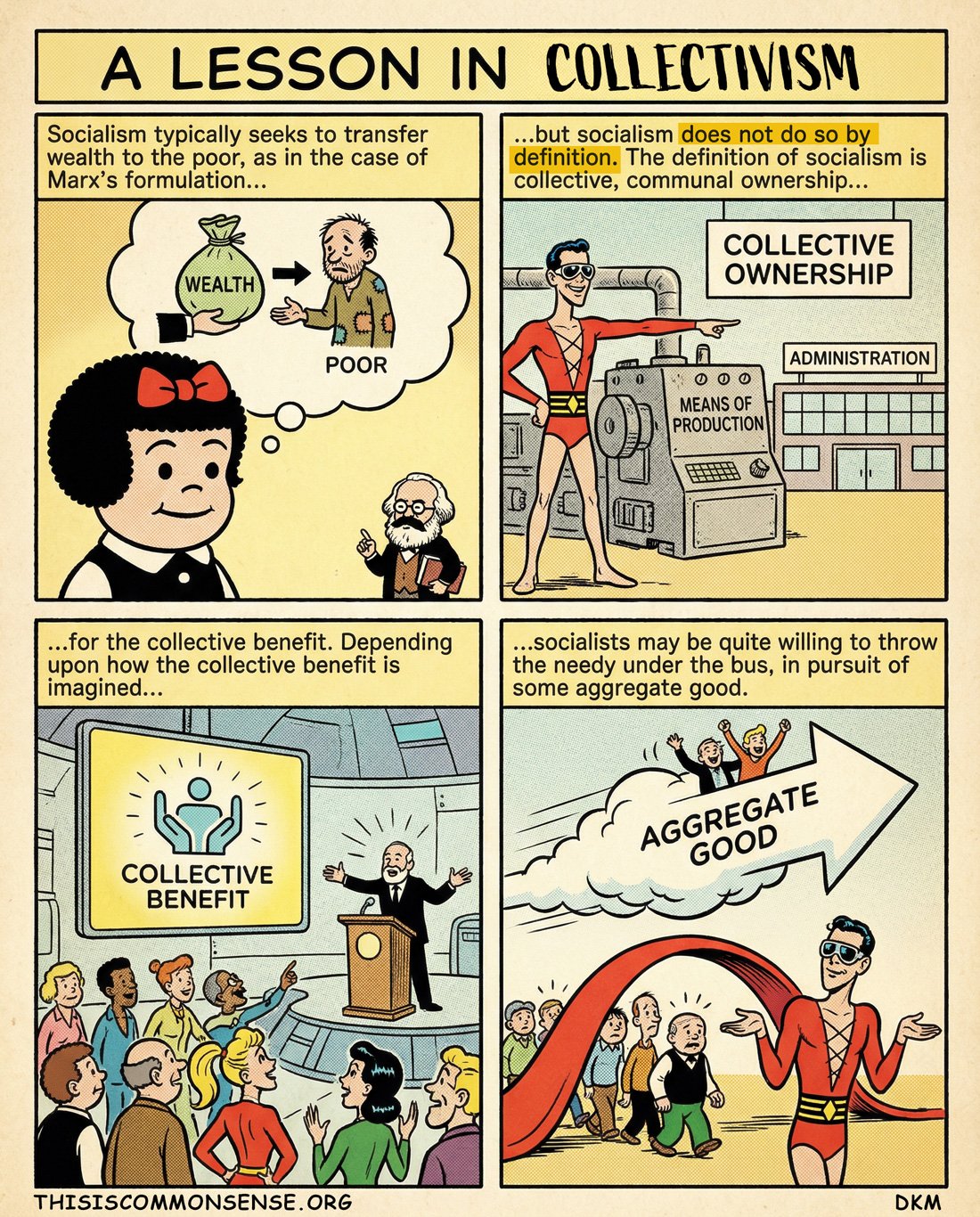
“Socialism typically seeks to transfer wealth to the poor, as in the case of Marx’s formulation; but socialism does not do so by definition. The definition of socialism is collective, communal ownership of the means of production and administration for the collective benefit. Depending upon how the collective benefit is imagined, socialists may be quite willing to throw the needy under the bus, in pursuit of some aggregate good.”

–DKM

Categories
crime and punishment ideological culture subsidy too much government

Tip of the Socialism-berg 

“In 2024 alone, state Medicaid Fraud Control Units reported more than 1,151 convictions and more than $1.4 billion in civil and criminal recoveries,” writes Veronique de Rugy at Reason. “Federal enforcement recovers a tiny share of what is stolen. Fraud that goes undetected never appears in the data.”

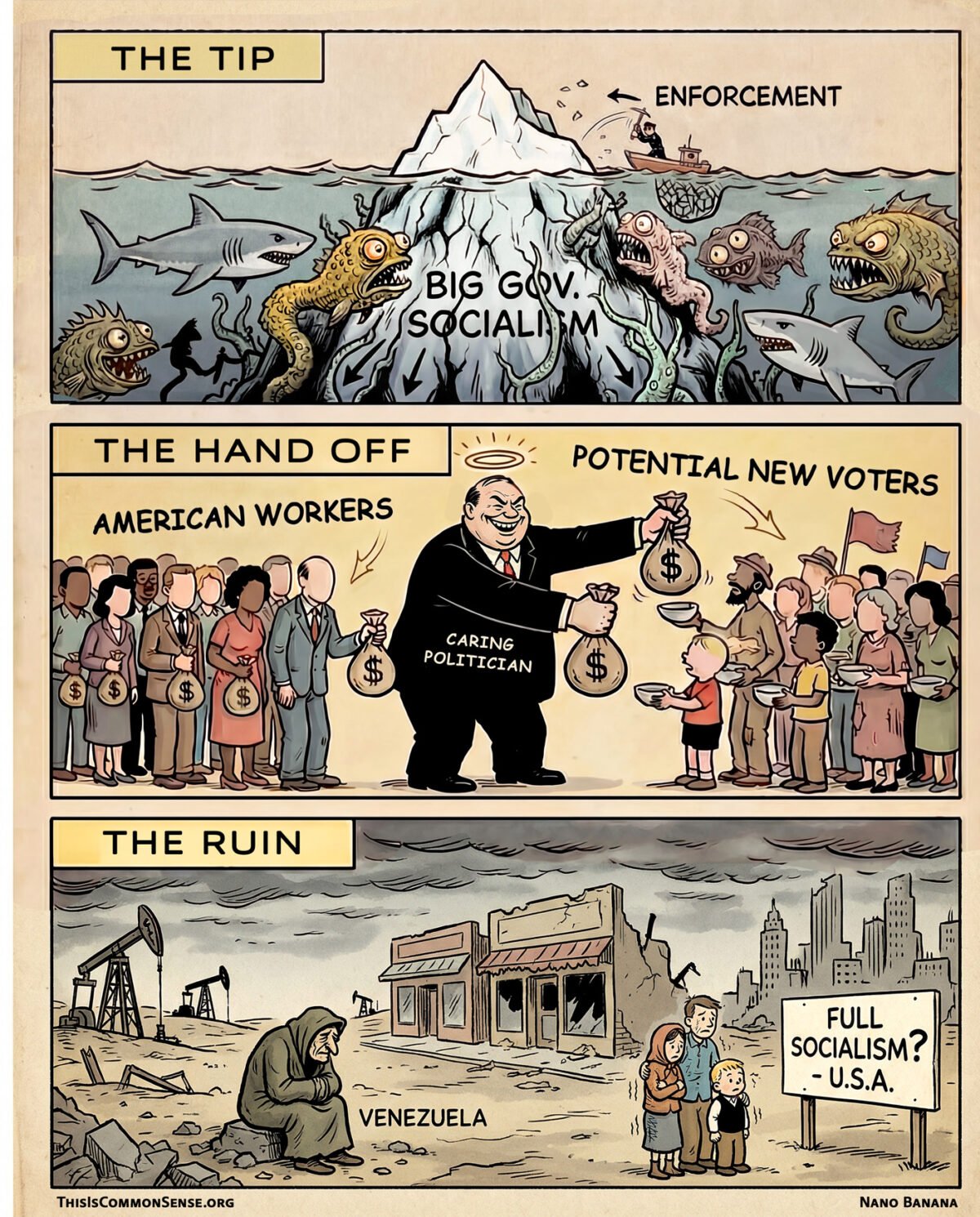
And then she makes a claim that increasing numbers of astute observers make: “That’s only the tip of the iceberg.” She goes on to suggest that Medicare, the Supplemental Nutrition Assistance Program (SNAP), and “many other welfare programs” constitute a huge hunk of fraud.

The solution? “If we want less fraud,” she argues, “we need less government.”

Fraud and big government seem to go hand in hand. At least this kind of big government, which resembles the biggest kind of government imaginable. For taking wealth from many productive American citizens and giving it to a small but growing population of refugees from distant lands, that’s not necessarily fraud, I suppose, but it is something close to socialism.

We see in Venezuela just how devastating rule by thieving socialists can be. (Hugo Chavez nationalized oil industry infrastructure and then ran it into the ground.) In Minnesota and in other states of the union, we see a similar ethic. When done on a limited basis, we could call it “helping the poor,” the folks who just cannot produce what they need. That’s how transfer socialism was sold to us.

And they could say, truthfully, that’s not full socialism.

But extending the beneficiary class from our most needy friends and neighbors to the less-and-less needy, and then to waves of refugees from other countries, that’s a recipe for disaster. Like socialism when “full.”

How far should Americans go to help “others”? To our own ruin?

This is Common Sense. I’m Paul Jacob.


PDF for printing

Illustration created with Nano Banana

See all recent commentary
(simplified and organized)
See recent popular posts

Categories
ideological culture too much government

Memo to Mamdani Voters

New York City is expensive. Housing is expensive, often prohibitively so. The city has crime problems. Other problems.

Answers: Unshackle the housing market? Slash regulations and taxes? Make it easier to catch and punish bad guys? No. Prevent builders from supplying more and cheaper housing. Further hobble the police. Etc. Pro-Hamas socialist Zohran Mamdani has a slew of such pseudo-solutions. 

And has a large following.

In New York’s mayoral race, decided Tuesday, the Republican candidate was excluded by the city’s heavily Democratic tilt. The incumbent mayor was also nonviable. Scandal-plagued former Governor Cuomo was the main alternative to a reputedly charming Mamdani now claiming a mandate to rob the rich.

Song Ying is a 72-year-old New Yorker who escaped the Chinese communists in 1976. She “swam for eight hours from Shenzhen, then a small fishing village, to Hong Kong,” explains  The New York Times in a report on the growing generational divide among Chinese immigrants regarding the prospect of a socialist city. Song is dismayed by the strong support among young New Yorkers for Mamdani. She says — and knows — that socialism doesn’t work.

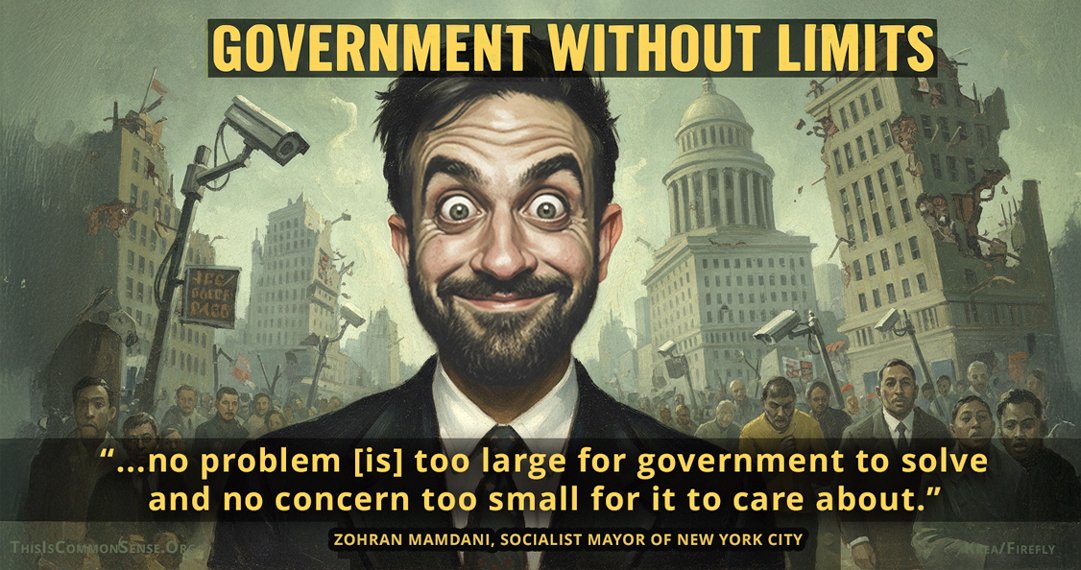
The Times belittles her concerns, stressing that Mao’s China is not the vision that Mamdani is selling. Yet upon winning, the mayor-elect asserted that his administration would prove that “no problem [is] too large for government to solve and no concern too small for it to care about.” Sounds like a government without limits.

Mamdani will not fix things. He offers as solutions more of the policies that caused current problems: more regulations; more taxes; more spending; more government in power and scope.

If a boulder is tumbling right toward you, demanding more and heavier boulders won’t stop you from being crushed.

This is Common Sense. I’m Paul Jacob.


PDF for printing

Illustration created with Krea and Firefly

See all recent commentary
(simplified and organized)
See recent popular posts
Categories
folly too much government

How Socialists Learn

Not all socialists in mayoral runs won on Tuesday.

Sure, socialist/communist Zohran Mamdani is now Mayor Elect of New York, but Omar Fateh lost to the incumbent mayor of Minneapolis on a second counting of the city’s ranked choice vote system. The latter is a victory for old-fashioned city politics, but what is the former?

Mamdani obviously wants to take from the rich and give to the poor, with a lot of government workers shuffling the money in between rich benefactors and poor dependents. Running grocery stores, of all things: Mamdani seeks to bring the efficiency of the DMV to the food industry. 

But just how much harm can he do? 

He still has to balance city budgets, and if he wants to spend billions, he has to “raise” billions in revenue. He cannot simply spend money he’s created — Mamdani doesn’t control the money supply. After all, socialism doesn’t create wealth ex nihilo.

Further, he will face opposition on his many pipe dreams. Since he has almost no work experience, and none managing anything, he may also prove to be way over his head.

Worst case? If he pushes his dream earnestly and effectually in the Big Apple, the rich and industrious will flee. (A possibility so likely that it is worth stating multiple times: when fools vote socialist, the wise vote with their feet.) Mamdani may usher in Atlas Shrugged faster than any pro-capitalist political party ever could.

Which, though disastrous for the poor, might prove educational.

This is Common Sense. I’m Paul Jacob.


PDF for printing

Illustration created with Krea and Firefly

See all recent commentary
(simplified and organized)
See recent popular posts
Categories
too much government

Escape from New York

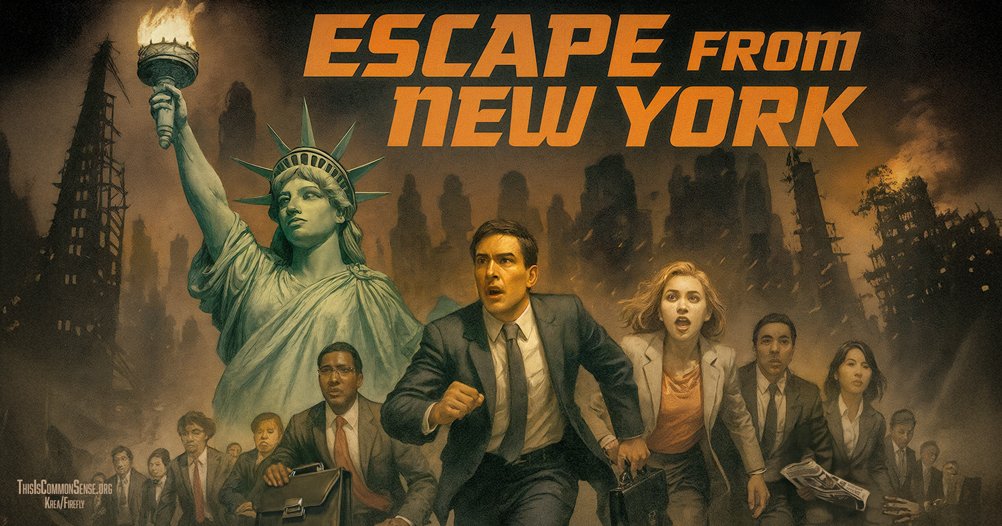
People in New York City with any money and property are unhappy about the prospect of a communist mayor. They apparently see the potential of the government taking much more of their money less a politician’s promise and more a revolutionary threat.

While Zohran Mamdani might lose, it’s not looking that way. (Note the standing of his chief competitor.) Therefore, many homeowners are fleeing, without waiting for Election Day.

One destination is next-door Connecticut, site of a failed revolt in 1991 against the enactment of a state income tax. New Yorkers reasonably suppose that the taxes imposed by a Mayor Mamdani would prove worse than that — and worse than New Yorkers’ already-heavy tax burden.

Escapees are also worried about crime.

Mamdani could do much unilaterally but would need the cooperation of the state legislature and governor or the city council to impose the tax hikes he’s dreaming about. Still, these entities hardly serve as bulwarks of limited government.

We know that New Yorkers are lurching to Connecticut because, as the New York Post reports, a “bidding war frenzy and soaring prices” have hit the state’s housing market.

According to real-estate agents there, the frenzy resembles that of early pandemic times. Properties are being scooped up within days. Deals are cash on the barrelhead, even for multi-million-dollar homes. Sale prices are much higher than expected.

And the bidders are coming “out of New York City,” the agents say. Prospective buyers have been “mentioning concerns about the mayoral election. . . .”

Good news, for a while, for Connecticut home sellers and their real-estate agents. Bad news for everybody else, soon enough.

This is Common Sense. I’m Paul Jacob.


PDF for printing

Illustration created with Krea and Fireflly

See all recent commentary
(simplified and organized)
See recent popular posts
Categories
budgets & spending cuts ideological culture national politics & policies

Pleistocene Politics

Back in the Eocene — I mean the 1990s — Senator Chuck Schumer and President Bill Clinton and most other Democrats insisted that “healthcare” benefits not be distributed to “those who’ve entered the country illegally.” Now, the party is united behind the opposite notion, in which benefits — paid for by resident taxpayers — must be delivered generously to all comers. 

This was most clearly demonstrated in 2019, during one of those huge panels of presidential hopefuls on the Democratic side, all raising their hands on whether they supported giving tax-funded medical assistance to illegal aliens. 

Yesterday I quoted Rep. Maxine Waters (D-Calif.) on how Democrats want to “save people.” 

What I didn’t quote was the question she was asked — “Do Democrats want to prioritize the healthcare for illegal aliens over a government shutdown?” — or how she initially responded: “Excuse me; stop it right there. We’re not prioritizing; what we’re doing is saying, simply, we wanna keep the government open and we wanna work with the Republicans and have a bipartisan agreement to keep this government open and healthcare is at the top of our agenda.”

Whew. While denying she’s prioritizing what’s at “the top” of her “agenda” — what prioritization means — her desire for a “bipartisan agreement” is just as fake, for what she and her fellow Democrats demand is that the Republicans completely agree with their most extreme agendum: subsidized medical assistance for all comers.

 That’s not “bipartisan.” There’s no compromise. It’s a tactic of intransigence.

Nassim Nicholas Taleb wrote about this in terms of an “intransigent minority rule,” positing that in complex systems — such as societies, markets, or Congress — a small, highly committed minority (as little as 3-4 percent) can impose its preferences on a flexible majority due to an asymmetry of choice.

Meaning that the opponents of “limitless” subsidies (socialism) must become intransigent themselves to win.

This is Common Sense. I’m Paul Jacob.


PDF for printing

Illustration created with Krea and Firefly

See all recent commentary
(simplified and organized)
See recent popular posts
Categories
subsidy too much government

Free Transit Isn’t Free

If Zohran Mamdani, the Big Apple’s openly democratic-socialist, covertly communist mayoral candidate makes it into Gracie Mansion, he will try to enact many plans to improve — i.e., worsen — things.

The candidate wants to increase taxes and government spending, reduce freedom and individual responsibility. The standard Democratic agenda, but foisted bigger and faster.

One announced plan is to scrap mass transit fees.

Taxpayers would then suffer new costs. But so would riders who travel “free.” Greater crowding is one. Another is the kind of people who would be more often riding, no longer discouraged by having to pay fares or having to risk arrest for jumping a turnstile. Riders would be plagued by more bums and more criminals.

Beggars already being a common sight on NYC subways, it’s easy to project that ending financial and physical barriers to entry would only encourage more. Criminals would also be encouraged.

We might consider what happened elsewhere when this has been tried. Kansas City, Boston, Philadelphia — a “scientific socialist” would insist on a thorough study of all those cases, but Mamdani’s merely mentioned Bogotá’s, and is not pushing a study, maybe because he’s seen the mess Albuquerque’s in, after eliminating its one-dollar bus fare in 2023. Buses were soon being used as “rolling homeless shelters.” Local media also reported that they were “being used as getaway vehicles for shoplifters. . . .  The addition of security guards on buses has undoubtedly caused criminals to think twice, but it has not solved the problem.”

The author of these words, Paul Gessing, is hoping that recounting Albuquerque’s experience will convince Mamdani to scrap his free-transit proposal. Should Mamdani become mayor, he may eventually be forced do so, but probably only after first making everybody suffer.

This is Common Sense. I’m Paul Jacob.


PDF for printing

Illustration created with Krea and Firefly

Categories
media and media people national politics & policies subsidy

Propaganda Shoved Where?

The continued existence of “public radio” and “public television” is out of place in these United States. Not because it’s partisan — all news vendors tend to toe some partisan line — but because it’s partisan and taxpayer subsidized.

Though NPR aficionados tend to downplay the subsidies to NPR and PBS, what public media boosters have more consistently done is deny the partisanship

They have no standing any longer — if the evidence of our senses weren’t enough. 

In “The Bell Finally Tolls for National Public Radio,” Matt Taibbi explains how the media behemoth’s CEO Katherine Maher admitted NPR’s and PBS’s partisanship in her defense of it.

That won’t help her case in Congress, though, notes Mr. Taibbi. 

While the New York Times insists that tax-funded “public” media “improves the lives of millions of Americans” and “strengthens American interests” (presumably by being relentlessly progressive), it has no defense to Taibbi’s indictment: the branches of the Corporation for Public Broadcasting have taken “the country’s signature public news shows into an endless partisan therapy session, a Nine Perfect Strangers retreat for high-income audiences micro-dosing on Marx and Kendi.”

Taibbi makes clear just how annoying the dish served by CPB/NPR/PBS is, the entities seeing no “problem with taking funds from a huge plurality or even a majority of citizens and pursuing a nakedly politicized, ear-splitting propaganda project in opposition to the views of those people. NPR is the vegetables we refuse to eat, administered up a different entrance for our own good.”

I was thinking about the blight upon our eyes and ears and reason, but point taken.

De-fund National Public Propaganda immediately.

This is Common Sense. I’m Paul Jacob.


PDF for printing

Illustration created with Krea and Firefly

See all recent commentary
(simplified and organized)
See recent popular posts