Categories
Accountability Common Sense government transparency ideological culture national politics & policies political challengers

Walker vs. Union Power

Governor Scott Walker, who is running for the U. S. Presidency, has cooked up a white paper on the subject for which he is nationally known: labor relations. It’s a doozy.

His main points are:

  • Reduce the power of union bosses by eliminating the National Labor Relations Board.
  • Eliminate big-​government unions.
  • Take “right to work”
  • Protect state employees’ First Amendment rights.

And that’s not the whole of it. Some of his points are worth quoting at length, including this:

On Day One of my administration, I will put in place accountability and transparency rules. I will require online disclosure of union expenditures, including revealing the total compensation of union officers, itemizing union trust fund expenditures, increasing reporting requirements for local affiliates of government employee unions, and restoring conflict-​of-​interest reporting requirements.

Walker’s is not a detailed, in-​depth policy paper. It’s a list of goals, really. It does not address how he would accomplish this, if elected. It’s obvious that many (perhaps most) of these reforms would require congressional compliance and even legislation.

Yet by focusing on the inordinate power of government workers’ unions, Gov. Walker advances what many of us were hoping for when we first heard that the surprisingly daring, surprisingly successful Wisconsin governor would make a bid for the top spot in the federal government. Something needs changing.

And that something is the general purpose for government: what and whom government serves, other than itself, and how.

Or, in Walker’s words, “commonsense reforms” to narrow “the federal government’s role.…”

He says let’s close “special-​interest loopholes … once and for all.”

Is that possible? It’s worth a try.

This is Common Sense. I’m Paul Jacob.

Printable PDF

Taxes Make Us Strong


Categories
crime and punishment general freedom ideological culture national politics & policies

Robert Reich Makes Common Cause With Police State

Common Cause says its job is “Holding Power Accountable.” Robert Reich is the pre-​eminent “people’s progressive” propagandist of our time, promoting himself as on the side of underdogs and against corporate power structures.

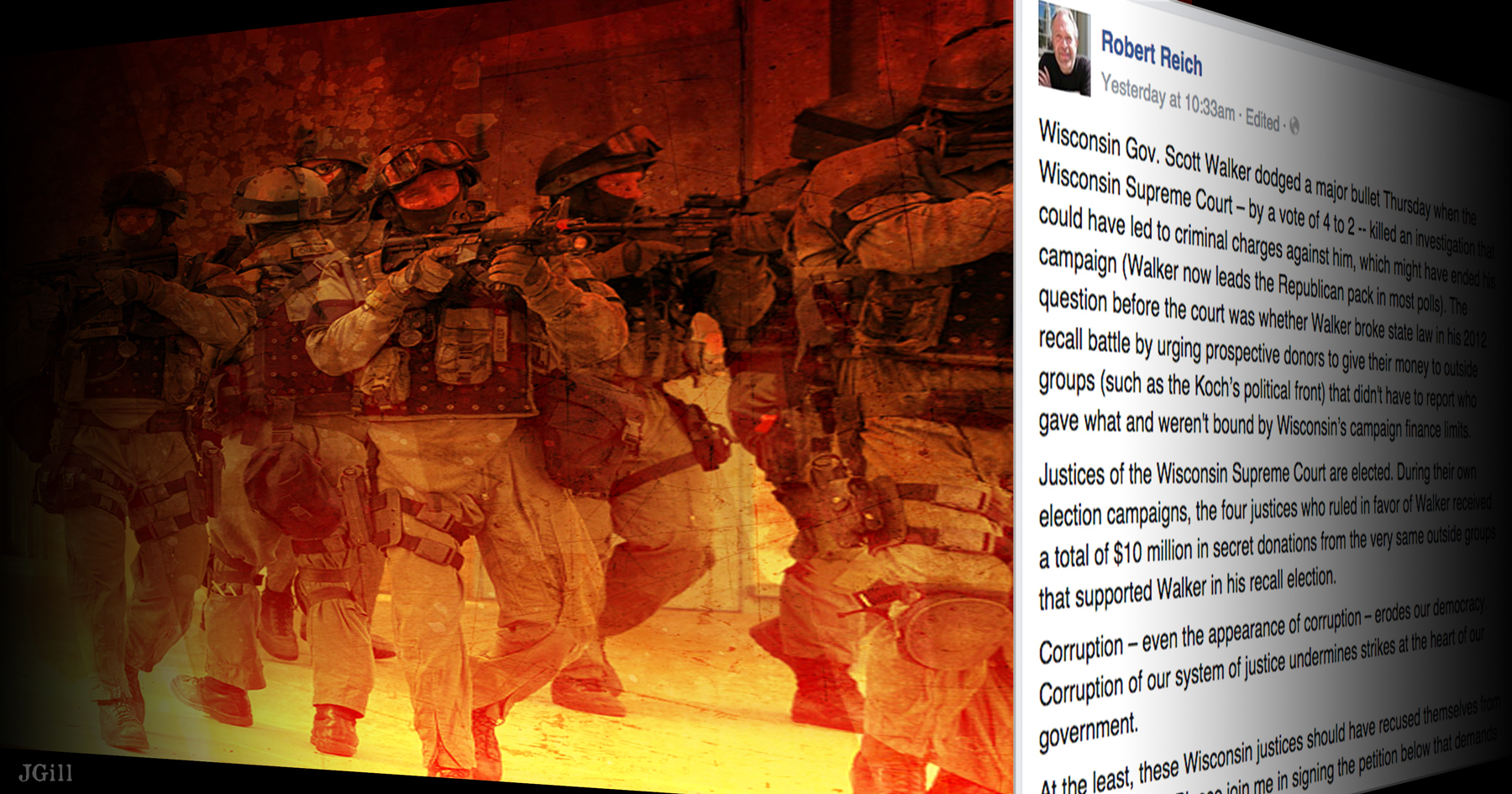
After the Wisconsin John Doe probe was judicially squelched, last week, Reich promoted Common Causes’s official reaction, insisting that “Corruption — even the appearance of corruption — erodes our democracy. Corruption of our system of justice undermines strikes at the heart of our government.”

This is the Common Cause take:

The Wisconsin Supreme Court recently ended the investigation of possible illegal activity between Scott Walker’s 2011 – 2012 recall campaign and outside special interest groups.

Four of the justices of the court were the beneficiaries of dark money spent in their behalf and which was the heart of this case. They should have recused themselves and did not.

Robert Reich enthusiastically reiterated Common Cause’s demand for adoption and practice of strict judicial “recusal rules.”

Hmmm. No mention that a federal judge had also ordered the investigation shut down, but that ruling was stayed awaiting state court resolution.

No mention, by either Reich or Common Cause, of the methods the prosecutors used in this case, the gag rules and secrecy, the official attempt to squelch public discussion.

Also no mention of the pre-​dawn raids, complete with SWAT teams, barking dogs, and pointed guns, as if the political activists (targeted for unsubstantiated campaign finance rule breaches) were violent drug dealers or terrorists.

The lack of mention of those tactics suggests not merely a lack of interest in the real rule-​of-​law questions, but also an acceptance of those tactics … when applied to political enemies.

That is worse than mere corruption.

This is Common Sense. I’m Paul Jacob.

Printable PDF

Police State Apologist


Categories
crime and punishment responsibility too much government

J’accuse, Chisholm

Shouldn’t we imprison anyone who dares criticize the conduct of abusive public officials?

Panic not. You haven’t slipped through a portal into another dimension.

This is still Common Sense. I’m still Paul Jacob.

Interpret the initial interrogative, above, as my sardonic paraphrase of somebody else’s sentiment — that of a power-​abusing official who bemoans any chastisement of his lousy actions. Who even threatens to prosecute persons voicing such criticism.

The man is John Chisholm, a Milwaukee D.A. who intimates that Wisconsin Governor Scott Walker should be investigated for blasting Chisholm’s churlish tactics against political opponents. These tactics include late-​night raids motivated solely by political animus. (I’ve reported on these doings.)

Scott Walker told Iowans that “if the government can do that against people of one political persuasion, they can do it against anybody.… [I]t was really about people trying to intimidate people … [A] political witch hunt.”

Responding, Chisholm suggested, with blunderbuss subtlety, that “the Iowa criminal code, like Wisconsin’s, has provisions for intentionally making false statements intended to harm the reputation of others.”

Chisholm, you bum. You knave. You vile excrescence. Not even you dispute that your office’s raids directed against people like my colleague Eric O’Keefe occurred. Thus, you’ve no hint of a basis for a slander claim. You did the dirty deeds we’re deriding. Cheer and hug you for it, should we? (Eric has sued to block Chisholm’s secretive “John Doe” raids.)

All this does sound like the Twilight Zone. Unfortunately, it’s part of a new normal. Not one we need accept, however.

This is Common Sense. I’m Paul Jacob.

Printable PDF

Crybaby Bully


Categories
national politics & policies too much government

Free Money?

Monday, I lamented our deeply-​indebted federal government’s policy towards the states: Bribery.

It busily borrows more and more money to entice our more fiscally sound state governments into dramatically expanding Medicaid spending to ever less sustainable levels. I also noted that several Republican Governors who were long opposed to Obamacare are now taking the bribes.

Wisconsin Governor Scott Walker isn’t one of them, but he appeared on Fox News Sunday to speak with host Chris Wallace, who said:

“As you well know, seven Republican governors have agreed to the expansion of [Medicaid] to 133 percent of the poverty [line] … And they say they’re doing it because of, if you will, free money.… [C]ritics say that your decision is, one, going to cost your state millions of dollars and, two, going to mean a lot of people in Wisconsin are uninsured.”

“In our case,” explained Walker, “we actually reduced the number of uninsured, we reduced the number of people on Medicaid and we actually saved a little bit of money.”

Wallace then asked if he feared Congress wasn’t going to live up to its end of the bargain.

“No doubt about it,” Walker responded. “Just for my cost to continue Medicaid in the state of Wisconsin, without any expansion, it cost me $644 million more in this budget. Thirty-​nine percent of that is because the federal government under the Affordable Care Act and other provisions is pulling back on their previous commitments. That’s today. That’s without the expansion.… If Congress can’t fulfill the commitments they’ve made, I’m concerned about where they’re going to be in the future.”

Wallace then asked Governor Markell (D‑Delaware), “why is it that he doesn’t trust Washington and you do?”

That question went unanswered.

This is Common Sense. I’m Paul Jacob.
Categories
initiative, referendum, and recall term limits

Trick and Treats

After more than a year of big labor throwing industrial-​size kitchen sinks at Scott Walker, Wisconsin’s Republican governor became the first of the three governors in U.S. history to face recall and retain the office.

Walker more than survived; he prevailed, beating his Democratic rival by seven percentage points, 53 to 46. In a light blue state, it was a thorough thwacking of the public employee unions, the biggest, bluest special interest.

According to exit polls, Walker even won better than a third of union households.

The man had kept his word not to raise taxes. Further, ending collective bargaining for most government employee unions, along with other reforms, saved lots of money for state and local governments and school districts. This, it turns out, prevented public sector layoffs and helped secure future health and pension benefits.

Walker’s success will be repeated elsewhere.

Hey, already happened! On Tuesday, in San Diego and San Jose, California, voters overwhelmingly passed measures to get a handle on out-​of-​control public employee pension costs. These measures were, of course, fiercely opposed by government unions.

As cities are cutting programs to pay pension benefits for retirees, a post on the Calpensions blog explains, “Public pension amounts in California are based on what unions are able to obtain through collective bargaining, not what is needed for a reasonable retirement.”

Among Tuesday’s many treats, there was one really rotten trick. California’s Prop 28 passed, weakening the state’s legislative term limits. Most voters, misled by the official ballot summary, thought the measure would result in tougher term limits.

Can’t wait until the next election, which falls nearer Halloween. Hope for more treats than tricks.

This is Common Sense. I’m Paul Jacob.
Categories
tax policy too much government

A Tale of Two States

Tuesday is Election Day for Wisconsin’s gubernatorial recall, pitting Republican Gov. Scott Walker against Democratic Milwaukee Mayor Tom Barrett in a rematch of their 2010 contest, won by Walker. Polls show Walker leading, and likely to become the first “recalled” governor to ultimately defeat his recall and retain his office.

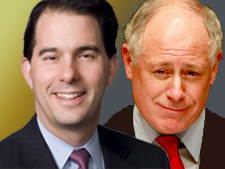
In fact, after all the massive protests and the recall campaign, Walker’s popularity has increased.Governors Walker and Quinn

Why?

Mr. Walker has done what he said he would. He hasn’t raised taxes. He staked out his position on ending collective bargaining for most public employees as well as requiring them to pay something toward healthcare and pension benefits, and, against a flurry of opposition, stuck to his guns.

Now the Badger State’s unemployment rate is down below the national average and economic prospects are up.

For a very different story, look south, to Illinois.

Gov. Patrick Quinn supports initiative, referendum and recall, but gets demerits for his response to the current economic difficulties. In 2010, Illinois raised the state income tax by 66 percent. But the $7 billion in extra revenue has done little to solve the state’s chief budget woe — Illinois was $8 billion in the hole when the income tax was hiked, and somehow faces that same $8 billion shortfall today.

So, just a week ago, lawmakers slapped a $1‑per-​pack tax on cigarettes.

If a state could tax itself out of trouble, Illinois would be a near paradise today.

Walker took on the government employee unions; Quinn took on the taxpayers. That’s why Wisconsin — including their embattled governor — is on the upswing and Illinois is not.

This is Common Sense. I’m Paul Jacob.

Categories
initiative, referendum, and recall too much government

Spending Cuts, Seriously

Taking on the government employees’ unions was a gutsy move for Wisconsin’s freshman governor, Scott Walker. Now facing recall, he’s caught in a swarm of controversy, his opponents as angry as bees near a kicked hive.

Nick Gillespie and Jim Epstein, in a Reason TV video segment called “3 Lies About the Wisconsin Gov. Scott Walker Recall,” look behind the hysterical denunciations and at the facts. All three of their points deserve consideration, but I’m most interested in the first, their debunking of the “lie” that “Gov. Walker Cut Spending.” Surprise, surprise — total spending in Wisconsin is going up:

Gov. Walker has cut the rate at which Wisconsin’s state budget is growing, but he hasn’t actually cut spending. In fact, the state’s biennial budget is scheduled to increase by about 3 percent on Walker’s watch, rising from $62.6 billion (2009 – 11) to $64.3 billion (2011 – 13).

We see the same disconnect at the federal level. A few Republicans present budgets that slow growth in spending, yet do not decrease spending in total. But, since we do see cuts here and there, to this program or that, Democrats take each minor cut as an occasion to scream and holler about how indecent and heartless “greedy Republicans” are for cutting spending.

And yet spending has gone up.

The complainers, by focusing on those few actual cuts, ignore the overall increases. They thus effectively demand that government spending increase always and everywhere.

While talk of Republican “cutters” must be taken with a grain of salt, it’s impossible to take their critics seriously at all.

This is Common Sense. I’m Paul Jacob.

Categories
initiative, referendum, and recall

Wisconsin’s Kumbaya Moment

With all our divisive politics, who would’ve thought it would take a spate of recalls in Wisconsin to bring folks together in democratic unity.

Whether we root for the blue team, the red one or seek a third color — green or something — we can all celebrate that an election was held Tuesday. 

It was a special recall election of state legislators — made all the more special because it was called by citizens. 

Miffed at Democrats for leaving the state to block a quorum in the senate or incensed at Republicans for passing legislation removing collective bargaining for most unionized state workers, Wisconsin voters didn’t just have to sit there and take it. Empowered by their state’s recall law, they gathered hundreds of thousands of voter signatures. 

Six incumbent Republicans were on Tuesday’s ballot. Four held their seats and two were defeated by Democrats, who fell just one seat short of grabbing the majority. Two incumbent Democrats still face recalls next Tuesday. 

The Progressive Change Campaign Committee told supporters:

Last night, we stood in a crowded square outside the state Capitol in Madison. Teachers, fire fighters, police officers, moms, and dads chanted, “This is what democracy looks like.”

Republicans and Tea Party leaders declared victory in maintaining the majority. Gov. Scott Walker, perhaps the subject of a recall next year, told the MacIver Institute, “I’ve had great confidence in the voters.”

It’s a Kumbaya moment! At least, as close as we’re likely to get.

This is Common Sense. I’m Paul Jacob.
Categories
free trade & free markets too much government

A Necessary Solution?

Wisconsin Governor Scott Walker is playing hardball. On Meet the Press, he defended himself:

Wisconsin is “broke,” and unions use their power to block necessary cost-​saving measures, Walker said.

“It’s about time somebody stood up and told the truth in this state, and said, ‘Here’s our problem, here’s the solution,’ and acted on it,” he said.

But how sensible is his proposal to remove collective bargaining regarding benefits for most public employee unions? As everyone points out, the unions are agreeing to his other proposals, such as paying for more of their insurance than before. 

Why is he being so unreasonable, so “arrogant”?

Last Sunday, I considered the whys on Townhall. Contracts with public employees are completely out of whack because compensation is negotiated outside market competition and by politicians more afraid of the political clout of the powerful unions than their principals (the taxpayers) whose money they’re spending. So, wage rates and especially promises of future medical and pension benefits are sky high and open to abuse.

The union reps can’t be trusted, either. So honed to getting the most for union members (their principals), their monomaniacal purpose washes away every other thought. Now that the corner they’ve shoved the state into has been made apparent, they’ll concede points, sure. But taking away bargaining leverage?

No way. They want to be able to do it all over, when good times roll.

And that is why Gov. Walker’s proposal seems so sound.

This is Common Sense. I’m Paul Jacob.

Categories
tax policy

A Chill Hits Illinois

That big bump in the night? It was the sound of a massive new tax increase dropping on the backs of Illinois citizens and businesses.

Not long after midnight, Wednesday morning, mere hours before the newly elected legislature was to be sworn into office, the state’s lame-​duck legislature voted to increase the personal income tax by a whopping 67 percent and the business income tax by nearly 50 percent.

That’s lame, all right.

Governor Pat Quinn, who had campaigned in favor of a smaller increase, will sign the bigger tax hike. “Our fiscal house was burning,” he said in its defense.

Is the fire now out? 

Well, there sure is a lot of smoke, and where there’s smoke, there’s … a lot of people making a quick exit.

Remember, people can vote with their feet. “Leaving Illinois,” a study by the Illinois Policy Institute, points out that between 1991 and 2009 Illinois lost one resident every ten minutes.

That’s $16.9 billion in lost state and local tax revenue.

So Wisconsin Governor Scott Walker was quick to offer a safer haven. “In these challenging economic times while Illinois is raising taxes, we are lowering them.”

As William Brodsky, chief executive of CBOE Holdings Inc, argues, “Merely throwing tax dollars at a broken system, without overhauling the expense side of the ledger, compounds the problem…” Bemoaning Illinois’ lost tax advantage in attracting business, Brodsky remarked, “They don’t come here for the weather.”

This is Common Sense. I’m Paul Jacob.