Categories
political challengers social media

Ron Paul & the Fascisti

Yes, you can make this stuff up. 

But long before you could add your implausible idea to your farfetched script about the weird dystopian future or recent tyrannical past, some big-​tech social-​media company will have galumphingly implemented that notion.

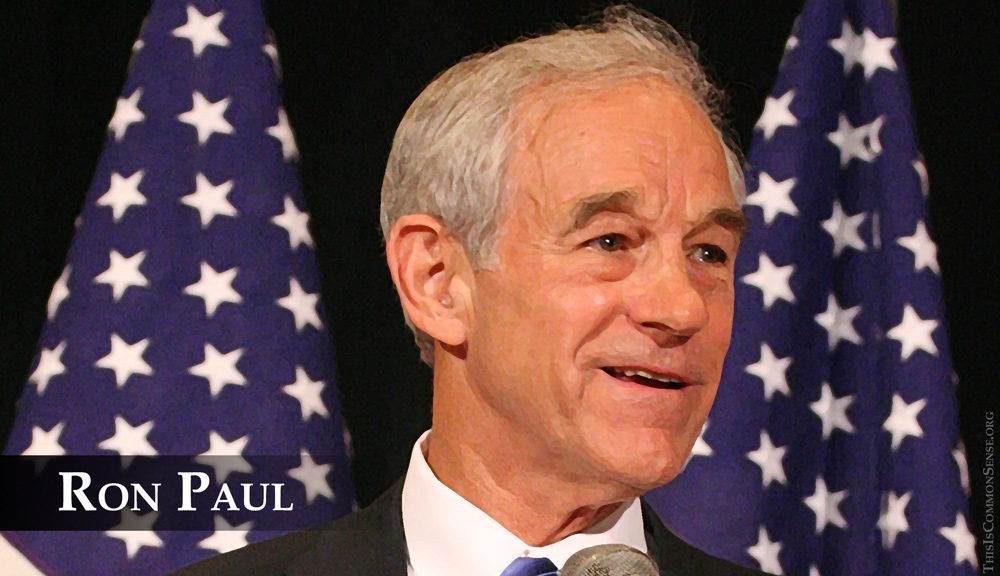
Former Congressman Ron Paul said the following on Facebook, reprinting a column on his site:

“Last week’s massive social media purges — starting with President Trump’s permanent ban from Twitter and other outlets — were shocking and chilling, particularly to those of us who value free expression and the free exchange of ideas.

“The justifications given for the silencing of wide swaths of public opinion made no sense, and the process was anything but transparent. Nowhere in President Trump’s two ‘offending’ Tweets, for example, was a call for violence expressed explicitly or implicitly. It was a classic example of sentence first, verdict later.”

Then Facebook blocked Dr. Paul.

“With no explanation other than ‘repeatedly going against our community standards,’ Facebook has blocked me from managing my page,” he reported on Twitter, itself no sturdy redoubt. “Never have we received notice of violating community standards in the past and nowhere is the offending post identified.”

Can humongous corporations really jerk people around so dishonestly? Is it legal? 

Paul further argued that “this assault on social media” is not merely “a liberal or Democrat attack on conservatives and Republicans.” 

“As progressives like Glenn Greenwald have pointed out,” explains the doctor, “this is a wider assault on any opinion that veers from the acceptable parameters of the mainstream elite, which is made up of both Democrats and Republicans.”

The narrowing of opinion down to what elites find acceptable is one definition of fascism: a no-​opposition-​allowed corporatist state.

I’m not making this up.

This is Common Sense. I’m Paul Jacob.


PDF for printing

See all recent commentary
(simplified and organized)
See recent popular posts
Categories
First Amendment rights Internet controversy

Ron Paul vs. Fauci, YouTube vs. You

It’s new news but also, unfortunately, old news.

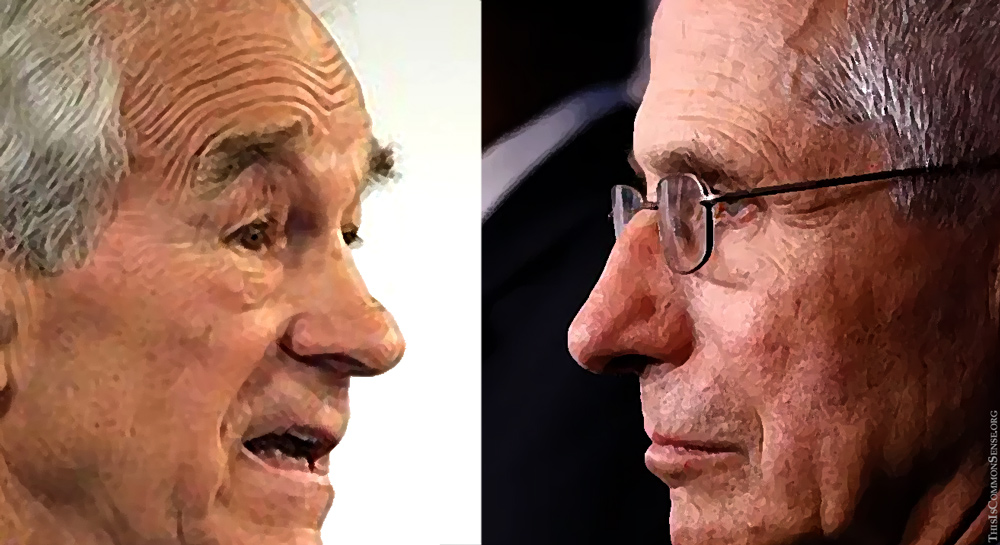
Tech-​giant providers of forums for public discussion keep banning discussion of the issues of the day. The latest victim: Ron Paul, medical doctor, former congressman and presidential candidate, father of U.S. Senator Rand Paul.

Alphabet/​Google/​YouTube has pulled a video from Dr. Paul’s YouTube channel in which he criticized Fauci for, among other things, reversing his advice about wearing masks to combat COVID-​19. YouTube warns of further suppression if this kind of thing (debate, I guess) continues. You can still watch the video, since there are competitors to YouTube (and we hope there will be many more). SoundCloud has it.

Paul linked to an image of the YouTube communiqué. “Your content was removed due to a violation of our Community Guidelines. . . . Medical misinformation.”

“If this happens again,” Paul’s channel will be hobbled for a week.

And if even then he still speaks freely, like any red-​blooded American would? Still more sanctions, presumably.

Alas, there are many examples of these obnoxious policies.

We’ve recently complained about YouTube’s removal of a Mises Institute talk — once again, for failure to follow the pandemic panic party line. We’ve also complained about how WordPress buzz-​sawed The Conservative Treehouse blog for nebulous violations of policy, violations suddenly discovered after years of hosting the blog.

We could go on. We probably will. Like the proverbial “broken record.” 

When’re we gonna stop?

Well, right after the tech giants stop their accelerating efforts to suppress debate.

This is Common Sense. I’m Paul Jacob.


PDF for printing

See all recent commentary
(simplified and organized)
See recent popular posts

Categories
Common Sense general freedom national politics & policies political challengers

Defeat the Machine

Standing with Rand, as Sen. Rand Paul (R‑Ky.) announced yesterday his candidacy for the U.S. Presidency? A banner: “Defeat the Washington Machine — Unleash the American Dream.”

I know and like Rand, both personally and politically. I love that message.

Yet, today, I come not to praise Dr. Paul but to use him as an example about political reality, nuts and bolts.

Like Jeb Bush and Hillary Clinton, Dr. Paul inherited a tremendous leg up in politics. All three have access to extensive networks of supporters and funding. But, “they didn’t build” those networks, not in toto. They are standing on the efforts of family members — a husband in Hillary’s case; parents for Paul and Bush, plus a Bush brother president.

The Kentucky senator’s father, Dr. Ron Paul, served 23 years representing a Houston, Texas, U.S. House district and ran for president three times.

I’m not whining. And I’m certainly not proposing a new area for the Federal Election Commission (FEC) to police. I’m glad, frankly, for Rand’s parental good fortune. (Mother, too.)

I am simply identifying the built-​in advantages that come with holding political power … and the potential danger it unleashes: an entrenched, unaccountable, unrepresentative government.

Like we have.

The solution to powerful political dynasties? More competition. More participation. More activity and organizing, more money raised and spent and more messages expressed. Fewer limits and regulations blocking fundraising.

Easier entry into the political marketplace of ideas.

Is that what the IRS and the FEC have been working toward? Facilitating our opportunity to “Defeat the Washington Machine”?

Be that the case, or no, I’m happy to note that Rand Paul, in his kick-​off, endorsed term limits.

This is Common Sense. I’m Paul Jacob.


Printable PDF

Rand Paul


Categories
tax policy

End the IRS?

Every day: more revelations, more questions.

Was the IRS’s repressive targeting of Tea Party and similar groups seeking tax-​exempt status “accidental”? Were only a few rogue or harried clerks responsible for the repressive targeting? Did anybody in the White House know about the repressive targeting as it happened? What does the frequency of IRS commissioners’ visits to the Obama White House tell us? What about the IRS union chief’s visit with Obama just before the repressive targeting began?

And that’s not all. How similar is the latest IRS repressive targeting of the enemies of those in power to previous IRS repressive targeting of the enemies of those in power? What about all the other forms of riding roughshod over individuals’ rights that the IRS routinely perpetrates?

And then there’s the practical question: What do we do about the mess?

Well, we could try to curtail the allegedly “unusual” abuses of government power and rights violations.

But what if the problem runs deeper?

Former presidential candidate Ron Paul argues that the problem lies “in the extraordinary power the tax system grants the IRS.” He very plausibly puts the current scandals in the context of the bureau’s central mandate: “The very purpose of the IRS is to transfer wealth from one group to another while violating our liberties in the process. Thus the only way Congress can protect our freedoms is to repeal the income tax and shutter the doors of the IRS once and for all.”

Hard? Yes. Doable? Yes — but only if such ideas catch on with more leaders than just the indefatigable Ron Paul.

This is Common Sense. I’m Paul Jacob.

Categories
video

Video: Rand Paul and the Future of the GOP

“I love Rand, he’s awesome”; “We are the future of the Republican Party”; “The youth are … tired of the same-​old/​same-​old”:

Categories
insider corruption too much government

Squelching the Revolution

During the months of primaries and caucuses, the popularity of Ron Paul was a fear expressed amongst both neoconservative and “mainstream” Republican insiders in hushed tones, rarely ever surfacing, but instead roiling under politics’ prudential lid. Now that Mitt Romney has sealed the nomination with enough delegates from the primary states, GOP insiders are trying to solidify their position.

Instead of magnanimously bringing Ron Paul’s supporters into the party to court them for the next four years, they seem to be doing their darnedest to keep them out. Take Romney’s gubernatorial state, Massachusetts.No Revolution

The GOP machine, there, has required that the Ron Paul nominees to the Tampa convention sign an affidavit to support Mitt. This is something new. Just for Ron Paul delegates. And of course some

libertarian-​leaning delegates balked at the notion of signing legal affidavits pledging what they had committed verbally at the caucuses where they were elected. Many later submitted them, but not until after the deadline.

As a result, the committee disqualified them, winnowing the number of Liberty delegates and alternates to the convention from 35 to 19.…

Not surprisingly, the duly elected delegates “feel cheated.”

A spokesman for the Massachusetts Republican Party would not say why the affidavits were required of delegates this year, and the chairman of the Allocations Committee would not agree to an interview. Instead, the chairman offered an e‑mailed statement saying that the Romney campaign, through its representative on his committee, had the right to reject delegates for “just cause.”

When I prophesy negative consequences of a Mitt Romney presidency, this sort of thing lingers in my mind. What is the GOP afraid of? Actual limits on government?

This is Common Sense. I’m Paul Jacob.

Categories
political challengers

Send in the Clones

As scientists spend grant money attempting to bring into modern times the extinct Woolly Mammoth, conscientious citizens should be concerned about a more pressing matter: cloning our few good leaders before they go extinct. Ron Paul in particular.

The mammoth is a hard thing to clone: DNA breaks down over time.

Leadership requires candidates of good character combined with the right ideas.

The ideas are the DNA. Ron Paul’s have been nicely identified by Nassim Taleb as “The Big Four”: opposition to (1) deficits and metastatic government, (2) Federal Reserve flirting with hyperinflation, (3) self-​feeding militarism, and (4) bailouts that undermine economic resilience (“what is fragile should break early and not too late”).Ron Paul's Revolution

Such notions have been available to Americans since the Founding.

But folks with the right character?

That’s more difficult, because each of us is embedded in the institutions we grow up in, and accepting those institutions is natural. This isn’t a problem for leadership to maintain the current system. It is, however, a bit of a snag for producing leaders to help greatly alter the system. The rewards for bucking the system are less immediate than for supporting it.

Ron Paul has been running for the presidency largely to promote real, substantial change. His son, Rand Paul, has taken his ideas and added some successful and politic twists.

There are other, younger leaders emerging in the Ron Paul mode. A few are discussed in the current book, Ron Paul’s Revolution, by Brian Doherty.

But consider: Maybe we don’t want to “send in the clones” — maybe you want to take up the mission. Don’t dismiss the idea out of hand.

Or laugh in a friend’s face if he or she indicates interest, a calling.

This is Common Sense. I’m Paul Jacob.

Categories
free trade & free markets ideological culture

Competition in Currency

Monopoly control of money is at the root of all kinds of evil.

As the Euro faces collapse, and the dollar’s value becomes increasingly unsteady, central bankers the world over worry about what to do next.

But it doesn’t have to be this way.

Last Thursday I mentioned monetary experimentation, including Ron Paul’s support for F.A. Hayek’s idea of competing currencies. In my Townhall column this weekend, I noted that Rep. Paul has done more than promote the idea “that government policy should allow all currencies to float, favoring none.… Last year he introduced the Free Competition in Currency Act, as Hayekian a piece of legislation as you could imagine.”Monopoly Money

Paul’s proposal is not merely a sign of the times, it is a sign of intellectual seriousness — in a politician, no less. In the early 1980s he had introduced a measure to return the United States to the gold standard. But now he is willing to let “the market decide” which monies should circulate.

We may know a lot more about money than we used to, but one of the things we’ve learned is that no one knows for sure how to manage an entire monetary system, the whole kit and kaboodle.

So, just as we don’t need a grocery czar or an “industrial policy” to micromanage either technological production or R&D, centrally managed money is just too hard for any one set of persons … to manage.

Competition in money and banking (sans today’s progressivist doctrine of “too big to fail”) would not only work, it would keep politicians from the extremity of irresponsibility.

For yes, today’s politicians rely upon the Federal Reserve. They need to keep the “printing presses” running to supply that special, hidden tax that funds their deficits: inflation.

This is Common Sense. I’m Paul Jacob.

Categories
free trade & free markets links

Townhall: The Next Thing in Money

More about Ziggy?

This weekend’s Townhall column takes off on a subject broached here at This Is Common Sense last week. But there’s a lot more to it, so check it out. And come back here if you want a complete, easy-​to-​access full list of the column’s links:

For further reading, please consider:

Categories
free trade & free markets too much government

Ziggy Stardust Bucks

Josiah Warren Time Store note for Three Hours Labor

When times get tough, the tough … switch currencies.

A fascinating report in The Atlantic tells of the upswing in “local currencies.” In the United Kingdom, the Brixton Pound is being floated, engraved on its paper notes the likes of “David Bowie in his Ziggy Stardust era.” Pegged to the British pound, it serves mainly as a scheme to promote local business and trade, though maybe it’s a tad more than mere boosterism.

Bavarians are also “enthusiastically using the local currency as a protest” — the local currency being the Chiemgauer. And “similar currencies have popped up around the world,” including in Canada and the United States.

The Atlantic story also mentions the idea of a “time bank,” a one-​step-​up-​from-​barter method based on labor hours and (in some cases) accounting for a variety of skill levels. Such “systems are in use all over the world … though the organizers are careful to make sure that the time is never given a specific value in a hard currency, which would open the door to taxation from governments.”

That caveat shows how barter and labor time exchanges might seem the more “revolutionary,” from, say, an establishment point of view. It’s worth noting that the idea’s greatest early proponent was Josiah Warren, America’s genius utopian experimenter and theoretician of “individual sovereignty.”

Less of a radical, Rep. Ron Paul echoes eminent monetary economist and Nobel Laureate F.A. Hayek by promoting the “denationalization of money,” arguing that government policy should allow all currencies to float, getting rid of all taxation on trade amongst currencies as well as repealing all legal tender laws.

For my part, I would greatly enjoy spending a Ziggy Stardust banknote.

This is Common Sense. I’m Paul Jacob.