
Categories
First Amendment rights privacy regulation

The War Against Anonymity

The Mexican government wants to stop people from using cellphones anonymously.

Every mobile phone number in Mexico — some 127 million — must now be biometrically tied to the owner’s identity. Cellphone owners must register their numbers by June 30 or lose signal.

The ID card to which numbers must be linked will in turn be linked, via QR code, to a national registry of biometrically verified records.

Who needs anonymity? Just criminals?

Criminals do use throwaway “burner” phones when committing crimes. They won’t necessarily be stymied now. Would they hesitate to steal other people’s cell phones, treat them as burners, then throw them away?

Maybe victims would act fast enough to get lost and stolen phones deactivated before thieves could use them, maybe not. Criminals may have several ways to circumvent the new law. 

We must remember, after all, that criminals are willing to commit crimes.

The safety of journalists, dissidents hiding from other governments, targets of abusers and stalkers, and anyone with good reason to keep his identity separate from his phone will be endangered by Mexico’s new mandate.

Some may say that Mexico’s ID database is inaccessible by all but authorized, benign, unbribable government personnel. One problem with this fairy tale is that not long ago, a cyberhacker used AI to steal 195 million taxpayer and other records from the Mexican government.

Not the first time hackers have grabbed “secure” data. And what has happened again and again and again and again, can happen again.

This is Common Sense. I’m Paul Jacob.


PDF for printing

Illustration created with Nano Banana

See all recent commentary
(simplified and organized)
See recent popular posts
Categories
privacy regulation too much government

All Your OS Are Belong to Us

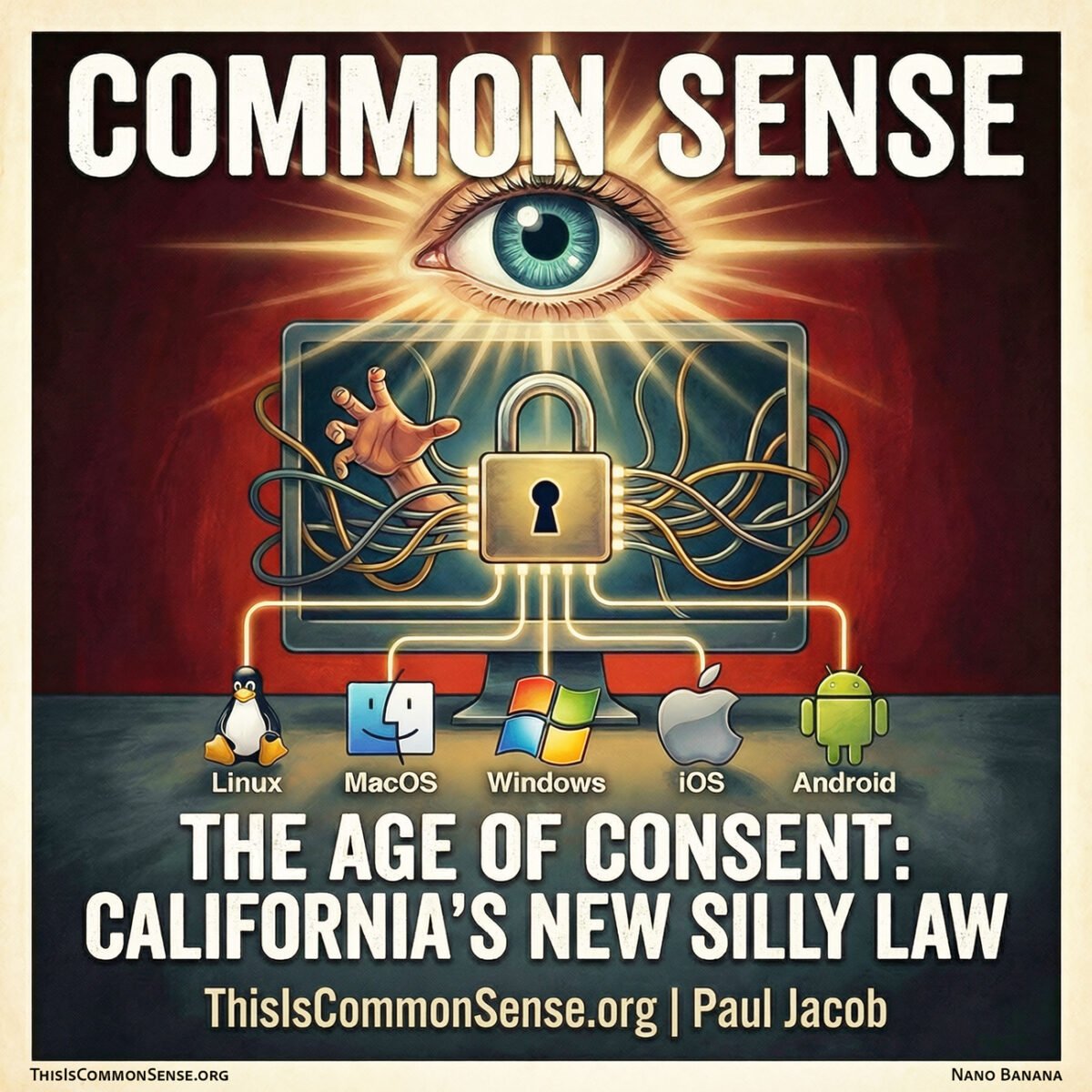
The always-wrong California legislature has unanimously passed — and the state’s always-wrong governor has signed — legislation to compel makers of computer operating systems to verify the owner’s age. The information from Linux, MacOS, Windows, iOS and Android would then be transmitted to the software (“apps”) running on each respective platform.

Reclaim the Net observes that in a “different timeline, wiring an age-surveillance layer into the boot sequence of every computing device in California is an idea that would have died in committee.”

AB1043 doesn’t require any upload of government ID or facial scan, just that the user report age when setting up the OS. I am not relieved.

All the shmexperts eager to erode our privacy say that requiring web surfers to type a number into a box to report age is insufficient. If California’s new law is allowed to stand, perhaps in part because it seems fairly innocuous — any plucky 12-year-old could type “89” when ordered to report age — would the politicians stop there?

Some kind of ID verification would be mandated sooner or later. Then use of fake IDs would lead to calls for biometric confirmation. Etc.

Reclaim the Net explains that Linux distributions don’t even have a way to comply with the silly California law. Decentralized Linux exists for people who don’t want to be surveilled when doing their computing, and “there’s no entity to mandate, no account system to modify, no API to build.”

These and many more objections appear to me to be just common sense — now illegal in California.

I’m Paul Jacob.


PDF for printing

Illustration created with Nano Banana

See all recent commentary
(simplified and organized)
See recent popular posts

Categories
crime and punishment government transparency privacy

Transparency, Weaponized

Transparency is usually a good thing. But so is privacy. And so, too, are limits on government power. 

Which bring me to the Epstein files — or, more accurately, those files bring me here. 

“I don’t think we’ve had a scandal like this in this country,” Rep. Ro Khanna (D-Calif.) offered yesterday on Meet the Press, “and what we’re asking for is justice for those survivors.” 

I want justice, too — that is, the prosecution of any crime grand juries honestly believe was likely committed. 

By anyone! No matter how powerful that suspect might be.

On the other hand, the Epstein File Transparency Act, which will be voted on this week in the U.S. House of Representatives and for which Khanna is a primary sponsor, “would require the Justice Department to declassify and release all files pertaining to the prosecution of the late sex trafficker, Jeffrey Epstein.”

The public has a right to know! 

But does it? 

And if so, does that ‘right’ mean we permit the federal Department of Justice to use prosecutorial power to grab incriminating evidence on “suspected criminals” and then weaponize and deploy that information not to prosecute a crime in a court of law, but rather to publicize the damaging dirt discovered in the court of public opinion?

From then-FBI Director James Comey’s ridiculous public preening over the non-prosecution of Hillary Clinton in 2016 to the demanded release of the Epstein files today, we must be careful the DOJ does not become an opposition research firm for the party in power, using badges and guns. Or the world’s most outrageous doxxing scheme.

Our criminal justice system should do one thing and only one thing: Prosecute crimes.

This is Common Sense. I’m Paul Jacob.


PDF for printing

Illustration created with Krea and Firefly

See all recent commentary
(simplified and organized)
See recent popular posts

Categories
First Amendment rights privacy

Permit to Harass, Interrupted

Minnesota’s permit to harass has been interrupted — not halted, because a federal court has granted only a preliminary injunction.

Nancy Brasel, the district judge, has for now blocked Minnesota’s law requiring grassroots advocacy groups to publicly disclose the names and addresses of their vendors because she expects that this requirement will indeed be ultimately thrown out.

Violating, as it does, freedom of speech.

One of the targets of the law is Minnesota Right to Life. One of its vendors dropped MRL with a thud in the middle of a campaign. As MRL’s executive director, Ben Dorr, notes, the challenged law mostly hands “a ready-made ‘enemies list’ to our political opponents.” He counts seven vendors who refused to work with his organization after being harassed by abortion rights proponents.

This harassment is the apparent reason for the disclosure regulation’s existence. When the names and locations of vendors who facilitate spread of political messages is forcibly disclosed, this allows opponents of the message to stoop to any low, such as harassing companies that provide services to organizations trying to get the word out.

What the harassers hope to accomplish, and sometimes do, is frighten vendors into dropping clients who engage in advocacy.

The thugs who would impede speech any way they can sometimes speak of “transparency” as if it were an end in itself. Whether transparency is desirable depends on the context. Citizens have every right to know how much government spends, and on what, and why — transparency is necessary there, because governments belong to citizens. But no crook or bully has an inalienable right to all the information about innocent people that he needs in order to go after them.

This is Common Sense. I’m Paul Jacob.


PDF for printing

Illustration created with Krea and Firefly

See all recent commentary
(simplified and organized)
See recent popular posts

Categories
national politics & policies privacy

The State vs. Our Privacy

The policies of the new Trump administration have given us only partial reprieves from the war on freedom of speech.

The war is still chugging along. It extends even to our most private communications, including those now hidden from prying eyes by encryption. Revived legislation in the U.S. Senate threatens the providers of such encryption.

Reclaim the Net’s Dan Frieth observes that under the STOP CSAM Act of 2025 (S. 1829), which targets “child sexual abuse material,” providing a “secure, privacy-focused service could be interpreted as ‘facilitating’ illegal activity, regardless of whether the provider can access or verify the content being transmitted.”

The legislation stipulates that providers may defend themselves from charges of “facilitating” illegal activity by showing that it is “technologically impossible” to remove CSAM without disabling their encryption. But firms would still often have to go to court to make this case, and “many platforms may adopt invasive scanning out of fear, not necessity, just to avoid liability, with real consequences for privacy and user trust.”

Defaulting to routine invasive scanning means an end to providing users with encryption, including users threatened by despotic regimes.

Current law already requires platforms to report known examples of material that entails the sexual abuse of children.

Any good or service that can be put to good use can also be put to evil use. Just as we shouldn’t penalize the makers of knives, forks, mail, curtains, roads, and guns for their use by criminals, the makers of encryption services should also not be so punished.

Nor should we grant to government bodies such a frightening dystopian power, accumulated to override our basic freedoms.

This is Common Sense. I’m Paul Jacob.


PDF for printing

Illustration created with Krea and Firefly

See all recent commentary
(simplified and organized)
See recent popular posts

Categories
privacy

Big Ugly Border Bill

The price of liberty may be more than eternal vigilance. Must we also employ all-knowing vigilance? Encyclopedic knowledge of all possible dirty tricks freedom’s enemies may employ?

One such is burying the latest assault on liberty in legislation about an unrelated matter in hopes that nobody will notice.

In Canada, a controversial effort to sabotage online privacy has wormed its way into a bill supposedly about strengthening border security: the Strong Border Act (Bill C-2).

It’s not exactly new, since, as Reclaim the Net reports, it’s something “law enforcement agencies have been pursuing since the late 1990s.”

As with populations south of the border, the people themselves hate such interference. “Despite being repeatedly rebuffed by public opposition, parliamentary committees, and Canada’s highest court,” observes Ken Macon, “the drive to erode digital privacy protections continues.”

In 2014, the Supreme Court ruled that Canadians have a right to expect that their subscriber information will be kept private. In 2023, the courts affirmed that users’ IP addresses were also entitled to protection. Investigators couldn’t simply rummage through a Canadian’s subscription details and surfing history without a warrant.

But the new legislation would entitle authorities to make warrantless “information demands” on service providers.

If this legislation ostensibly about the border is enacted, service providers would, on demand, have to identify particular users and whether the provider possesses his transmission data. The actual data itself would not have to be handed over, but Macon stresses that permitting such indirect searches would “effectively sidestep the very privacy protections the courts have upheld.”

Vigilance, indeed, knowing our governments’ lust for omniscience about us.

This is Common Sense. I’m Paul Jacob.


PDF for printing

Illustration created with Krea and Firefly

See all recent commentary
(simplified and organized)
See recent popular posts

Categories
privacy

Tearing Into the Apple

“Any kind of back door . . . access for the ‘good guys’ can also be exploited by the ‘bad guys,’” observes a Technology & Innovation Foundation report.

We can omit the skeptical scare quotes around “bad guys”; cyberhackers stealing your private information are bad guys.

Example: the China-affiliated hackers who looted U.S. telecommunications systems with the help of U.S.-mandated back doors.

But “good guys” demanding unlimited access to encrypted information are also bad guys.

Example: the United Kingdom officials behind a secret order last month, recent divulged by the Washington Post, demanding that “Apple allow access to all cloud content from users worldwide.”

Reporter Joseph Menn observes that this hitherto undisclosed order requiring “blanket capability to view fully encrypted material, not merely assistance in cracking a specific account, has no known precedent in major democracies.”

Apple is not commenting, now, to avoid legal jeopardy. But in March, when told the order was impending, Apple said: “There is no reason why the UK should have the authority to decide for citizens of the world whether they can avail themselves of the proven security benefits that flow from end-to-end encryption.”

Apple may stop offering encrypted storage in the UK rather than obey the order. This probably wouldn’t satisfy the Starmer government. If Apple sticks to its guns, its products may even end up being banned in the UK.

The alternative is open season for private and state-backed cyberhackers.

Meanwhile, time to remove your secrets from the cloud.

This is Common Sense. I’m Paul Jacob.


PDF for printing

Illustration created with Flux and Firefly

See all recent commentary
(simplified and organized)
See recent popular posts
Categories
Fourth Amendment rights general freedom privacy

GOP Fails on FISA

“The House appears ready to reauthorize FISA 702 — which has been abused literally hundreds of thousands of times to spy on Americans without a warrant — without requiring the government to get a warrant,” tweeted Sen. Mike Lee (R–Utah) on X last weekend.

“The U.S. government uses the Foreign Intelligence Surveillance Act to spy on Americans without a warrant,” Rep. Thomas Massie (R–Ky.) seconded, also on X. “This week, the House will vote to require the Feds to get a warrant to snoop on Americans. Sadly this vote is likely to fail. I will demand a recorded vote & post results.”

The “sadly” indicates that the Republicans in Congress are split, despite years of complaining about how the FISA courts treated Trump . . . and us. (A common complaint has been that the courts almost never say No to a FISA request from the Deep State.) 

The Electronic Freedom Foundation explains the nitty-gritty of Section 702: “As the law is written, the intelligence community cannot use Section 702 programs to target Americans, who are protected by the Fourth Amendment’s prohibition on unreasonable searches and seizures. But the law gives the intelligence community space to target foreign intelligence in ways that inherently and intentionally sweep in Americans’ communications.”

So while de jure the Deep State is disallowed from peering into our digital data, de facto our paid government snoops do it all the time. 

Rep. Massie seeks to add a warrant process to FISA requests, but it looks like his amendment will fail. In that case, Massie urges Republicans not to re-authorize the whole FISA program.

But that effort will probably fail, too.

Our representatives are just not that into the Fourth Amendment.

This is Common Sense. I’m Paul Jacob.


PDF for printing

Illustration created with PicFinder and Firefly

See all recent commentary
(simplified and organized)
See recent popular posts

Categories
general freedom ideological culture privacy

Something to Protect

Some people, enemies of drawing the curtains, say: “If you aren’t doing anything wrong, you have nothing to hide.”

Doesn’t follow. Hiding is a form of protecting. We all have things to protect. Innocent people advisedly hide information from neighbors, from bureaucrats eager to erode liberty, from plain criminals.

And from the political fanatic who acts as a criminal. 

If you’re a political activist with a public profile, or even just a voter, it may be a good idea to prevent ideological criminals from knowing where you live or work. That’s why God gave us post offices boxes and commercial mail receiving agencies.

Somebody recently firebombed the offices of Powerline’s John Hinderaker, a pro-liberty activist. One fire was set in an office that he subleases in “the building that houses Center of the American Experiment,” Hinderaker’s organization, another near a law center that he works with in the same building.

The suspects are many. Why? Well, as Hinderaker told federal investigators, CAE is “unusually effective across a broad range of issues.”

If bad guys can do something to hurt you — doxxing, stalking, firebombing — once they’ve got certain information about you, it is eminently reasonable to keep that information as private as possible.

Even when such data is already circulating, you can take significant steps to improve your privacy. Among the better books on how to do so is How to Be Invisible by J. J. Luna. More current and comprehensive is Michael Bazell’s Extreme Privacy.

Worth consulting, since — without the recourse these resources provide — the cost of political activism could induce us to cede to evil people the future of our country and the world.

This is Common Sense. I’m Paul Jacob.


PDF for printing

Illustration created with PicFinder and Firefly

See all recent commentary
(simplified and organized)
See recent popular posts

Categories
national politics & policies partisanship Regulating Protest

Home of the Surveilled 

Abusive investigations that must themselves be investigated are piling up.

In the case commanding our attention today, the meta-investigating organization is the Select Subcommittee on the Weaponization of the Federal Government. It is investigating the Financial Crimes Enforcement Network (FinCEN).

Who does FinCEN pursue? True scoundrels? Hapless executives caught in a regulatory net?

Nope. FinCEN has been on fishing expeditions. It hasn’t been going after persons suspected of either willfully committing crimes or even tripping over regulations accidentally, or at least not only such types.

It has been going after anybody whose purchasing history puts them in the category of wrong-thinking rightists — hence, I guess, crypto-terrorists.

FinCEN has been instructing banks to scan customer records for evidence of suspect purchases. Not illegal purchases. Just “suspicious” in light of an ideological filter, unconstitutionally applied.

On Twitter, Representative Jim Jordan reported recently that the subcommittee now knows that FinCEN required financial institutions to screen transactions in which terms like “MAGA,” “Trump,” “Bible,” and “Bass Pro Shop” popped up. 

Apparently, if you’re fishing while wearing a MAGA cap and quoting Genesis, you just might be on the verge of shooting up your local post office.

Please don’t ask me to explain what anybody involved with FinCEN could possibly be thinking by engaging in this illegal spying. Or whether they have even a glancing acquaintance with constitutional protections against unreasonable searches and seizures.

I’m just glad Jordan and his Weaponization Subcommittee are on the job, “watching the watchers.”

This is Common Sense. I’m Paul Jacob.


PDF for printing

Illustration created with PicFinder and Firefly

See all recent commentary
(simplified and organized)
See recent popular posts