Categories
Accountability folly political economy

Green Goes Red

Well, at least they were earnest. Hopeful. Committed.

Swedes in the north part of their country channeled State pension funds — billions of kronor! — into climate-​friendly projects.

Well, I’m not sure to what degree Swedish citizens were for this ideologically driven investment portfolio, but Swedish politicians sure were!

And now those investments appear iffy. “State pension fund AP2 had invested £117.7 million in Northvolt before its collapse,” explains GBN News, out of Great Britain. “It also holds £46.8 million in Stegra, plus a further £15.6 million exposure through its investment in Al Gore’s Just Climate fund.” And both Northvolt and Stegra — “once flagship companies of the energy transition,” as Blackout News puts it — teeter at the abyss of failure.

Northvolt was once Europe’s leading Great Green Hope, an electric vehicle battery company with a commitment to sustainability; in November it filed for bankruptcy protection.

Stegra was until recently seen as Sweden’s high-​profile “green steel” leader, but now faces an £858 million funding gap.

There has been some shuffling of management, but even were the world’s most magical managers to pull these companies’ feet out of the fire — even if the endeavors can limp out of the current fire-​sale conflagration — ask yourself: does it ever make sense to leave pension funds in the hands of zealots who seek to change the world for some utopian dream? 

It makes far more sense to let private equity fund risky projects, for private fund managers have more (voluntarily given funds) on the line.

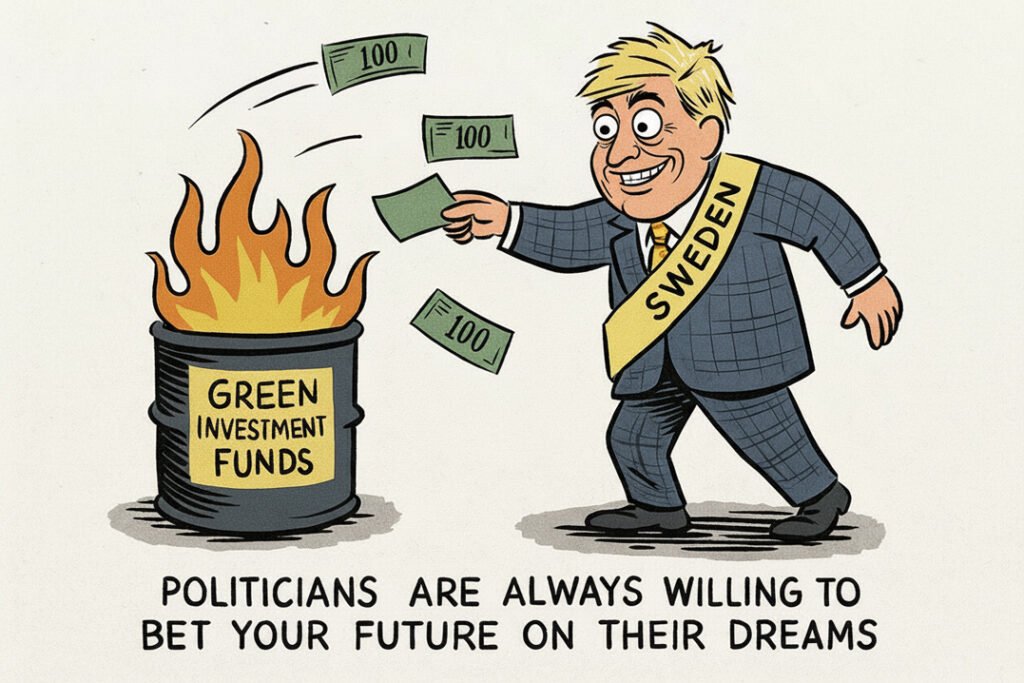
Politicians, after all, are notoriously irresponsible — always willing to bet your future on their dreams.

This is Common Sense. I’m Paul Jacob.

PDF for printing

Illustration created with ChatGPT and NanoBanana

See all recent commentary
(simplified and organized)

See recent popular posts
Categories
Accountability local leaders moral hazard porkbarrel politics responsibility tax policy too much government

Panic in the Prairie State

When your state has the lowest credit rating in the union, the highest population decline rate, and spends nearly a quarter of its annual budget on an out-​of-​control government-​employee pension system, what do you do?

Raise taxes, of course!

That’s the advice of experts in Illinois, anyway.

You can see why they panic: The unfunded portion of Illinois’s public employee pension system amounts to $11,000 per person in the state. Something extraordinary must be done.

Yet, as Pat Hughes at the Illinois Opportunity Project insists, taxpayers need relief — not a statewide 1 percent property tax increase.

Besides, it is not as if tax hikes could solve the problem. “It was just last year that politicians raised the state income tax by 32 percent in a desperate attempt to balance the budget,” Hughes explains. “Despite over $5 billion in new taxes, the state was back in deficit spending in less than a year.” 

Hughes mentions a number of tax limitation measures in the works. More power to them. 

But what’s needed even more? Spending limitation measures.

No government can be trusted to offer anything but defined-​contribution pensions — and no government, at any level, should ever manage a pension system. Politicians can’t help themselves. They just cannot resist the temptation to buy off the government-​worker constituency by promising more in the future than financially feasible (or just plain old politically possible) to pay for now. 

Other people’s money is theirs to spend. And a future financial bind? Some other politician’s problem. 

This is Common Sense. I’m Paul Jacob.


N.B. Congratulations to the Illinois Policy Institute for its Liberty Center, which won its case against forced unionization, Janus v. American Federation, on June 27. Commentary about this Supreme Court case appeared on this site in early May, “Post Blindfold.”


PDF for printing


Categories
by Paul Jacob video

Video: Our Pension Problem

Around the country, politicians and government employees have committed future taxpayers to pay for pensions that should have been funded at time of employee service. Things must change. The problem is huge. 

Categories
responsibility

Stop Digging

If you find yourself in a hole, stop digging.

When it comes to pension systems, the State of Illinois appears shovel in hand, digging to the bottom. The state’s five public employee retirement systems face a combined unfunded liability of $100 billion dollars; they have only 40 percent of what they need to pay the benefits politicians negotiated with public employee unions — the lowest funding level of any state.

The Daily Herald, a suburban Chicago-​area paper, calls a spade a spade: “The shortfall is due largely to decades of legislators skipping or shorting the state’s pension payments — a practice that allowed them to spend that money elsewhere.”

Today, Illinois’ legislators will trudge into Springfield for an expected vote to fix the broken system.

“This deal was made by Speaker Madigan and other politicians behind closed doors,” charges Illinois Policy Institute CEO John Tillman, who fears it makes matters worse.

The bizarre attempt at a fix allows the Legislature to be sued before the Illinois Supreme Court if it fails to make its required ongoing contributions into the pension fund.

The legislation also contains a guarantee clause prioritizing pension payouts before most other state spending. As Tillman says, “Not caring for the poor. Not public safety. Not education.”

And a much ballyhooed option for employees to switch to a 401(k)-style plan turns out to allow only 5 percent of employees to so choose, blocking the rest.

Pay what was promised, but stop digging! Move new workers to 401(k) style plans they can own, with employer contributions handed over every pay period.

This is Common Sense. I’m Paul Jacob.

Categories
national politics & policies too much government

Cliff Dwellers

When you hear talk about “the fiscal cliff,” ask, “Which one?”

This coming January, if Congress and the president fail to take action, every American who pays income taxes will pay more. Also set to increase? Payroll taxes, which every worker pays.

But even if we can avoid falling off those cliffs, another threatens.

It has been identified by finance professors Robert Novy-​Marx at the University of Rochester and Joshua Rauh at the Stanford Graduate School of Business, who summarized their recent research paper, “The Revenue Demands of Public Employee Pension Promises.”

The bottom-​line? Looking at the pension commitments state and local governments have already made to public employees, the professors “found that, on average, a tax increase of $1,385 per U.S. household per year would be required, starting immediately and growing with the size of the public sector.”

That’s only the average. “New York taxpayers would need to contribute more than $2,250 per household per year over the next 30 years,” according to their analysis. “In Oregon, the amount is $2,140; in Ohio, it is $2,051; in New Jersey, $2,000.”

Politicians have promised lavish pension benefits. And then not funded them. Plus, employees often outrageously game the system, spiking their benefits to the tune of millions over decades of retirement — like the Illinois teacher’s union lobbyist did by teaching a single day in the classroom.

If we don’t get the problem under control, this cliff keeps getting higher, making, as the professors put it, “the $1,385 per-​household increase required today seem cheap.”

This is Common Sense. I’m Paul Jacob.

Categories
folly responsibility

The Stockton Bust

Stockton, California, had seen a flurry of new home projects right up till the mortgage market crash. But, boy, did that come to a screeching halt. The crash led to foreclosures, which led to lower revenues from property taxes for the city. And though the city tried some spending cuts, they haven’t been enough. The Stockton City Council just voted, six to one, to seek federal bankruptcy protection.

Reasons for the bankruptcy, however, are not confined to reduced revenues. Add “soaring pension costs” and “contractual obligations” to the list of disaster factors.Stockton Bankruptcy - an illustrative image, not a photojournalistic artifact

And it’s pensions and medical insurance that make up the elephant’s share of “contractually obligated” must-​pays. We’ll see if official bankruptcy will allow the city to get out from under that mess. The Chapter 9 plan includes dropping medical benefits for currently fully-​covered retirees.

Who’s to blame? Politicians who negotiate really cushy deals for their (our) employees. The contracts obligate future taxpayers to pay out huge pensions for future retirees, rather than being funded (through insurance and investment) at the time of salary disbursement. The problem is that politicians love to make promises others must keep. Specifically, in this case, they contract defined benefit pensions not defined contribution pensions.

It makes no sense to do this, of course. It encourages irresponsibility, and is (to use a buzzword that should be used often against its usual purveyors) unsustainable. As proven by the Stockton bankruptcy.

Stockton is, so far, the largest American city to go belly up. We can expect further such busts, since the cause of Stockton’s problems — under-​funded pensions coupled with full-​coverage, gold-​plated, lifelong health insurance for government retirees — remain endemic throughout the country.

This is Common Sense. I’m Paul Jacob.