Categories
Accountability general freedom government transparency media and media people nannyism national politics & policies responsibility too much government

Ad Budget Slashed

Republican politicians, who had been running since 2010 on killing ObamaCare, did not. Not when they had a chance. Despite dominating Congress, they failed, because 

  1. they opted for a goofy way to do it (the House’s AHCA plan being a terrible mess, probably worse than the monster it was trying to replace) and 
  2. partly because the libertarians — along with a few “liberal” Republicans — blocked it in the Senate.

But that’s the olds; here’s the news: the Trump Administration has cut back ObamaCare’s advertising budget.

Progress?

I’m not sure. Maybe. Probably not.

The facts: ObamaCare outreach has been cut by 90 percent, and outsourcing grants to groups engaging in sign-​up efforts have been cut by 40 percent:

The Trump administration downplayed the impact of boosted ad spending, noting that during 2017 open enrollment there was a decline of 5 percent in overall sign-​ups. It also saw a 42 percent decline in first-​time enrollment and enrollment of people who pay their premiums decline by 500,000 people.

So, it seems natural to respond to a perceived decline in “demand” with a reduction in “supply” — or any attempt to drum up more “customers” for subsidized policies.

Also natural is the partisan fall-​out, with Democrats crying “foul” over the decided lack of support for their program. As Peter Suderman noted over at Reason, ObamaCare became partisan because it started out partisan.

But it was always — from conception in the Heritage Foundation braintrust* to its current choking gasps — an unworkable monstrosity.

And folks of all parties — and none — should be able to understand that.

This is Common Sense. I’m Paul Jacob.


* Note: the Heritage folks not unreasonably distance themselves from their past association with some of ObamaCare’s core notions, and others are skeptical of the distancing.



PDF for printing


Categories
Accountability folly free trade & free markets general freedom ideological culture moral hazard nannyism national politics & policies too much government

ObamaCare’s Casualties

We all know the truth: Partisan “warfare” yields the usual war casualty, truth itself. Now, because of the increasing weight of federal government presence in healthcare markets, partisan untruth incurs medical costs. 

Take the goofy Republican plan(s) to “repeal and replace” ObamaCare — pushed with so many half-​truths and downright lies that one wonders where to begin. But before die-​hard Republicans get too incensed about this judgment, let’s note that the supporters of the mis-​named “Affordable Care Act” are no better.

Probably worse.

“Fact-​checking,” writes David Harsanyi on the media mishandling of ObamaCare, “has evolved from an occasionally useful medium to an exercise in revisionism and diversion.” Journalists now seem more like spin doctors. 

And their patient? The reputation of ObamaCare’s namesake.

One journalist, for example, insists that “Obama didn’t lie or ‘mangle facts’ or mislead anyone,” Harsanyi writes.

What does this journalist claim Obama did in repeatedly promising “if you like your doctor you can keep your doctor”? 

Well, “he gave a ‘misguided … pledge.’ The word ‘misguided’ intimates that Obama wasn’t misleading anyone on purpose.”

It helps the former president save face if he accidentally got us in this fix. He had the best intentions, you know.

Worse yet, as both sides snipe about these little untruths, they lose sight of the biggest truth, which I wrote about this weekend: that “government-​run” means “government-decided,” and that, in turn, means 

government deciding matters of your life and your death.

It would be helpful if our leaders took this all a bit more seriously, daring to speak truth … to us … as well as to themselves and each other.

This is Common Sense. I’m Paul Jacob.


Printable PDF


Categories
Accountability folly free trade & free markets general freedom moral hazard nannyism national politics & policies responsibility too much government U.S. Constitution

According to Logic

“Polling on every possible option confounds all logic,” or so writes Tiana Lowe about ObamaCare and its repeal, at National Review.

“Americans overwhelmingly dislike the individual mandate and prioritize lowering the cost of health care over all other health problems in the country,” Ms. Lowe elaborates, “but a majority of Americans do not want to roll back Obamacare’s guaranteed coverage of pre-​existing conditions. Just a quarter of Americans are happy with Obamacare as-​is, but a mere 12 percent favor the now-​dead Senate health-​care bill.” 

Perceptively, she notes that the situation is as bad or worse for politicians, who want to “have their cake and eat it too.” The problem with politicians is pretty obvious: they lie because they are afraid of confronting the truth.

But it seems to me, on the evidence Lowe herself provides, Americans mostly have it right. 

We want to lower costs of health care. Well, that should be the first priority. It should’ve been government’s highest priority, since government caused our predicament. 

A huge supermajority is unhappy with ObamaCare, which makes sense. The Affordable Care Act is not affordable. But the Senate health-​care bill was worse than ObamaCare, so folks were right to oppose it.

The only real issue? Many Americans don’t seem to understand that the “pre-​existing coverage” mandate necessarily raises costs. Forcing insurance companies to pay for non-​eventualities* requires them to pass those extras onto customers in general. Here is where leadership would be of help.

And where it has failed, our President most of all. 

Lowe criticizes Trump for not pushing the Senate’s bill more effectively. I’m thankful for that.

This is Common Sense. I’m Paul Jacob.


* Insurers wager against unpredictable future illness or accident, not the sucker’s bet of paying for an existing predicament.


Printable PDF


Categories
Accountability folly general freedom ideological culture moral hazard nannyism national politics & policies property rights responsibility too much government

The Worst Is the Enemy of the Cure

You’ve heard the adage: “the perfect is the enemy of the good.” This can be true in politics, where opposing an ameliorating reform because it is not ideal means, sometimes, getting stuck with unmitigated policy disasters.

But there’s a corollary: in politics the worst is likely to emerge … when practiced compromisers succumb to fearing the best, because unpalatable, or perhaps not in line with political interests.* Trying to avoid the “best is the enemy of the good,” we’re left with the outrageously awful.

Cures worse than the disease are not uncommon. The Democrats’ “Affordable Care Act” (ObamaCare) was a clumsy, badly drafted hodgepodge designed to fix problems by doing the opposite of what made sense.

And it immediately started having ill effects, pushing up costs for many, many health-​care and medical insurance consumers.

No wonder Republicans ran year after year promising repeal.

But now that Republicans have the chance for a real cure, they’re chickening out. The Senate just debuted their ObamaCare replacement. And Senator Rand Paul (R‑Ky) calls it “worse than ObamaCare.”

Why worse?

Because Republican politicians are better at promising than delivering. Fearing how those who directly benefited from ObamaCare might squawk, and how badly the GOP would be treated in the media because of this, moderates went with what they know: snake oil. 

Fortunately, Rand Paul’s opposition may kill the bill. If one other senator joins Dr. Paul — and Sen. Susan Collins (R‑Maine) who announced her opposition for other reasons — in not voting for the monster, it will not pass. 

Which is great, because going for a cure worse than the previous cure leaves us all with the worst possible outcome.

This is Common Sense. I’m Paul Jacob.


* Like many cures. Politicians these days no longer have the knack for the necessary “spoonful of sugar” to help medicine go down. They prefer distributing just sugar pills.


Printable PDF


Categories
free trade & free markets general freedom local leaders national politics & policies political challengers property rights responsibility too much government

The Real ObamaCare Opposition

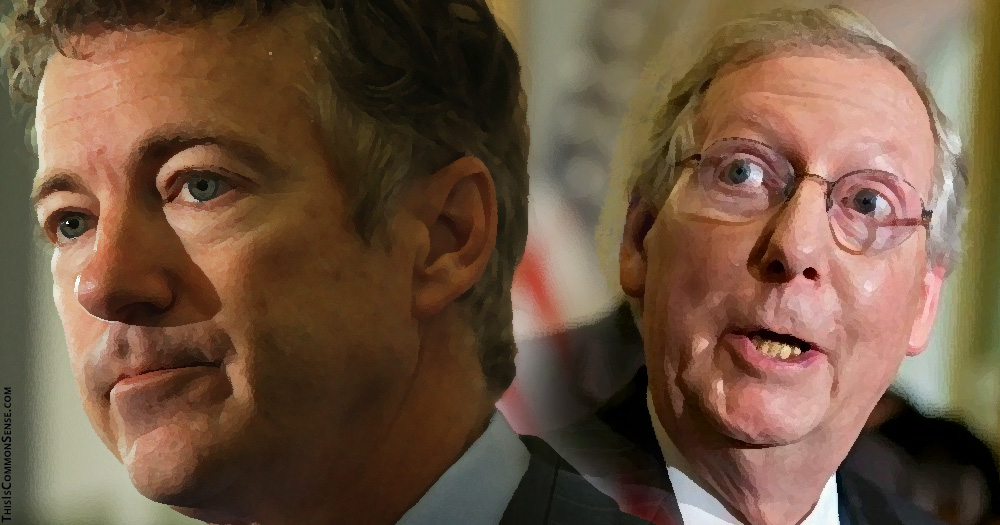
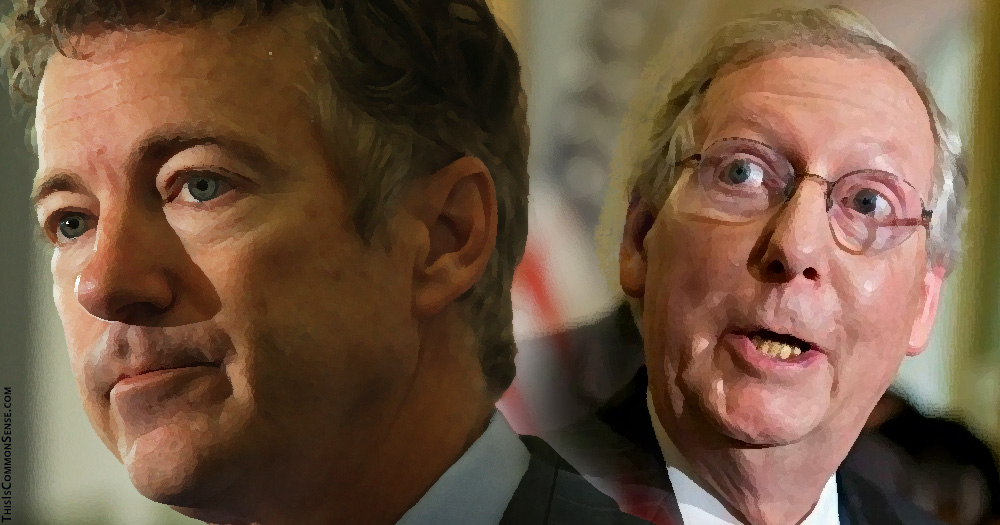
Senate Majority Leader Mitch McConnell (R‑Ky) has introduced a bill to compromise between the House’s recent Affordable Health Care Act and the current “ObamaCare” Affordable Care Act. Though there seems to be some “what the heck, go with it” enthusiasm for it on Capitol Hill, it’s not coming from Senators Rand Paul of Kentucky, Ted Cruz of Texas, Ron Johnson of Wisconsin and Mike Lee of Utah.

‘‘Currently, for a variety of reasons, we are not ready to vote for this bill,” their joint statement from yesterday reads. 

Their objections? Well, they agree that there are “provisions in this draft that represent an improvement to our current healthcare system but…”

— and this is a big but

“it does not appear this draft as written will accomplish the most important promise that we made to Americans: to repeal Obamacare and lower their healthcare costs.’’ Their opposition, the Boston Globe tells us, puts the TrumpCare wannabe in jeopardy.

Dr. Rand Paul is the key figure in the opposition. One of Capitol Hill’s ongoing amusements has been to watch the junior Kentucky senator repeatedly pit himself against his state’s senior member — who, the Globe tells us, now threatens “to bring the bill to a vote next week even if he doesn’t have the necessary votes.”

Pressure tactics.

Which you need to put an obviously bad bill through Congress.

Too many mainstream Republican congressmen lack the courage of their constituents’ convictions. They apparently do not really believe that a freed-​up health care system and insurance market can work to the general good.

At least, not in time for the next election.

This is Common Sense. I’m Paul Jacob.


Printable PDF


Categories
ideological culture incumbents local leaders media and media people national politics & policies

Monied Hopes Dashed

Democrats had high hopes. Their come-​back after the 2016 defeats seemed near at hand. After all, Trump is proving increasingly erratic and incompetent, and the Republican mis-​handling of the ObamaCare repeal appears to be a disaster of ginormous proportions.

How could they not start taking seats in Congress back? 

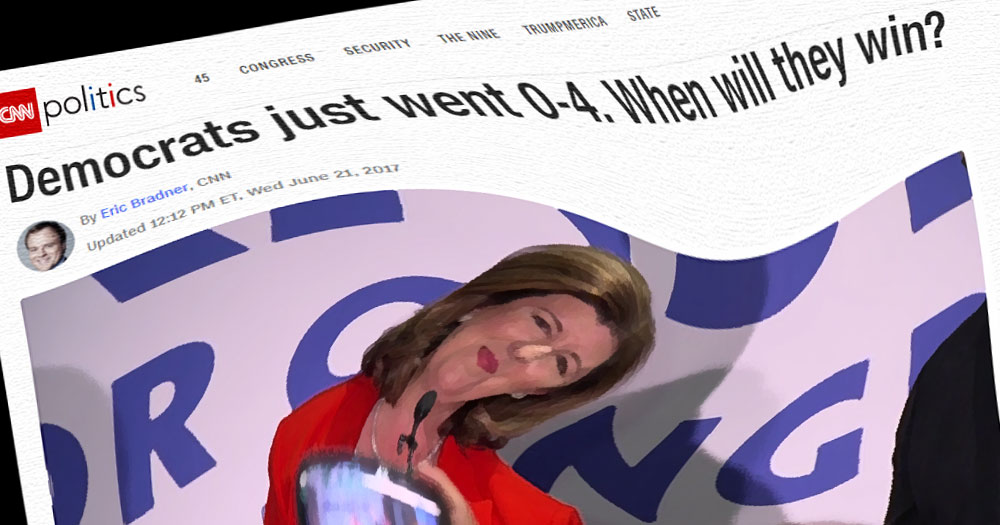
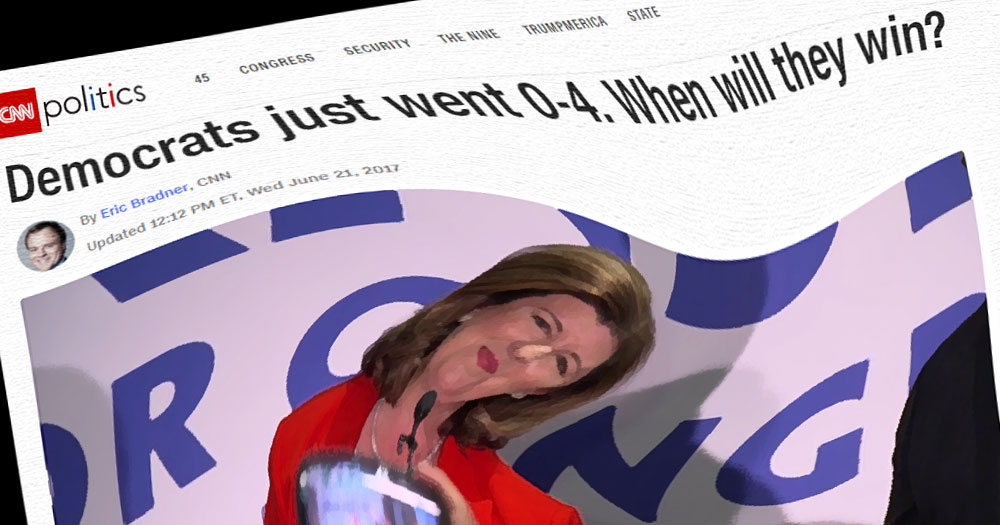
There were four open seats requiring new votes this late Spring. “Democrats tried an inoffensive moderate message in Georgia,” CNN’s Eric Bradner informs us. “They ran a banjo-​strumming populist in Montana. They called in the cavalry in South Carolina and tried to catch their foe sleeping through a long-​shot in Kansas.”

Democrats failed, 0 – 4.

Why? Well, the congressional vacancies were made by the new president’s appointments, and he may have targeted those districts that were especially safe. Nevertheless, CNN notes, “[t]he party got closer than it has in decades to winning some of the four seats — a sign they’ve closed their gaps with Republicans in both suburban and rural areas.…”

But there is a lesson here that CNN did not draw from the debacle. The much-​lamented Georgia race, in which Jon Ossoff lost to Republican Karen Handel, was a race in which Ossoff out-​spent Handel six to one in what is called “the most expensive House race in history.” And yet, somewhat oddly and perhaps hypocritically, Ossoff, the bigger spender, went on air complaining about money in politics.

All that moolah did not push him over the top. Ossoff and the Democrats — as well as the feckless Republican majority — might look for fewer excuses and stand for something voters actually want.

This is Common Sense. I’m Paul Jacob.


PDF for printing


Categories
folly general freedom ideological culture responsibility too much government U.S. Constitution

UN-​appealing

Like E.F. Hutton, when the United Nations’ Office of the High Commissioner for Human Rights “Special Rapporteur on the right of everyone to the enjoyment of the highest attainable standard of physical and mental health” talks, people listen.

In disbelief, perhaps. Or amusement. But they listen. Well, at least Washington Post columnist Dana Milbank does, anyway.

Unfortunately, Milbank couldn’t get Dainius Puras — the Lithuanian doctor serving as the U.N.’s Special Rapporteur on the right of everyone to blah, blah, blah — to talk. Milbank did, however, uncover an “urgent appeal” sent by Puras to the U.S. State Department, with instructions to pass it along to congressional leaders.

Puras won’t discuss his confidential February letter until June, when “it becomes public at the next session of the Human Rights Council.” But the “leaked” letter announces the U.N. has launched an investigation to determine whether repealing the Affordable Care Act (Obamacare) violates international law.*

“The letter urges that ‘all necessary interim measures be taken to prevent the alleged violations’” Milbank further explains, “and asks that, if the ‘allegations’ proved correct, there be ‘adequate measure … to guarantee the accountability of any person responsible.’”

Should Congress repeal Obamacare, will U.N. troops occupy Washington, arresting congressmen for voting against its mandate?

The international body has no way “to impose its will,” Milbank acknowledges, seeming to wish it did and complaining that folks just “scoff at lectures from U.N. bureaucrats.”**

Taking solace, Milbank declares: “[T]he U.N. letter is at least a bit of moral support for those defending Obamacare.” 

Moral support? From the U.N.? Now, you’re pulling my leg.

This is Common Sense. I’m Paul Jacob.


* Along with other U.N. gobbledygook, the letter cites Article 25 of the Universal Declaration of Human Rights, which proclaims, “Everyone has the right to a standard of living adequate for the health and well-​being of himself and of his family” etc. etc. Standard U.N. speak: flowery, vague and unenforceable.

** People throughout the world and across the political spectrum — from the UK’s Daniel Hannan to Chelsea Clinton — scoff at the U.N. for being incompetent and corrupt. Not to mention thoroughly socialist.


Printable PDF


Categories
Accountability government transparency ideological culture moral hazard nannyism national politics & policies political challengers porkbarrel politics responsibility too much government

Legislating in the Real World

Rolling back Big Government is not easy, especially when you are not that into it.

Robert Draper, profiling Steve Bannon in the New York Times, gives us a view into the mind of Trump’s right-​hand man, who appears to think GOP insiders are obsessed with principles. “[I]t’s all this theoretical Cato Institute, Austrian economics, limited government — which just doesn’t have any depth to it. They’re not living in the real world.”

At best, this only fits the Freedom Caucus members, who killed RyanCare. But who is avoiding reality, here?

“Bannon clearly is not as familiar with the mindset of congressional Republicans as he imagines,” counters Jeff Deist, head of the “Austrian” Mises Institute. “They are primarily concerned with how the whole ‘repeal and replace’ debacle plays back home.” 

Like Deist, I see the spectacular fizzle of RyanCare as evidence of the increasing irrelevance of Republican compromising. “The GOP is the party of trillion dollar military budgets,” Deist insists, noting that it “won’t even kill an openly cronyist program like the Export-​Import Bank.”

If keeping Big Government secure is all Republicans can do, what use are they?

“All around us are the almost unimaginable benefits of markets, cooperation, and technology,” Deist explains, “yet somehow we’re naïve if we don’t want to funnel human activity through government cattle chutes.”

Bannon will not secure solid GOP support if he keeps pushing the usual establishment compromises while pretending they are either realistic or revolutionary. Freedom Caucus Republicans seem bent on doing something Republicans usually avoid: change “the real world” for the better by practically limiting government.

Not just in theory.

Bannon seems to have other goals.

This is Common Sense. I’m Paul Jacob.


Printable PDF


Categories
free trade & free markets moral hazard nannyism national politics & policies property rights responsibility subsidy too much government

TrumpCare Trumped

It took awhile for the Obama Administration to accept the term “ObamaCare.” Nancy Pelosi was the initial driver of the massive scheme to permanently alter American medicine and insurance, and “PelosiCare” would have been a fit moniker for the wildly mis-​named “Affordable Care Act.” But the administration put the whole of the new president’s political capital behind it, and the ACA went into law popularly known as “ObamaCare.”

The Republicans pledged to repeal it, from Day One. And repeatedly passed repeal bills, certain to be vetoed by the president named Obama. They needed a Republican in the White House.

Donald Trump ran, in part, on the promise of getting rid of ObamaCare. But upon taking the reins, two things became obvious: Republicans in Congress lacked the guts to repeal the ACA, and even lacked a coherent scheme to alter it.

The new president could hardly be expected to possess the plan they lacked, though on the campaign trail he suggested* the best approach: repeal, then open up insurance markets across state lines. The GOP Congress, on the other hand, was all promise and no clue.

So Speaker of the House Paul Ryan hastily cooked up what was to be the new TrumpCare — a ridiculous reform package with nothing much to say for it.

He failed to gain support from Democrats (of course) and Freedom Caucus representatives.

TrumpCare, trumped, became RyanCare. A failure.

The Freedom Caucus representatives? They breathe freely.

Sure, they “betrayed” the new president, “robbing” him of glory. But they also saved the country from a “reform” in many ways worse than ObamaCare.

This is Common Sense. I’m Paul Jacob.


* It’s worth keeping in mind that Trump had been for socialized medicine before running for office. This is why there was no reason to expect policy leadership on his part.


Printable PDF


Categories
Accountability folly free trade & free markets general freedom moral hazard nannyism national politics & policies responsibility too much government

DumpCare

Speaker of the House Paul Ryan insists that his “TrumpCare” plan to replace ObamaCare will decrease medical insurance rates. Others argue that his American Health Care Act will increase those rates. Likewise, he expects it to reduce strain on federal budgets; others deny this outright. The “coverage” issue is just as contentious.

TrumpCare is a mess because it is isn’t “DumpCare.” What’s needed is not yet another regulation-​plus-​subsidy system. We need repeal and then … more repeals.

Unfortunately, President Donald Trump has never really been on board with this. He has promised that no one would lose “coverage,” assuming that “coverage” is “health care.”

It is not. State charity programs like Medicaid (upon which ObamaCare relied way too much) are merely ways to pay for services. Dumping a gimcrack payment system is not the same as decreasing medical services. “DumpCare” wouldn’t dump care, only insane government.

For example, we know that health care outcomes for poor folks without Medicaid turn out to be better than poor folks with Medicaid.* Increasing the number of people on formalized subsidy programs is no panacea.

Besides, ObamaCare severely under-​delivered on “coverage.”

New programs, nevertheless, are traps, regardless of demerit: once you provide a benefit, folks come to rely on it and demand more — objecting when it’s taken away. Which is why few programs are ever repealed, despite failing to meet original expectations.

So far, the “small government party” hasn’t found the courage to actually limit government. Do Republicans really believe what they say, that fewer regulations and subsidies will lead to lower costs and better service?

It seems Republicans won’t take their own prescription.

This is Common Sense. I’m Paul Jacob.


* Oregon’s 2008 Medicaid “natural experiment” provides reasons to question the merits of the program. As the initial, randomized, controlled study found, “Medicaid coverage generated no significant improvements in measured physical health outcomes in the first 2 years, but it did increase use of health care services.…”


Printable PDF