Government is naturally prodigal, for it spends other people’s money.
Yves Guyot, Principles of Social Economy (1892).
Categories
Yves Guyot
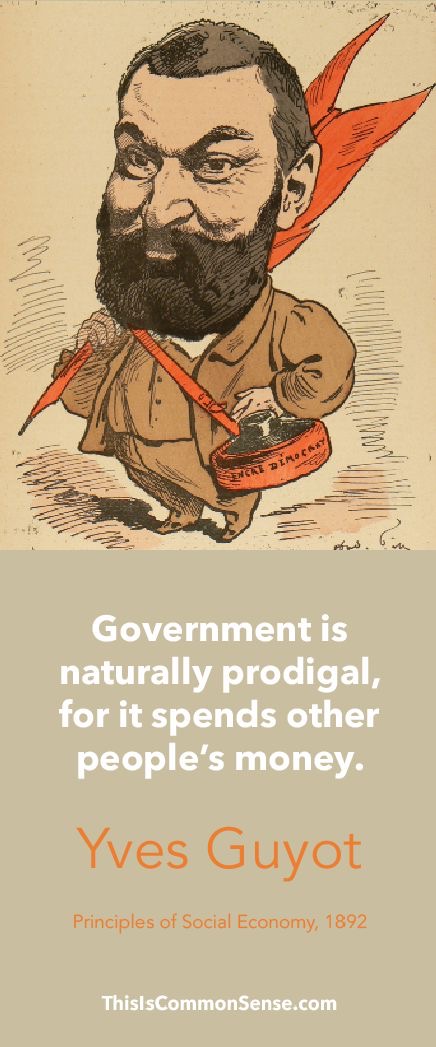
Government is naturally prodigal, for it spends other people’s money.
Yves Guyot, Principles of Social Economy (1892).

Being a clever person is hard work. Many of the truly clever things about everyday life have already been said. New and innovative cleverness? A rare thing indeed.
But if you are in the business of being clever, that puts you in a pickle, if “being relevant” and “worth our attention” is part of your cachet.
Take Alain de Botton, a very clever man who has written at least one brilliant book . . . and several not-so-brilliant ones. He has tackled Proust, Epicureanism, and is now deeply into religion.
Well, maybe not so deeply.
He wants politicians to follow the lead of religious leaders, who, he asserts, are masters of rebranding. (I had thought that was for marketing specialists.)
Recognizing that the word “tax” is an odious one — few people really like paying their taxes — de Botton says that politicians should follow what “religions do” and “rebrand ‘tax’ as ‘charity.’”
Charity, he notes, is a “much more appealing word.”
Well, yeah. That’s because charity is a word for love. It is all about deep concern, sympathy, etc., and “acts of charity” are expressions of love and concern.
And the only way that acts of charity can be determined to be expressions of concern is that they are voluntary. Taxes, on the other hand, are not voluntary. They are taken by force (try not paying them — force will find you).
Forcing people to “be charitable” will automatically scuttle that very purpose.
Trying to rescue politics from the stench of compulsion should not be done with rebranding, but by limiting government.
The less government, the less force.
And more scope for charity.
This is Common Sense. I’m Paul Jacob.

Also, please consider showing your appreciation by dropping something in our tip jar (this link will take you to the Citizens in Charge donation page… and your contribution will go to the support of the Common Sense website). Maintaining this site takes time and money. Your help in spreading the message of common sense and liberty is very much appreciated!
“Government is naturally prodigal, for it spends other people’s money.”
A few weeks ago, when the Ferguson, Missouri, protests were well underway, a few crucial facts emerged from the tumult.
A graph showed that Ferguson led the state — by a wide margin — in arrests per capita.
While it’s true that Ferguson could be that much more violent and criminal than every other city in the state, somehow that possibility doesn’t seem very plausible.
When we learned that “86 percent of stops, 92 percent of searches and 93 percent of arrests were of black people — despite the fact that police officers were far less likely to find contraband on black drivers (22 percent versus 34 percent of whites)” … well, the whole thing stank of something other than a mere crime problem.
It’s a policing problem.
And, of course, a “war on drugs” problem.
Another fact, from the same source: “Ferguson receives nearly one-quarter of its revenue from court fees; for some surrounding towns it approaches 50 percent.”
No way to run a government. Journalists and activists call such regimes “for-profit policing,” and cite the rise in civil forfeiture practices as encouraging and solidifying the method.
But “for-profit” is a bit of a misnomer.
It’s more like rapine (an old word you might most often see paired with “pillage”) than “for-profit.” It’s a looting system, while “for-profit” suggests selling a service freely on the market and earning rewards for filling consumer needs. Ferguson basically engages in shaking down a population of people, repeatedly profiling and harassing them, extracting as much of their wealth as can be had — Frédéric Bastiat’s “legal plunder” comes to mind — and leaves them to … protest, later.
This is Common Sense. I’m Paul Jacob.
Certain sheriffs in Colorado and other states have something in common. None of them will ever have to say “I was just following orders” as an excuse for failing to respect the right of an individual to bear arms.
They’re simply not following those orders.
In Colorado, Sheriff John Cooke of Weld County says that in addition to being unconstitutional, the state’s new gun-control laws are so vague as to be unenforceable. Before July 1, it was legal to sell or transfer a 30-round magazine. After that date, not. In explaining his policy, Cooke flourishes two such identical-looking magazines, one purchased before July 1, one after. Then shuffles them. “How is a deputy or officer supposed to know which is which?”
John Cooke is one of 55 elected sheriffs (out of 62 total) across Colorado who joined a federal lawsuit challenging the constitutionality of the new law. Also, two Colorado lawmakers have been recalled by voters for supporting it; and a third resigned rather than face a recall.
“In my oath it says I’ll uphold the U.S. Constitution and the Constitution of the State of Colorado,” says Sheriff Cooke. “It doesn’t say I have to uphold every law passed by the Legislature.”
We all know that the vagueness, ludicrousness, or unconstitutionality of a law doesn’t necessarily stop officials from coming down on citizens like a ton of bricks. So the sheriffs’ refusal to obey is commendable. And an example to follow.
This is Common Sense. I’m Paul Jacob.
The business of business is to profit by helping others. The business of government is to make sure that businesses don’t profit by cheating others.
Unfortunately, sometimes it’s the governments that cheat.
Take the airline industry. Though substantially deregulated by the early 1980s, government has not treated it in an exactly laissez faire manner since. First there are the taxes, quite heavy. And recently the Department of Transportation decided that it must regulate the way in which airlines may advertise their prices . . . and the taxes. That is, the DOT insists that the “total price” — by which it means the price-plus-tax — must be shown prominently, with the tax portion “presented in significantly smaller type than the listing of the total price.”
Talk about regulatory micromanagement!
Now, this rule isn’t something Congress cooked up. It’s the result of a bureaucracy gone wild.
And the rule has one obvious effect: It shields government from consumer criticism, showing bureaucrats at their most self-serving. About one fifth of every airline ticket goes to the government, and folks in government don’t want you to know that.
This being the case, you might think — as George Will does — that the First Amendment would apply, especially since the First Amendment is now routinely held as protecting political speech more strictly than commercial speech. But, so far, courts have ruled for the taxing and regulating bureaucrats, not the competitive airlines. Or consumers.
Frequent fliers (I’m one) should hope the Supreme Court justices take up the case, which shows why economic and political freedom go best together.
This is Common Sense. I’m Paul Jacob.
Should we surrender our industrially fueled civilization the better to fuel fantasies of appeasing Gaia, goddess of the Earth?
The New York Times urges the Obama administration to block a much-needed oil pipeline from Canada as a gesture toward deflecting the purported threat of anthropogenic global warming.
“In itself, the Keystone pipeline will not push the world into a climate apocalypse,” admits the editorial. “But it will continue to fuel our appetite for oil and add to the carbon load in the atmosphere. There is no need to accept it.” The oil drops add up. “At the very least, saying no to the Keystone XL will slow down plans to triple tar sands production from just under two million barrels a day now to six million barrels a day by 2030.”
That’s what we want, right? Less and less of the fuel we need to go places and do things?
But if government is justified in blocking the Keystone pipeline on such a basis, isn’t it also warranted in stopping existing oil production?
What offends the “greens” is every form of “raping of the earth” for mere human survival and comfort — including to protect ourselves against weather that has always been variable, often extremely so. By their logic, the only moral way to defend against the elements is to surrender to them. No more building houses, wearing coats, adding gas to heater tanks and car tanks. Shut everything down.
I can’t say I’m persuaded.
This is Common Sense. I’m Paul Jacob.
Washington State has a long history of popular antagonism to political parties. For years, the state enforced an open primary, which meant that Republicans could vote in Democratic primaries and Democrats in Republican primaries. This was very popular, because it led to widespread strategic voting.
Well, that’s a euphemism. In open primaries, what you get is not mere strategic voting so much as sabotage. I have heard of Democrats and others boasting of voting in Republican primaries, for example, supporting Pat Robertson. Why? They believed Robertson to be unelectable, and hoped putting Robertson ahead would undercut the GOP in independent voters’ eyes, and make running against the party easier in the general election.
Well, a few years ago that system was thrown out as unconstitutional, as an abridgment of free association rights.
But instead of allowing party members to select candidates, Washington State movers and shakers cooked up something else altogether. They set up a system wherein anyone could use a party’s label — even if that party’s members don’t know said candidate or despise him. Robbing parties of any control over candidates offered in their name is far worse on the very constitutional issue that nullified Washington’s traditional open primaries. Though Top Two has been legally challenged, the U.S. Supreme Court just this week refused to hear arguments.
The name “Top Two” comes from the fact that only the top two vote-getters in this super-open primary are on the general election ballot. The new system has completely removed minor party candidates from the general election ballot, when most folks vote.
Top Two has had the same impact in California. Arizona voters will decide the issue this November, on their ballot as Prop 121.
This is Common Sense. I’m Paul Jacob.

When times get tough, the tough . . . switch currencies.
A fascinating report in The Atlantic tells of the upswing in “local currencies.” In the United Kingdom, the Brixton Pound is being floated, engraved on its paper notes the likes of “David Bowie in his Ziggy Stardust era.” Pegged to the British pound, it serves mainly as a scheme to promote local business and trade, though maybe it’s a tad more than mere boosterism.
Bavarians are also “enthusiastically using the local currency as a protest” — the local currency being the Chiemgauer. And “similar currencies have popped up around the world,” including in Canada and the United States.
The Atlantic story also mentions the idea of a “time bank,” a one-step-up-from-barter method based on labor hours and (in some cases) accounting for a variety of skill levels. Such “systems are in use all over the world . . . though the organizers are careful to make sure that the time is never given a specific value in a hard currency, which would open the door to taxation from governments.”
That caveat shows how barter and labor time exchanges might seem the more “revolutionary,” from, say, an establishment point of view. It’s worth noting that the idea’s greatest early proponent was Josiah Warren, America’s genius utopian experimenter and theoretician of “individual sovereignty.”
Less of a radical, Rep. Ron Paul echoes eminent monetary economist and Nobel Laureate F.A. Hayek by promoting the “denationalization of money,” arguing that government policy should allow all currencies to float, getting rid of all taxation on trade amongst currencies as well as repealing all legal tender laws.
For my part, I would greatly enjoy spending a Ziggy Stardust banknote.
This is Common Sense. I’m Paul Jacob.
Rob Walton is rich, $21 billion rich.
An email I received yesterday from the folks at Wal-Mart Watch (WMW) implores me to click to a website to vote for Mr. Walton as “the worst of the 1 percent . . . the person who is doing the most with their wealth to exploit the rest of the country.”
Could this be true?
“The Waltons inherited that wealth,” WMW says, “much of it was created by paying many workers at poverty-level wages, offering poor benefits, and lowering conditions in the supply chain by demanding ever-lower prices.”
Count me out.
Even Sam Walton, founder of Wal-Mart, had the right to give his wealth to whomever he wished, especially his children. Besides, as chairman of Wal-Mart for 20 years now, Rob’s earned plenty on his own.
The email forgets to mention that Wal-Mart provides more to the poor through lower prices than the federal government provides through food stamps.
And hey, didn’t workers at Wal-Mart apply for — and freely accept — their jobs? How many “living-wage” jobs has WMW created?
The sentence in bold type signals the real gripe, I bet: Rob Walton has transgressed by supporting causes that “advance a right wing agenda.” The Walton Family Foundation (of which he’s a board member) has donated to the Heritage Foundation, Cato Institute, school choice groups, and others.
Horrors! If Rob Walton is the worst of the 1 percent, the self-appointed vanguard of the 99 percent ought to occupy a mirror.
This is Common Sense. I’m Paul Jacob.