Categories
too much government

Homelessness Costs

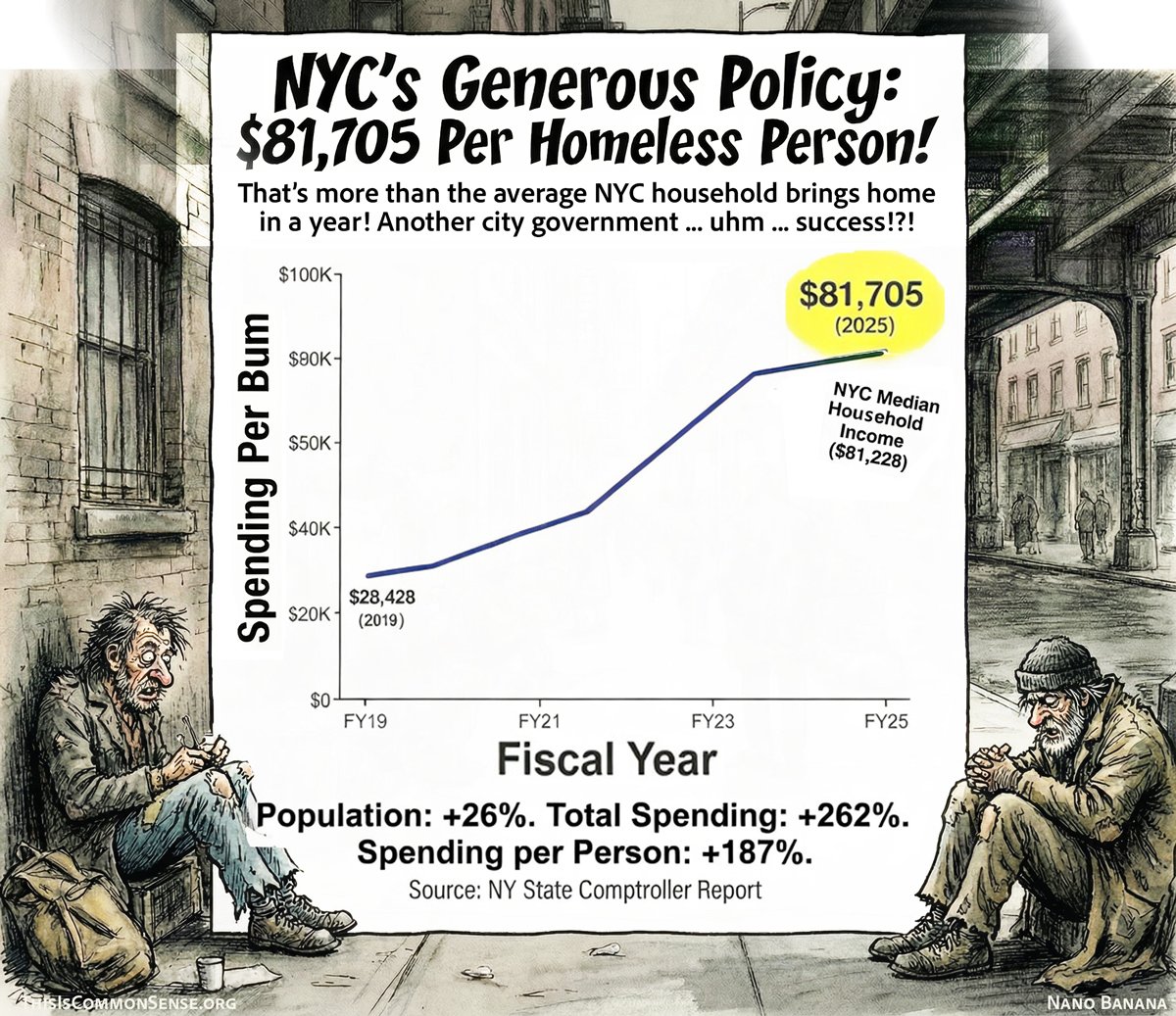
“Spending tripled,” shows the graph, but the “population grew 26 percent.”

Charlie Smirkley (@charliesmirkley) provided the graph, deriving the numbers from official state reports, just out.

New York City, writes Mr. Smirkley, “spends more per homeless person than the median NYC household earns.” And that “$81,705 per person in FY2025,” he explains, “is a floor.” Excluded? Supportive housing (about a half a billion per year), mental health response teams; the costs of police department dealings with homeless encampments. 

Shocking? Yes and no. We expect increasing costs in government “charity,” in part because governments centralize and standardize methods, discouraging innovation and adaptation. It’s not a market. Government bureaucrats and operatives try to coordinate increasing staffs (along with market costs in housing, etc.) while necessarily dealing with clients as objects of pity and bother rather than, as in markets (where people exchange valuable goods), subjects whose responses immediately affect the “business” at hand.

This year, the city projects to spend about $97,000 per person.

Some of the articles on the subject are better than others, naturally enough, and at least one had great graphs, too. But this sentence in Meagan O’Rourke’s Reason contribution caught my eye: “The most alarming part of the comptroller’s report is that the state cannot assess whether tax dollars are being spent effectively.”

It’s a typical problem governments have — which points to a problem not with the homeless but with government.

And of course this is not just a Big Apple thing: while spending per homeless individual since 2019 is up 187 percent in New York, spending’s up 190 percent in San Francisco, 430 percent up in Portland, and 480 percent up in L.A.

Homelessness is expensive.

This is Common Sense. I’m Paul Jacob.


PDF for printing

Illustration created with Nano Banana

See all recent commentary
(simplified and organized)
See recent popular posts
Categories
ideological culture judiciary property rights

Must Your Town Become San Francisco?

I love San Francisco. Such a beautiful city, I thought on a recent visit. 

But then I turned the corner and discovered, once again, that all-important skill of rapidly averting one’s eyes. 

Where was an escape route?

The city by the bay, like other towns with mild weather, is always going to get more than its share of what we used to call hobos, or — more accurately — bums. Sleeping on the streets there must beat sleeping on Chicago streets in the winter.

Still, Frisco gives added benefits to those living on its streets. Indeed, vagrants can become less vagrant by setting up encampments in public, apparently wherever, toilet facilities optional. An impending Supreme Court ruling may push other cities in the same direction.

The case, Johnson v. City of Grants Pass, Oregon, has reached the U.S. Supreme Court.

Three vagrants challenged a Grants Pass ordinance prohibiting them “from using a blanket, pillow, or cardboard box for protection from the elements”; in other words, from setting up camp in the street.

In response, the Ninth Circuit blocked Grants Pass from enforcing the ordinance unless it provides shelter to those kicked off the street. Many towns cannot afford such expenditures, especially if the vagrant population is of any great size.

You get more of what you subsidize. If, obeying such rulings, towns do stretch budgets to prevent encampments, they thus encourage vagrants from nearby lands to move into town to get the taxpayer-funded accommodations.

The Ninth Circuit decision applies to nine states. Now the Supreme Court will either throw out the decision; revise it; or, upholding it, begin to consign all of us in all states to the fate of San Francisco.

This is Common Sense. I’m Paul Jacob.


PDF for printing

Illustration created with PicFinder and Firefly

See all recent commentary
(simplified and organized)
See recent popular posts

Categories
crime and punishment ideological culture

The Long Road Back

Decades of wrongheaded policies have eroded San Francisco’s once much-vaunted charm. 

These policies include onerous burdens on building construction; lax attitudes toward homeless folks’ tent cities and public excretory practices; and a green light for sundry criminal activities, including broad-daylight theft.

The green light flashed statewide in 2014, when Californians passed Proposition 47, giving looters much less to worry about if caught stealing less than $950.

Remove a disincentive and you wind up with a huge incentive: thugs were emboldened; folks on the margin between criminality and civilized peace went the wrong direction.

In San Francisco, they were further emboldened when voters installed Democrat Chesa Boudin as district attorney in 2019. At least the election was close.

A recent recall election wasn’t so close, with some 61% voting to oust him.

In the cause of abetting criminals, DA Boudin did everything but serve as getaway-car driver.

Right away, he fired several prosecutors, and The Epoch Times reports that soon “more than 50 prosecutors, support, and victim services staff had either been fired or had quit their jobs over Boudin’s progressive agenda.”

The agenda included ending cash bail, slashing incarceration rates, routinely releasing repeat offenders.

Although it has lost a lot, San Francisco still has piers and fog and that famously twisty road, Lombard Street. Residents have a ways to go to emerge from their ideological fog and perhaps must travel an even twistier road to reclaim their city.

By getting rid of Boudin — and three pretty rotten school board members in another recent recall election — San Franciscans have taken the first steps back to something like sanity. Which always makes next steps easier.

This is Common Sense. I’m Paul Jacob.


PDF for printing

See all recent commentary
(simplified and organized)
See recent popular posts

Categories
national politics & policies porkbarrel politics too much government

Homeless Red Ink

I have a prediction.

Even though President Obama insists that all of the trillions in so-called “stimulus” spending will be expertly managed and masterfully allocated — of course, to only the most deserving and stimulating beneficiaries — lots of the hastily cobbled new spending will end up being wasted.

I’m afraid I cheated with this prediction. I already have an example in hand. The town of Union, New York, is slated to receive almost $600,000 from the Department of Housing and Urban Development. Why? To combat homelessness.

Problem? There isn’t one — that is, there isn’t a homeless problem in Union. Which is why the town does not have any programs for dealing with the homeless and it has no means of administering the money that’s been flung at it. Nor did the town request the funds. Town supervisor John Bernardo says, “We were surprised. We’ve never been a recipient before.”

A less honest man would have trucked in some homeless guys and warbled, “Thank goodness we’re finally getting these funds.” But what Union lacks, Washington provides: A HUD spokesman says the new grant recipients should employ “creative strategies” in figuring out how to spend the money.

So that more than half-million dollars will find a home somewhere — anywhere but the wallets it came from.

You see why I shake my head and say, “I could have predicted this.” This isn’t change. It’s more — way more — of the same.

This is Common Sense. I’m Paul Jacob.