Categories
First Amendment rights

Fake News; Real Assault

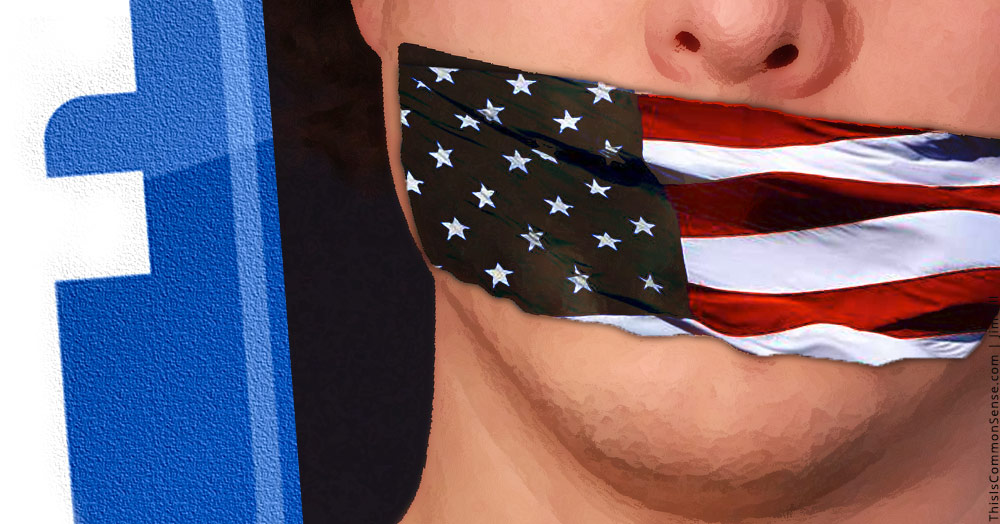
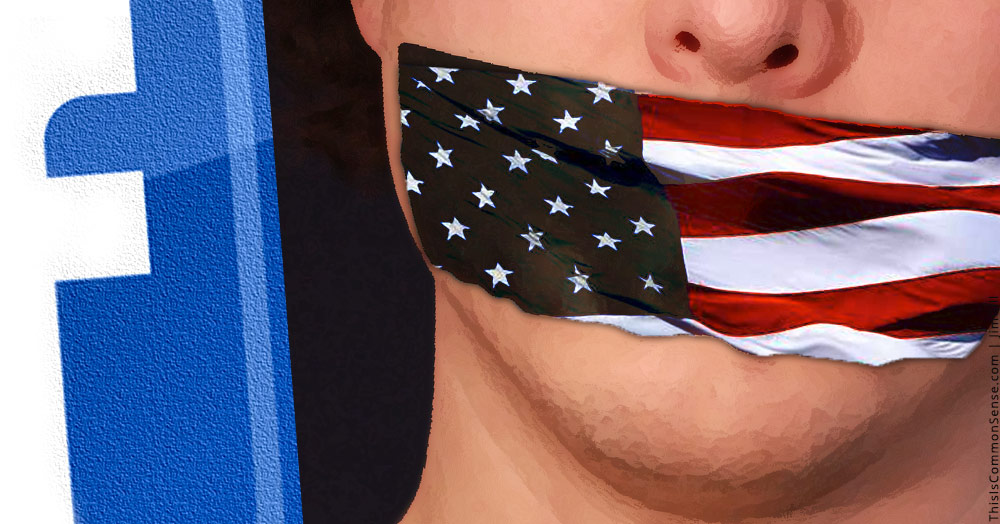
I don’t defend the way Twitter, Facebook, and others target users for expressing views that these firms dislike. I do defend the individual rights of all persons, including owners of companies. Our freedom to act includes the freedom to act in ways others consider to be wrong — if we do so while respecting the (actual) rights of others.

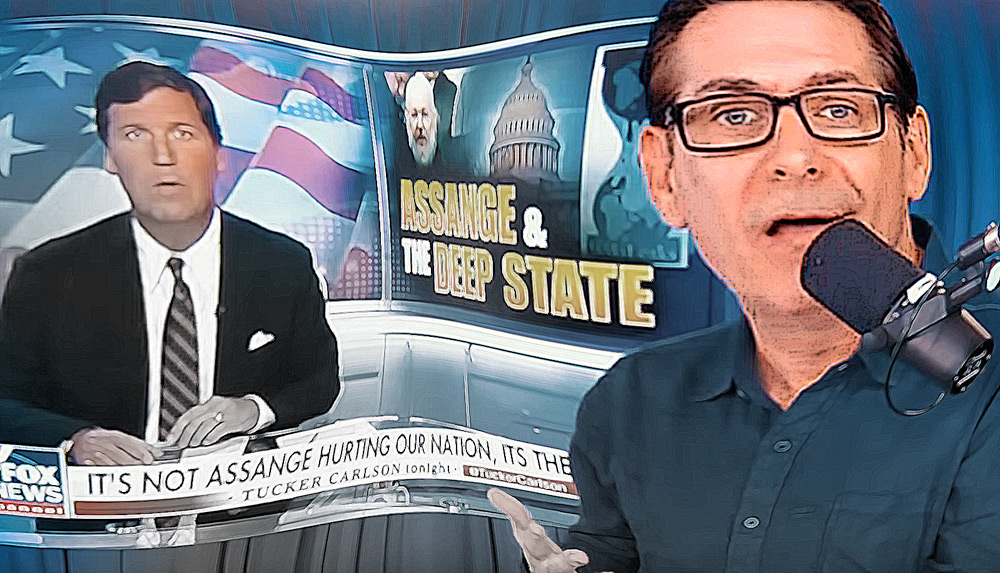
But something is extra-​disturbing about the way Facebook, Google, Apple, Spotify, etc. (though not Twitter) ejected Alex Jones from their platforms. The firms apparently obeyed journalists and politicians demanding InfoWar’s ouster for purveying “hate speech.”

And now: “These companies must do more than take down one website,” intones incumbent U.S. Senator Chris Murphy.*

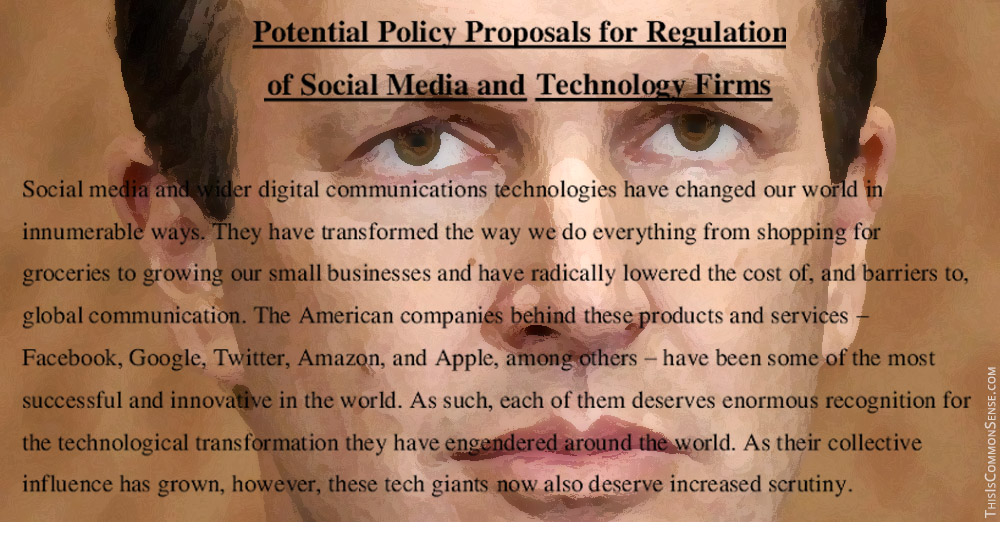
Such statements aren’t laws. But every company must worry about the arbitrary government power that incumbents like Murphy can deploy. And fellow U.S. Senator Mark Warner’s leaked paper on the dangers of technology-​abetted fake news tells us we’re in for a more direct assault on free speech.

“The size and reach of these platforms demand that we ensure proper oversight, transparency and effective management of technologies that in large measure undergird our social lives … and our politics,” says the plan. The goal is to “ensure that this ecosystem no longer exists as the ‘Wild West’,” i.e., unfettered by government.

So … the idea is to rescind that wild First Amendment? 

I would sooner press for a new law penalizing politicians who threaten the liberty of firms on the basis of catering to the “wrong” customers.

But there is no crying need for this. Let’s stick with “Congress shall make no law …”

This is Common Sense. I’m Paul Jacob.


* These companies did not take down a website, by the way. Alex Jones’s InfoWars​.com appears to be going gangbusters. Those companies ousted InfoWars from their Web services. This is a distinction with a difference.

PDF for printing


Categories
First Amendment rights general freedom ideological culture media and media people moral hazard

May Trigger Eye Rolling

The fashionable campus notion of “microaggressions” blurs the distinction between peaceful speech (offensive or not) and bashing somebody over the head with a club. 

If courts, police and/​or university officials can rationalize regarding the perpetrator of a so-​called “microaggression” as initiating force against an offended listener, they can also rationalize using actual physical force in retaliation. Which, to the extent implemented, would mean the end of freedom of speech. 

After all, nobody needs a First Amendment in order to utter banal pronouncements about the weather.

The allied campaign urging or requiring professors to issue “trigger warnings” before discussing anything that might provoke discomfort also dampens discourse. 

Who can object to letting viewers of TV news know that they are about to see a corpse? Or sending little kids out of the room when certain subjects are discussed? But is such common sense the point of “trigger warnings”?

At best, “trigger warnings” are a silly name for referring to what nobody seeks to keep secret. At worst, they help trigger distress themselves — or impede frank discussion of controversial subjects. The latter treats adults as if they were not adults; the former makes adults less adult. 

If and when “trigger warnings” are imposed by force, with penalties for omitting them, they also endanger freedom of speech.

Advocates of open discourse seem to be in an endless war with champions of a repressive political correctitude. The jabberwocky used to justify that repression keep evolving. The response must be constant: intellectual clarity and eternal vigilance.

This is Common Sense. I’m Paul Jacob.


PDF for printing


Categories
Common Sense First Amendment rights national politics & policies Second Amendment rights

Free Designs

The relationship between the First and Second Amendments is closer than commonly believed.

This is especially clear in the 3D gun printing story, the subject of yesterday’s Common Sense, “Progressive Designs.” As I finished the copy, a news story broke: U.S. District Judge Robert Lasnik “muzzled Defense Distributed with a court order,” as Declan McCullagh puts it. 

And then, as McCullagh goes on, a mirror site appeared. Though Cody Wilson, the man behind Defense Distributed, immediately took his plans offline, “the Calguns Foundation, the Firearms Policy Coalition, and other civil rights groups” published plans for “AR-​15, AR-​10, Ruger 10 – 22, Beretta 92FS, and other firearms” on their sites.

This made my footnote especially relevant, for it was there that I noted that “plans like this have been available on the not-​exactly-​easy-​to-​access Dark Web for some time.” And now Cody Wilson’s precise “freely downloadable computer-​aided design (CAD) files,” though “dark” on his site, are bright elsewhere.

McCullagh admits that though it is certainly “possible that Defense Distributed may lose this legal skirmish and be prevented from returning its instructions to the DEFCAD site,” since such plans are now everywhere, and not easily stoppable, constitutionally, the “Second Amendment, it turns out, is protected by the First.”

Which is, of course, natural enough — for the Second Amendment’s protections of self-​defense has held power-​lusting politicians at bay, keeping Americans freer than citizens anywhere else. What other country has better free speech protections?

All freedoms help each other, reinforce each other.

This is Common Sense. I’m Paul Jacob.


PDF for printing


Categories
crime and punishment First Amendment rights general freedom Second Amendment rights too much government U.S. Constitution

Progressive Designs

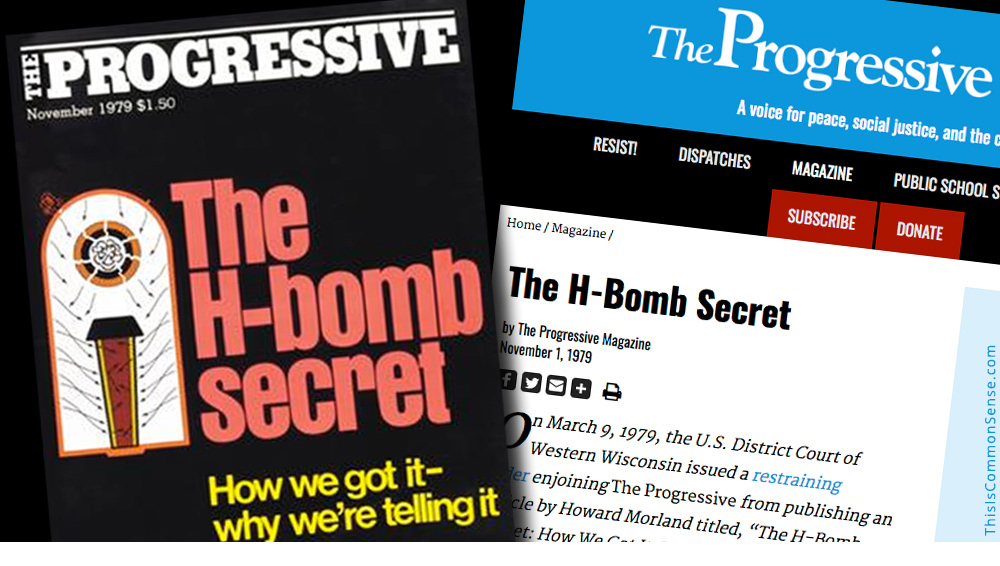
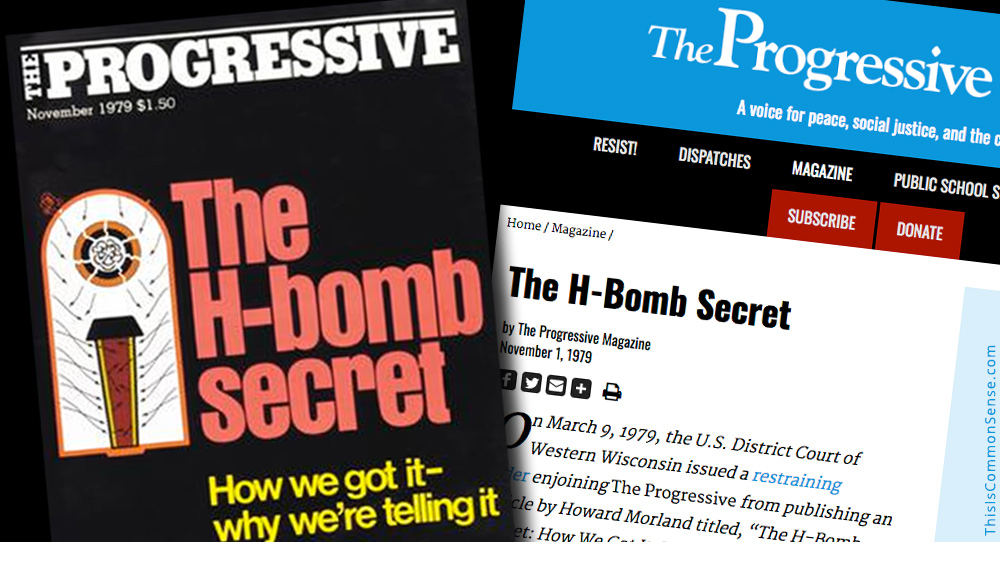
In February 1979, Professor George Rathjens called the editors of The Progressive, urging them not to publish a story in the works, which included a journalistic best guess as to the design of a hydrogen bomb. The Progressive refused to squelch the story, and the professor of poli-​sci (not nuclear physics) contacted the Department of Energy, which sued to suppress the article.

The Progressive defended itself on free speech grounds.

Fast forward to today, with progressives screaming to squelch the freedom of speech and press of Defense Distributed, an Austin, Texas, organization, which expressed its intention to publish easily downloadable plans* to print plastic guns using 3D printing technology.

This hit the news first as the result of a court decision early in the month,** but now Senator Edward Markey (D‑Mass.) blames the Trump administration, not the court. “Donald Trump will be totally responsible for every downloadable, plastic AR-​15 (gun) that will be roaming the streets of our country.”

Why blame the administration? Because the administration settled its lawsuit holding up the publication.

Amusingly, back in 1979, the government dropped its suit against The Progressive.

Progressives were definitely not for nuclear bombs 40 years ago, and The Progressive had its own agenda in publishing a version of the article that saw print in the magazine’s November 1979 issue. Now progressives express more alarm about private individuals having weapons, not about the government’s weaponry. 

But the biggest change? It has something to do with free speech.

This is Common Sense. I’m Paul Jacob.


* I say “easily downloadable” because plans like this have been available on the not-​exactly-​easy-​to-​access Dark Web for some time.

** The decision is clear: “Arguments for tighter restrictions on firearms are, in this case, directly opposed to arguments for the unfettered exchange of information on the internet.”

PDF for printing


Categories
Accountability First Amendment rights folly general freedom ideological culture media and media people moral hazard nannyism national politics & policies Regulating Protest too much government U.S. Constitution

Freedom “Weaponized”

Justice Elena Kagan has a way with words. The conservative majority on the court, she said after two recent rulings, is “weaponizing the First Amendment.”

What a phrase! But what does it mean? 

“Conservative groups, borrowing and building on arguments developed by liberals,” explains The New York Times, “have used the First Amendment to justify unlimited campaign spending, discrimination against gay couples and attacks on the regulation of tobacco, pharmaceuticals and guns.”

First: if “liberals” now find themselves not supporting the idea of particular freedoms, or freedom in general, are they really “liberal”?

Second: “borrowing arguments” is what we expect to happen. Logic isn’t partisan.

Third: the point of the Bill of Rights is to “weaponize” the defense of freedom.

Remember, it is freedom of speech; freedom of the press; freedom of association; freedom of exercising one’s religion. The First Amendment weaponizes their defense by disallowing Congress from legislating against them.

Now, it has long been a “problem” that these listed freedoms blend together. They all work together or don’t work at all. And each points to freedom more broadly.

Kagan wants to read freedoms narrowly — though liberals historically have, indeed, read them broadly.

She’s objecting to two recent rulings. The first prohibits states from requiring pregnancy centers to talk up abortion options to their clients. An obvious free speech issue. The second prohibits governments from backing unions in their extraction of “agency fees” from non-​members. An incontrovertible issue of freedom of association.

Kagan and The New York Times apparently think that “liberalism” means defending some freedoms in some contexts, but denying freedom in others.

This is Common Sense. I’m Paul Jacob.


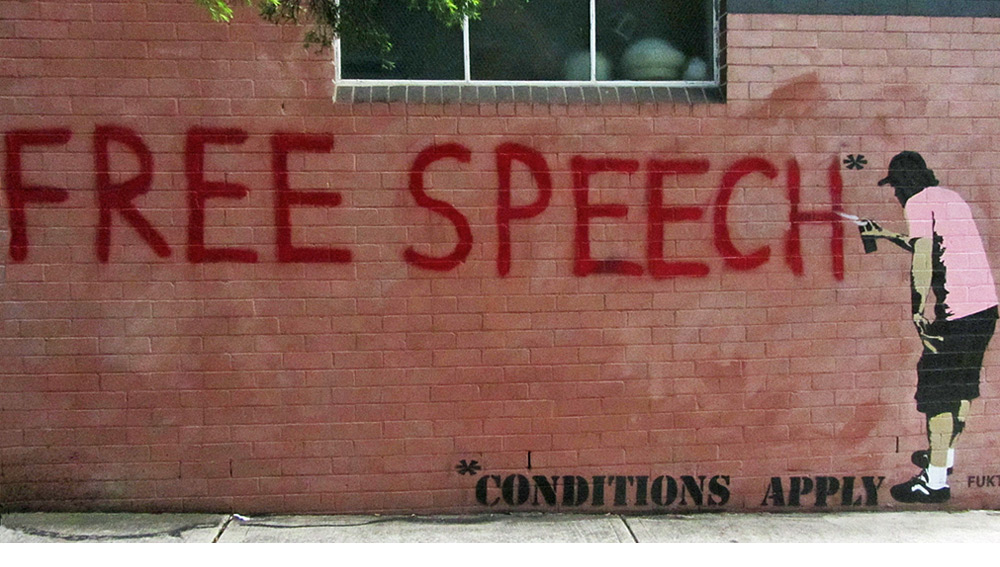
Illustration by Newtown grafitti


Categories
Accountability First Amendment rights ideological culture media and media people moral hazard U.S. Constitution

Exit Strategy Advised

The First Amendment applies only against governments, but our free speech rights can be violated by nearly anyone.

These days, these rights are most notoriously and routinely violated by mobs of students … attending colleges and universities nearly all of which depend upon taxpayer subsidies.

David E. Bernstein, writing at the Volokh Conspiracy, in “USC Law Professor: Supporters of Campus Free Speech are ‘Preying on Vulnerable Teenagers,’” makes a number of points regarding a law professor’s published defense of nasty student reactions to a Federalist Society speaker … on a campus not his own.

Bernstein notes that “the article has to have the requisite references to the Emmanuel Goldsteins of the modern left, the Koch Brothers, who are mentioned four times for no discernable reason.” The reason, of course, is demonization. For a movement needs enemies.

The USC law professor argues that journalists should ignore campus speaking events that “goad” students into “tactical mistakes” by the “mean-​spirited provocations” of “seasoned political operatives preying on vulnerable teenagers and inexperienced young adults.”* Bernstein shows that the “tactical mistakes” amount to peaceful and intellectual speakers being “harrassed, shouted down, and subject to or threatened with violence”; every reasonable person knows that disagreeing with the ideas someone communicates does not excuse violating that someone’s rights.

No matter how “provocative.”

Most chillingly, the speaker who incited student ire and accusations, etc., had been advised by “a security guard” before his “talk” to devise “an ‘exit strategy.’” This indicates that the American taxpayer needs an exit strategy from subsidizing anti-​democratic mob activism.

And its professorial enablers. 

This is Common Sense. I’m Paul Jacob.


* Don’t you find this language awfully coddling of people who should be treated as responsible for their actions, and who, by their attendance at an institution of higher learning, should be capable of listening to any point of view? I find it maddening.


PDF for printing


Categories
Accountability crime and punishment education and schooling First Amendment rights general freedom ideological culture moral hazard Regulating Protest

The Shallow State

Amidst all the talk of The Deep State, we are in danger of losing track of a parallel problem: the Shallow State — which, despite lack of depth, is very wide.

I am referring to government employees who increasingly abandon any pretense of impartiality. And the public institutions that protect them. 

Consider the case of the University of Illinois at Urbana-​Champaign and its 39-​year-​old lecturer Tariq Khan, who is a member of an Antifa-​affiliated group called the Black Rose Anarchist Federation. Mr. Khan had been angrily shouting and chanting at a campus anti-​Trump rally when he was mildly challenged by a non-​nut student journalist. Khan went on a rampage, screamed at and pushed the young journalist, and deliberately broke the smartphone of a fellow journalist who had been recording the fracas.

Khan was charged with destruction of property. But the story doesn’t stop there.

“I was told that if I wanted the ‘situation to improve,’” wrote a third journalist, “that I should stop writing about Khan.” 

The university placed a restraining order on the three, to squelch news and dissent.

So the trio sued on First Amendment grounds.

Here we have a teacher willing to abridge free speech the old-​fashioned way, by playing the bully. And a public institution ready and willing to defend him, to take his petty criminality and raise it to a conspiratorial, Big Brother level.

Not only does this rob Americans of rights, taxpayers are being forced to fund what they might justifiably regard as the destruction of the republican form of governance.

Root out the infamous Deep State? 

Sure.

But limit and make transparent the Shallow State, too.

This is Common Sense. I’m Paul Jacob.


PDF for printing


Categories
First Amendment rights general freedom media and media people moral hazard nannyism national politics & policies too much government

Why They Hate the First Amendment

Does banning Facebook in the weeks leading up to an election sound like freedom?

“The corrosive effect of social media on democratic life,” writes The New Republic’s Jeet Heer, “has led both French President Emmanuel Macron and Canadian Prime Minister Justin Trudeau to make the same threat to Facebook: self-​regulate or be regulated.”

But Macron doesn’t go far enough. “If fake news truly poses a crisis for democracy, then it calls for a radical response,” Heer insists. 

“Many countries have election silence laws, which limit or prohibit political campaigning for varying periods of time ranging from election day alone to as early as three days before the election.” And Heer sees little reason not to apply such regulations to social media. 

“What if you weren’t allowed to post anything political on Facebook in the two weeks before an election?”

This exactly parallels the prohibition of political spending “by corporations” before an election, as in the McCain-​Feingold campaign finance regulation. Except here we have it directly affecting normal citizens.

The current excuse, “fake news,” appears to be defined by partisans almost entirely as the errors and lies and spin of their opponents’ side(s).

But since lying about one’s political enemies is at least as old as the Election of 1800, why is this different now? 

Because, I submit, Facebook is just another area the folks pushing such obvious breaches of the First Amendment — politicians and most of the media — do not yet control.

Competition mustn’t be tolerated. 

This is Common Sense. I’m Paul Jacob.


PDF for printing


Photo credit: by John Nakamura Remy


Categories
crime and punishment First Amendment rights general freedom moral hazard property rights too much government

A Cakewalk Case?

The Justices seem split — on the “gay cake” case. 

A Christian baker had no trouble selling a gay couple a pre-​made cake, out of his showcase, but balked at selling a custom wedding cake of any kind. According to NPR’s Nina Totenberg, the couple understood that requesting a “gay” themed cake would go too far. But the baker’s refusal to decorate any wedding cake seemed unacceptable.

In Colorado, where the cake didn’t get made, there is a public accommodations law that says businesses must serve all customers regardless of race, religion, or sexual orientation. So Colorado went after the baker, the baker hired a lawyer, and Masterpiece Cakeshop v. Colorado Civil Rights Commission was heard by the Supreme Court this week.

Commonly billed as a conflict between First Amendment-​guaranteed religious freedom* and the civil rights of citizens as defined and protected by a state law, it almost defies easy solution. 

One could argue that the First Amendment right to freely associate (including the right not to associate) should extend to business. But that goes against legislation built up since the 1964 Civil Rights Act, which in many places ended an often violent racial segregation** no one wants back. However, a custom-​made wedding cake is also expressive and therefore speech.

One could decide for Colorado on federalist grounds. And the late Justice Antonin Scalia, Ms. Totenberg tells us, argued that a general law not directed at a religion does not allow a specifically religious defense.

But one defense of the baker may work. The Colorado Civil Rights Commission has not applied its rulings equally. It sided with non-Christian bakers who refused to make cakes for Christians requesting Bible-​verse cakes.

And that “takes the cake.”

This is Common Sense. I’m Paul Jacob


* In this regard, Justice Kennedy stated from the bench that it seemed to him “that the state in its position here has been neither tolerant nor respectful of Mr. Phillips’ religious beliefs.” Kennedy will likely be the swing vote.

** No small amount of this violence, segregation and discrimination was coerced by state laws in defiance of the Fourteenth Amendment and the Bill of Rights.


PDF for printing


Categories
Accountability First Amendment rights folly media and media people moral hazard national politics & policies too much government U.S. Constitution

Our Royals Are Not Amused

“You created these platforms,” Sen. Dianne Feinstein (D‑CA) informed the top legal minds at Facebook, Twitter, and Google, “and now they’re being misused.”

“And you have to be the ones who do something about it — or we will.”

Take that as a threat.

But also take it as the grand moment when the Establishment showed its hand.

Consider: Facebook, Twitter, and YouTube (a Google product) are “media platforms.” So are books, libraries, newspapers and newsstands. Imagine being a king right after Johannes Gutenberg invented the printing press. Very quickly, the world changed. 

People thought differently. And they began demanding change from government. The sovereigns had to make room for subjects-turned-citizens.

Royalty and aristocracy did try to regulate the new platforms of information and opinion. Censorship was all-​too-​common. The rulers killed upstarts for writing the wrong things, saying the wrong things.

So, which side would you be on, Mrs. Feinstein?

That is Scott Shackford’s basic take on this. I’m with him.

I just wish to expand: in my lifetime the media platforms of newspapers and television were regulated. Heavily. Mergers and business purchases were subject to government permission; the electromagnetic spectrum was licensed rather than treated as private property, and the actual content of radio and TV shows were regulated by the FCC.

And the Feinsteins of Washington got awfully secure in their positions. Had the regulation of American media done its trick?

Enter new media, uncorking the bottle of opinion.

No wonder the Establishment is scared.

We shouldn’t let them regulate political content on the Internet. Demand, instead, the opposite: a complete repeal of the regulation of business management — and non-​criminal content regulation — of all media platforms

This is Common Sense. I’m Paul Jacob.


PDF for printing