Categories
ideological culture political economy too much government

Capitalism’s Communism?

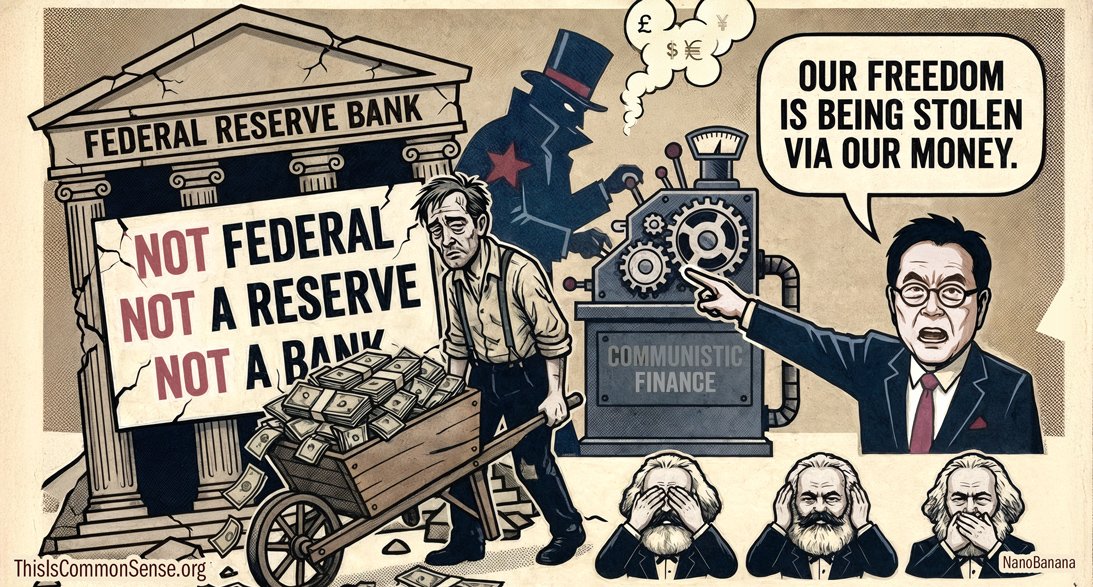
The problem is communism — in finance.

That’s the world according to Robert Kiyosaki, says an Epoch Times profile. “Kiyosaki described the U.S. Federal Reserve Bank — established in 1913 with a goal of stabilizing the nation’s monetary supply following years of extreme volatility, and preventing panic — as a Marxist organization,” Travis Gillmore writes.

“When the Fed came to America, it was the end of America,” states Kiyosaki, who co-​authored a bestselling investment book, Rich Dad, Poor Dad, in 1997, “and our freedom is being stolen via our money.”

This is a familiar theme. Attacking crony capitalism as a massive swindle, and central banking as the lynchpin of bad government practices and general exploitation, that’s so basic to my view of “political economy” that I hardly bring it up anymore. It’s just so obvious.

But is our central bank communist

If you don’t like “communist” or “socialist” you can add the suffix ‑ic: communistic or socialistic.

“As most people know, there’s a big movement to end the Federal Reserve Bank, because it’s not federal, it’s not a reserve, and it’s not a bank,” adds Kiyosaki. 

“U.S. currency was once tradeable for silver or gold,” Gillmore’s article summarizes. “The Federal Reserve notes in circulation today, however, carry no guarantees, which results in significantly devalued currency.…

“Marxists want to destabilize society by ‘taking the currency,’ Kiyosaki said,” blaming this kleptocracy for the rising tide of homelessness along with other maladies.

The Epoch Times ends on a hopeful note, but does not quote recent tweets by Kiyosaki, warning us that the “biggest crash in history” is underway, predicting millions would “lose everything” while prepared investors (like himself) get richer.

All very familiar?

Sure.

But that does not mean there is no truth in it.

This is Common Sense. I’m Paul Jacob.


PDF for printing

Illustration created with Nano Banana and Firefly

See all recent commentary
(simplified and organized)

See recent popular posts
Categories
free trade & free markets general freedom too much government

Bank on It?

It took me a moment. And I assure you, I wasn’t high.

When I read that California State Treasurer John Chiang was considering a “marijuana bank,” my first thought was that he was talking about warehousing bud and leaf.

Well, no. That would be stupid.

So, maybe reporters and bloggers shouldn’t call it a “marijuana bank.” What these government officials are doing is trying to determine “the potential of a public bank to service the cannabis industry in California.”

A state bank, in other words. Not unheard of.

But would it be stupid?

Not according to Treasurer Chiang.* But his notion is not just about serving an industry that the federal government still tries to suppress — and continues to use its regulatory powers over banks to monkey-wrench. 

Chiang defends his move in part on anti-​capitalist grounds: “We see deepening public dissatisfaction and cynicism over the private banking system — a dissatisfaction that can be traced to the financial excesses of Wall Street, which triggered the worst recession since the Great Depression.”

Was the financial crisis the result of “bad actors” in the industry alone? No. The American banking industry is heavily regulated, the government-​created Federal Reserve is very hands-​on in its control of money and banking, and federal regulatory and financial bodies have exerted similar influence over housing industry financing for scores of years.

So of course a Californian politician wants to solve a government-​induced problem by creating more government.

That’s what’s stupid, if you ask me. 

This is Common Sense. I’m Paul Jacob.


* He’s going forward with a big study to “answer questions about costs, benefits, risks, and legal and regulatory issues, including the needs for capitalization, deposit insurance, and access to interbank transfers of funds.”


PDF for printing


Categories
Accountability free trade & free markets

The Fed Feeds a Scam

Real and effective “anti-​establishment” ideas come from unexpected places. That is, they are unexpected if you read only the dominant media and its insider sources, or follow politics only during the quadrennial presidential farce.

Quite a few news junkies would be surprised at David Stockman’s critique of current Federal Reserve behavior and policy, for example. In “Why Ronald Reagan Is Rolling In His Grave: The Keynesian Putsch At The Fed,” he charges the central bank with having managed “an economic coup d’etat” by engaging in an ongoing wealth redistribution scam — shoveling wealth to the rich.

Stockman sees the confidence of Fed Chair Yellen’s macro-​policy micromanagement agenda as a scary case of hubris, of self-​appointed effrontery. “Yellen & Co believe they are in charge of virtually everything on the main street economy … based on nothing more than their own subjective and unexplained wisdom.”

Stockman is in high form, here. Yellen’s latest pronouncement, he says, is “unaltered Keynesian claptrap. It is the arrogant over-​reach of a model-​obsessed academic zealot who has no respect whatsoever for the real main street economy and for the historically proven truth that free markets are the best route to prosperity and higher living standards for the people.…”

Her policies, he claims, amount to “‘trickle down’ economics with malice of forethought.”

Does that sound Bernie Sanderish to you? It shouldn’t.

The case for limited government and against the Fed (and federal government management in general) are that it is modern unlimited government that serves the few at the expense of the many. Stockman is just restating very old wisdom.

Remind your Occupier friends of this. They are on the wrong team.

This is Common Sense. I’m Paul Jacob.


Printable PDF

D. Stockman


Categories
Accountability free trade & free markets government transparency

The Dark Guardian of Opacity

Sen. Harry Reid has his reasons that reason does not know.

Well, Nick Gillespie of ReasonTV (and .com) doesn’t know them. But he has his suspicions.

While the House has passed the Federal Reserve Financial Transparency Act, aiming to audit the Fed, Senate Majority Leader Reid balks at bringing the proposal up to a vote in Congress’s upper chamber. (Gillespie says it won’t happen, not while Reid has his say.)

In the House, both parties supported the audit — a majority of Democrats, and all Republicans save one lone holdout giving a Nay vote. But Reid, whose commitment to corporatism and opacity is well known, presumably fears the upwelling of good old republican values in the Old Man’s Club that is the U.S. Senate — Reid’s romper room for so many decades.

Egads, he must be thinking, even Senators Elizabeth Warren and Rand Paul agree on the need for some sunlight into the dark corridors of America’s bank cartel.

And they don’t agree about much of anything!

Gillespie spells out the whys of transparency. He also explains the basic context: “The central bank is explicitly tasked with the fundamentally incompatible duties of conducting stable monetary policy, promoting full employment, acting as a lender of last resort, and regulating the banks it works with. Good luck with all that.”

Who needs luck when you have power? Some do benefit from the current Old Boys’ system. They’re just not the general citizenry. Or republican governance.

A free society would have a very different banking and monetary system. Adding transparency might begin the process toward such a system.

Next step? Boot Harry Reid out of his cushy position of power.

This is Common Sense. I’m Paul Jacob.

Categories
free trade & free markets ideological culture national politics & policies

Greenspan’s Tarnished Standard

Long ago, before becoming Federal Reserve Inflater-​in-​Chief, Alan Greenspan advocated a gold standard.

The idea is that everybody pays for things in gold, a natural medium of exchange. Receipts for gold used for convenience in trade are “backed” and can be easily redeemed. With appropriate protections in place, politicians can’t dilute the value of money by printing more receipts or by shuffling phosphor dots on a computer screen.

But our world is very different.

At the Fed, Greenspan oversaw a lot of credit expansion, encouraging a horde of folks who couldn’t afford homes to take out mortgages. Any discussion of the financial crisis of 2007 – 2008, or why “we” “failed to predict” it, must discuss Fed policies and other government interventions.

Not, though, if you’re a former Federal Reserve chairman intimately aware of those policies and fully capable of grasping their baleful effects. Then you blather about “irrational exuberance,” or, in a new article for Foreign Affairs magazine, Keynes’s “animal spirits.”

Not a word about how monetary inflation spawns malinvestments that must eventually be washed away. Indeed, the best interpretation of Greenspan’s new book, or his appearance on The Daily Show with Jon Stewart, is that Greenspan is doing his utmost to deflect attention from his own disastrous record.

He’d rather have us believe that “free markets” failed in 2008, not — oh, no! — the policies he himself had pushed since obtaining his seat as head honcho at America’s inflationary central bank.

This is Common Sense. I’m Paul Jacob.

Categories
national politics & policies

Making the Rounds

The “trillion-​dollar” coin proposal hit big in the last few months, even garnering a smile, a wink, and a nod from Paul Krugman. The idea was for the government to mint a high face-​value platinum hunk of token money and sell it to the Federal Reserve — to weasel around congressional approval for raising the debt limit.

Something very much like it was floated by Populist and inflationist Bo Gritz back in the early ’90s, when he was running for the presidency.

Though the current president has dismissed the notion, people like it so much — perhaps because of its “just so goofy it might work” aspect — that the whole meme is still making the rounds.

As a technical matter, a one trillion dollar coin would probably be too unwieldy. If actually given the go-​ahead, the Treasury and the U.S. Mint would likely opt for smaller amounts, cranking out a batch of them — a big batch, to cover the federal government’s rising debt.

My modest proposal? Mint coins at the legal tender amount of $666 million each.

The effigy of Liberty could sport a 666 tattoo on her forehead, and a neat UPC symbol on her wrist, which she could hold up instead of a torch.

That would indicate, by commonly understood symbology, just how dangerous America’s debt really is, and how anti-​American the whole idea of the high face-​value coinage debt ceiling workaround would be.

Another way to go would be to carve each coin out of coprolite. Another fitting symbol for the last days of our fiat currency.

This is Common Sense. I’m Paul Jacob.

Categories
free trade & free markets ideological culture national politics & policies too much government

Paying for Agreement

How do you get a body of professionals to go along with your program?

Pay them.

It’s an old idea: He who pays the piper calls the tune.

The pipers are economists. The paymaster is not you, but the Federal Reserve. There’s a suprising amount of agreement amongst even disagreeing economists that the Federal Reserve is, on the whole, “a good thing,” a necessary thing, even an institution whose existence and rationale must not be questioned.

Shocking, but less so when you apply what is called “Public Choice” analysis to economists themselves. Assume that economists are self-​interested. Assume that they like to get paid. Opinions turn out to be somewhat elastic, even given some very hard facts. The results?

Don’t bite the hand that feeds you.

Nicely, a few economists bring this up, every now and then. Garett Jones on EconTalk did, reviving a letter monetary economist Milton Friedman wrote to researcher David M. Levy in the early 1990s. Friedman summarized the situation concisely, saying that the Fed

hires directly roughly half of all economists specializing in the field of money, and indirectly provides funds for a large fraction of the remainder. I have no doubt that is a major reason why the Federal Reserve, despite such a poor record of performance, has such a high public standing.

This also helps explain why there was a major shift away from laissez faire amongst economists. In the 20th century, the “worldly philosophers” developed a new labor market; they found that they could make a great deal of money working for government. And they don’t get paid for telling the government not to do what it wants to do, or to fire most economists.

This is Common Sense. I’m Paul Jacob.

Categories
national politics & policies

It’s So Simple, If You Forget

“We cannot be complacent,” Federal Reserve Bank President Charles Evans said yesterday. He was most distressed by any lingering notion that the economy would remain undamaged were “no action” taken.

He wants more money flushed into the system. “If we continue to take only modest, cautious, safe policy actions,” he argued, “we risk suffering a lost decade similar to that which Japan experienced in the 1990s.”

Ah, and I was going to use the long Japanese recession as an example of what can happen when too much monetary and bailout hanky-​panky is allowed.

Evans apparently thinks that mid-September’s unleashing of quantitative easing — or QE, the currently fashionable banker’s version of crony capitalism — with the Fed promising monthly $40 billion purchases of mortgage-​backed securities, is tantamount to “no action” and “doing nothing.”

Or else he’s worried that Bernanke’s critics might have some sway.

Relying on the old (by-​the-​textbook but long-​discredited) Phillips Curve story of inflationary money leading inexorably to increased employment, cheap money maven Evans told reporters that “the economy” would “need 200,000 to 250,000 job gains per month” before the Fed could dare rethink its current policy.

He’s apparently forgotten that stagflation is possible. I don’t know why: He’s just a few years older than me, and I remember when the Phillips Curve’s simple trade-​off between inflationary monetary policy and unemployment rates hit the trash bin of history, as both inflation and unemployment soared in the 1970s.

When our leaders forget history, are we doomed to repeat it?

Stagflation may be the best we can hope for from current QE.

This is Common Sense. I’m Paul Jacob.

Categories
free trade & free markets national politics & policies

The Bernanke Stretch

Last week, the Federal Reserve announced it was going ahead with “quantitative easing.” Chairman Ben Bernanke said that he’d be buying $40 billion dollars of mortgage-​backed securities every month, no end in sight.

Now, the traditional way that the Federal Reserve influenced the money supply, economist Randall Holcombe explains, was via “open market operations by buying and selling government securities.” But this changed in 2008 with the $85 billion AIG bailout: “Since then it has engaged in continual bailouts of financial firms and purchases of non-​government securities.…

The Fed has moved from engaging in monetary policy in a way that was neutral toward various businesses and industries in the economy to one in which monetary policy is targeted toward specific firms and industries. This current foray, specifically targeted at the housing market, is crony capitalism.

It’s actually worse. It’s crank policy, as the redoubtable Mr. Peter Schiff summarizes: “Ben Bernanke’s plan to revive the U.S. economy and create jobs is to inflate another housing bubble. That’s it. That’s what the Fed’s got. That’s what it came up with. As if the last housing bubble worked out so well for the economy that the Fed wants an encore.”

Our leaders are obviously desperate.

And out of control. George Will states that the Fed has gone far beyond “mission creep” — it’s “mission gallop on part of the Fed, which is on its way to becoming the fourth branch of government — accountable to no one and restrained by nothing, as far as I can tell, in exercising both monetary and fiscal policy.”

This is what forsaking limited government and the Constitution gets you: a sort of frantic idiocy in aid of politically connected speculators and financiers.

This is Common Sense. I’m Paul Jacob.

Categories
free trade & free markets ideological culture

Competition in Currency

Monopoly control of money is at the root of all kinds of evil.

As the Euro faces collapse, and the dollar’s value becomes increasingly unsteady, central bankers the world over worry about what to do next.

But it doesn’t have to be this way.

Last Thursday I mentioned monetary experimentation, including Ron Paul’s support for F.A. Hayek’s idea of competing currencies. In my Townhall column this weekend, I noted that Rep. Paul has done more than promote the idea “that government policy should allow all currencies to float, favoring none.… Last year he introduced the Free Competition in Currency Act, as Hayekian a piece of legislation as you could imagine.”Monopoly Money

Paul’s proposal is not merely a sign of the times, it is a sign of intellectual seriousness — in a politician, no less. In the early 1980s he had introduced a measure to return the United States to the gold standard. But now he is willing to let “the market decide” which monies should circulate.

We may know a lot more about money than we used to, but one of the things we’ve learned is that no one knows for sure how to manage an entire monetary system, the whole kit and kaboodle.

So, just as we don’t need a grocery czar or an “industrial policy” to micromanage either technological production or R&D, centrally managed money is just too hard for any one set of persons … to manage.

Competition in money and banking (sans today’s progressivist doctrine of “too big to fail”) would not only work, it would keep politicians from the extremity of irresponsibility.

For yes, today’s politicians rely upon the Federal Reserve. They need to keep the “printing presses” running to supply that special, hidden tax that funds their deficits: inflation.

This is Common Sense. I’m Paul Jacob.