Categories
Accountability crime and punishment folly local leaders media and media people national politics & policies responsibility

The Early Vote Worm

Last week was consequential for Greg Gianforte. Awfully.

The Republican businessman won the special election for Montana’s lone seat in the U.S. House of Representatives. He also body-slammed a reporter. He now faces misdemeanor assault charges.

For which Gianforte apologized publicly . . . as he was declaring victory. Welcome to modern American politics.

Democrats claimed victory, nonetheless — with media cover to boot. “Republicans’ 7-point win in last night’s Montana election is great news for Democrats,” the progressive Vox headlined their report.

At Townhall.com on Sunday, I explained why that claim misses both the forest and the trees. Yes, Trump won Montana by 20 percentage points against Hillary Clinton’s mere 35.4 percent back in November, while Gianforte won last week by only 7 points. But Trump was lucky to be opposed by a very unpopular Hillary.

Moreover, at that same election wherein Trump trounced Secretary Clinton, Gianforte lost the governor’s race to a Democrat. Indeed, Gianforte performed 11 points better last week than back in November — winning, instead of losing.

How does that show Republican support slipping?

The message from the Montana special election is that early voting periods are far too long. Montana’s early voting began nearly four weeks before Election Day. The assault by Gianforte, with criminal charges, hardly mattered, because roughly two-thirds of Montanans had already voted when it occurred.*

Rather than a nearly month-long process, whereby a candidate can bank a majority of the vote before the campaign is over, let’s make Election Day a three or five-day period. Make it easy to vote, but let’s all vote together, with the same information.  

This is Common Sense. I’m Paul Jacob.


* This means not only that Gianforte may have “gotten away” with his violent outburst, but that those voters did not have time to adequately appraise Gianforte on information they would have possessed and been able to act upon, with a shorter voting period.


Printable PDF


Categories
Accountability initiative, referendum, and recall local leaders responsibility

The Maine Thing

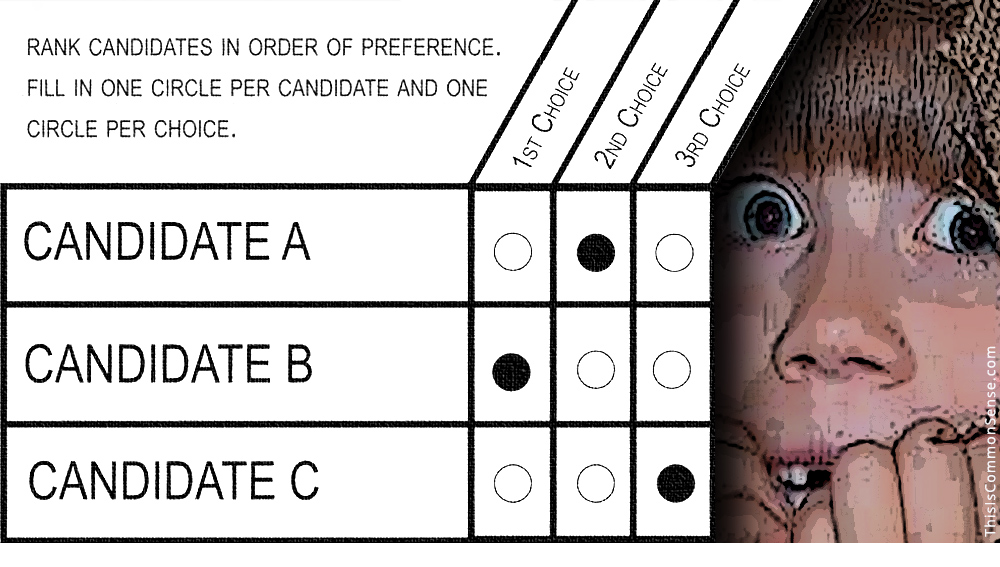
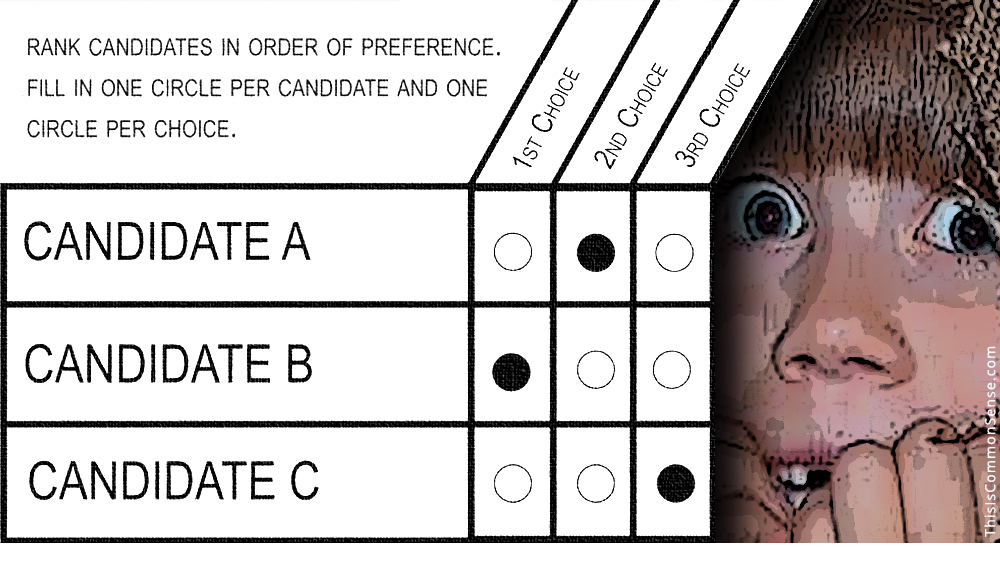
Ranked Choice Voting (RCV) allows voters to rank electoral candidates and not “waste” their vote in cases where their most favored candidate is* unlikely to win. RCV also requires a majority for election, not merely a plurality of the vote.

Last November, Mainers passed Question 5 to begin using this voting system for statewide races, state legislative races and congressional contests. Voters in Portland, the state’s largest city, already use ranked choice voting for several city offices.

Nonetheless, Gov. Paul LePage, who has won twice for governor without ever capturing a majority, opposes RCV, as do many state legislators, also elected under a different first-past-the-post plurality system.

Because Maine’s state constitution specifically mentions plurality winners for statewide officials and state legislators (in the General Election), legislative leaders asked the Maine Supreme Court for an advisory opinion on the constitutionality of the ballot measure. Earlier this week, the court ruled that Question 5 was not constitutional when applied to those specific offices and elections.

However, the constitutionality of RCV was not challenged regarding congressional elections or primary elections for the state legislature.

Now some legislators are proposing a constitutional amendment to enact the RCV that voters supported. Others are urging that the entire law be repealed — even the parts not ruled unconstitutional. They claim the new system is too confusing if not used for every office.

But Portland city voters use RCV for some offices and not others, without confusion.

Legislators should follow the court’s decision, sure, but also respect the vote of the people for every part of the measure not addressed by the court.

This is Common Sense. I’m Paul Jacob.


* Ranked Choice Voting also prevents wasted votes in cases where a voter merely expects or fears (even inaccurately) that his or her favorite candidate does not have enough support to get elected.


Printable PDF


Original cc Photo by Tim Evanson on Flickr


Categories
ideological culture political challengers too much government

Forwards ! Backwards ?

France held an election over the weekend. Emmanuel Macron and Marine Le Pen came out on top, and will face each other in a runoff on May 7th.

Current polling puts Macron over Le Pen, 62-38. But a SkyNews reporter cautions: there is no certainty.

We in America have reason to respect that cautionary note. Our last election was an upset against the establishment candidate in favor of a wild card often dubbed “far right” and even “fascist” — which is precisely what Ms. Le Pen is being called.

Indeed, pitting a Big Government “centrist” (Macron) against an anti-immigrant protectionist (Le Pen) in the context of an economic slump and rising terrorism, and with neither candidate having much contact with limited-government principle, eerily echoes the 2016 U.S. presidential race.

But, on closer inspection, the parallels between the American and French contests appear inexact. Macron’s En Marche ! party* was created just over a year ago, while Le Pen’s National Front has continually found itself on the margins of power, despite its rise in popularity.**

Still, it is hard not to suspect that Ms. Le Pen could come from behind to upset the status quo. Macron is not invulnerable. The man worked, after all, in Hollande’s government, and Le Pen has characterized him as a socialist in a snazzy suit.

Macron is way ahead in the polls. And TV experts talk about how reliable modern polling is, while we in America . . . snicker.

But, since France lacks an Electoral College, can Le Pen really “Trump” the odds?

France will be in for a bumpy fortnight.

This is Common Sense. I’m Paul Jacob.


* Amusingly, the party’s initials are identical to those of its founder, Emmanuel Macron. “En Marche !” (the extra space is there in party material) translates into English as “Forward!” or “On the Move!” and is formally designated as the Association pour le renouvellement de la vie politique (the Association for the Renewal of Politics).

** All the established, formerly governing parties are on the outs.


Printable PDF


Categories
Accountability ballot access general freedom incumbents initiative, referendum, and recall national politics & policies political challengers responsibility too much government U.S. Constitution

Votes Without Poison

Strange election. So . . . round up the usual suspects!

Immediately after Hillary dried her tears and conceded, out came the Tweets, then the analyses: the “third parties” are to blame!

Over the weekend, I focused* on one such election post-mortem. The basic idea is not altogether wrong: minor party efforts together may have cost the Democrat her Electoral College advantage this time around, just as Nader’s Green Party run spoiled Al Gore’s bid in 2000 and several past congressional races have been spoiled for the GOP by Libertarians.

Is there a problem here? Yes. But do not blame the minor party voters. It’s the way we count their votes that is “problematic.” The current ballot-and-count system turn voters most loyal to particular policy ideas into enemies of those very same ideas.

When we minor party voters turn away from a major party — usually because said party tends to corrupt or betray our ideas, or make only small steps toward our goals — our votes aren’t so much wasted as made poisonous.

Because the candidate least preferred may prevail.

But there’s a way out: On election day, voters in Maine showed how to cut through the Gordian Knot. Voting in approval for Question 5, Maine now establishes “ranked choice voting.”

Under this system, you don’t “waste” your vote when expressing a preference for a minor party candidate. You rank your choices and, if your first choice proves unpopular, your second choice (or maybe your third) gets counted. So you don’t “poison” your cause.

Republicans and Democrats have more than enough reason, now, to adopt ranked choice voting across the country.

This is Common Sense. I’m Paul Jacob.


* See yesterday’s links page to my weekend Townhall column for the basic references. But there were many, many articles on the Minor Party Effect, including a skeptical one by Sasha Volokh’s.


Ask the next question.

Questions Answered:

What is the effect of minor parties on major party outcomes?

What causes those effects, voter intent or something else?

Is there a way to prevent this, short of further sewing up the ballot access system to minor parties?

The Next Question:

What might our elections look like if people spent more time discussing issues and ideas … and less about class, culture wars, and sex crimes?


Printable PDF

ranked choice, vote, voting, democracy, clown, illustration


Categories
Accountability Common Sense general freedom ideological culture initiative, referendum, and recall insider corruption media and media people moral hazard nannyism national politics & policies political challengers responsibility too much government U.S. Constitution

America After November

Yesterday, I bemoaned the disaster that is this year’s presidential race. But big whup. As the LifeLock commercial rightly asks, “Why monitor a problem if you don’t fix it?”

Hillary Clinton or Donald Trump will be the next president. That means we have our work cut out for us. And we can’t wait for the 2020 presidential race to fix the problem. We must immediately assert citizen power to create an effective check on government-gone-wild.

So, what to do?

First, let’s admit that fixing Washington isn’t easy. We must fight the Feds through national organizations, of course, but we actually gain greater leverage by working closer to home — at local and state levels.

We need to elect mayors, governors, legislators and councilmembers in 2017 and 2018, men and women who will fight for free markets and against cronyism. And stand up to the federal government.

And where we have the power of ballot initiatives and recall, let’s use it.

By Inauguration Day, we can be changing the conversation in most of the top 25 media markets. How? By petitioning the right issues onto the ballot. By April and May, voters in those cities and counties can directly enact those reforms. Next November, Ohio and Washington state voters can weigh in with ballot initiatives.

Sadly, tragically, it’s too late to stop campaign 2016’s tornado from doing damage. The next disaster of an administration is on its way. But we can create a competing agenda to the Hillary Clinton or the Donald Trump agenda.

A pro-liberty agenda. Starting now.

This is Common Sense. I’m Paul Jacob.


Printable PDF

activism, politics, elections, initiatives, president, Trump, Clinton, meme, illustration


Original (cc) photo by Niklas Hellerstedt on Flickr

Categories
Accountability folly general freedom moral hazard national politics & policies political challengers responsibility

The Choice That Isn’t

Americans are used to being betrayed by their political representation.

This long series of infidelities has led to the current predicament, where the Republican and Democratic parties present us with the opposite of what most Americans want.

Why this vexing stalemate?

History.

The current Democratic President, Mr. Obama, gained both notoriety and trust for his stance against war. Rank-and-file Democrats rejoiced. The Bush Wars were over!

Nope. Obama grew into his role as war president.

Like his predecessor.

Under his watch, the U.S. expanded regime change to Libya, stretched the Afghanistan incursion into our longest war, and now sends more troops into Iraq. (Sans their boots.)

The peacenik manqué has discovered his talent for killing foreigners. His supporters, in consequence, “cling to” his other paltry achievements: a weak, ephemeral recovery; the imperiled, perilous Obamacare.

And a long series of lectures.

No wonder Democrats are demoralized enough to vote for hawkish Hillary Clinton, the least qualified presidential candidate in American history.

But wait, Obama hath ballyhooed: she is “the most qualified”!

Why “least”?

Because FBI Director James Comey just admitted* that any underling of his that had behaved as recklessly as she had with national security would be “disciplined” and “in big trouble.”

Instead, Americans may wind up hiring her . . . for Commander in Chief!

Republicans, on the other hand, have enthusiastically kicked at that “small government” football so many times, only to witness their “leaders” yank it away. Have they now given up? Donald Trump has no interest in limiting government; he talks of new spending programs.

With a “choice that isn’t” in these two losers, no wonder “we don’t win anymore.”

This is Common Sense. I’m Paul Jacob.

 

*Comey’s exact words, in July, were “They might get fired, they might lose their clearance” — expertly hedging with those mights — “There would be some discipline.” Though he could find no evidence of intent to commit a criminal act, Comey did judge Mrs. Clinton “extremely careless” and “negligent.”


Printable PDF

politics, Obama, Hiillary Clinton, lies, elections, FBI Director, James Comey, war president


Categories
Accountability folly incumbents meme national politics & policies term limits

Indicting Incumbency

How does that old, pithy anti-term limits slogan go, again? “We already have term limits, they’re called indictments!”

Wait . . . is that it?

Must be. This election year — the year of the outsider, the year of unbridled contempt for establishment, Washington, D. C., politicians — has seen only one incumbent congressman defeated by the voters.

Just one. It came late last month in the wake of a 29-count felony indictment charging Congressman Chaka Fattah (D-Pa.) with bribery, theft, bank and mail fraud, racketeering, and more.

In all the other congressional primary contests pitting incumbents against challengers across the country so far this year, a solid 100 percent were won by the incumbent — zero won by challengers.

Rep. Fattah, whose corruption trial began in federal court on Monday, has pled not guilty to all charges, proclaiming his innocence. “Chaka Fattah’s lifestyle is not on trial,” his defense attorney told jurors. “Philadelphia politics are not on trial. [Congressional] earmarks, donations, grants to nonprofits are not on trial.”

But Congressman Chaka Fattah certainly is.

The incumbent’s previous re-election had been a breeze — completely unopposed in the all-important Democratic Primary, and then garnering 88 percent of the vote against his sacrificial GOP challenger. That was in 2014, before the felony charges.

Following the indictment, the Washington Post reported that Fattah “found it difficult to raise money after the party establishment all but abandoned him.” So, even in this single instance, the FBI and the party establishment, more than voters, sent this 22-year incumbent packing.

I have a new slogan: “We don’t have term limits, and we need ’em!”

This is Common Sense. I’m Paul Jacob.


Printable PDF

term limits, indictments, democracy, elections, meme, Congressman Chaka Fattah, illustration


Common Sense Needs Your Help!

Please consider showing your appreciation by dropping something in our tip jar  (this link will take you to the Citizens in Charge donation page… and your contribution will go to the support of the Common Sense website). Maintaining this site takes time and money.

Your help in spreading the message of common sense and liberty is very much appreciated!


Categories
Accountability general freedom national politics & policies political challengers

Listen to Whom?

It’s a time for choosing, I concluded yesterday, for Republican voters — between the so-called “establishment” Republicans endorsing Donald Trump’s candidacy and those, such as House Speaker Paul Ryan, Mitt Romney, and both President Bushes, who have declined to endorse.

Sen. John McCain’s admonition that, “You have to listen to people that have chosen the nominee of our Republican Party,” raises the imperative question: Who gets to choose?

Moreover, who should choose?

I’m a big fan of democracy — not pure democracy as a form of government, of course, but voting as a wonderful mechanism for people to control their government, and therefore, to protect our rights, our republic.

Yet, the Republican and Democratic Parties are private associations of citizens. We have a right to vote on who serves in public office, but not a right to decide who is nominated by a political party to which we do not belong.

“Without borders,” Mr. Trump has argued, “we don’t have a country.” To which a Republican friend recently added, “Without borders, we don’t have a party.”

People in political parties, as in any association, have rights, including who they nominate and how. Parties should be independent, not government-controlled.

Nor should political parties be advantaged in law, or their primaries and national conventions subsidized by taxpayers, as they are now.

Trump has railed that the GOP nomination process is rigged. Like most public-private partnerships, it is! But not the way you might think . . . as I’ll delve into tomorrow.

This is Common Sense. I’m Paul Jacob.


Printable PDF

political parties, elections, party, Republican, Democrat, corruption, illustration


Common Sense Needs Your Help!

Please consider showing your appreciation by dropping something in our tip jar  (this link will take you to the Citizens in Charge donation page… and your contribution will go to the support of the Common Sense website). Maintaining this site takes time and money.

Your help in spreading the message of common sense and liberty is very much appreciated!


Categories
meme term limits

We already have term limits, you moron…

Uhmmm,Yeah. So…how’s that Been working out for you?

(Public Approval Rating for congress: 15% | Re-election rate for congress: 90%)


Click below to get a high resolution version of this image (suitable for printing and sharing)

Term Limits, meme, illustration, congressional approval rating, re-election rate


Photo credits (endorsement of this message is not implied): cc Randy Stern on flickr / cc Raelene Gutlerrez on flikr


Categories
crime and punishment folly general freedom ideological culture

South Dakota Déjà Vu

In the words of Yogi Berra, the recently deceased baseball great: “It’s déjà vu all over again.”

We’ve followed the incredible case of Dr. Annette Bosworth extensively this year. She was convicted of twelve felony counts of petition fraud for circulating petitions that were signed at her medical office by patients (and her sister), while the doctor was in the Philippines on a medical mercy mission.

I don’t defend Dr. Bosworth signing that affidavit, stating that she witnessed those signatures, but I also don’t see criminal intent. Her attorney advised her it was lawful and all the signers were legitimate voters who truly wanted her to run for the U.S. Senate. Talking about felony fraud in such a case seriously misses the forest for the trees.

Bosworth wasn’t sentenced to prison time, thankfully.

But she lost her medical license.

Let’s hold people accountable, but not with an over-the-top vengeance likely to scare the average citizen away from political participation altogether. That’s been my message to South Dakota Attorney General Marty Jackley.

What about déjà vu?

Today, in a Pierre courtroom, Annette’s husband, Chad Haber, will be arraigned on felony charges for signing as the circulator on a petition with two signatures affixed when he was with his wife on that medical trip.

AG Jackley loudly proclaims that this is not his indictment; it was filed by a county prosecutor. But anyone who didn’t fall off the turnip truck yesterday knows how these things tend to work.

Haber challenged Jackley last election and the feud is well known and long-running. Being a prosecutor requires judgment, something Jackley lacks . . . as he will no doubt prove in court.

This is Common Sense. I’m Paul Jacob.


Printable PDF

Chad Haber, Annette Bosworth, Marty Jackley, South Dakota, illustration, Paul Jacob, Common Sense