Categories
Common Sense initiative, referendum, and recall too much government

Rich Mischief

The SFGate.com headline was clear: “State ballot initiative fee raised to $2,000 to prevent mischief.”

It just wasn’t accurate.

Assembly Bill 1100, introduced by Assemblyman Evan Low (D-Campbell), passed by Democrats in the legislature and signed by Gov. Jerry Brown, doesn’t do anything to address “mischief.” Which, incidentally, abounds in California government — especially in the legislature.

The new law raises the cost for citizens to file a ballot initiative from $200 to $2,000. Now, if the mischief-maker has $2,000 to spend, this new law accomplishes . . . nothing.

Only five of the 26 states with initiative and/or referendum charge citizens any filing fee. California’s is now the highest by far.

“There are some lunatics out there and for $200 we encourage them to put measures on the ballot that say we should put a gun to the head of someone who is gay or lesbian, bisexual or transgender,” argued Sen. Mark Leno (D-San Francisco). AB1100 was about “clearing out what’s nonsense.”

The senator was referring to an initiative filed by an Orange County attorney, called the “Sodomite Suppression Act,” which, if passed, would establish the death penalty for homosexual conduct.

“This reform is overdue,” argued Assemblyman Low, calling it “a threshold for reasonableness.”

Reasonableness? Those with $2,000 are more reasonable than those with just $200?

The anti-gay measure was a stunt. No signatures were collected. It wasn’t going to be on any ballot. Still, the Attorney General went to court to have it declared unconstitutional. Case closed.

So, why pass AB1100?

To make it harder for voters to go around legislators via the ballot initiative. Just more mischief.

This is Common Sense. I’m Paul Jacob.


Printable PDF

Government Scold, collage, montage, Paul Jacob, Jim Gill


Categories
ballot access Common Sense general freedom initiative, referendum, and recall national politics & policies responsibility term limits U.S. Constitution

The Quadrennial Distraction

As the leading Republican candidate for the presidency ascends into the air in a helicopter filled with kids, and makes his most astute declaration yet — “I am Batman” — it becomes clearer than ever how distracting these presidential campaigns are.

Much of American Big League politics is theatrics, with some pandering for good measure. Of course, all people running for the presidency are by definition over their heads, at best . . . posturing attention-seekers at worst. Fretting about what they believe and “would do” if voted in as President of these United States is mostly a waste of time. Experience tells us that what they promise is perhaps the least likely outcome of all.

What is more effective? Affecting the political environment by getting together with like-minded folk to advance principled causes closer to home. As a side effect of your activism, a successful issue in a single city or region — especially one that spreads — can have a dramatic influence on present and future presidential wannabes.

With organization and consistent activity at the local level, your voice can be heard. But you have to do something. That activity doesn’t have to be to “run for office”; you can turn up the volume by proposing (and sometimes opposing) ballot initiatives, constitutional and charter amendments in the state, county and city where you live.

There is so much to be done at this level that could create political climate change, which in turn would invariably make federal-level candidates better, that it seems a shame to see us so focused on long shot bets.


Printable PDF

Citizen Action


Categories
Accountability Common Sense general freedom government transparency too much government

(Un)Intended System Failure

The system worked. The problem? The system doesn’t work.

Last year’s successful term limits ballot initiative in Grand Rapids pitted two pro-limits ladies with scant political experience against a united big business/big labor opposition campaign, sporting Dr. Glenn Barkan, professor emeritus of political science at Aquinas College, as treasurer.

Just before Election Day, Professor Barkan’s group stuffed mailboxes with advertisements warning residents: “Don’t let your vote be shredded.” The mailings seemed odd in two more respects: (1) there was no mention of “term limits,” and (2) according to campaign finance reports, the professor’s committee didn’t have enough money for mass mailings.

Then, after the election, the committee filed reports acknowledging big money raised and spent prior to the election.

“It just seemed odd that they could do all the mass mailings with little money,” said term limits advocate Bonnie Burke. “We ran a totally above-board campaign and they have these seasoned people and they weren’t sticking to the rules.”

Michigan’s Bureau of Elections concluded the professor’s committee “deprived voters from knowing the source and amount of more than half of the contributions it received. . . .” The group was fined $7,500.

The system worked! Reporting led to a violation, which led to a complaint, which led to an investigation, which led to the imposition of a fine.

But to what point?

As my colleague at Liberty Initiative Fund, Scott Tillman, who filed the complaint, explains, “Campaign finance laws do not stop connected insiders from gaming the system and hiding donations. Big money can ignore the laws and pay the fines if they get caught.”

Even worse, Tillman warned, “Campaign finance laws intimidate and discourage outsiders and grassroots activists from becoming active in politics.”

Is either result unintended?

This is Common Sense. I’m Paul Jacob.


Printable PDF

Campaign Finance Follies


Categories
Common Sense incumbents meme term limits

Scandal-Less

In the 15 states voters have enacted term limits for their state representatives and senators, those politicians and the lobbyists and heads of powerful interest groups constantly complain that the limits are a problem.

I know. That’s why I like term limits.

Am I a broken record on the subject? Perhaps. But let me tell you about a different type of record . . . criminal.

“Are term limits good ideas for Pa. elected officials?” asked a Newsworks.org headline, after Steve Reed, the former 28-year mayor of Harrisburg, Pennsylvania, “was arrested on nearly 500 criminal charges that included corruption, theft, bribery and dealing in proceeds of unlawful activity.”

“Top N.Y. lawmaker arrested on corruption charges,” read a January USA Today headline. Sheldon Silver, after more than 20 years as Assembly Speaker was “arrested on federal corruption charges alleging he was involved in a multimillion-dollar kickback scheme for more than a decade.”

In 2009, after Massachusetts saw its third House Speaker in a row indicted, I ranked New Jersey, Illinois and Massachusetts as the three most corrupt states. The top contenders all have one thing in common: a lack of term limits.

A couple years ago, I joined Greg Upchurch, a St. Louis patent attorney and entrepreneur at a conference on term limits in Missouri. Greg (the driving force behind the state’s 1992 initiative) told the audience, mostly opposed to term limits, that the limits are here to stay.

Before term limits, Upchurch pointed out, legislative leaders were going to prison for corruption. With term limits, there simply haven’t been such scandals.

This is Common Sense. I’m Paul Jacob.


Printable PDF

Term Limit Protection


Categories
government transparency initiative, referendum, and recall

Temporal Redistricting

They must be proud of themselves, the Little Rock insiders who pushed through a vote on a bond measure in hot-as-Hades mid-July.

Less than 4 percent of eligible voters turned out for the off-cycle exercise in 100-degree democracy. The measure, which refinances previous library bonds and puts an influx of cash into Little Rock public library branches, passed with over four-fifths of the minuscule turnout.

Now, as bond measures go, this one sure seems like a dream; its advocates say it will reduce, not increase, taxes.

But that July 14 vote!

“There was no organized opposition to the bond refinancing campaign,” we read, courtesy of the Arkansas Democrat-Gazette. “Still, Pulaski County Election Commission Executive Director Bryan Poe expected a higher voter turnout.” He thought they would get at least 6,000 voters. Still, even that many votes would have amounted to less than 5 percent of the over 126,000 registered city voters.

It certainly wasn’t any surprise, then, that turnout would be tiny and democratic decision-making left to a tiny fraction of the public.

Detect a certain odor?

It stinks of redistricting. When politicians redistrict voters so that predictable partisan outcomes can be reached — somehow to the benefit of those doing the redistricting — the insiders are not really trying to provide representation to voters. They are trying to continue their business as usual.

“Insiders know best”?

By selecting a summer date for the vote, insiders in effect redistrict the voters using time as the gerrymandering boundary. Call it temporal redistricting, advantaging those with the most at stake in the vote’s outcome.

Call it democracy for the 1 (or 3½) percent.

This is Common Sense. I’m Paul Jacob.


Printable PDF

Sneaky Democracy


Categories
term limits

Universal Bull

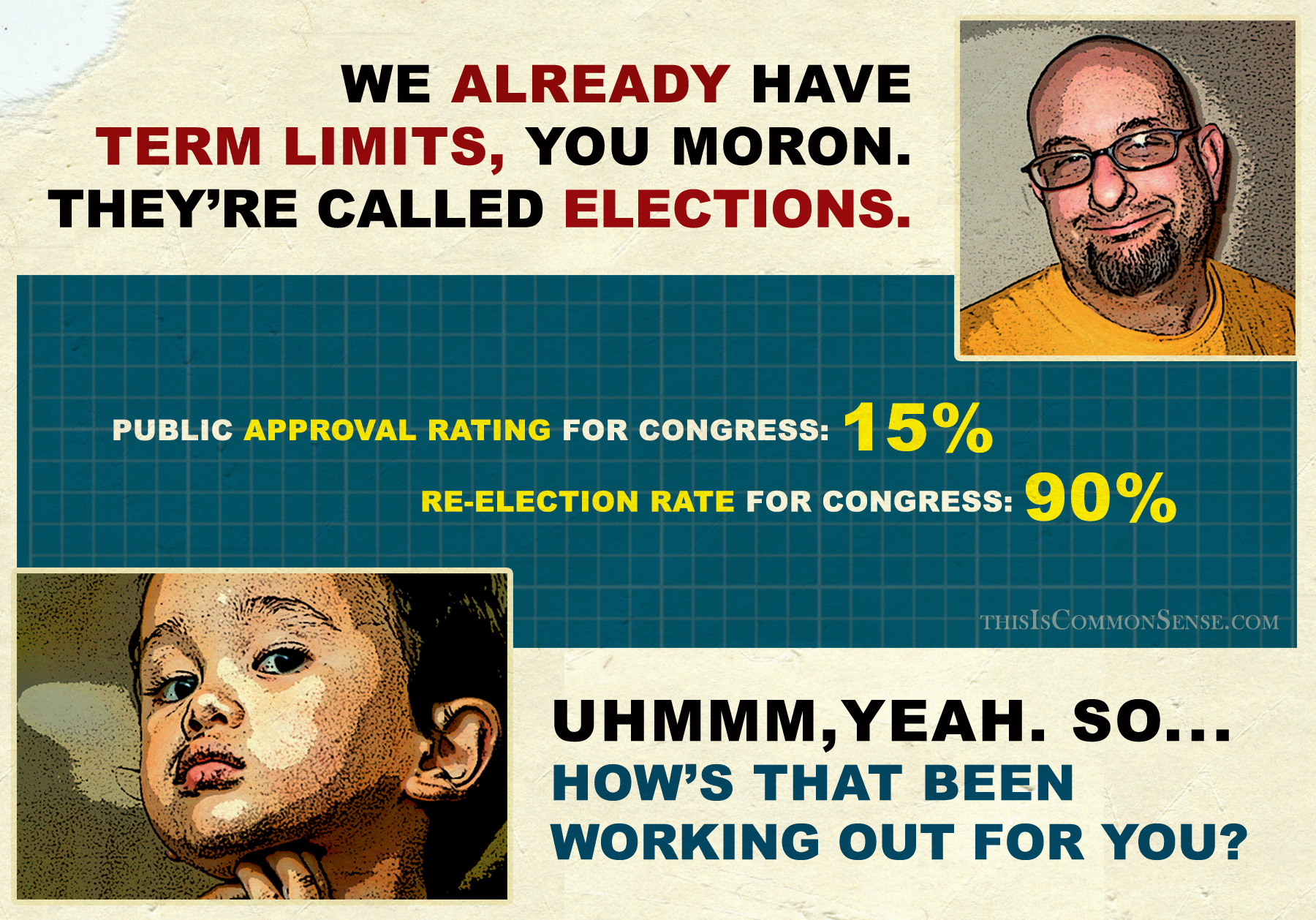
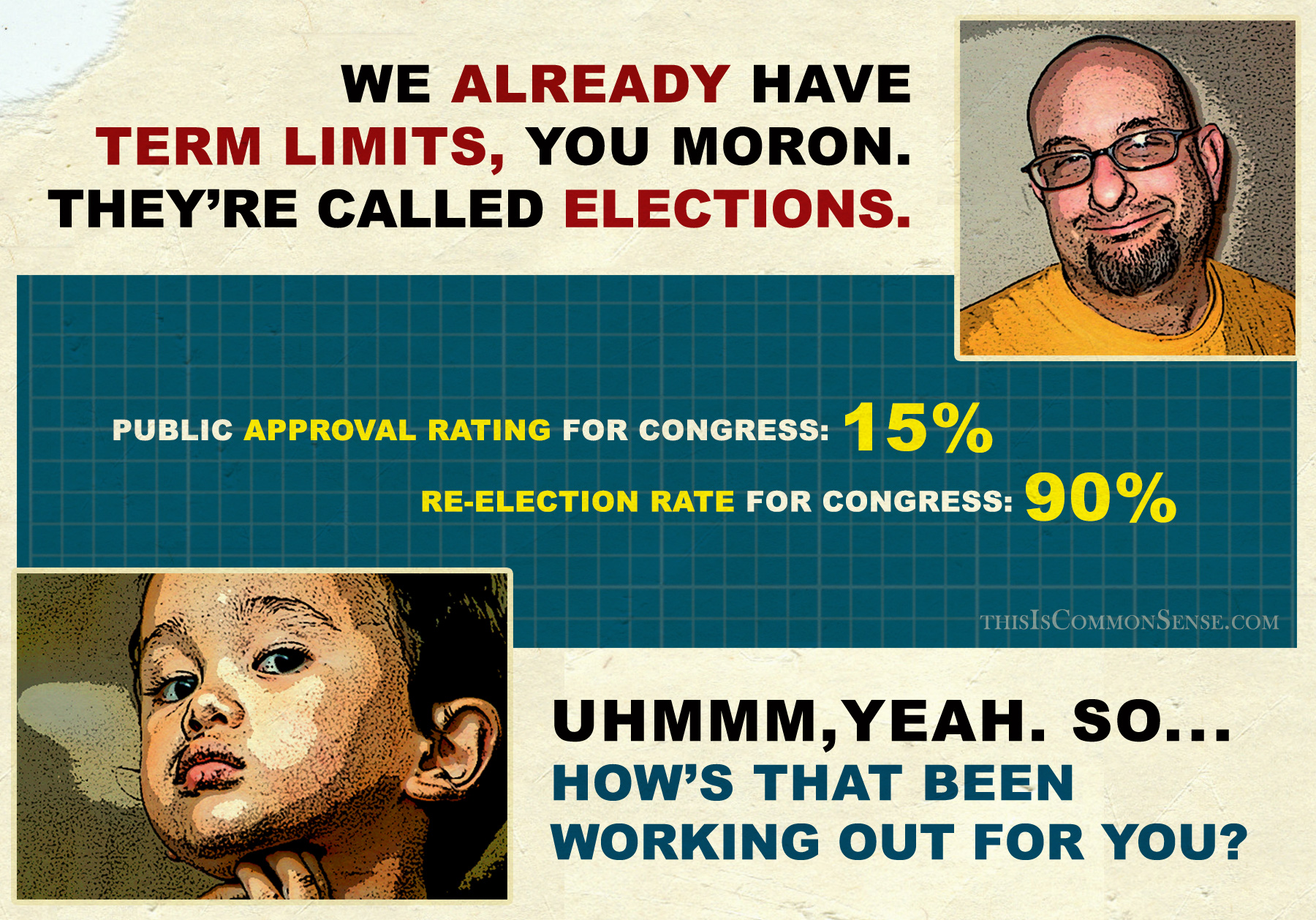
“We have term limits, they’re called elections.”

So goes one argument, famously paraphrased by President Robert Mugabe of Zimbabwe for an African Union summit: “It is a democracy. If people want a leader to continue, let him continue.”

“All over the world,” Owen Bennett-Jones writes at BBC.com, “leaders…are reluctant to give up power.” He points to a number of cases, mainly in nations struggling for democratic stability:

  • “The most striking current example,” according to Bennett-Jones, “is Burundi’s President Pierre Nkurunziza who, amidst violent opposition, is campaigning for a third term in office despite the constitution saying he can only have two.” The president’s spokesman acknowledged, “ Nkurunziza indeed believes he is president by divine will.”
  • In Burkina Faso, thousands clogged the streets after the 27-year presidential incumbent, Blaise Compaore, schemed to evade a constitutional term limit on his office. But facing unrelenting pressure, Compaore soon stepped down.
  • Speaking about his campaign to have the parliament eliminate term limits so he can run for re-election, Ecuador’s socialist President Rafael Correa told reporters, “The easiest thing would be for me to retire in 2017 as one of the best presidents in our history, as the people refer to me.” Correa’s decision to reluctantly remain in power has sparked protests across the country.

It is easy to recognize the sad abuse of power by these “third world” strongmen. Yet, we are continually fighting politicians in “first world” America.

When will politicians ever learn?

When the people are organized enough to assert power over those politicians . . . in Ecuador . . . Burundi . . . and the good ol’ US of A.

This is Common Sense. I’m Paul Jacob.


Printable PDF

Term Limits


Categories
Accountability general freedom tax policy

The People Supreme

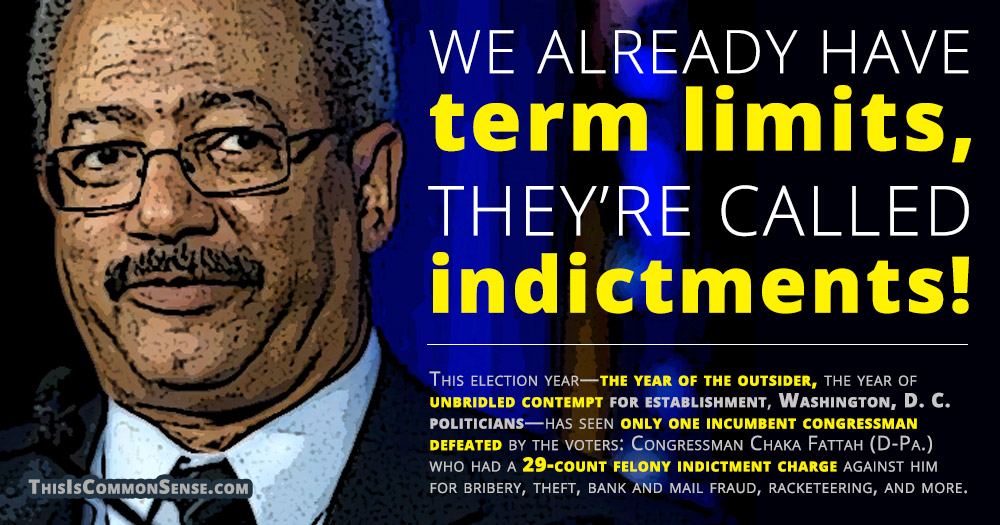
“We’re the only state in the nation,” wails Wade Buchanan of the liberal Bell Policy Center, “where you can only raise revenues, taxes, by a vote of the people.”

Buchanan is talking about his state of Colorado and defending his side in the Kerr v. Hickenlooper case, which features 34 card-carrying members of Colorado’s political elite — sitting legislators, former legislators, former U.S. congressmen, local politicians and other assorted bigwigs — suing the voters of Colorado for having the gall to pass the state’s Taxpayer Bill of Rights (TABOR) initiative back in 1992.

Lovers of big government call TABOR a disaster; most Colorado voters like TABOR and will vote to keep it.

The crux of the case? The ridiculous notion that legislators have some cockamamie constitutional right to levy taxes and spend money without the people empowered with any veto. “When the power to tax is denied,” the suit alleges, “the legislature cannot function effectively to fulfill its obligations in a representative democracy and a Republican Form of Government.”

Immediately, however, the legal issue is whether the politically powerful Kerr plaintiffs even have standing to bring the lawsuit.

Last week, the U.S. Supreme Court vacated a 10th Circuit Court of Appeals decision that had granted standing, returning the case to the appeals court “for further consideration in light of Arizona State Legislature v. Arizona Independent Redistricting Commission.”

That’s good news.

“Most tellingly,” constitutional scholar Rob Natelson points out in a Denver Post column, in that Arizona case “the court praised direct democracy and held that it was ‘in full harmony with the Constitution’s conception of the people as the font of governmental power.’”

Font? We’re the boss.

This is Common Sense. I’m Paul Jacob.

Printable PDF

Tax Vote


Categories
crime and punishment general freedom ideological culture

Bosworth Sentenced

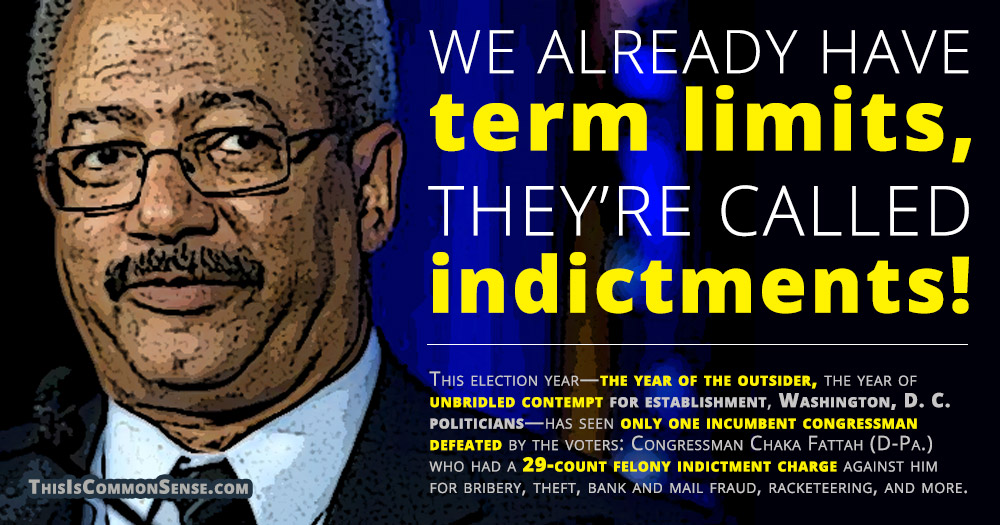
Last week, Judge John Brown sentenced Dr. Annette Bosworth, a neophyte candidate for U.S. Senate from South Dakota, to twelve concurrent two-year prison terms . . . to be suspended provided she successfully completes three years of probation, pays the cost of her prosecution, and performs 500 hours of community service providing medical care to the poor.

Note: that final punishment is what she has been doing on her own for years, and is sort of why she is in this mess in the first place.

The case isn’t an innocent person being unjustly accused. I’ve met Annette Bosworth; I’m proud to call her a friend. But she wasn’t exactly innocent. She got bad advice and made a faulty decision to sign as the circulator of petitions when not every signature was affixed in her presence.

That’s a mistake. It shouldn’t be a felony.

The bigger issue? The over-the-top prosecution. Attorney General Marty Jackley’s heavy-handed, multi-felony approach sends a chilling message to anyone in South Dakota considering political participation.

More ominous is the apparent long-running personal feud between Jackley and Bosworth. In a statement after her sentencing, Jackley declared that Bosworth had “crossed the line of exasperation.”

But it is South Dakotans who should be exasperated with the AG: “Jackley had said before her sentencing,” the Capitol Journal reported, “that he might recommend prison time depending on Bosworth’s attitude after conviction.”

Meanwhile, State Rep. Steve Hickey, a chief Bosworth accuser, appears to have committed her same sin: signing a petition as circulator and not witnessing each signature. Jackley hasn’t bothered to investigate, but defensively told reporters, “I’ve never said that I won’t look into it.”

Tellingly, Mr. Hickey just resigned his seat in the legislature.

This is Common Sense. I’m Paul Jacob.

Previous commentary:


Printable PDF

Dr. Annette Bosworth


Categories
ballot access general freedom national politics & policies

The Duopoly Rules

As Americans brace themselves for another presidential campaign, USA Today’s editors hazard that the “configuration” of the Commission on Presidential Debates (CPD) “certainly creates an appearance of a political duopoly designed to limit independent voices.”

In 1987, after the League of Women Voters displeased the two major parties, the duopoly’s respective chairmen cooked up the CPD. Both men indicated that including non-R-or-D candidates was not part of the plan.

Thirteen years later, to keep the CPD’s tax-exempt status, the CPD established a “non-partisan” rule to “fix” an opportunity for minor parties: candidates must garner 15 percent support in the polls for inclusion in the debates.

Fast forward to today, and we witness a new group pushing the CPD to drop that requirement. Change the Rule wants one third-party nominee to be included, provided that candidate is on enough state ballots to mathematically have a chance to win the presidency.

“A third person in the general-election debates would make it harder for the major-party candidates to stick to talking points and platitudes,” agrees USA Today. But the newspaper worries about “unintended consequences,” that rather than the “centrist” they want in the debates, a new system might produce someone “on the far left or far right.”

Dear Editors, the election process ought not be designed to produce a certain pre-arranged ideological outcome.

Establishing a fair system entails not limiting voter choice ahead of time. Voters should get to hear from every candidate on enough ballots to be elected president.

This is Common Sense. I’m Paul Jacob.

Printable PDF

Duopoly


Categories
ballot access initiative, referendum, and recall national politics & policies

Anti-Democratic Republicans?

The Republican Party of Ohio paid lawyers $300,000 to keep a competitor off the ballot.

Typical two-party corruption. We can blame the party, yes — but also blame the system.

A “two-party system” is, mathematicians tell us, the logical result of simple plurality/winner-takes-all elections. That is, when the first candidate “past the post” wins enough votes to best any other, that candidate wins.

When you count votes like this, two parties emerge to dominate.

But to really rule the roost, those parties are incentivized to pile on . . . to make it hard for “minor-party” challengers. Ballot access becomes a nasty business.

Last year Charlie Earl ran for the governorship of Ohio as a Libertarian Party candidate. But he was blocked from the ballot. And when the Ohio LP “filed a federal lawsuit to try to force Earl’s name on the ballot,” Ohio Republican Party Chair Matt Borges testified that his party had nothing to do with the legal maneuvers involved.

As Borges put it at the time, “Anyone who’s looking for the conspiracy behind it — it’s just not there.”

Now, it turns out, the conspiracy was there. His party paid the bills.

Whether Borges was lying or not — maybe he was clueless about these shenanigans — the deed got done.

More important than whether Borges himself can be held culpable for the ballot-access conspiracy, it’s the system that encourages such anti-democratic nonsense that needs changing. First-past-the-post elections must go. There are alternatives, as my friends at FairVote.org champion.

As Ohio GOP leaders stand shame-faced with the evidence of evildoing, it’s time to press such reforms.

This is Common Sense. I’m Paul Jacob.

Printable PDF

2 Party Lockout