Categories
media and media people national politics & policies political challengers

The New Centrism?

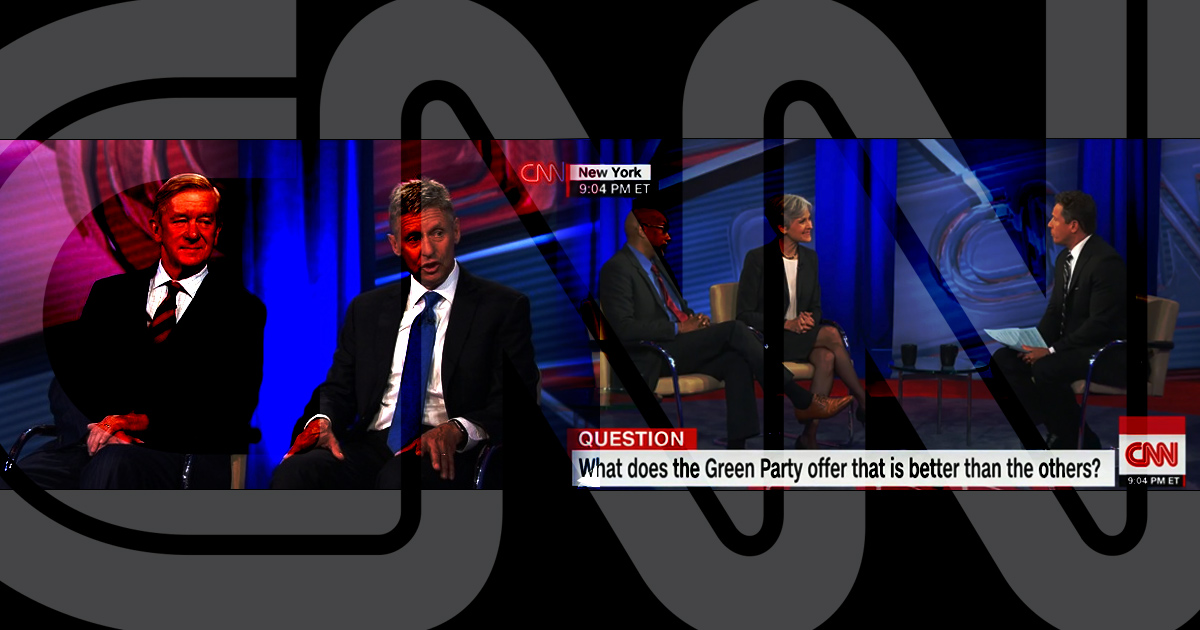
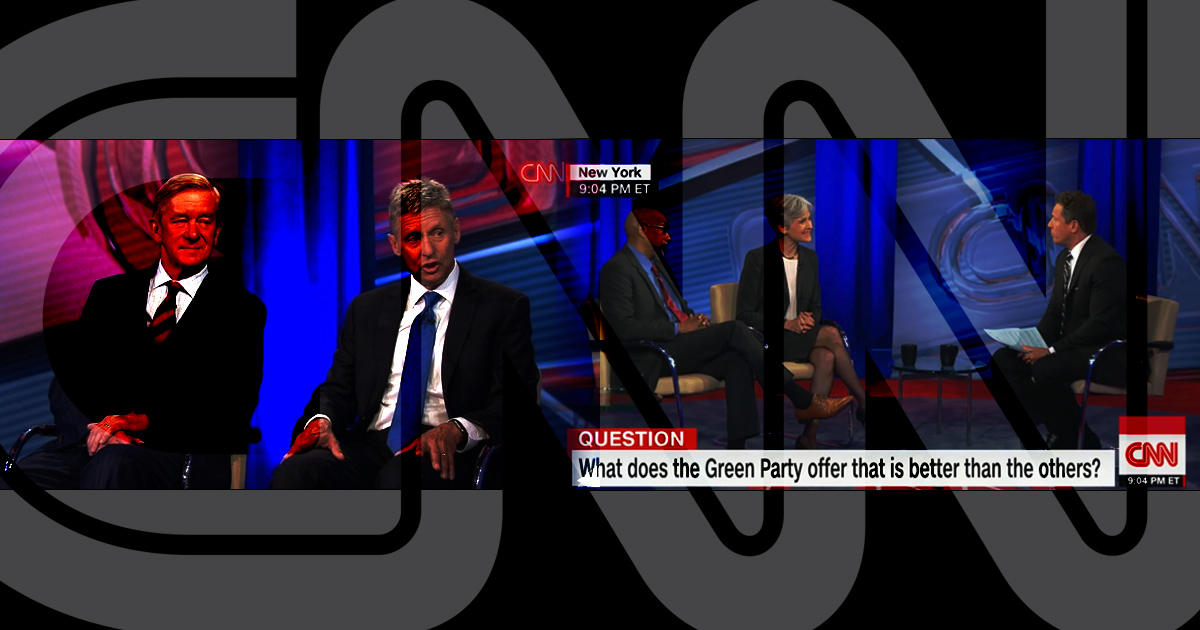
Have you noticed that CNN has been offering multiple “town hall” presentations of the Libertarian and Green Party presidential candidates?

I think this is not only great for the Libertarians and the Greens, but also good for the country — and I hope it proves good for CNN.

When the Cable News Network started, it was the only player in its league. Then Fox News pulled away its right-leaning viewers. MSNBC followed, offering a safe space for the far left. And there remains the center-left of the rest of major media.

So CNN has to distinguish itself. Why not appeal to those left . . . out of the political process?

By opening up to libertarians and radical environmentalists, CNN may bring in more viewers. And temper its well-known bias.

With the libertarians, though, CNN may really be just appealing to the new center.

Which is now libertarian . . . -ish.

Surely, with Trump harrumphing from the apparent “right” and Hillary Clinton dominating the neo-con left — and Dr. Jill Stein trying to soak up the far left — moderates need a voice.

And with moderate libertarian Gov. Gary Johnson and libertarian-leaning centrist Gov. Bill Weld, there does exist a reprieve from the scary extremes. Surprised? Well, that is precisely the case Johnson and Weld make. They pitch themselves, as Walter Olson perceptively argues in Reason, as “the ‘sane’ choice, the ‘responsible’ and ‘adult’ ticket . . . campaigning not on fear and anger but on a positive message of problem-solving.”

More of that, please.

This is Common Sense. I’m Paul Jacob.

Printable PDF

CNN, debates, town hall, libertarian, green, Gary Johnson, Jill Stein, centrism, illustration


Categories
crime and punishment free trade & free markets too much government

Giddy, Nope

The National Labor Relations Board has ordered CNN to rehire 100 workers and pay off 200 others.

NLRB rebukes CNN for “failure to bargain” with a union. The dispute apparently involves no breach of contract with employees — only a breach with a union’s demand that CNN deal with it.

Blogger Daily Pundit is giddy: “I can’t imagine a happier outcome than seeing CNN, the hack propaganda mouthpiece for the ‘respectable’ American left, being forced into bankruptcy” by a “rogue bureaucracy.”

But wait. Would the tyrannical destruction of CNN be — ideological schadenfreude aside — a happy outcome?

No.

However poetic the justice, or injustice, being inflicted on its owners and officers, their right to make economic decisions — the right to control our own lives and property — does not hinge on the content of their notions. The only way we can all have rights, share the same standing  in the world, is to ground our rights in our shared humanity … and not anything more specific, narrow, or particular. Only those who forcibly violate the rights of others properly forfeit some of the protections to which peaceful persons are normally entitled.

Even if Pundit’s point is only to relish CNN’s comeuppance, not to root for governmental harassment of lefty prattlers, it’s misguided. Each new assault on our freedom — to hire, to fire, to speak, to write — serves as precedent for comparable and worse assaults. If we hope to defend our own freedom, we should defend that of all peaceful individuals. And prefer that they be left alone.

We must defend even those with some pretty noxious ideas.

This is Common Sense. I’m Paul Jacob.

Categories
media and media people national politics & policies

A Surplus of Slant

The Washington Post Metro section headline seems to tell a story: “Virginia taxes yield $311 million surplus.”

Odd, though: Virginia’s legislators didn’t raise taxes; they cut spending. The article, thankfully, reveals this, reporting that there was “no general tax increase” and “hundreds of millions of dollars in cuts.”

But if you just read the headline and moved on, you might have been misled.

Later that day, CNN charges Congresswoman Michele Bachmann with “again” characterizing “a settlement to black farmers as fraud.” No explanation as to why. Then CNN presents John Boyd (or Dr. John Boyd?), president of the National Black Farmers Association.

Boyd denies all talk of fraud. “I just don’t understand why people like Ms. Bachmann . . . have continued to criticize this settlement,” he explains, before figuring it might be to “divide and conquer America.”

Rep. Bachmann is shown saying 94,000 people were given settlement money even though the census showed only 18,000 black farmers. But CNN avoids that obvious math problem. CNN also neglects the testimony of Jimmy Dismuke, a black farmer who claims the lawyers told potential plaintiffs that “if you had a potted plant, you can be a farmer.”

Then CNN anchor Kyra Phillips asks, “Do you feel that she’s racist?”

Boyd responds, “She’s going to have a hard time proving to America that she’s not racist if she continues to make these kinds of comments.”

Media folks are going to have trouble proving to America that they don’t slant the news.

This is Common Sense. I’m Paul Jacob.

Categories
ideological culture media and media people

How the Worm Turns

Some folks wait till the last moment to decide how to vote. And when indifference was the mental state right before the decision, we can’t help but wonder what moved the person from indecision to selection. A coin toss?

Or something more insidious?

This kind of worry lies behind a mini-controversy over a CNN News feature. For the 2008 presidential campaign CNN gathered 32 undecided voters and gave them knobs to turn as they listened to candidates’ speeches. Turn the knob one way for approval, the opposite for disapproval. A computer averaged out the responses, and graphed them in real time underneath the TV image of the candidate speaking.

Such graphic elements of newscasts have been called “worms.”

Psychologists have studied this sort of thing, and suspect that the mere presentation of this average approval rating amounts to “spin.”

And, as such, constitutes undue influence of a small group, perhaps easily manipulable, over a large group of voters.

British psychologists studying CNN-like worms say they accumulated data of measurable signs of influence. “The responses of a small group of individuals could, via the worm, influence millions of voters,” the scientists write. They also declare this effect “not conducive to a healthy democracy.”

Yes, yes, but “peer pressure” has been a known element of democracy for some time.

Only the worms are new.

And, in their context, they provide more information. As with speech we may not like, more and different worm varieties (on different networks, perhaps) is undoubtedly the best response.

This is Common Sense. I’m Paul Jacob.