Categories
Today

Saint Valentine

On February 14, A.D. 278, Valentine, a priest in Rome during the reign of Emperor Claudius II, was executed.

In order to facilitate the raising of an army for his unpopular military campaigns, the emperor outlawed all marriages and engagements. Valentine defied Claudius’s order and continued to perform marriages for young lovers in secret. Once discovered, Valentine was arrested and condemned by the Prefect of Rome to be beaten to death with clubs and to have his head cut off. The sentence was carried out on February 14.

Valentine was named a saint by the Roman Catholic Church after his death.

Though February 14th is celebrated as “St. Valentine’s Day,” in today’s vernacular, the 14th of February, 278, was, ahem, “not his day.”

Categories
obituary term limits

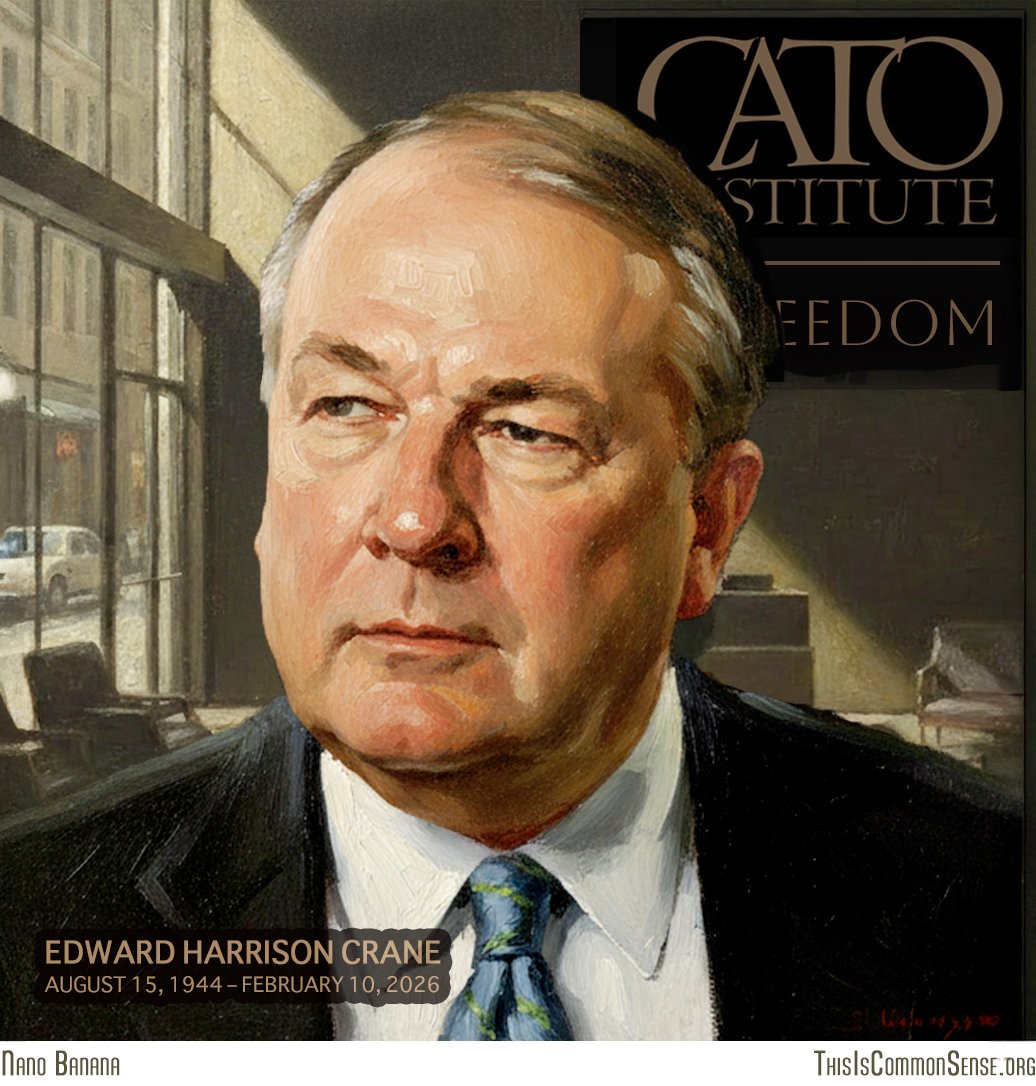
Ed Crane’s Beautiful Panacea

“A great light has gone out,” offered my friend Tom Palmer.

Ed Crane, the most important libertarian in my lifetime, passed away earlier this week, at age 81. 

“On the exclusive list of persons who have had the greatest impact on the pro-liberty movement, Ed Crane’s name is preeminent,” wrote Bob Levy, chairman emeritus of Cato. “He built the Cato Institute from an inconspicuous, small-scale operation into a public policy powerhouse — the world’s foremost proponent of individual liberty and limited government.” 

Years ago, my wife worked as Ed’s assistant and in other roles at the Institute. She even convinced him to give me a job in the mailroom. When I left Cato (and my mailroom career), I marched into his office and deadpanned: “Ed, I think I’ve taken Cato just as far as I can.”  

We both laughed. He seemed to have it well in hand from there.

Crane had already put the Libertarian Party on the map with Ed Clark’s impressive 1980 presidential run. That’s how I first got to know both Eds, serving (at age 19) as the chair of the Arkansas Libertarian Party and the Clark campaign. So glad to have been part of it; sad that it remains the high-water mark for the party.

In his tribute, Bradley Smith, the former FEC Commissioner and now chairman and founder of the Institute for Free Speech, noted that “Ed was instrumental in helping to found the Institute for Free Speech — originally called the Center for Competitive Politics, a name Ed came up with (nobody’s perfect).”*

Still, as I told U.S. Term Limits head honcho Howie Rich, what comes to mind when I think about Ed is the fact he was the only person who loved term limits even more than we do.

Ed was a tireless advocate and Cato a leading producer of good information on the issue. Speaking about term limits, Ed would repeat the common refrain, “Folks say term limits are not a panacea.”

Only to counter: “Yes, they are.”

Thank you, Ed. 

This is Common Sense. I’m Paul Jacob.


P.S. Love and condolences to Kristina, Ed’s wife, who is spectacularly wonderful. I remember especially the early 1980s when she was the den mother to a motley crew of young libertarian activists and intellectuals then descending upon Washington, D.C. 


*  Smith tells an interesting story about Ed Crane: “In fact, it is often forgotten that he was one of the original plaintiffs in the landmark campaign finance case, Buckley v. Valeo (he often expressed, with his typical sarcasm, his disappointment that the case had not been captioned Crane v. Valeo.)”

PDF for printing

Illustration created with Nano Banana

See all recent commentary
(simplified and organized)
See recent popular posts

Categories
Thought

Thomas Sowell

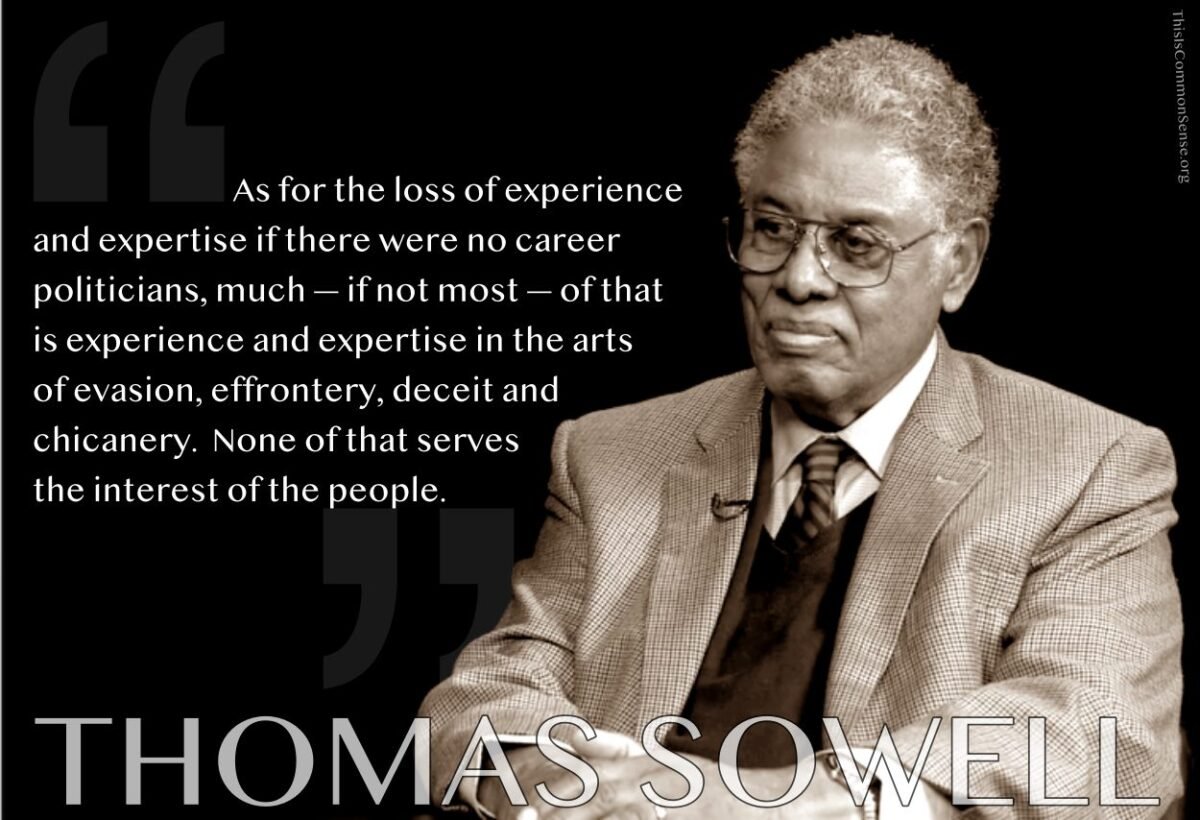
As for the loss of experience and expertise if there were no career politicians, much — if not most — of that is experience and expertise in the arts of evasion, effrontery, deceit and chicanery. None of that serves the interest of the people.

Thomas Sowell, “A Real Term Limit,” Capitalism Magazine (March 20, 2013).
Categories
Today

Galileo’s Heresy

On February 13, 1633, Italian philosopher, astronomer and mathematician Galileo Galilei arrived in Rome to face charges of heresy for advocating Polish astronomer Nicolaus Copernicus’s theory that the Earth revolves around the Sun. In April, Galileo pled guilty before the Roman Inquisition in exchange for a lighter sentence. Put under house arrest indefinitely by Pope Urban VIII, Galileo spent the rest of his life at his villa in Arcetri, near Florence, dying in 1642.

Categories
folly too much government

Sir Surtax

When, one wonders, will politicians become less impressed with their wares and wiles?

The new New York mayor has taken city reins and unfurled his first major effort: begging for money.

Begging, that is, for it to be demanded from others.

“New York City Mayor Zohran Mamdani called on state lawmakers Wednesday to approve a 2 percent personal income tax increase on the city’s wealthiest residents,” writes Kimberly Hayek* for The Epoch Times, “as well as a hike in the corporate tax rate in a bid to close a multibillion-dollar budget gap.”

Though Mamdani proclaims a new era of city and state working together, there is nothing new in his pitches for more taxes to redistribute to various voters, rather than attempting to build (or restore) a good foundation for normal social and business life.

Ms. Hayek does her duty, though, telling the old, old story of class-envy politics. “Estimates suggested it” — a 2 percent surtax just for the “very” rich — “could create approximately $4 billion annually to support increased public services and affordability programs, as well as offset costs for broad social investments while not saddling middle- and low-income residents.” 

But that’s merely the politician’s “theory.”

In reality, writes Hayek, “France’s experiment with a similar surtax on high incomes underperformed revenue projections. It yielded €400 million in its first year against an expected 1.9 billion euros.”

Same-old story. Zohran Mamdani was never a breath of fresh air.

Just another old-timey demagogue.

Mamdani may never tire of his schtick, but when will New Yorkers wake up … and yawn?

This is Common Sense. I’m Paul Jacob.


* Great name, eh?

PDF for printing

Illustration created with Nano Banana

See all recent commentary
(simplified and organized)
See recent popular posts
Categories
Thought

Erasmus

In regione caecorum rex est luscus.

In the country of the blind the one-eyed man is king.

Desiderius Erasmus Roterodamus, Adagia (1500; 1536).

Categories
Today

Freeing Scharansky

On February 12, 1986, Soviet human rights activist Anatoly Scharansky was released after spending eight years in Soviet prisons and labor camps. The amnesty deal was arranged at a summit meeting between Soviet leader Mikhail Gorbachev and President Ronald Reagan. Scharansky had been imprisoned for his campaign to win emigration rights for Russian Jews — who had been forbidden to practice Judaism in the USSR.


On Feb. 12, 1909, the National Association for the Advancement of Colored People (NAACP) was founded.

On Feb. 12, 1593, approximately 3,000 Korean defenders led by General Kwon Yul successfully repelled more than 30,000 invading Japanese forces in the Siege of Haengju.

Categories
general freedom ideological culture

Medicine Reverses Course

Scott Jennings reports on what he calls “a political earthquake”: both the American Society of Plastic Surgeons and the American Medical Association have “gone on the record saying the same thing. There is insufficient evidence to justify ‘gender transition surgeries’ for minors, and these surgeries should generally be deferred to adulthood.”

The ASPS made its statement on February 3, which the New York Times explained was prompted by “a lack of quality research on the long-term outcomes for young people who had undergone surgical interventions like mastectomies and cited ‘emerging evidence of treatment complications and potential harms.’”

The next day, the AMA, the nation’s largest medical organization, spoke up. 

When this issue came to the fore a few years ago, the usual response was “this is only happening to a tiny group of young people, if any.” Now, according to TheTimes, a review of “hospital data from 2016 through 2020 identified about 3,600 patients aged 12 to 18 who had received gender-related surgery. The vast majority were mastectomies.” 

The Times references a York University social scientist studying “transgender medicine” who attributes the new positions, in part, to “the growing political backlash over gender-affirming care.” Just as Scott Jennings judges these two big turnarounds as huge blows to “the left,” which has supported those surgical practices in the cause of gender-fluidity and -identity along with inclusion and whatnot.

By advising against major irreversible interventions into the maturation process of young people, ASPS and the AMA have, at the very least, made a long-overdue advance for Common Sense.

I’m Paul Jacob.


PDF for printing

Illustration created with Nano Banana

See all recent commentary
(simplified and organized)
See recent popular posts
Categories
Thought

Rabelais

What cannot be cured must be endured.

François Rabelais, Pantagruel: Fifth Book (1564).

Categories
Today

Gerry Mandered

On February 11, 1812, Governor Elbridge Gerry signed into law a plan to redistrict Massachusetts so that the Federalists would lose votes. The new Republican districts were said to be in the form of a salamander, so Gerry was accused of “gerrymandering” — the epithet deriving from his name and a salamander, which some said was the shape of the districts he had drawn up to favor his party. A cartoon gerrymander map was published in the Boston Gazette on March 26, 1812, with the salamander more in the mythical draconic form than the natural amphibious form.