Categories
general freedom U.S. Constitution

Why We Fought

When I was young, we were instructed to revere the men dubbed by President Warren Harding as “the Founding Fathers.” Reverence has since gone out of fashion.

Even today’s freedom-minded often express a general iffiness about America’s separation from England.

Now, I’m so deep-seatedly anti-monarchical, so resolutely anti-royal that I tend to shake my head at this sort of stuff. Yet people I very much admire might be called Revolution Liberty Skeptics.

“Can anyone tell me why American independence was worth fighting for?” asks economist Bryan Caplan. He says “it’s hard to get a decent answer” on specific policies improved by the secession from the Empire, at least liberty-wise.

He speculates, for example, that separation “allowed American slavery to avoid earlier — and peaceful — abolition.”

Historian Jeffrey Rogers Hummel ably answers him, noting that before “the American Revolution, every New World colony, British or otherwise, legally sanctioned slavery, and nearly every colony counted enslaved people among its population. As late as 1770, nearly twice as many Africans were in bondage throughout the colony of New York as within Georgia, although slaves were a much larger percentage of Georgia’s population.” Vermont, which did not join the union until 1791, abolished slavery in 1777. By 1804, gradual emancipation had begun in all the remaining northern states that had not abolished slavery outright.*

Do we really think all this would’ve happened under British rule?

As Hummel reminds us, “emancipation had to start somewhere.”

It started in the country that put liberty up front.**

Scoffing at the Revolution now won’t put liberty further forward.

This is Common Sense. I’m Paul Jacob.


* New York’s gradualist plan declared all children of slaves born after July 4, 1799, to be free after ages 25 and 28 years, female and male, respectively.

** Hummel makes good points on other freedoms, too.


Categories
Today

Armenia

The Liberty Bell left Philadelphia by special train on its way to the Panama–Pacific International Exposition, on July 5, 1915 — the last trip outside Philadelphia that the custodians of the bell intend to permit.

In 1937 on this date, Spam, the luncheon meat, was introduced into the market by the Hormel Foods Corporation.

The Twenty-sixth Amendment to the United States Constitution, lowering the voting age from 21 to 18 years, was formally certified by President Richard Nixon on July 5, 1971.

On July 5, 1995, Armenia (flag, above) adopted its constitution, four years after the country’s independence from the Soviet Union.

Categories
Thought

George Mason

In all our associations; in all our agreements let us never lose sight of this fundamental maxim — that all power was originally lodged in, and consequently is derived from, the people.

Categories
general freedom meme national politics & policies U.S. Constitution

Independence Day

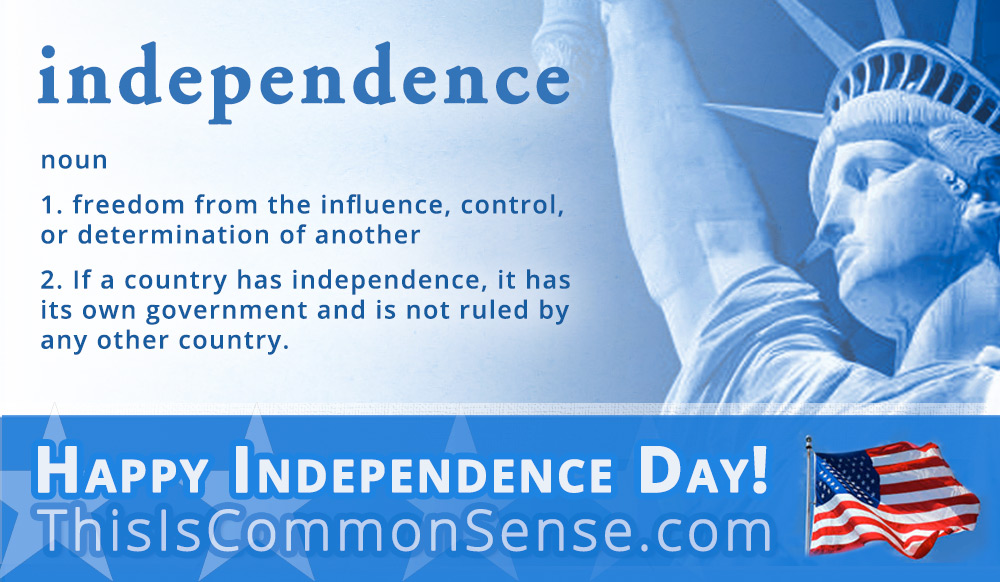
independence:

noun

1. freedom from the influence, control, or determination of another. If a country has independence, it has its own government and is not ruled by any other country.

2. If a country has independence, it has its own government and is not ruled by any other country.


Happy Independence Day!


Categories
Thought

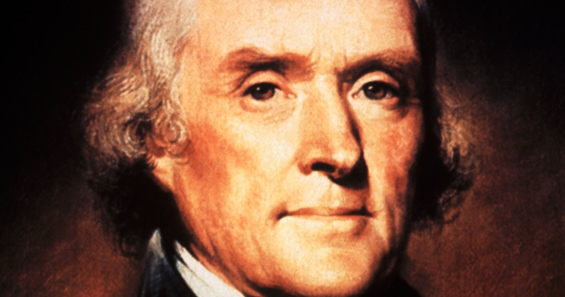
Thomas Jefferson

When in the course of human events it becomes necessary for a people to advance from that subordination in which they have hitherto remained, & to assume among the powers of the earth the equal & independant station to which the laws of nature & of nature’s god entitle them, a decent respect to the opinions of mankind requires that they should declare the causes which impel them to the change.

We hold these truths to be sacred & undeniable; that all men are created equal & independant, that from that equal creation they derive rights inherent & inalienable, among which are the preservation of life, & liberty, & the pursuit of happiness; that to secure these ends, governments are instituted among men, deriving their just powers from the consent of the governed; that whenever any form of government shall become destructive of these ends, it is the right of the people to alter or to abolish it, & to institute new government, laying it’s foundation on such principles & organising it’s powers in such form, as to them shall seem most likely to effect their safety & happiness. prudence indeed will dictate that governments long established should not be changed for light & transient causes: and accordingly all experience hath shewn that mankind are more disposed to suffer while evils are sufferable, than to right themselves by abolishing the forms to which they are accustomed. but when a long train of abuses & usurpations, begun at a distinguished period, & pursuing invariably the same object, evinces a design to subject them to arbitrary power, it is their right, it is their duty, to throw off such government & to provide new guards for their future security. such has been the patient sufferance of these colonies; & such is now the necessity which constrains them to expunge their former systems of government. the history of his present majesty, is a history of unremitting injuries and usurpations, among which no one fact stands single or solitary to contradict the uniform tenor of the rest, all of which have in direct object the establishment of an absolute tyranny over these states. to prove this, let facts be submitted to a candid world, for the truth of which we pledge a faith yet unsullied by falsehood.

Categories
Today

The Fourth

July Fourth events include:

1054 – A supernova was spotted by Chinese, Arab, and possibly Amerindian observers near the star Zeta Tauri, remaining, for several months, bright enough to be seen during the day. Its remnants form the Crab Nebula.

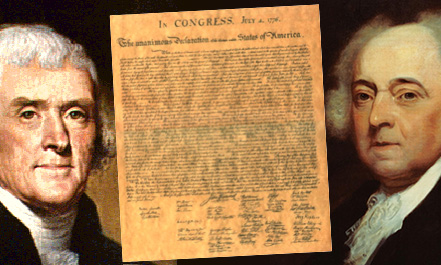
1776 — The Second Continental Congress approved the Declaration of Independence, thus formalizing its policy of secession from the rule of the Kingdom of Great Britain.

1803 — The Louisiana Purchase was announced to the American people.

1804 – Nathaniel Hawthorne, American author of The Scarlet Letter, House of Seven Gables, The Blithesdale Romance, and other classics, was born.

1826 – Thomas Jefferson, third president of the United States, died a few hours before John Adams, second president of the United States, on the fiftieth anniversary of the adoption of the United States’ Declaration of Independence.

1826 – Stephen Foster, composer of “Old Black Joe,“ ’“Beautiful Dreamer,” and many other classic American songs, was born.

1827 – Slavery was abolished in New York State.

1831 – Samuel Francis Smith wrote “My Country, ’Tis of Thee” for Boston’s July 4th festivities, set to the tune of Great Britain’s national anthem, “God Save the King/Queen.”

2009 – The Statue of Liberty’s crown re-opened to the public after eight years of closure that resulted from security concerns following the September 11, 2001, attacks.

Categories
Accountability First Amendment rights folly general freedom ideological culture media and media people moral hazard nannyism national politics & policies Regulating Protest too much government U.S. Constitution

Freedom “Weaponized”

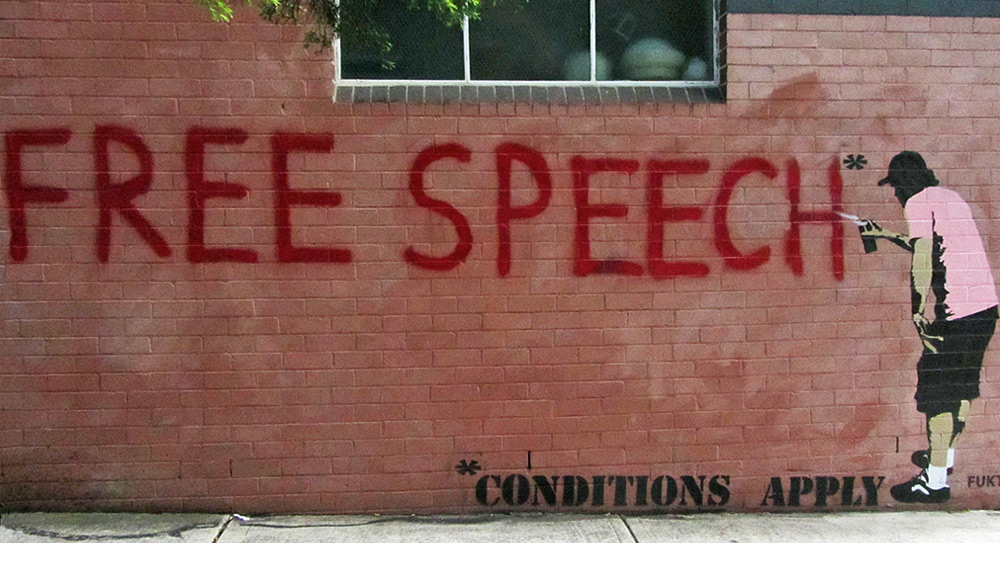
Justice Elena Kagan has a way with words. The conservative majority on the court, she said after two recent rulings, is “weaponizing the First Amendment.”

What a phrase! But what does it mean?

“Conservative groups, borrowing and building on arguments developed by liberals,” explains The New York Times, “have used the First Amendment to justify unlimited campaign spending, discrimination against gay couples and attacks on the regulation of tobacco, pharmaceuticals and guns.”

First: if “liberals” now find themselves not supporting the idea of particular freedoms, or freedom in general, are they really “liberal”?

Second: “borrowing arguments” is what we expect to happen. Logic isn’t partisan.

Third: the point of the Bill of Rights is to “weaponize” the defense of freedom.

Remember, it is freedom of speech; freedom of the press; freedom of association; freedom of exercising one’s religion. The First Amendment weaponizes their defense by disallowing Congress from legislating against them.

Now, it has long been a “problem” that these listed freedoms blend together. They all work together or don’t work at all. And each points to freedom more broadly.

Kagan wants to read freedoms narrowly — though liberals historically have, indeed, read them broadly.

She’s objecting to two recent rulings. The first prohibits states from requiring pregnancy centers to talk up abortion options to their clients. An obvious free speech issue. The second prohibits governments from backing unions in their extraction of “agency fees” from non-members. An incontrovertible issue of freedom of association.

Kagan and The New York Times apparently think that “liberalism” means defending some freedoms in some contexts, but denying freedom in others.

This is Common Sense. I’m Paul Jacob.


Illustration by Newtown grafitti


Categories
Thought

George Mason

Introduced by George Mason at the Virginia Convention in the Capitol in Williamsburg.
Unanimously adopted June 12, 1776:

A DECLARATION OF RIGHTS made by the representatives of the good people of Virginia, assembled in full and free Convention, which rights do pertain to them, and their posterity, as the basis and foundation of government.

  1. THAT all men are by nature equally free and independent, and have certain inherent rights, of which, when they enter into a state of society, they cannot, by any compact, deprive or divest their posterity; namely, the enjoyment of life and liberty, with the means of acquiring and possessing property, and pursuing and obtaining happiness and safety.
  2. That all power is vested in, and consequently derived from, the people; that magistrates are their trustees and servants, and at all times amenable to them.
  3. That government is, or ought to be, instituted for the common benefit, protection, and security, of the people, nation, or community; of all the various modes and forms of government that is best, which is capable of producing the greatest degree of happiness and safety, and is most effectually secured against the danger of mal-administration; and that whenever any government shall be found inadequate or contrary to these purposes, a majority of the community hath an indubitable, unalienable, and indefeasible right, to reform, alter, or abolish it, in such manner as shall be judged most conducive to the publick weal.
  4. That no man, or set of men, are entitled to exclusive or separate emoluments or privileges from the community, but in consideration of publick services; which, not being descendible, neither ought the offices of magistrate, legislator, or judge, to be hereditary.
  5. That the legislative and executive powers of the state should be separate and distinct from the judicative; and, that the members of the two first may be restrained from oppression, by feeling and participating the burthens of the people, they should, at fixed periods, be reduced to a private station, return into that body from which they were originally taken, and the vacancies be supplied by frequent, certain, and regular elections, in which all, or any part of the former members, to be again eligible, or ineligible, as the laws shall direct.
  6. That elections of members to serve as representatives of the people, in assembly, ought to be free; and that all men, having sufficient evidence of permanent common interest with, and attachment to, the community have the right of suffrage, and cannot be taxed or deprived of their property for publick uses without their own consent, or that of their representatives so elected, nor bound by any law to which they have not, in like manner, assented, for the publick good.
  7. That all power of suspending laws, or the execution of laws, by any authority without consent of the representatives of the people, is injurious to their rights, and ought not to be exercised.
  8. That in all capital or criminal prosecutions a man hath a right to demand the cause and nature of his accusation, to be confronted with the accusers and witnesses, to call for evidence in his favour, and to a speedy trial by an impartial jury of his vicinage, without whose unanimous consent he cannot be found guilty, nor can he be compelled to give evidence against himself; that no man be deprived of his liberty except by the law of the land, or the judgement of his peers.
  9. That excessive bail ought not to be required, nor excessive fines imposed, nor cruel and unusual punishments inflicted.
  10. That general warrants, whereby any officer or messenger may be commanded to search suspected places without evidence of a fact committed, or to seize any person or persons not named, or whose offence is not particularly described and supported by evidence, are grievous and oppressive, and ought not to be granted.
  11. That in controversies respecting property, and in suits between man and man, the ancient trial by jury is preferable to any other, and ought to be held sacred.
  12. That the freedom of the press is one of the greatest bulwarks of liberty, and can never be restrained but by despotick governments.
  13. That a well regulated militia, composed of the body of the people, trained to arms, is the proper, natural, and safe defence of a free state; that standing armies, in time of peace, should be avoided, as dangerous to liberty; and that, in all cases, the military should be under strict subordination to, and be governed by, the civil power.
  14. That the people have a right to uniform government; and therefore, that no government separate from, or independent of, the government of Virginia, ought to be erected or established within the limits thereof.
  15. That no free government, or the blessings of liberty, can be preserved to any people but by a firm adherence to justice, moderation, temperance, frugality, and virtue, and by frequent recurrence to fundamental principles.
  16. That religion, or the duty which we owe to our CREATOR and the manner of discharging it, can be directed only by reason and conviction, not by force or violence; and therefore all men are equally entitled to the free exercise of religion, according to the dictates of conscience; and that it is the mutual duty of all to practice Christian forbearance, love, and charity towards each other.
Categories
Today

Happy Birthday, Dave

July 3 marks the 1947 birthday of Dave Barry, American columnist and author.

Five years later on the same date, Puerto Rico’s Constitution was approved by the Congress of the United States.

Categories
Accountability crime and punishment ideological culture media and media people moral hazard national politics & policies political challengers responsibility

Black Mask Terrorism

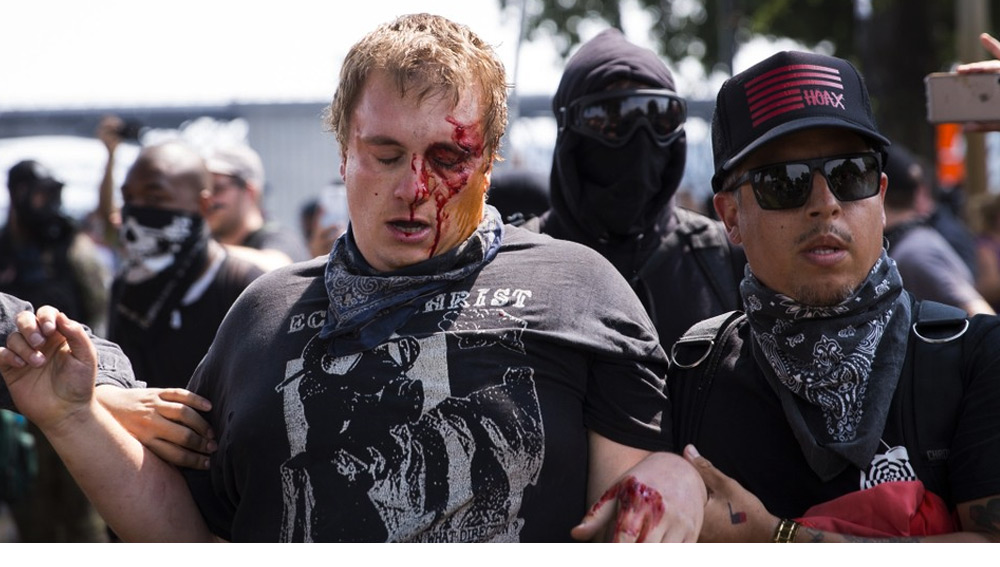
I was in Arkansas on Saturday when the downtown streets of Portland, Oregon, “exploded into its worst protest violence of the Trump era,” as The Guardian explains. “More than 150 supporters of the far-right Patriot Prayer group fought pitched street battles with scores of anti-fascist protesters. In total, nine people were arrested.”

Notice that “Patriot Prayer” — a group sponsored by a Republican Senatorial candidate, and which says it stands for free speech — was labeled “far right” while the “anti-fascist protesters” were not called “far left.”

Characteristically, The Guardian vagues it up. “Violence suddenly ‘erupted,’” noted a Romanian YouTuber of the British rag’s evasiveness. “Who started it? We don’t know.”

Well, from the videos I saw it looked like the “anti-fascists” started it. The “patriots” were marching down the street when a young man, with helmet and backpack, and a young women, dressed in black, marshaled antifa mobs towards the legal march, and then stones and bottles were thrown, and explosives, too . . . into the Patriot Prayer rally.

Note: the Patriot Prayer group had filed the paperwork for the march; antifa had not. The Portland police did not protect the licensed marchers, but did revoke their license, telling everyone to disperse (threatening “duress” to the non-compliant) after the violence broke out.

If you did not carefully look at more than one video, you might be confused. Indeed, not all videos showed the crucial break from peace to violence.

So, what other clues might one look for?

In old cowboy movies, whoever ganged up masked, and wore black, were usually the bad guys.

Antifa — thanks for providing the clues: masks, black fighting gear, and Luciferian handsigns.

This is Common Sense. I’m Paul Jacob.