Categories
ideological culture social media

Left-Winged Wikipedia

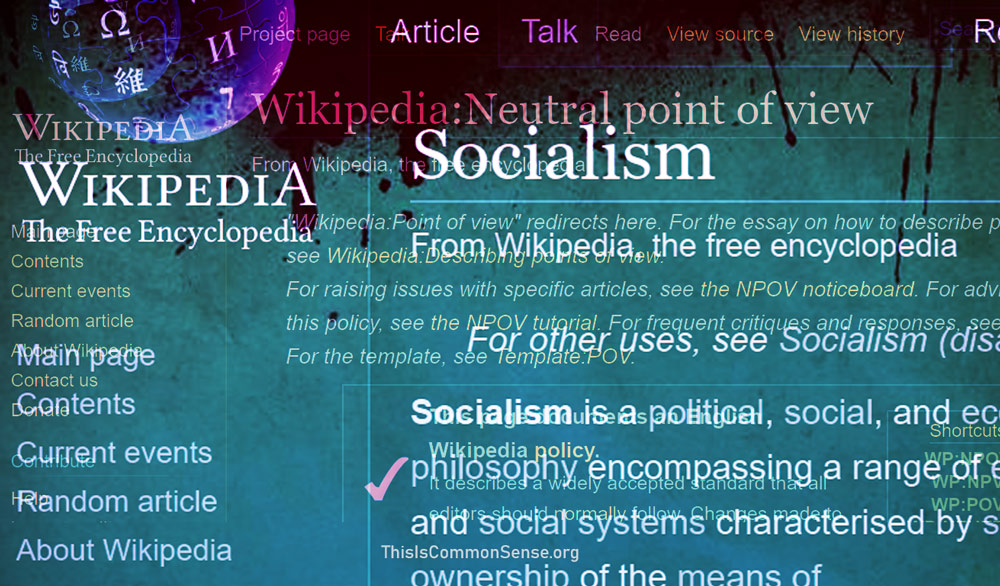
Wikipedia — the free online, once freely editable encyclopedia — started out upholding a principle about “neutrality.”

According to Wikipedia, this means that Wikipedia content “must be written from a neutral point of view (NPOV) . . . representing fairly, proportionately, and, as far as possible, without editorial bias, all the significant views that have been published by reliable sources on a topic.”

NPOV isn’t the same as objectivity, which is about getting at the truth by honest observation and logic, not primarily by balancing viewpoints about what’s true. But if good objective work by “reliable sources” has been done about a subject, Wikipedia’s neutrality standard requires that both the sludge and the good work be included. 

Somebody new to the subject has a fighting chance to be steered in the right direction.

NPOV still guides many Wikipedia articles where it is not really necessary, articles about elms and carburetors. The standard is now often ignored, however, in articles about controversial subjects. Like politics. Or socialism.

As I write, Wikipedia’s article on socialism mentions the kill list of “suspected high-ranking Communists” drawn up by Indonesia’s Suharto but not the many millions slaughtered under the commie-socialist regimes of the Soviet Union, China, Cuba, et al. Critiques of socialism are barely touched on. No NPOV here.

Such agitprop is guarded by non-neutral left-wing Wikipedia editors. Britannica is one alternative. Conservapedia was launched in 2006 as “a conservative, family-friendly Wiki encyclopedia,” and appears to be going strong. Wikipedia co-founder Larry Sanger, harshly critical of Wikipedia’s centralized propagandistic turn, is developing an alternative called Encylosphere.

It’s even mentioned in Wikipedia.

This is Common Sense. I’m Paul Jacob.


PDF for printing

See all recent commentary
(simplified and organized)
See recent popular posts
Categories
Thought

Alexis de Tocqueville

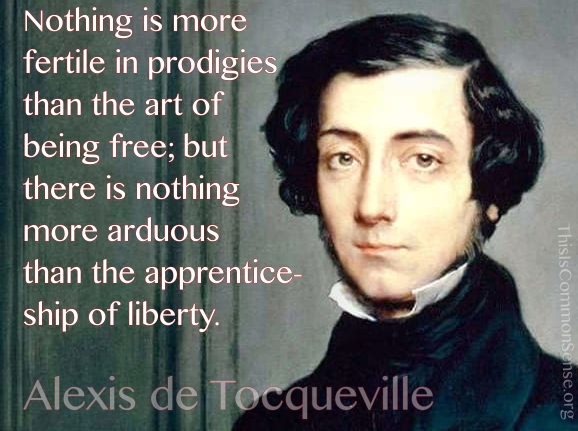
It cannot be repeated too often that nothing is more fertile in prodigies than the art of being free; but there is nothing more arduous than the apprenticeship of liberty. It is not so with despotism: despotism often promises to make amends for a thousand previous ills; it supports the right, it protects the oppressed, and it maintains public order. The nation is lulled by the temporary prosperity that it produces, until it is roused to a sense of its misery. Liberty, on the contrary, is generally established with difficulty in the midst of storms; it is perfected by civil discord; and its benefits cannot be appreciated until it is already old.

Alexis de Tocqueville, Democracy in America, Volume 1.
Categories
Today

House of Lords

On March 19, 1649, England’s House of Commons passed an act abolishing the House of Lords, declaring it “useless and dangerous to the people of England.”

This was during Oliver Cromwell’s rule as Lord Protector, after the execution of Charles I. The House of Lords did not again meet until the Convention Parliament of 1660, under the Restoration of the monarchy.

Categories
international affairs

First-Class Freedom Fighting

Just seven years ago today — March 18, 2014 — Taiwanese students began a 23-day occupation of the country’s legislature, in what became known as the Sunflower Student Movement. They were protesting the rushed and opaque passage of a Cross-Strait Service Trade Agreement with China.

Trade deals usually aren’t so explosive, but China is a neighbor 58 times larger than Taiwan’s 24-million population and one that regularly threatens military invasion. Furthermore, the agreement was negotiated in secret and initially passed by the Legislative Yuan in 30 seconds. 

Obviously without debate.

Opponents of the deal argued it would allow China to effectively “purchase” Taiwan, and to economically leverage and then strangle Taiwan’s vibrant democracy, which like Hong Kong’s aspirations constitutes a terrible affront to the anti-democratic Chinese Communist Party (CCP) ruling over more than a billion silenced, disenfranchised Chinese. 

The students’ concerns for transparency and safeguards connected with the Taiwanese public, which put enormous pressure on the government. 

Ultimately, the spring Sunflower Movement in Taiwan helped influence the autumn Umbrella Movement protests in Hong Kong as well as energizing the 2016 win for Taiwan’s Democratic Progressive Party and far less Beijing-friendly President Tsai Ing-wen (who won a second term last year).

In these last seven years, the world has come a long way in recognizing the threat posed by totalitarian China. For that I give those students in Taipei a lot of credit. Their standing up kept Taiwan free — and helped us all begin to stand up to the Chinazis (as Hong Kongers call the CCP). 

The other aftermath? Le Monde’s report on students finally leaving the Yuan, noted it was “not without having thoroughly cleaned the building.”

This is Common Sense. I’m Paul Jacob.


PDF for printing

See all recent commentary
(simplified and organized)
See recent popular posts
Categories
Thought

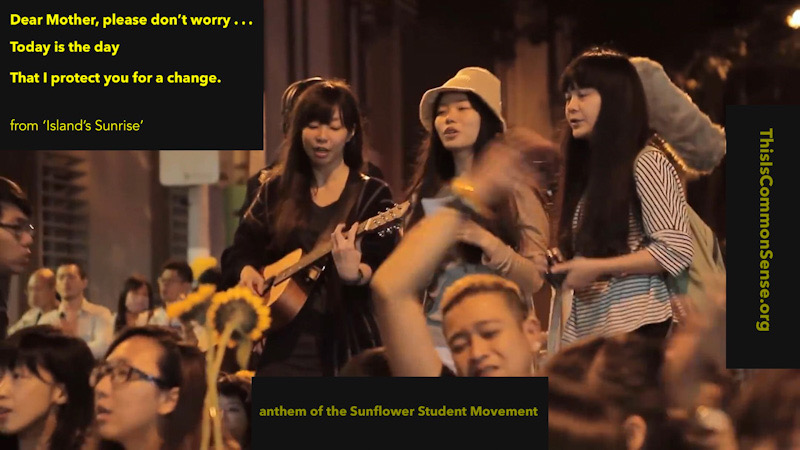
Island’s Sunrise

Dear Mother, please don’t worry . . . 

Today is the day 

That I protect you for a change.

From “Island’s Sunrise,” an alternative rock anthem of the Sunflower Student Movement.

Categories
Today

Sunflower & Hawaii

March 18 marks the 7th anniversary of the 2014 Sunflower Student Movement, wherein students occupied the Taiwanese legislature to block a trade agreement between Taiwan and China, which the public came to believe gave too much economic leverage to China, a power that regularly threatens to invade the free and democratic island nation.

The event awakened a deep concern about China’s dangerous encroachment as well as further impressing a “Taiwanese identity.” The protest also is believed to have influenced the 2014 Umbrella movement in Hong Kong as well as leading to electoral victories in Taiwan for the pro-independence Democratic Progressive Party in 2016 and again in 2020, This website salutes the Sunflower Student Movement and hopes this date may be long remembered as the day the modern world first stood up and said “No” to totalitarian China.


On March 18, 1959, President Dwight D. Eisenhower signed a bill enabling Hawaii to become the 50th state in the Union. The official day of statehood was set for (and became) August 21 of that year.

The statehood signing occurred exactly 85 years after The Kingdom of Hawaii formalized its treaty with the U. S. establishing exclusive trading rights.

Categories
partisanship social media

Another Comedian Breaks Free

Comedian Sarah Silverman, who has famously lent no small part of her cachet to the progressive cause, supporting Senator Bernie Sanders in both of his Democratic presidential runs, is now ditching the Democratic Party.

Her complaint isn’t that the party stiffed her candidate twice, first when the Democratic National Committee stabbed Bernie in the back for Hillary and next when it orchestrated ingenious maneuvers to gain the nomination (and then the presidency) for the tepid (and tepidly supported) Joe Biden.

I have argued before that Democrat insiders’ treatment of Sanders was deeply anti-democratic. But no, Ms. Silverman directs her ire against “the absolutist-ness of the party,” as she put it the other day on Instagram. “It’s so . . . elitist. You know, for something called ‘progressive,’ it allows for zero progress.”* Telling, perhaps, that Ms. Silverman emphasizes “progressive” and not “democratic,” as if it were named “The Progressive Party.”

Silverman specifically called attention not only to progressives’ unwillingness to compromise, but also to the it-takes-two-to-tango divide: “You know, Republicans might hear an idea that they would totally agree with, but, if it comes from AOC then they hate it.” She admitted that the same thing applied to her.

No wonder, then, that she does not “want to be associated with any party anymore,” complaining about “too much baggage.”

But she’s objecting to her fellow progressives’ anti-free speech agenda, too, characterizing it as “righteousness porn.”

Silverman, who has a special named Jesus Is Magic and is famous for her rape jokes, has herself felt the sting of cancel culture and would be a natural proponent of principled free speech.

But that is not a progressive cause, it is a very old-fashioned liberal one.

This is Common Sense. I’m Paul Jacob.


* An f-bomb has been elided in the quotation from Ms. Silverman.

PDF for printing

See all recent commentary
(simplified and organized)
See recent popular posts

Categories
Thought

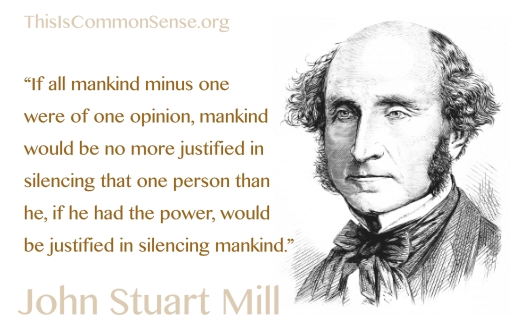
John Stuart Mill

If all mankind minus one were of one opinion, mankind would be no more justified in silencing that one person than he, if he had the power, would be justified in silencing mankind.

J. S. Mill, On Liberty (1859), Chapter Two: “Of the Liberty of Thought and Discussion.”
Categories
Today

Wartime

On March 17, 1780, General George Washington granted the Continental Army a holiday “as an act of solidarity with the Irish in their fight for independence.”

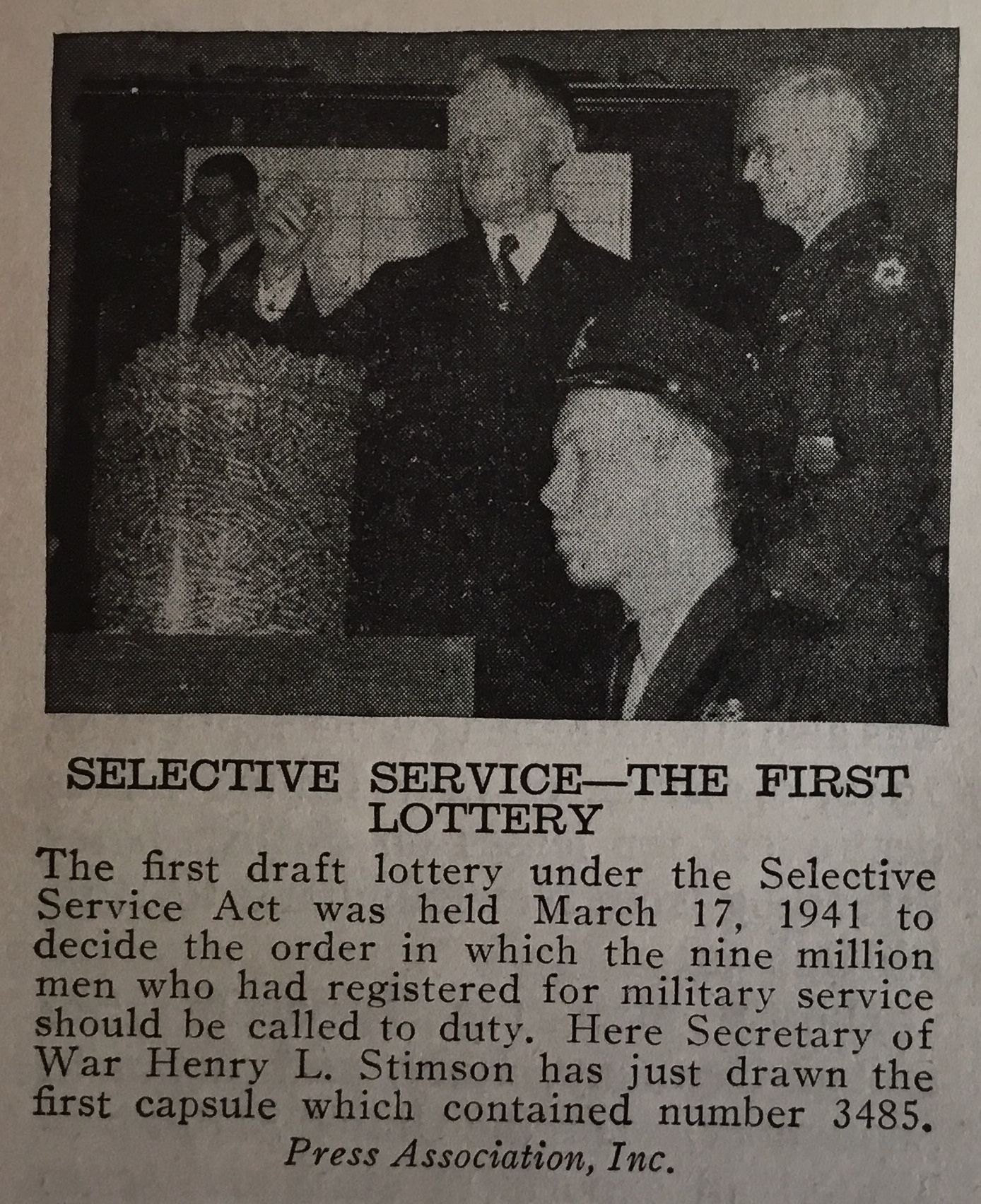
On March 17, 1941, the U.S. Selective Service held its first lottery for the draft, in preparation for World War II. (Image, above, from the Morning Oregonian, from that year.)

Categories
ballot access national politics & policies

The Incumbency Fraud

“There’s nothing that shortening the period by which people can vote early does to combat any perceived fraud,” Democratic Party attorney Marc Elias said Sunday on NBC’s Meet the Press. “It’s really just a cover for what they’re really trying to do, which is to make it harder to vote.”

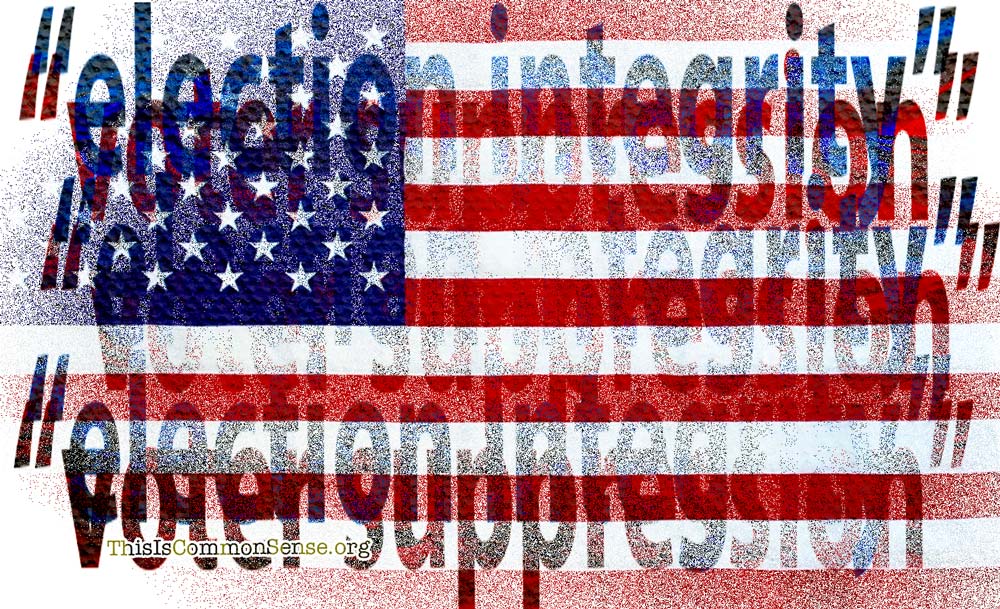
At issue is a new law courtesy of Iowa Republicans, along with numerous bills pending in other states, addressing what Republicans call “election integrity” and Democrats call “voter suppression.”

Host Chuck Todd informed viewers that a poll found two-thirds of Floridians wanted more early voting days. Not fewer.

Hardly surprising, since that’s easiest for voters. And while voting should be easy, ease is not the only consideration.

The Iowa “law shortens the early voting period to 20 days from the current 29,” the Associated Press reported, “just three years after Republicans reduced the period from 40 days.”

Here’s why I support that change, though it would be better even shorter*:

  • We should vote together. Not weeks apart. With three, four, six weeks of early voting, election day ballots can be cast with a different set of facts than those cast so many weeks earlier. 
  • The longer the time during which ballots are cast, the greater the expense in running for office. Candidates must be in touch when voters make their decisions. Since incumbents hold an average four-to-one spending advantage over challengers, more expensive campaigns give incumbents an even greater advantage.  

So, while early voting doesn’t cause fraud, by making elections more expensive it fosters what we might call “the incumbency fraud.”

This is Common Sense. I’m Paul Jacob.


* One provision in H.R. 1, which passed the U.S. House on a party-line vote, requires that states allow at least 15 days of early voting. The overall bill is terrible; plus, we are better off with the states as laboratories of democracy, rather than marionettes of Washington. But my preference would be not more than 15 days.

PDF for printing

See all recent commentary
(simplified and organized)
See recent popular posts