Categories
Thought

Alexis de Tocqueville

AFTER the general idea of virtue, I know no higher principle than that of right; or rather these two ideas are united in one. The idea of right is simply that of virtue introduced into the political world. It was the idea of right that enabled men to define anarchy and tyranny, and that taught them how to be independent without arrogance, and to obey without servility. The man who submits to violence is debased by his compliance; but when he submits to that right of authority that he acknowledges in a fellow creature, he rises in some measure above the person who gives the command.

Alexis de Tocqueville, Democracy in America, Volume 1.

Categories
Today

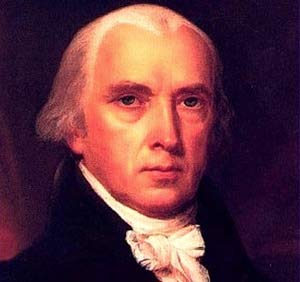
Madison and Freeing the Slaves

On March 16, 1995, the state of Mississippi formally ratified the Thirteenth Amendment, becoming the last state of the Union to approve the abolition of slavery. The Thirteenth Amendment had been officially ratified in 1865, one hundred thirty years earlier.

James Madison, fourth President of the United States and “Father of the Constitution,” was born on this date in 1751.

Categories
insider corruption national politics & policies

Dystopia de la Brazile

“When will the check arrive?”

That’s what “voters want to know,” former Democratic National Committee Chair Donna Brazile told Fox News Sunday host Chris Wallace yesterday.

Not whether President Joe Biden is dodging the media’s questions, as Wallace had inquired of his panel of Washington experts, after explaining that Biden now holds the modern record for longest time as president without facing reporters in a news conference.

“Well, it’s no surprise,” offered Jonathan Swan, national political correspondent for Axios. “It’s an extension of what he basically did throughout the campaign, which was very minimal — he basically didn’t subject himself to extended, tough questioning.” 

GOP strategist Karl Rove went further, arguing, “he’s just not up to it . . . at the age of 78 he’s lost a few steps and he’s not going to look good in a news conference.”

But Brazile was having none of it. Citizens are laser-focused, she contends, on being shown the money . . . and really aren’t too concerned as to whether their commander-in-chief, the sleepy fellow in possession of the nuclear codes, might be suffering something approaching early dementia.

People do like money. But to what degree is she really correct? With palms greased will the public look the other way? How many votes have Democrats bought?*

Don’t think Brazile is alone, either; as I pointed out recently (“Big Bucks Buy Votes”), too much of Washington actually thinks purchasing apathy, support, votes is how Washington should work.

They marvel as modern political statecraft transcends the hubbub of bread and circuses with electronic direct deposits of spendable cash into bank accounts. But with the same hoped-for result.

This is Common Sense. I’m Paul Jacob.


* And ask the same question of Republicans who voted for sending similar checks to everyone when they controlled the Senate and the White House last year. 

PDF for printing

See all recent commentary
(simplified and organized)
See recent popular posts

Categories
Thought

Aldous Huxley

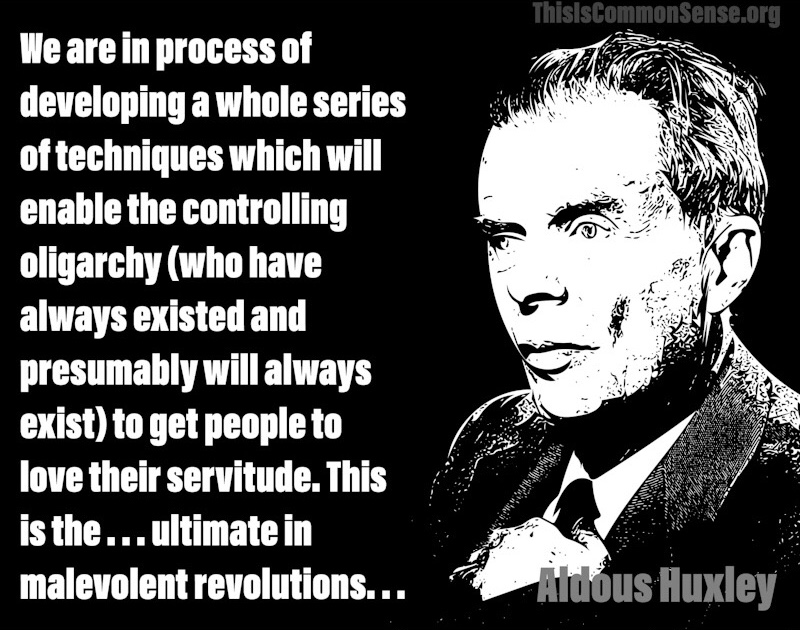
Today we are faced, I think, with the approach of what may be called the ultimate revolution, the final revolution, where man can act directly on the mind-body of his fellows. Well needless to say some kind of direct action on human mind-bodies has been going on since the beginning of time. But this has generally been of a violent nature. The techniques of terrorism have been known from time immemorial and people have employed them with more or less ingenuity sometimes with the utmost cruelty, sometimes with a good deal of skill acquired by a process of trial and error finding out what the best ways of using torture, imprisonment, constraints of various kinds.

But, as I think it was Metternich said many years ago, ‘you can do everything with bayonets except sit on them.’ If you are going to control any population for any length of time, you must have some measure of consent, its exceedingly difficult to see how pure terrorism can function indefinitely. It can function for a fairly long time, but I think sooner or later you have to bring in an element of persuasion an element of getting people to consent to what is happening to them. It seems to me that the nature of the ultimate revolution with which we are now faced is precisely this: That we are in process of developing a whole series of techniques which will enable the controlling oligarchy (who have always existed and presumably will always exist) to get people to love their servitude. This is the . . . ultimate in malevolent revolutions….

Aldous Huxley, speech,“The Ultimate Revolution,” March 20, 1962.

Categories
Today

Two Men, Two Republics

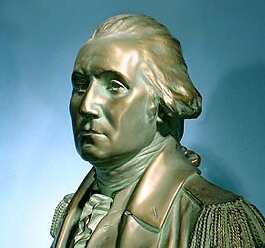
March 15 was “the Ides of March” in the Roman calendar. On that date in 44 BC, Julius Caesar, Dictator of the Roman Republic, was stabbed to death by a handful of prominent senators.

On the same date in 1783, General George Washington eloquently entreated his officers not to support the Newburgh Conspiracy. His plea was successful and the threatened coup d’état never took place.

Categories
by Paul Jacob video

Watch: Plague Year Progressives

This Week in Common Sense, March 13, 2021. (Also in audio-only.)

Categories
Thought

George Orwell

All the war-propaganda, all the screaming and lies and hatred, comes invariably from people who are not fighting.

Categories
Today

Gold

On March 14, 1900, the Gold Standard Act was ratified, ending the long practice of bimetallism by placing the United States Treasury — and banking and currency — on the gold standard.

Categories
audio podcast

Listen: Plague Year Progress?

This Week in Common Sense, March 12, 2021.
Categories
Thought

President Merkin Muffley

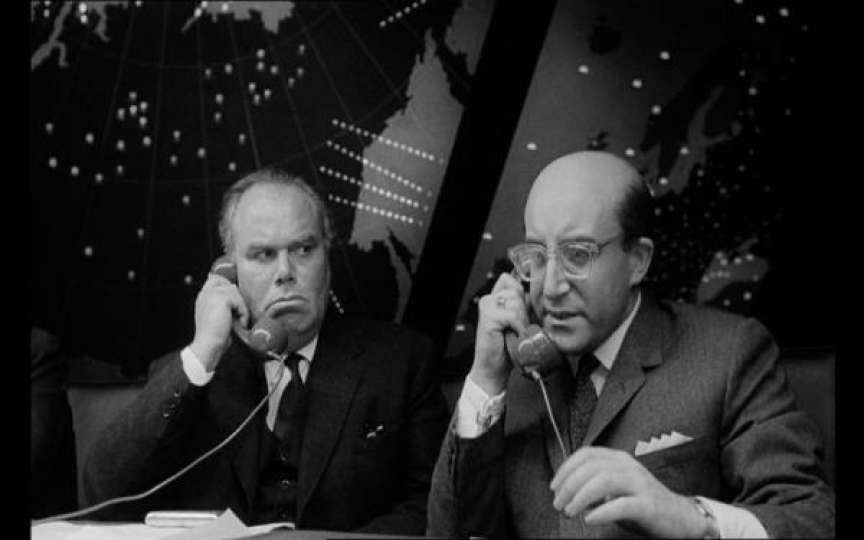
Hello? Uh, hello? Hello, Dmitri? Listen, I can’t hear too well, do you suppose you could turn the music down just a little? [pause] Oh, that’s much better. . . . Now then, Dmitri, you know how we’ve always talked about the possibility of something going wrong with the bomb. [pause] The BOMB, Dmitri! The hydrogen bomb! Well now, what happened is, uh, one of our base commanders, he had a sort of, well, he went a little funny in the head. You know. Just a little . . . funny. And uh, he went and did a silly thing. Well, I’ll tell you what he did, he ordered his planes . . . to attack your country. Well, let me finish, Dmitri. Let me finish, Dmitri. Well, listen, how do you think I feel about it? Can you imagine how I feel about it, Dmitri? . . . I’m just calling up to tell you something terrible has happened. It’s a friendly call. Of course it’s a friendly call. Listen, if it wasn’t friendly, you probably wouldn’t have even got it. They will not reach their targets for at least another hour. [pause] I’m sorry too, Dmitri. I’m very sorry. All right! You’re sorrier than I am! But I am sorry as well. I am as sorry as you are Dmitri. Don’t say that you are more sorry than I am, because I am capable of being just as sorry as you are. So we’re both sorry, all right? All right.

President Merkin Muffley, as played by Peter Sellers, speaking to the Soviet premier in Stanley Kubrick’s classic dark comedy, Dr. Strangelove or: How I Learned to Stop Worrying and Love the Bomb (1964), written by Terry Southern and Stanley Kubrick, based on the novel Red Alert (1958) by Peter George.