Categories
Today

“Malaise”

On July 15, 1976, Jimmy Carter accepted the nomination of the Democratic Party to run for the presidency.

Three years later, as president, he gave his infamous “malaise” speech, in which he focused on energy but did not mention the one thing that actually helped turn the 1970s’ energy crisis around: the phased deregulation of oil prices that had started three months earlier, under his own directive. Instead of touting this deregulatory effort, Carter did the usual politic thing and promised a number of new government programs, extensively ground home a “crisis of confidence” message, and vaguely talked of a spiritual challenge.

The deregulation was startlingly effective, in the long run — though the immediate effect was a rocketing of prices. These high prices presented profit opportunities, and (lo and behold!) domestic production greatly increased, allowing for many, many years of lower prices. Those high prices would have worked better as market signals had not Carter and Congress also established “windfall profits” taxes, to take away those temporary gains to existing business.

Had Carter deregulated prices earlier, he would probably have been re-elected president. Had he emphasized deregulation, he probably would have beat back Ronald Reagan’s free market rhetoric — with actual action.

The price controls had been put in place earlier in the decade by the Republican president at the time, Richard M. Nixon, with the great help of his aides Dick Cheney and Donald Rumsfeld.
Categories
ballot access initiative, referendum, and recall

Initiative-Crippling Law Clobbered

The right of citizen initiative is the right of voters to petition to get a measure on the ballot; then, if that happens, to vote on it and pass it. 

Many politicians hate this right and work to weaken it.

A few years ago, Florida’s Constitution Revision Commission considered sending a measure to the state ballot to treat voters who abstain from voting on a ballot question as having voted No. The proposal died on the vine, thankfully. But this is the kind of encroachment politicians fantasize about.

The latest attack on Floridians’ right of citizen initiative — a law to cap donations to such campaigns at $3,000 during the signature-gathering phase — has just suffered a less definitive setback.

Federal Judge Allen Winsor in the Northern District of Florida halted the new law from going into effect on the very day it was scheduled to do so. (Cutting it a little close, aren’t you, judge?) He ruled that contributions to an initiative campaign are obviously a form of political expression and that the law would inflict irreparable harm if even briefly in force.

True. 

If petition organizers can’t raise the funds needed to collect the required 891,589 signatures, it becomes enormously harder to get a measure on the ballot and let voters have their say. A say that foes of citizen initiative rights certainly do not want voters to have.

The ruling blocks the law only until the court reaches a final resolution on its constitutionality, so this legal battle isn’t over yet. 

What is most certainly determined, however, is that Florida legislators don’t care about the Constitution. 

This is Common Sense. I’m Paul Jacob.


PDF for printing

speech

See all recent commentary
(simplified and organized)
See recent popular posts

Categories
Thought

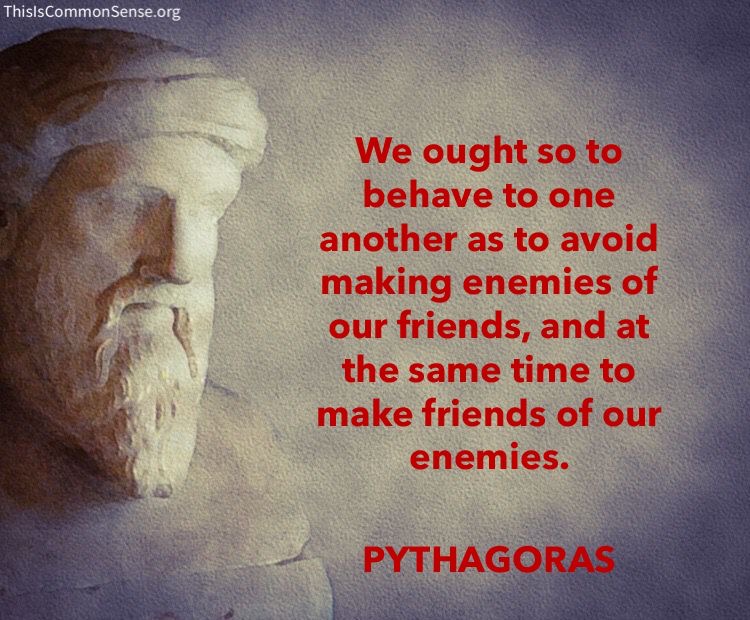
Pythagoras

We ought so to behave to one another as to avoid making enemies of our friends, and at the same time to make friends of our enemies.

Pythagoras, as quoted by Diogenes Laërtius, Lives and Opinions of the Eminent Philosophers,

Categories
Today

The Bastille and Beyond

On July 14, 1789, Paris citizens stormed the Bastille.

On the same date nine years later, in America, the Sedition Act prohibited the writing, publishing, or speaking false or malicious statements about the United States government.

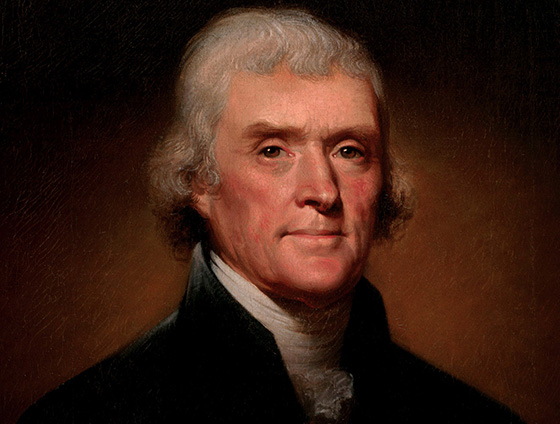
The passage of this repressive law spurred the formation of the first opposition party in the United States, with Thomas Jefferson [above] as its leader and figurehead.

Categories
individual achievement

The Division of Adventure

On Sunday, billionaire Richard Branson became the first person to ascend into space in his own spacecraft — assuming that myth, old rumors and sci-fi stories of god-kings and mad scientists going to the Moon or Mars remain just that, myth and rumor and fi.

“The launch with Branson marked the 22nd test flight of Virgin Galactic’s VSS Unity space plane,” writes Alex Veiga for MSN. “The company has planned at least two more space test flights this year.”

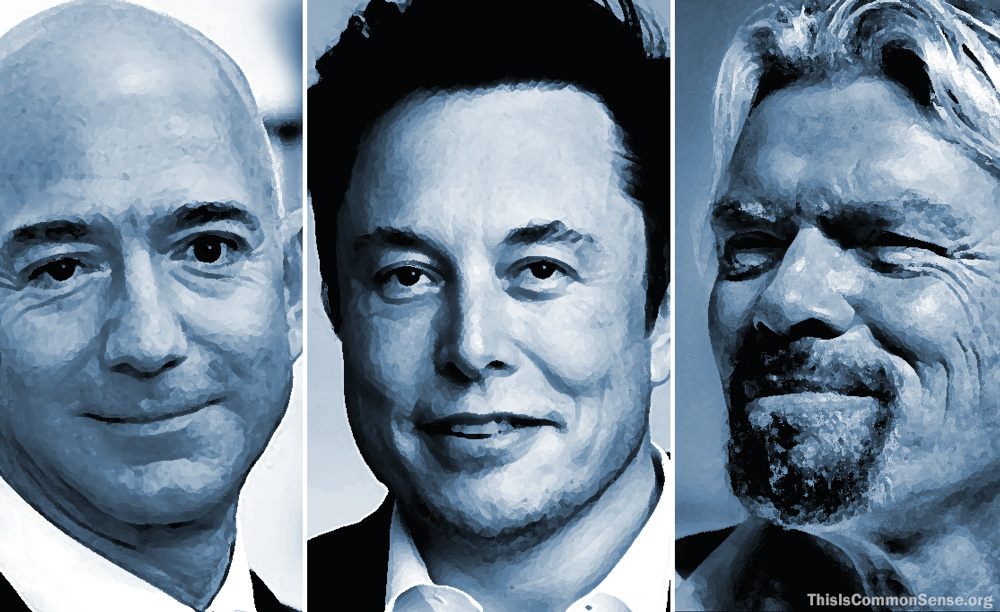
Thus Branson beat Jeff Bezos into space — depending how you figure. Later in the month Bezos’s Blue Origin spacecraft is set to launch Amazon’s less-than-beloved billionaire even higher above the planet.*

The billionaire space race is on, with the next level to be reached when regularly scheduled flights become the norm, ticket sales and all.

This is really “just” thrill-ride fare we are talking about here — and likely when commercial space travel first becomes normalized. Neither man is aiming to rocket into orbital space.

Yet.

Which is not to say this is not of great significance.

Of course, the fledgling industry receives criticism. Why go to space now, some say, when we have so many problems on Earth?

Well, explorers and adventurers did not wait till Europe’s problems were solved to explore and settle the Americas. They pushed forward.

Just as there is a division of labor in society, there is a division of ambition, of venture.

I will likely never go into space. But I am happy Richard Branson got there.

And I’ll applaud if you, too, jaunt upwards.

This is Common Sense. I’m Paul Jacob.


 * Branson and Bezos publicly squabble about what “space” is. Virgin Galactic went above the American standard of about 50 miles, while Bezos aims for the worldwide “accepted” standard of 62 miles.

PDF for printing

Jeff Bezos| Elon Musk | Richard Branson

See all recent commentary
(simplified and organized)
See recent popular posts

Categories
Thought

Richard Branson

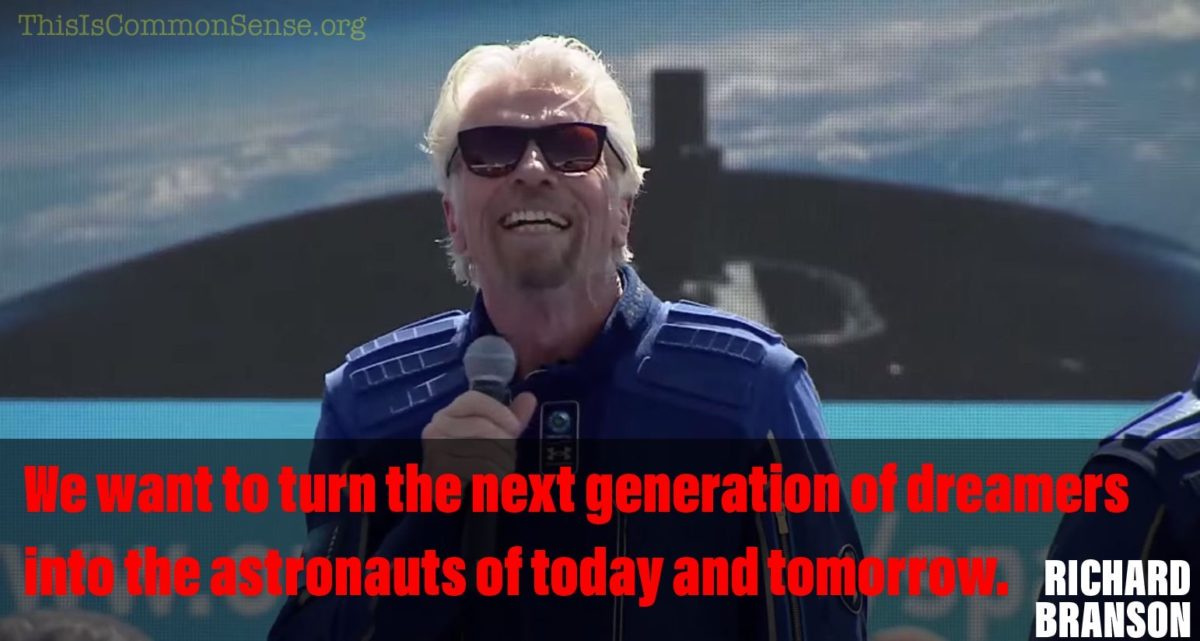
We’re here to make space more accessible to all. We want to turn the next generation of dreamers into the astronauts of today and tomorrow. We’ve all us on this stage have had the most extraordinary experience, and we’d love it if a number of you can have it, too. . . . If you ever had a dream, now is the time to make it come true — and I’d like to end by saying welcome to the dawn of a new space age.

Sir Richard Charles Nicholas Branson (born July 18, 1950), upon returning from his “first billionaire in space” flight on his Virgin Galactic VSS Unity, July 11, 2021.
Categories
Today

The Nixon Tapes

On July 13, 1973, the minority (Republican) counsel on the Senate Watergate investigative committee, Donald Sanders, asked Nixon aide Alexander Butterfield if he knew of any recordings made in the Nixon White House, and Butterfield responded, “everything was taped” at least while Nixon was in attendance, and that “there was not so much as a hint that something should not be taped.”

This revelation of the Nixon Tapes transformed the Watergate scandal into a major legal as well as political event, and proved to be one of the most astounding examples of “government transparency” in modern times — indeed, it helped demystify and desanctify the Office of the Presidency, a very republican (if not pro-Republican Party) development.

Categories
First Amendment rights international affairs national politics & policies

Optimized for Attack

Whence came this pandemic? 

Now that we can investigate the lab leak theory without being smeared as conspiracy nuts or buried in an avalanche of disinformation from China, the World Health Organization, and the U.S. scientific community — all protected in their deceit by Big Tech and our mainstream media — we might make progress in our inquiries.

On June 29, in a little-covered hearing before Republican-only members of the House Oversight and Reform Subcommittee on Select Coronavirus Crisis, several renowned scientists testified, most notably Dr. Richard Muller, emeritus professor of physics at Cal-Berkeley.

“I would like to emphasize five points,” Muller stated, “each of which is capable of separating or distinguishing between a natural origin — a zoonotic origin — and the lab origin” of SARS-CoV-2: 

  1. “The absence of pre-pandemic infections,” which he called “unprecedented”;
  2. “The absence of a host animal” (which was lied about early on); 
  3. “The unprecedented genetic purity. . . . Again, MIRS, SARS, previous viruses don’t have this, but it is exactly what you would expect if you’ve gone through gain-of-function”;   
  4. “The spike mutation . . . there is no known way for that spike mutation to get there except by gene mutation in a laboratory”; 
  5. “This virus was optimized to attack humans. Again, something that has never happened in natural releases — but it does happen if you run it through the gain-of-function.”

“All the scientific evidence argues in favor of the laboratory origin,” he concluded. “The evidence in favor of the natural, zoonotic origin? There isn’t any.”

But here comes the even bigger story, one that Dr. Muller called “horrifying” and “chilling.”

Muller had asked colleagues to assist in his lab-leak investigation. But they declined to help because that would anger China, which would then blacklist those labs. 

“The idea that China has managed to interfere, to break United States’ freedom of expression, freedom of investigation, freedom of thought, through this collaboration effort,” the doctor explained, “is really scary.” 

If you think the Chinazis are merely a threat to “their own people” and neighboring Taiwan and countries bordering the South China Sea . . . think again.

This is Common Sense. I’m Paul Jacob.


Note: Here and here are links to additional testimony at that June 29th hearing. Coverage of Dr. Muller’s testimony first appeared in these pages as a “Thought.”

PDF for printing

See all recent commentary
(simplified and organized)
See recent popular posts

Categories
Thought

Michael Avenatti

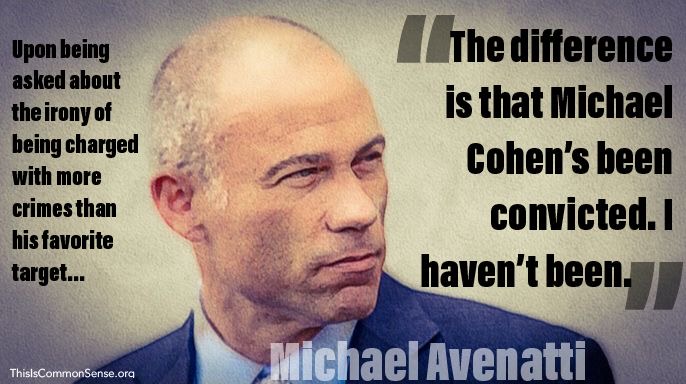
The difference is Michael Cohen’s been convicted. I haven’t been.

Michael Avenatti, upon being asked about being charged with more crimes than his favorite target in his harassment campaign against President Trump, for which Avenatti became a darling of the mainstream media. Avenatti was sentenced, last week, to two and one half years in prison for extortion. Other cases are pending.
Categories
Today

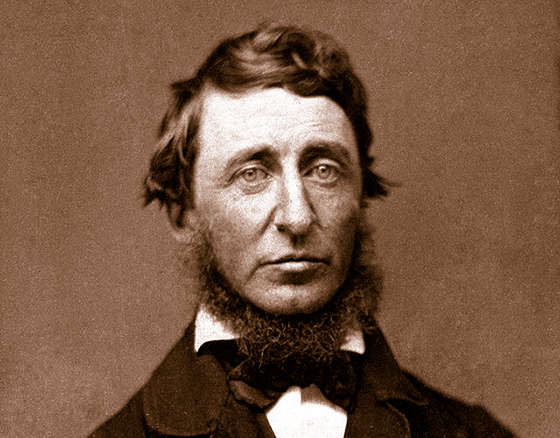
Thoreau

On July 12, 1817, American poet, abolitionist, businessman, and Transcendentalist philosopher Henry David Thoreau was born. He is perhaps best known, today, for his book of meditations on the simple life, Walden, and his influential essay on civil disobedience.