Categories
First Amendment rights free trade & free markets too much government

The California-Canada Connection

What do California and Canada have in common, aside from bone-chilling temperatures?

Well, the fact that they’re trying to chill the discourse of doctors.

In California, a new law empowers medical boards to punish doctors who spread “misinformation” about COVID-19. The misinformative nature of a stated view about the pandemic is allegedly proved by the mere fact that it contradicts a putative scientific “consensus.”

Such laws rely on misinformation for their very existence. 

When coping with complex, incomplete, sometimes murky evidence, do scientists and others ever simply disagree, even fundamentally, on the road to scientific “consensus”? Can a consensus ever be wrong? Does anybody ever hew to an asserted consensus out of fearful desire to conform rather than honest intellectual agreement?

To ask these questions is to answer them. But let’s move on.

To Canada — and the case of Dr. Jordan Peterson, whose professional status in the country is being jeopardized because of medical and/or political views, like opinions criticizing “climate change models,” “surgery on gender dysphoric minors,” and Canadian officials who threatened “to apprehend the children of the Trucker Convoy protesters.”

Stated on social media, these opinions are apparently incendiary enough — i.e., candid enough — to vex Canada’s powerful medical censors.

According to Peterson, the Ontario College of Psychologists demands that he submit to “mandatory social-media communication retraining” because of his views. If he doesn’t comply, he may lose his license.

Such repressive impulses, he says, are “way more widespread than you might think.”

It’s cold outside.

This is Common Sense. I’m Paul Jacob.


PDF for printing

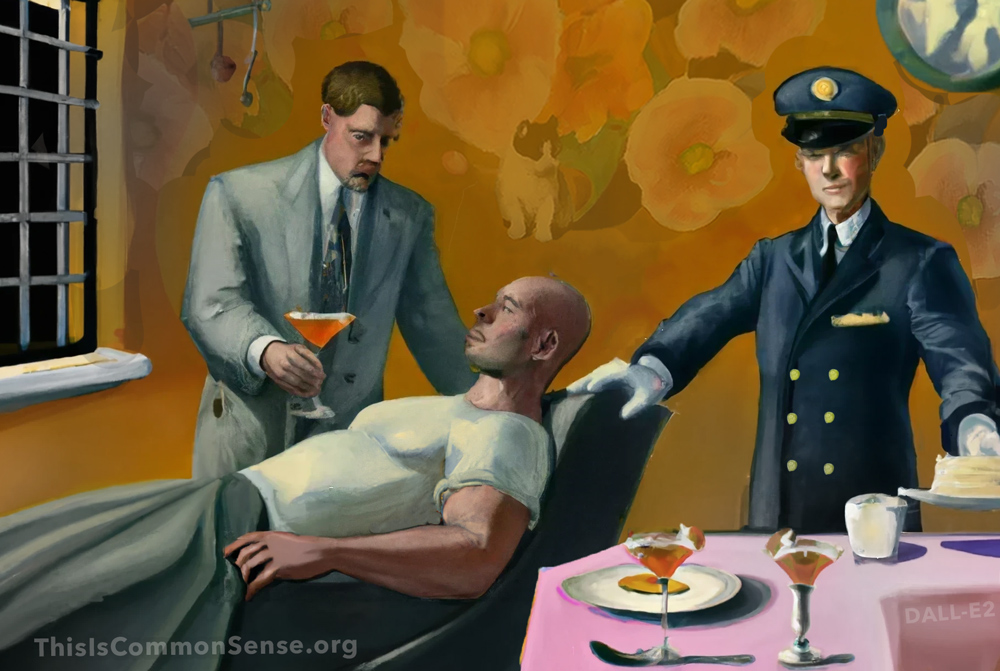
Illustration created with DALL-E2

See all recent commentary
(simplified and organized)
See recent popular posts
Categories
Thought

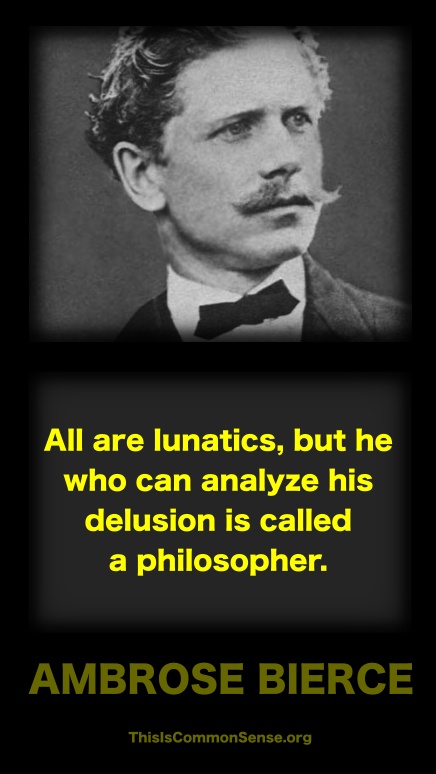
Ambrose Bierce

All are lunatics, but he who can analyze his delusion is called a philosopher.

Ambrose Bierce, The Collected Works of Ambrose Bierce, Vol. 8 (1911), § “Epigrams” (p. 369.).
Categories
Today

Ford’s Five

On January 5, 1914, the Ford Motor Company announced an eight-hour workday and a minimum wage of $5 for a day’s labor.

Categories
general freedom international affairs

What Is and Is Not Sinister

“Is this just human stupidity?”

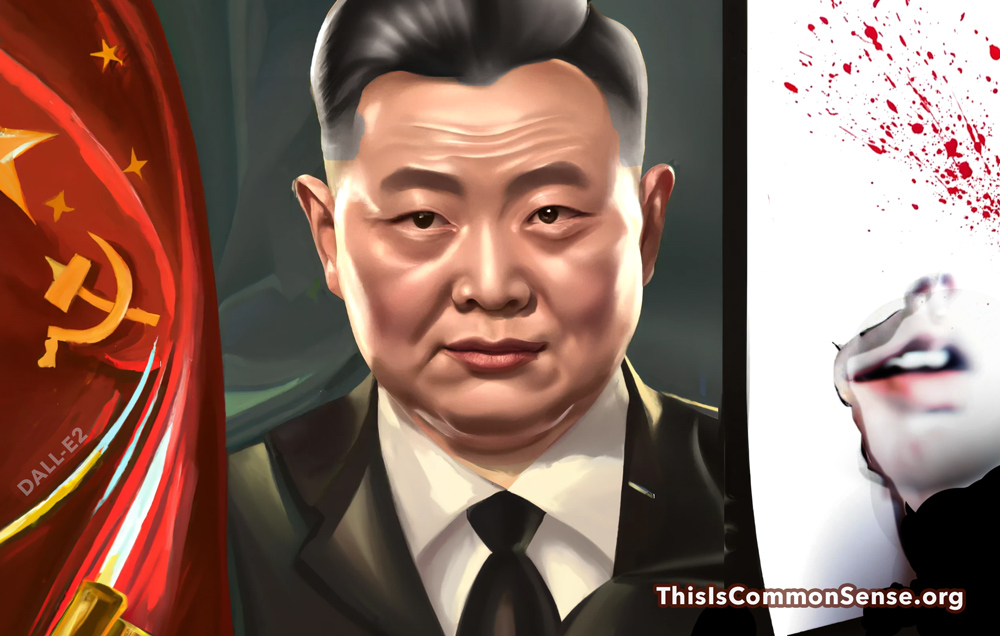
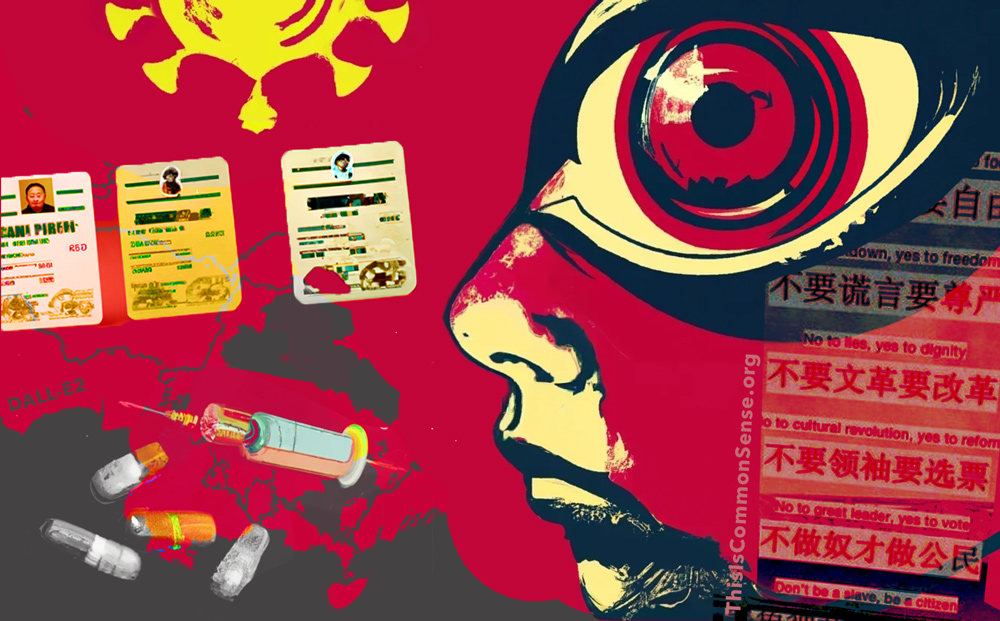
I asked that, last week, regarding the flourishing of the Omicron variants of SARS-CoV-2 in China. The Communist-run country is undergoing a huge spike in infections, millions of infections, after years now of totalitarian tracking and quarantine protocols.

I had mentioned the regime’s lack of interest in encouraging the growth of natural immunity, in its various forms. Instead of helping people cope with the new disease, the Chinazis thought they could corral their society to prevent the spread.

That broke down completely, this winter.

But was the quarantine policy and its breakdown just plain old stupidity? Folly in familiar forms?  “Or is it something more sinister?”

Well, yesterday Dr. John Campbell focused his regular online talk on how the totalitarian quarantines fell apart.

The Chinese infection rate had been relatively low — to the extent that we can trust statistics from a lying regime — because of the thoroughgoing nature of the quarantine policies, which immiserated millions, and caused numerous deaths, just as lockdowns would do in almost any society.

While acknowledging the protests that swept China, Campbell argues that a bigger factor in ending the policy was the fact that many Chinese were bribing officials to obtain negative results on the mandatory tests, thereby gaining license to go about as normal. And spread the disease — quite rapidly — in a low-immunity society, low in part because the CCP chose the Zero COVID policy . . . rather than a strategy of a freer society.

Still, in China and America, the totalitarian itch remains. The dream of zero transmission seems “rational” to many people, especially those who demand that The State solve every problem. It hasn’t worked anywhere, though. 

And not just due to the chronic bribery and corruption fostered by authoritarian societies, but because isn’t good medical or political science.

This is Common Sense. I’m Paul Jacob.


PDF for printing

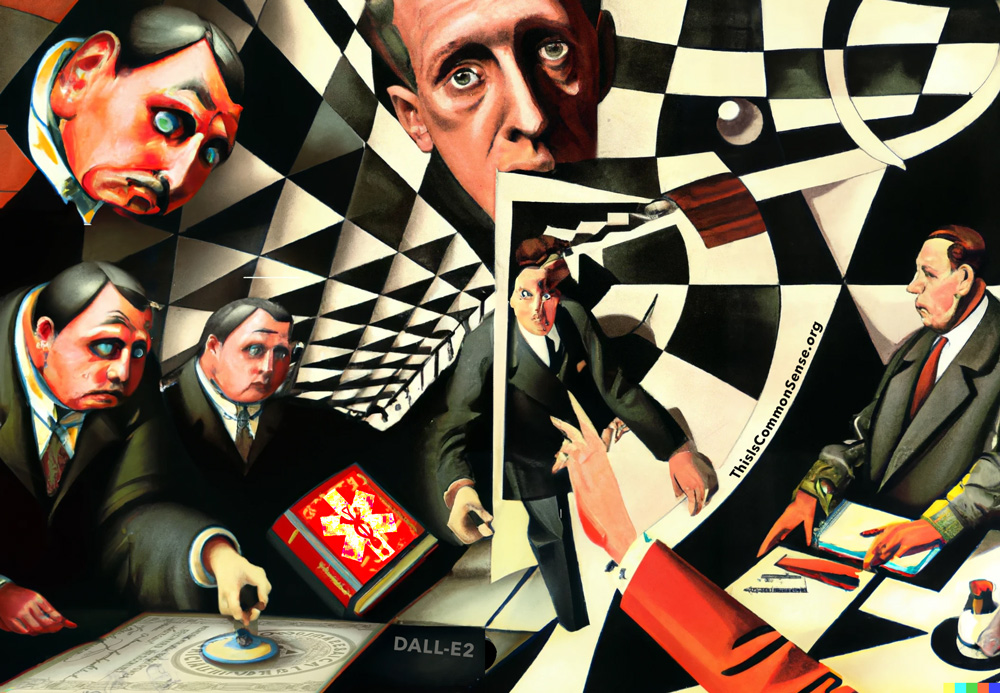
Illustration created with DALL-E2

See all recent commentary
(simplified and organized)
See recent popular posts
Categories
Thought

Voltaire

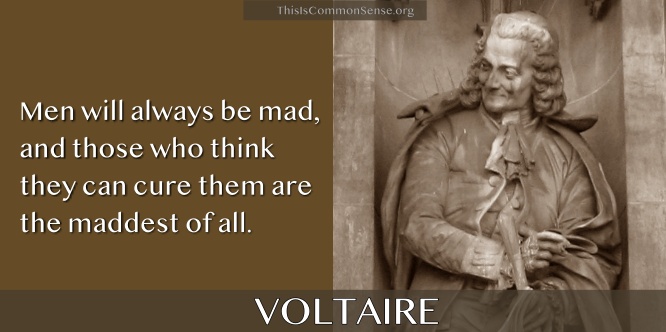
Men will always be mad, and those who think they can cure them are the maddest of all.

Voltaire, Letter to Louise Dorothea of Meiningen, duchess of Saxe-Gotha Madame (January 30, 1762).

Categories
Today

King Charles

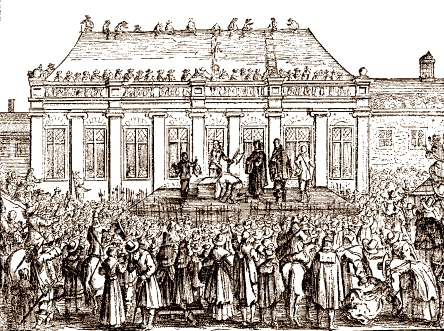
On Jan. 4, 1642, King Charles I of England sent soldiers to arrest members of Parliament, beginning England’s slide into civil war.

On Jan. 4, 1649, the English “Rump Parliament,” having purged those members willing to restore Charles I to the throne, voted to put Charles I on trial for high treason. Before the month was over, the king had been executed.

Categories
ideological culture international affairs Regulating Protest

Making Symbolism Count

“Governments do unconscionable things every day; it is in their nature,” writes Katherine Mangu-Ward in the February Reason. “But not all transgressions are equal.”

Ms. Mangu-Ward’s piece is entitled “Bodies Against the State,” and though she doesn’t quite come out and say it, not all protests are equal, either, with some deserving more respect than others.

“In China, crowds of people line the streets,” Mangu-Ward writes. “They are holding blank sheets of paper.” This is something I’ve written about, too, in “Point Blank Protest” back in November. “The police nonetheless know what they mean. The leaders of the Chinese Communist Party know what they mean. The world knows what they mean.”

Helpfully, she explains: “the protesters’ goal is to make manifest the implied violence that authoritarian states use to keep order.”

Of course, in China, even more than here (not all transgressions being equal), the state’s violence is too often more than merely implied. 

And in America, the symbolism of protests has been marred by too much violence — something Mangu-Ward mangles in her piece. But the point of pitting oneself symbolically against state crimes remains important, as she explains: “The most perfect and enduring image of a person weaponizing his body against the state was taken after the brutal suppression of protests in Tiananmen Square in 1989. The unknown Chinese man standing in front of a tank didn’t have to hold a sign for the entire world to know exactly what the problem was.”

The art of protest needs some perfecting in the west. When our protests run to riot, their symbolic impact becomes confused, and adds to our ideological strife, clarifying nothing — quite unlike Tank Man, and the blank paper protests.

This is Common Sense. I’m Paul Jacob.


PDF for printing

Illustration created with DALL-E2

See all recent commentary
(simplified and organized)
See recent popular posts
Categories
Thought

Ambrose Bierce

“There’s no free will,” says the philosopher; “To hang is most unjust.”

“There is no free will,” assents the officer; “We hang because we must.”

The Collected Works of Ambrose Bierce, Vol. 8 (1911), § “Epigrams,” p. 350.
Categories
Today

Cicero, Cornwallis, Craig, Tolkien

On the third of January in 1777, American General George Washington defeats British General Lord Cornwallis’s forces in the Battle of Princeton.

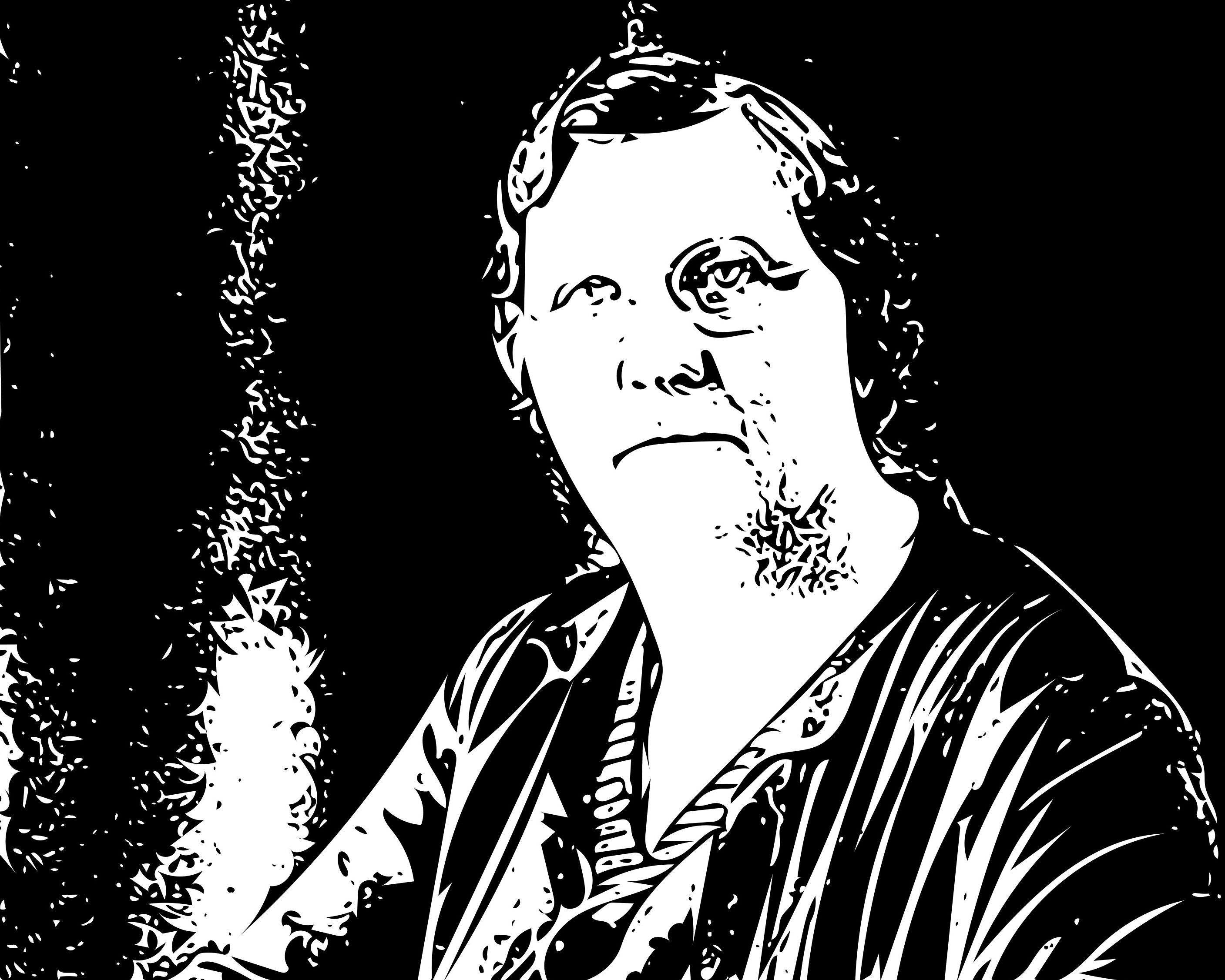
On January 3, 1933, Minnie D. Craig (pictured above) became the first woman elected as Speaker of the North Dakota House of Representatives, the first female to hold a Speaker position anywhere in the United States.

On the same date in 1977, Apple Computer was incorporated.

January 3rd birthdays include that of Cicero (106 BC), Roman philosopher and theorist of republicanism, and J.R.R. Tolkien (1892 AD), English philologist and author of The Hobbit and The Lord of the Rings. Both authors were deeply concerned about the problem of absolute power.

Categories
crime and punishment general freedom Second Amendment rights

Concealed Carry and the Careful Criminal

Crime is the most basic of problems. But across the political spectrum we see different strategies. 

On the right, the go-to solution has always been to ramp up policing, to make the basic function of the state — crime-fighting — stronger and more effective. 

On the left, a leading idea has been to disarm the populace so people cannot do as much harm, and also to “rehabilitate” troubled folks with government TLC.

I grew up in the ’70s, when the failures of benevolent leftism (which we called “liberalism”) were becoming clear. So there was a reaction: Lock more people up.

That reaction fizzled in recent years, and, perhaps not wholly coincidentally, crime on a city-by-city case, as well as nationally, has increased. 

Nevertheless, during this period another policy has gained a huge momentum: instead of disarming the populace, arm them!

How’s that going? The most recent case study is in Maine, which in 2015 allowed permit-less concealed carry of firearms.

“While rates of violent crime increased nationally from 2015 to 2020,” writes Steve Robinson in “Maine Crime Fell Following 2015 Repeal of Gun Control Law” (MaineWire, December 29, 2022), “the rate of violent crime in Maine fell steadily beginning in 2015, after a slight increase from 2014 to 2015, according to data collected by the FBI’s Uniform Crime Reporting Program.”

Robinson notes that while the Maine experience doesn’t prove that “an armed society is a polite society,” it falsifies, quite clearly, the catastrophic predictions made by gun control advocates back in 2015.

I hazard it does much more. It shows that distributed power (in this case, firepower and defensive capacity) in the peaceful population is a separate, non-left/non-right solution to the age-old problem of crime.

This is Common Sense. I’m Paul Jacob.


PDF for printing

Illustration created with DALL-E2

See all recent commentary
(simplified and organized)
See recent popular posts