Categories
Update

Not Just a Light Show

Maybe you saw the lights. Or maybe you just caught the news on Tim Pool’s show. It was an important story: a big solar storm that, had it been just a tad more intense could’ve taken down computers (which are in your watch and toaster) as well as the electric grid.

Why, yes, it could have ended our civilization, which is now utterly dependent on easily-overloaded electrical circuits and electronic components.

Actually, it was two sets of solar storms. And they had nothing to do with manmade global warming or MAGA politics or the death of Hollywood:

A severe (G4) geomagnetic storm lit up skies across the Northern Hemisphere overnight (Nov. 11-12), with vivid northern lights visible across Canada, the U.S, and as far south as Mexico.

The incredible display followed the arrival of multiple coronal mass ejections (CMEs) — eruptions of magnetic field and plasma from the sun — launched by sunspot AR4274, one of the most energetic sunspot groups of the current solar cycle. The ongoing storm ranks among the strongest of Solar Cycle 25 and last night’s peak at G4 clocked in as the third strongest geomagnetic storm this solar cycle. The first two CMEs struck in quick succession last night, compressing Earth’s magnetic field and unleashing spectacular aurora shows that lasted well into the night.

Daisy Dobrijevic, “Severe geomagnetic storm sparks northern lights across North America and as far south as Mexico,” Space.com (November 12, 2025).

This was a set of real events that took place this past week. Thankfully, we live on to talk about manmade global warming, MAGA politics, and the death of Hollywood.

As Rona Barrett likes to say, keep thinking the good thoughts.
Categories
Thought

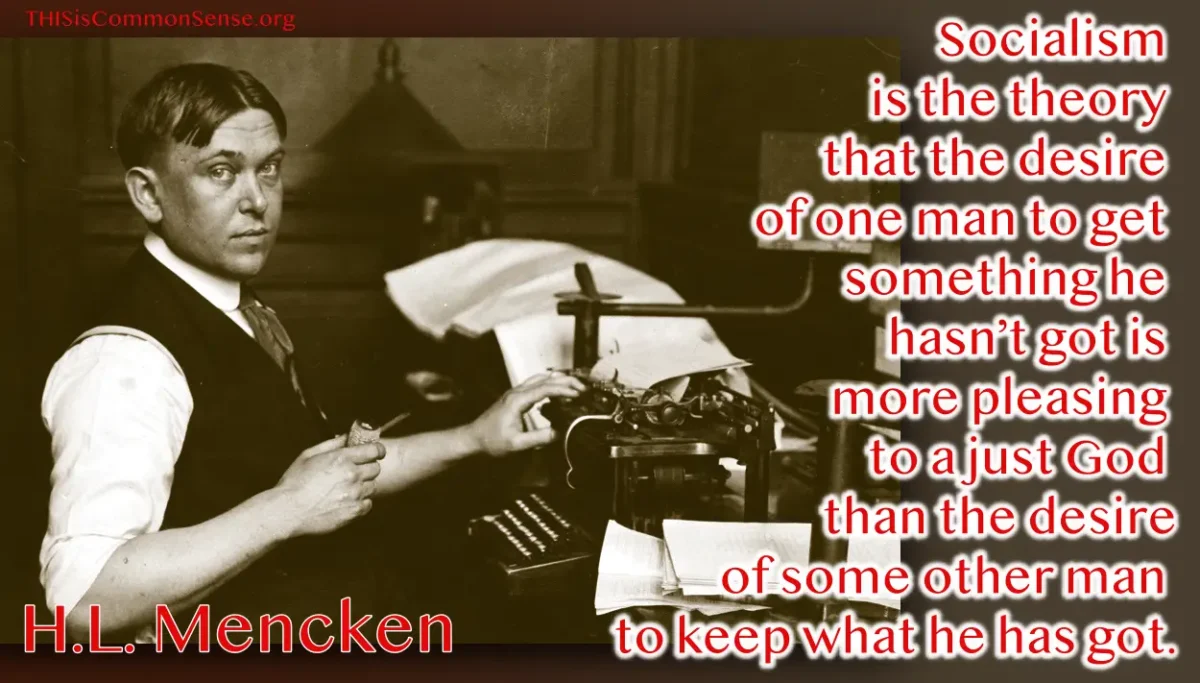
H.L. Mencken

Socialism is the theory that the desire of one man to get something he hasn’t got is more pleasing to a just God than the desire of some other man to keep what he has got.

H.L. Mencken, A Little Book in C Major (1916) p. 51.
Categories
Today

The Articles

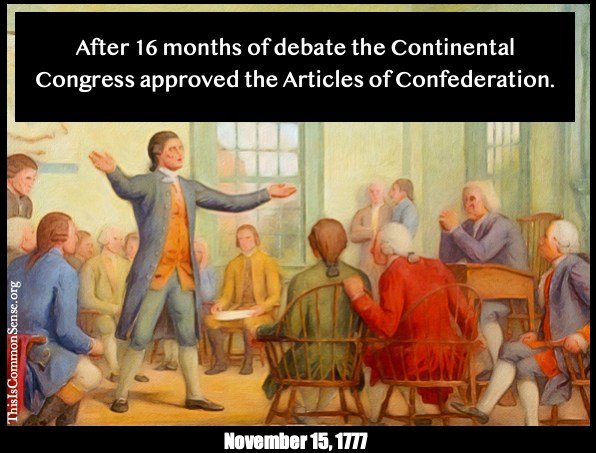
On November 15, 1777, after 16 months of debate, the Continental Congress approved the Articles of Confederation.

Categories
regulation

I Can’t Believe It’s Not Overkill

Butter is made from cream, which is derived from milk. Not a new truth; it’s never been anything but.

B-but — some people are allergic!

And we must protect them.

Under the Food Allergen Labeling and Consumer Protection Act (FALCPA) of 2004, milk is one of nine major allergens that must be explicitly declared — either in parentheses after the ingredient (e.g., “cream (milk)”) or in a separate “Contains: Milk” statement. 

Which is why Costco had to recall 79,200 pounds of butter. A labeling oversight meant that perfectly good and safe butter was placed on the big box store’s shelves without the explicit warning that butter contains milk. The FDA issued a Class II recall, and Costco began the process on October 11.

“Voluntarily,” we’re told. 

No doubt “voluntary” because neither Costco nor the bulk of its customers wants to get into arguments about government regulation designed to protect people with cows’ milk allergies.

In a world run by common sense and not a federal bureaucracy, however, even the most litigious lawyers would surely be satisfied by extra signage at point of sale — something like

But even this may strike us as bending too far backward for people whose responsibility is to know what the stuff they ingest is made from. They must protect themselves. If milk makes you ill, you’ll forswear all butter and reach for some good oil, or even margarine.

Something like I Can’t Believe It’s Not Butter . . . but only in its original spray and vegan versions . . . all others contain milk!

I can’t believe this isn’t Common Sense. I’m Paul Jacob.


PDF for printing

Illustration created with Krea and Firefly

See all recent commentary
(simplified and organized)
See recent popular posts

Categories
Thought

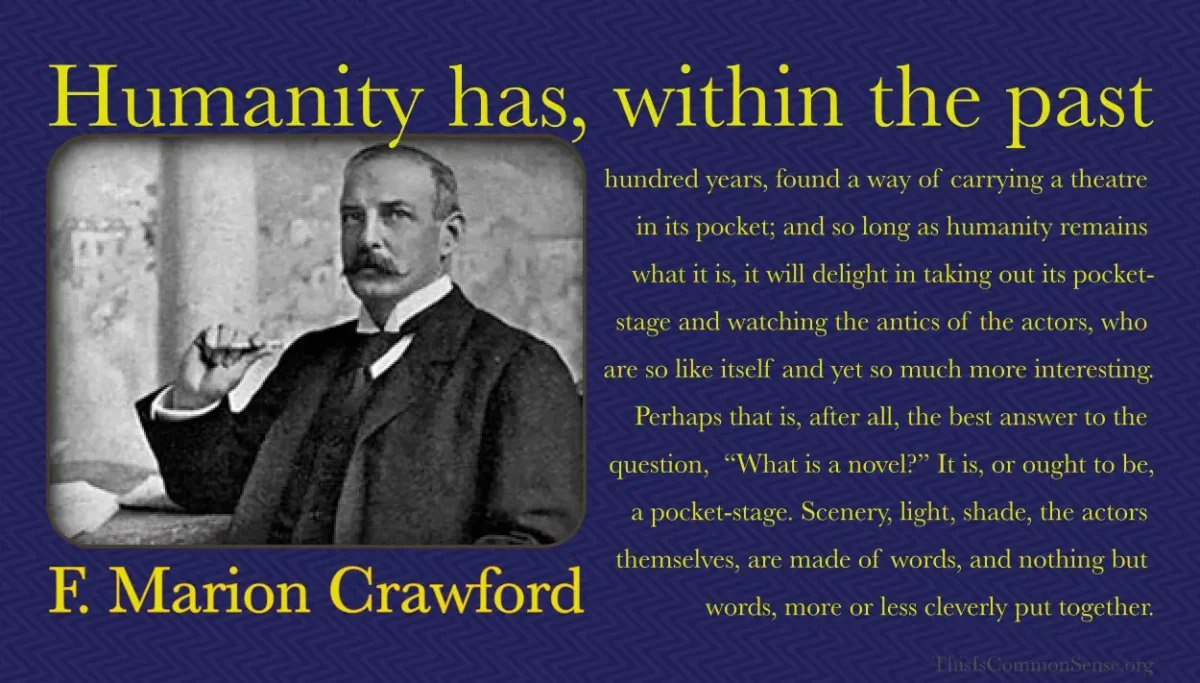
F. Marion Crawford

It may fairly be claimed that humanity has, within the past hundred years, found a way of carrying a theatre in its pocket; and so long as humanity remains what it is, it will delight in taking out its pocket-stage and watching the antics of the actors, who are so like itself and yet so much more interesting. Perhaps that is, after all, the best answer to the question, “What is a novel?” It is, or ought to be, a pocket-stage. Scenery, light, shade, the actors themselves, are made of words, and nothing but words, more or less cleverly put together. A play is good in proportion as it represents the more dramatic, passionate, romantic, or humorous sides of real life. A novel is excellent according to the degree in which it produces the illusions of a good play — but it must not be forgotten that the play is the thing, and that illusion is eminently necessary to success.

Francis Marion Crawford, The Novel: What It Is (1882), Chapter VIII.
Categories
Today

The Great White Whale

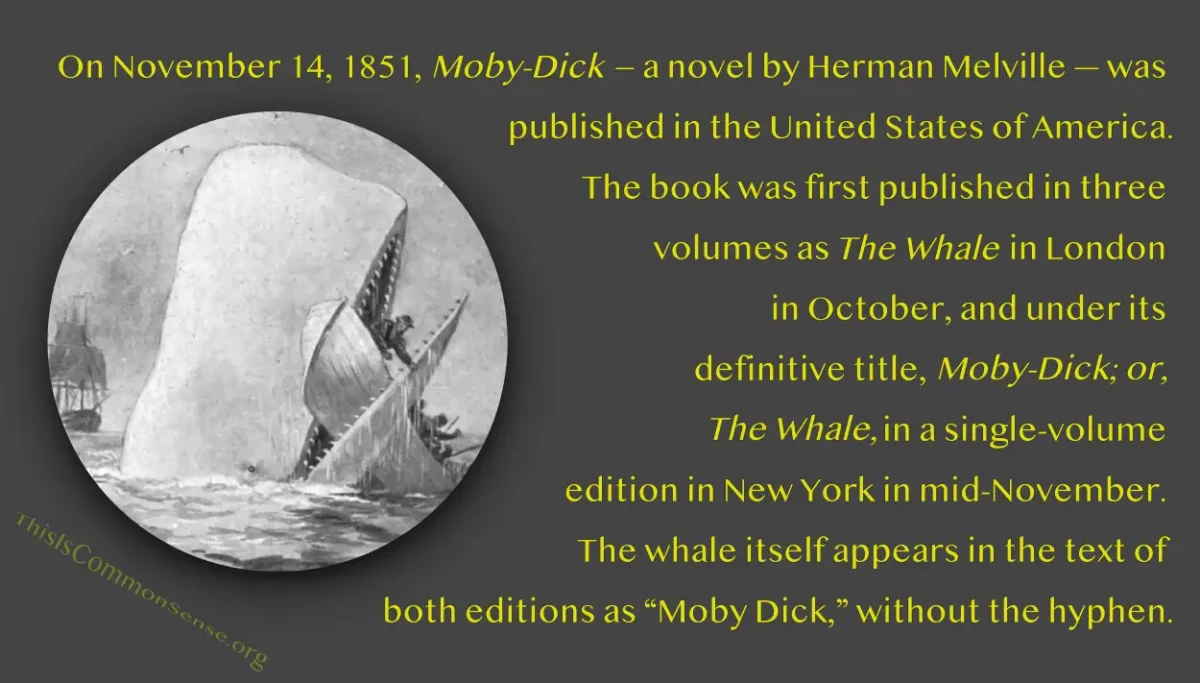
On November 14, 1851 — Moby-Dick, a novel by Herman Melville — was published in the United States of America. The book was first published in three volumes as The Whale in London in October, and under its definitive title, Moby-Dick; or, The Whale, in a single-volume edition in New York in mid-November. The London publisher, Richard Bentley, censored or changed sensitive passages; Melville made revisions as well, including a last-minute change of the title for the New York edition. The whale itself appears in the text of both editions as “Moby Dick,” without the hyphen.

Categories
crime and punishment regulation

Fix-It Man Pardoned

Troy Lake, the mechanic who helped truckers and bus drivers keep their vehicles going by removing crippling emissions systems, paid the price — jailed for this “crime,” and also fined $52,000. 

Prosecutors made an example out of the Wyoming fix-it man for following a practice that had become mandatory to keep rigs — in his case, at least 344 heavy-duty diesel trucks — on the road.

I’ve discussed his case, saying that President Trump should pardon him for this non-crime.

Though Troy Lake served about seven months in a federal prison, and he’s been out for a while, the conviction was still hanging over his head.

Now President Trump has indeed pardoned Mr. Lake.

He learned about it from a congratulatory voicemail left by U.S. Senator Cynthia Lummis, calling to “let you know how very sorry I am that this even happened to you guys but how delighted I am that the pardon has come through.”

“It’s great,” says 65-year-old Lake, who broke down after hearing the good word. “It’s news that, you know — I guess I look at it as, there are some good things that happen in the world.”

Troy and his wife, Holly, also tearfully relieved by the news, are grateful to Senator Lummis, Wyoming legislators, and others who went to bat for him.

About the environmental regulations that sent him to prison for helping diesel drivers survive, he says, “We need to sit down and think about a more logical way of doing it, not putting people out of work.”

Talk about an understatement.

This is Common Sense. I’m Paul Jacob.


PDF for printing

Illustration created with Krea and Firefly

See all recent commentary
(simplified and organized)
See recent popular posts

Categories
Thought

Doris Lessing

There are certain types of people who are political out of a kind of religious reason. . . . I think it’s fairly common among socialists: They are, in fact, God-seekers, looking for the kingdom of God on earth. A lot of religious reformers have been like that, too. It’s the same psychological set, trying to abolish the present in favor of some better future — always taking it for granted that there is a better future. If you don’t believe in heaven, then you believe in socialism. When I was in my real Communist phase, I and the people around me really believed — but, of course, this makes us certifiable — that something like ten years after World War II, the world would be Communist and perfect.

Doris Lessing, novelist, as quoted in “Doris Lessing on Feminism, Communism and Space Fiction,” Lesley Hazelton, New York Times Book Review (July 25, 1982).

Categories
Today

Shooting Stars

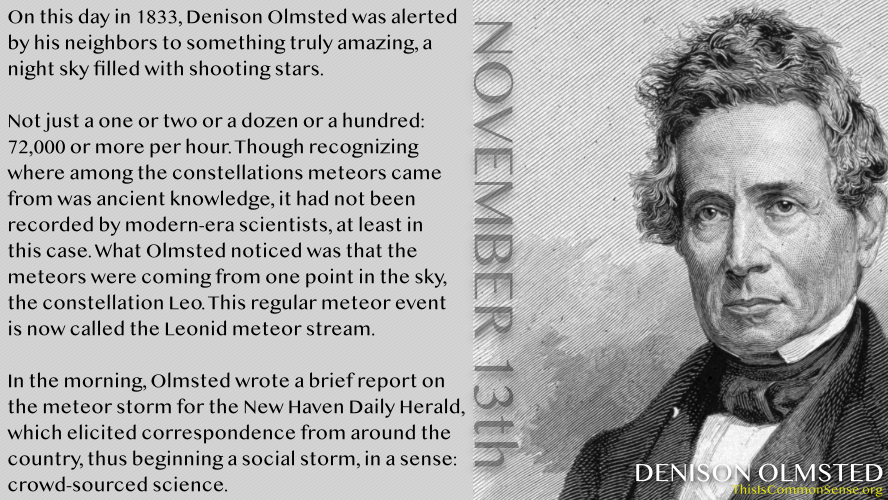
On this day in 1833, Denison Olmsted was alerted by his neighbors to something truly amazing, a night sky filled with shooting stars.

Not just a one or two or a dozen or a hundred: 72,000 or more per hour. Though recognizing where among the constellations meteors came from was ancient knowledge, it had not been recorded by modern-era scientists, at least in this case. What Olmsted noticed was that the meteors were coming from one point in the sky, the constellation Leo. This regular meteor event is now called the Leonid meteor stream.

In the morning, Olmsted wrote a brief report on the meteor storm for the New Haven Daily Herald newspaper, which elicited correspondence from around the country, thus beginning a social storm, in a sense: crowd-sourced science.

Categories
budgets & spending cuts international affairs political economy

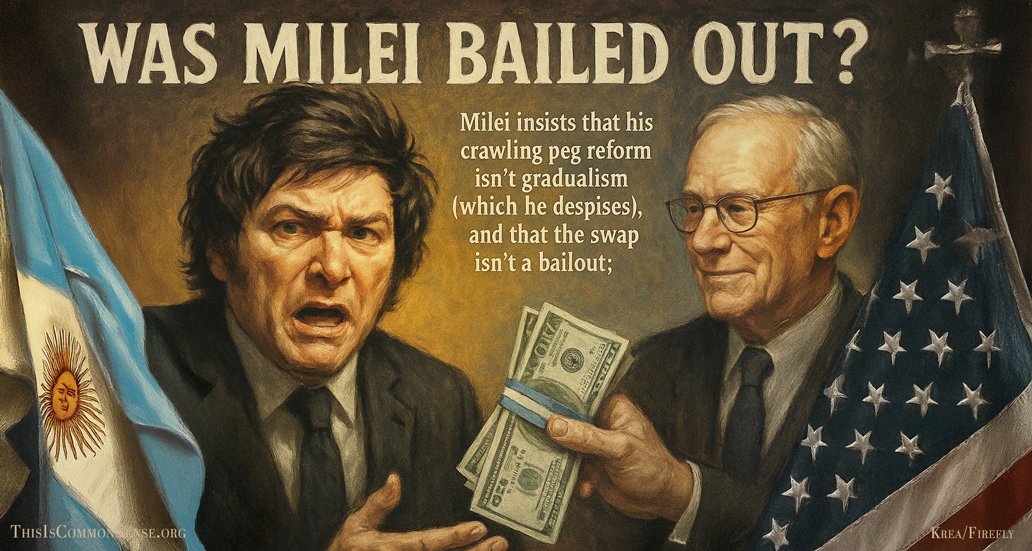
Was Milei Bailed Out?

You saw it on the news, newscasters almost gloating: Argentina’s peso plunged — triggered by  low reserves and political defeats for President Javier Milei.

Then the U.S. Treasury under Secretary Scott Bessent finalized a $20 billion currency swap line with Argentina’s central bank. This was on top of direct U.S. purchases of pesos in the market and plans for another $20 billion from private sources. The deal was seen as a U.S. strategic play to counter instability in Latin America.

Some called it a bailout.

Were Milei’s radical reforms saved at the expense of the U.S. taxpayer?

Bessant was asked this, yesterday, directly on MSNBC, and had a response: “Do you know what a swap line is?”

I had to brush up on it. (I don’t engage in any cross-currency swaps, understandably, not being a major corporation, a central bank, or a sovereign state.) A currency swap is a financial agreement between two parties to exchange principal amounts and interest payments in different currencies over a set period — a temporary loan in one currency backed by collateral in another, designed to provide liquidity, hedge exchange rate risks, or access cheaper funding without the full risks of outright borrowing.

“In most bailouts you don’t make money,” Bessent said. “The U.S. government made money.”

In an exchange, both parties gain. But in any exchange involving extended spans of time, there is risk, so any initial win for Treasury could be wasted by a failure of Milei’s course.

Unlike American politicians opposing inflation, Milei’s been quite honest with Argentinians: “To cure inflation, you have to go through a recession. There is no way around it.” So why Milei didn’t just peg the Argentine peso directly to the U.S.; why a “crawling peg” rather than strict? Milei has been clear: he lacked political clout.

Milei insists that his crawling peg reform isn’t gradualism (which he despises), and that the swap isn’t a bailout; Bessant agrees, saying the swap’s “a profitable move for America.”

This is Common Sense. I’m Paul Jacob.


Note: Milei’s party gained in the most recent election.

PDF for printing

Illustration created with Krea and Firefly

See all recent commentary
(simplified and organized)
See recent popular posts