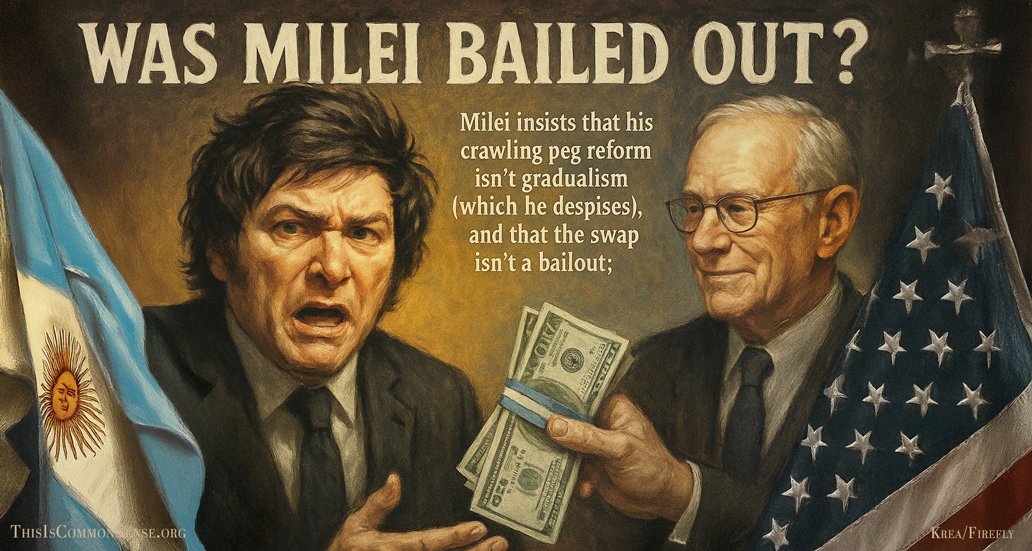
You saw it on the news, newscasters almost gloating: Argentina’s peso plunged — triggered by low reserves and political defeats for President Javier Milei.
Then the U.S. Treasury under Secretary Scott Bessent finalized a $20 billion currency swap line with Argentina’s central bank. This was on top of direct U.S. purchases of pesos in the market and plans for another $20 billion from private sources. The deal was seen as a U.S. strategic play to counter instability in Latin America.
Some called it a bailout.
Were Milei’s radical reforms saved at the expense of the U.S. taxpayer?
Bessant was asked this, yesterday, directly on MSNBC, and had a response: “Do you know what a swap line is?”
I had to brush up on it. (I don’t engage in any cross-currency swaps, understandably, not being a major corporation, a central bank, or a sovereign state.) A currency swap is a financial agreement between two parties to exchange principal amounts and interest payments in different currencies over a set period — a temporary loan in one currency backed by collateral in another, designed to provide liquidity, hedge exchange rate risks, or access cheaper funding without the full risks of outright borrowing.
“In most bailouts you don’t make money,” Bessent said. “The U.S. government made money.”
In an exchange, both parties gain. But in any exchange involving extended spans of time, there is risk, so any initial win for Treasury could be wasted by a failure of Milei’s course.
Unlike American politicians opposing inflation, Milei’s been quite honest with Argentinians: “To cure inflation, you have to go through a recession. There is no way around it.” So why Milei didn’t just peg the Argentine peso directly to the U.S.; why a “crawling peg” rather than strict? Milei has been clear: he lacked political clout.
Milei insists that his crawling peg reform isn’t gradualism (which he despises), and that the swap isn’t a bailout; Bessant agrees, saying the swap’s “a profitable move for America.”
This is Common Sense. I’m Paul Jacob.
Note: Milei’s party gained in the most recent election.
Illustration created with Krea and Firefly
See all recent commentary
(simplified and organized)
See recent popular posts
2 replies on “Was Milei Bailed Out?”
Call it a bailout if you like. Foreign aid is foreign aid. Bailouts come in many forms. Silicon Valley Bank depositors were bailed out by US taxpayers. Many US banks were bailed out when the housing market collapsed. Then there’s Solyndra and many other entities. This currency swap (i don’t know what its ramifications are, either.) looks like small potatoes.
Lack of access to your site appears to be fixed. Thanks…