Categories
Thought

George Santayana

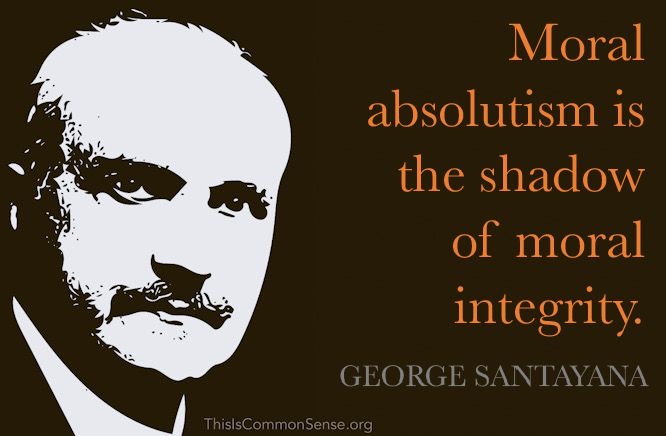
Almost all nations and religions, and especially the liberal party in them, think themselves the salt of the earth. They believe that only their special institutions are normal or just, and hope to see them everywhere adopted. They declare that only the scriptures handed down by their own clergy are divinely inspired; that only their native language is clear, convenient, deeply beautiful, and ultimately destined to become universal; that only the logic of their home philosophers is essentially cogent; and that the universal rule of morals, if not continued in tablets preserved in their temple, is concentrated in an insoluble pellet of moral prejudice, like the categorical imperative of Kant, lodged in their breast. Not being content, or not being able, to cultivate their local virtues in peace at home, they fiercely desire to sweep everything foreign from the face of the earth. Is this madness? No: I should say it was only haste, transposing a vital necessity into absurd metaphysical terms. Moral absolutism is the shadow of moral integrity.

George Santayana, The Genteel Tradition at Bay (1931), p. 27.
Categories
Today

Nullification?

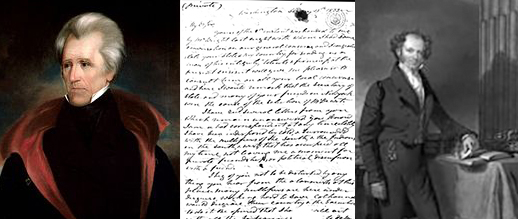
On January 13, 1833, United States President Andrew Jackson (pictured, top left) wrote to Vice President Martin Van Buren (pictured, top right) expressing his opposition to South Carolina’s defiance of federal authority in the Nullification Crisis. Jackson insisted that “the crisis must be now met with firmness” and “the modern doctrine of nullification & succession put down forever.”

South Carolina had blamed protectionist high tariffs for the severity of the economic slump of the time, and Andrew Jackson’s compromise Tariff of 1832 was still too much special-interest “protectionism” for South Carolina, which threatened to nullify the law as unconstitutional. Jackson, a nationalist at heart, had no sympathy for dissidents in the southern states. (The tariffs were designed by northern politicians to encourage the growth of industry. The belief among most economists of that time was that such high “protective” tariffs favored certain businesses at the expense of the general consumer, particularly farmers and agricultural producers.) After the crisis subsided, tariffs were further reduced from the 1832 level, much lower than of 1828’s “Tariff of Abominations,” which had been signed into law by President John Quincy Adams — and written mainly by Martin Van Buren as a way to precipitate the election of Jackson.

Since the somewhat ambiguous end to the Nullification Crisis, the doctrine of state prerogatives — “states’ rights” — has been asserted by opponents of the Fugitive Slave Act of 1850, proponents of California’s Specific Contract Act of 1863 (which nullified the Legal Tender Act of 1862), opponents of Federal acts prohibiting the sale and possession of marijuana in the first decade of the 21st century, and opponents of implementation of laws and regulations pertaining to firearms from the late 1900s up to 2013. State opposition to ObamaCare has also recently conjured up the issue.


On January 13, 1898, Émile Zola’s J’accuse exposed the Dreyfus affair.

Categories
deficits and debt national politics & policies political economy

The Economy Is Great-ish

“We have the highest share of working-age Americans in the workforce in 20 years,” Biden recently told reporters. “It’s no accident. It’s Bidenomics.”

Bidenomics being that old standby, tax-and-spend-omics.

So why do so many Americans think the economy is getting worse? Why do 84 percent say that their costs have gone up?

Well, says President Biden, the media mislead them. “You all are not the happiest people in the world [in] what you report,” is his view. “You get more legs when you’re reporting something that’s negative.”

The media do often mislead us; the negative news bias is real.

But I don’t think that our left-leaning, in-the-tank-for-Biden media can be blamed for the impression so many of us have that it’s harder to make ends meet.

Biden isn’t the only one professing puzzlement. Breitbart Business Digest observes that a “small army of establishment media types and economists” are intent on “unraveling what they take to be the great mysteries of our time.” As described by a recent Brookings Institution paper, this mystery is the “disconnect between consumer sentiment and the state of the macroeconomy.”

As BBD points out, the Brookings researchers simply start by assuming that everybody is wrong, then try to figure out why.

“A simpler explanation would be that the economy is falling short of the public’s expectations” because of things like high inflation, higher interest rates, and greater difficulty paying for groceries, Christmas presents, vacations. And rent, and medical bills, and tuition.

Saying it’s all in our heads won’t make tough times go away.

This is Common Sense. I’m Paul Jacob.


PDF for printing

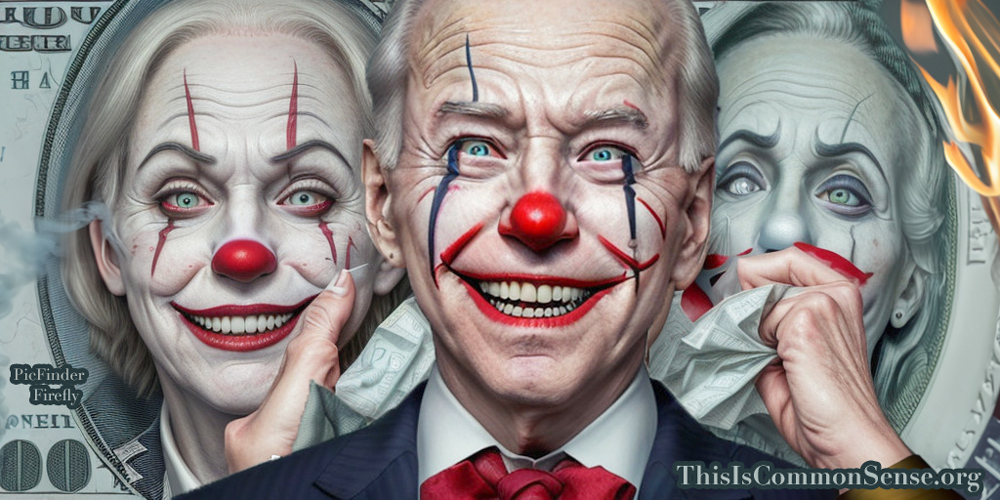
Illustration created with PicFinder and Firefly

See all recent commentary
(simplified and organized)
See recent popular posts

Categories
Thought

Leigh Brackett

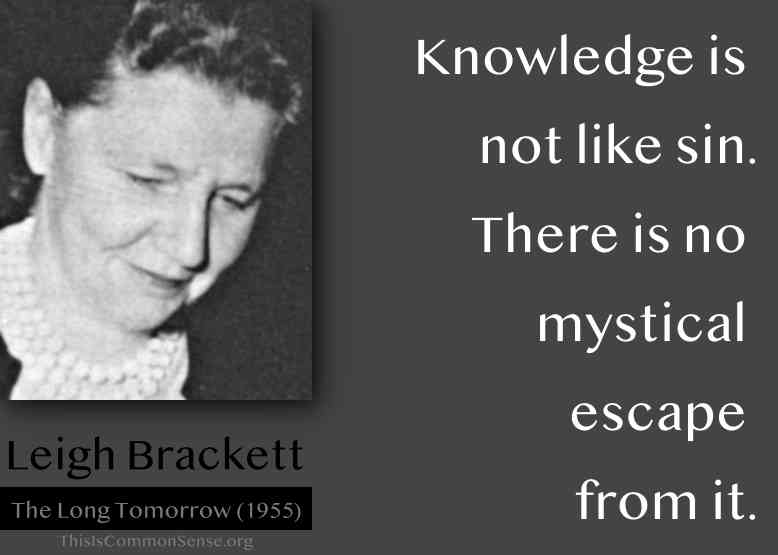
Knowledge is not like sin. There is no mystical escape from it.

Leigh Brackett, The Long Tomorrow (1955).
Categories
Today

Fast Ford

On January 12, 1904, Henry Ford set a land-speed record of 91.37 mph on the frozen surface of Lake St. Clair in Michigan, driving a four-wheel vehicle, dubbed the “999,” with a wooden chassis but no body or hood. Ford’s record was broken within a month, but the publicity from Ford’s achievement was valuable to the auto pioneer, who had incorporated the Ford Motor Company the previous year.

Categories
Accountability general freedom

The S-Word in California

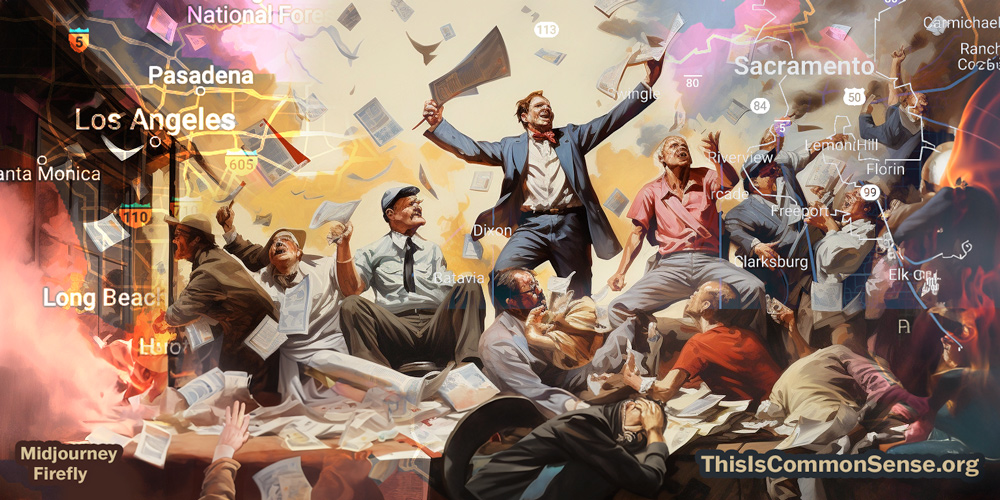
Frédéric Bastiat called it “spoliation”; California’s Democratic politicians call it social justice.

A bill went into effect last week, offering complete medical coverage to an estimated 700,000 undocumented — illegal — immigrants.  The price tag? 3.1 billion dollars.

Well, not “price tag”: call it a subsidy tag.

California taxpayers will pay for it. Or perhaps U.S. taxpayers will end up with the bill, as Dagen McDowell insisted on Fox News, prophesying that the program “will turn into a national issue” that will, inevitably, “swamp the federal budget.” 

Ms. McDowell also noted that the state’s targeted sugar daddies, the wealthy, “are going to other states, so much that they’ve lost a congressional seat,” all of which must lead to insolvency.

Indeed, the state is running far into the red — the color of the ink on budget columns, not voting columns. The state faces not merely annual deficits and a huge debt, there is also this looming trillion-dollar debt implied by the unfunded liabilities of the state employee pensions.

There is an old pattern here, which is why I brought up an old author in the first sentence.

First we subsidize the poor. Then we extend the subsidies up the income ladder. Now we give huge subsidies to those who enter the country illegally.

It’s as if Californians have forgotten the nature of income redistribution: you have to have income to redistribute. At some point the wealth being taken from the productive vanishes, as society becomes unproductive and descends into ruin.

There are two meanings of Bastiat’s “spoliation”:

noun
1 the action of ruining or destroying something.
2 the action of taking goods or property from somewhere by illegal or unethical means.

The two are linked. 

This is Common Sense. I’m Paul Jacob.


PDF for printing

Illustration created with Midjourney and Firefly

See all recent commentary
(simplified and organized)
See recent popular posts

Categories
Thought

Michael Moorcock

If the people at the top think that reaching for a gun will solve the problem, why shouldn’t the people at the bottom think the same?

Michael Moorcock, The Eternal Champion (1970).
Categories
Today

An Austrian Freedom

On January 11, 1571, the freedom of religion was granted to Austrian nobility.

Two years earlier, the first recorded lottery in England was held.

In Philadelphia, Pennsylvania, on the eleventh day of the first month of 1759, the first American life insurance company was incorporated.

On January 11, 1935, Amelia Earhart became the first person to fly solo from Hawaii to California.

On this date in 2003, Illinois Governor George Ryan commuted the death sentences of 167 prisoners on Illinois’s death row based on the Jon Burge scandal.

Categories
Accountability general freedom

Goods, Services, and Other Crimes

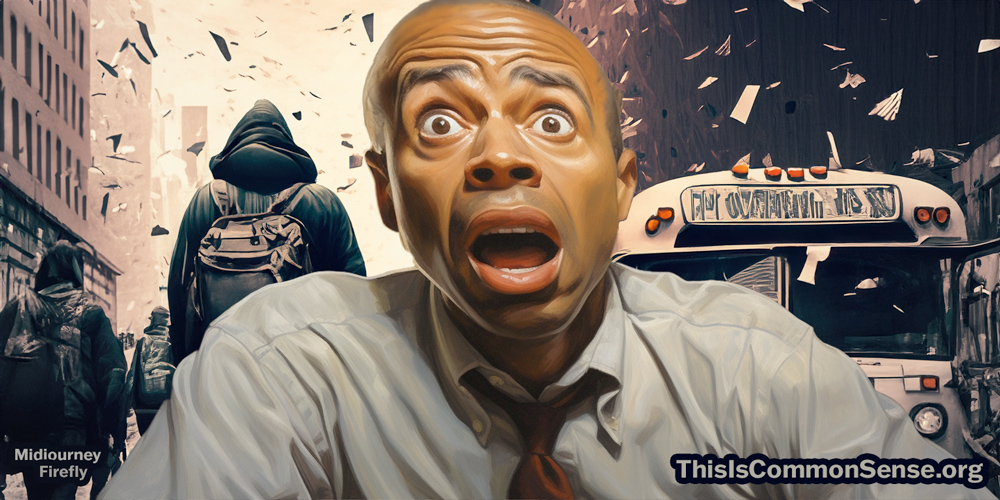
The mayor of New York City, Eric Adams, has announced a lawsuit against bus companies for providing bus services.

The bus companies are selling transportation not to gangs of thieves that the companies know to be on their way to rob banks but to the government of Texas. Texas has been sending people arriving in Texas from the other side of the border to the Big Apple, a self-proclaimed sanctuary city.

New York City is suing 17 bus and transportation companies for a total of more than $700 million. It wants the money to help take care of the people on the buses.

Apparently, Adams is one of that species of politician who has no standards — who will lurch in any direction at any moment, clutch at any straw, heedless of the rights of others, just as soon as an advisor says “Hey, let’s try this . . .”

Hey. Sue the federal government for its border policies, Mr. Mayor, if you object to those policies. Don’t sue bus companies and road pavement companies and restaurants and toll booths because they enable people to get from point A to point B.

My advice to the bus companies: countersue.

Many things bother me about the mayor’s ugly action. One is his indifference to the precedent being set, especially if the lawsuit succeeds. Doesn’t he care about the long-range effects of suing people for millions of dollars just for earning their living in a legal, peaceful way?

This is Common Sense. I’m Paul Jacob.


PDF for printing

Illustration created with Midjourney and Firefly

See all recent commentary
(simplified and organized)
See recent popular posts

Categories
Thought

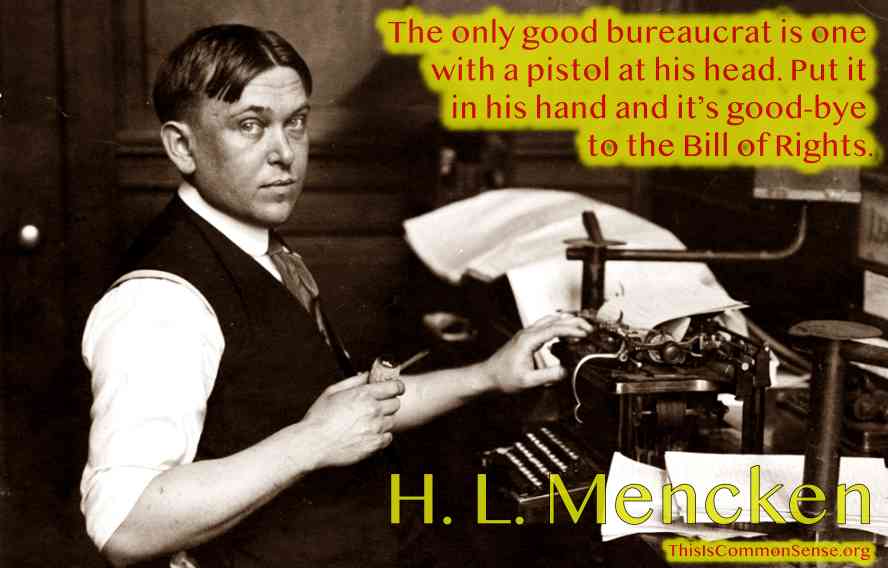
H. L. Mencken

The only good bureaucrat is one with a pistol at his head. Put it in his hand and it’s good-bye to the Bill of Rights.

H. L. Mencken, On Politics: A Carnival of Buncombe (1920-1936), p. 279.